Sparrowhawk
-
Posts
559 -
Joined
-
Last visited
Everything posted by Sparrowhawk
-
Would you do skirting boards with the track saw? I want a track saw for fitted furniture, and I've also got 400 bevel cuts to make in our skirting boards. If I can buy one tool rather than both, that's a nice saving.
-

MVHR installation help! Please
Sparrowhawk replied to AppleQueen's topic in Mechanical Ventilation with Heat Recovery (MVHR)
Hmm, my layout guide from them was like the one shown here, "X marks the spot" and a number for one run or two. Did yours cover more than that, like flow rates per room? -
MVHR installation help! Please
Sparrowhawk replied to AppleQueen's topic in Mechanical Ventilation with Heat Recovery (MVHR)
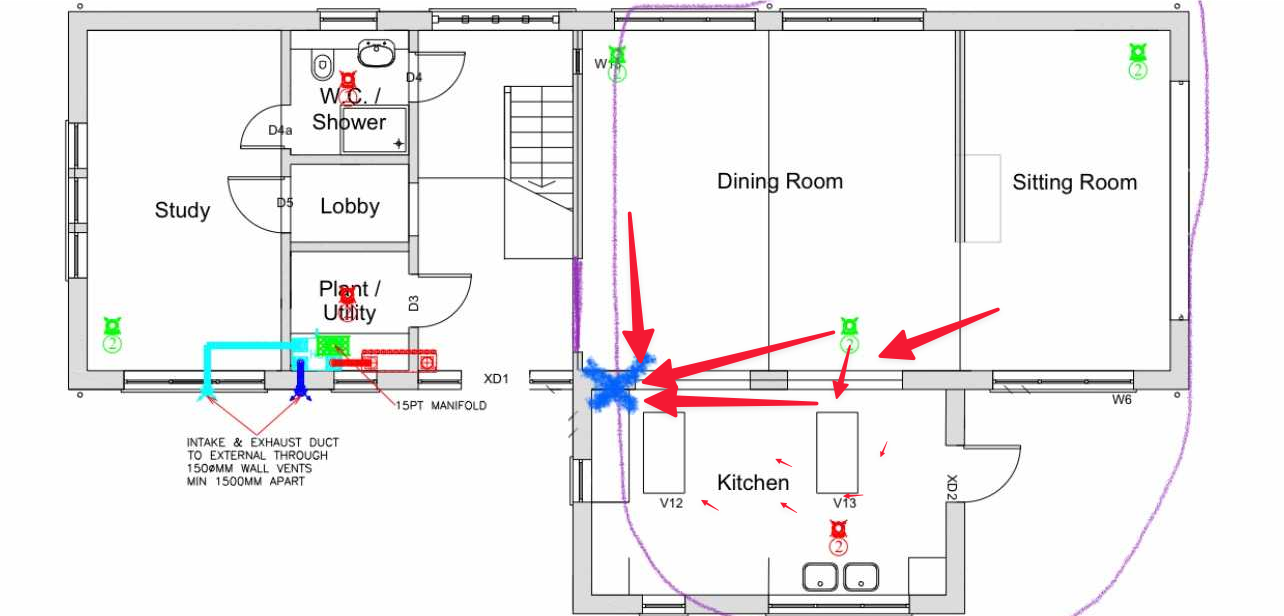
A paid MVHR design service isn't cheap (c£1k) but will provide things like: calculations of flow rate in ducts e.g. how fast the air is moving (too fast is audible) and the pressure drop (too high means the MVHR has to work too hard) work out how to best route the ducts around the house use the calculations to assess the size of ducts you need and which runs need to be doubled up position the supply/extract valves in sensible places (this is not a high bar to meet ) They do like to be involved before build starts though, to iron out problems like "there's a beam where all the ducts need to go" You are where you are, and my first thought is what does changing to 90mm ducting do for the number of ducts you need? If you use the Frankische 90mm duct which has ~half the pressure loss per m of the others, you can push a single duct to longer runs than would normally be advised. You're still restricted by the volume of air you need to move though. But - what does your structural engineer say about cutting holes through the beam? How many at each diameter are you allowed? I don't. With what looks to be an open plan setup, the air will mostly go from the supply vents straight to the extract vent, creating a dead space in the kitchen. I've tried to show that with arrows on the picture below.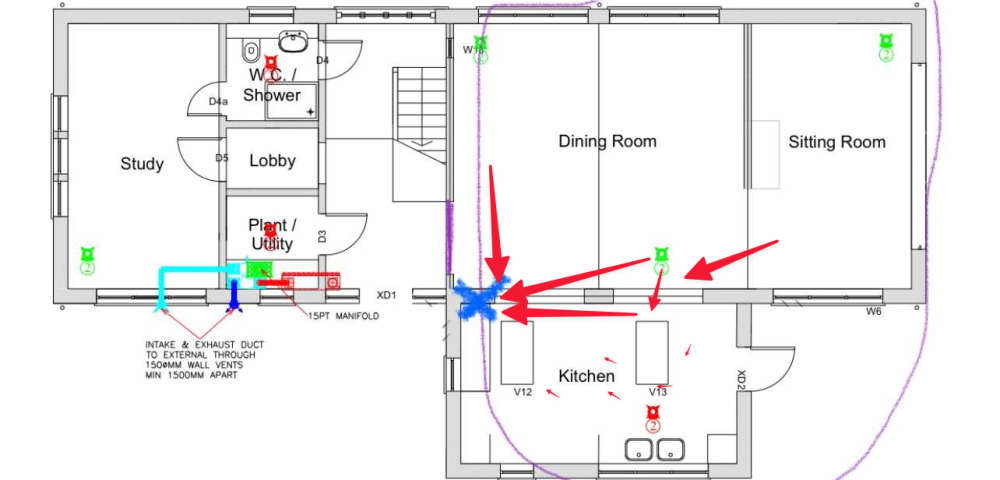
-
MVHR installation help! Please
Sparrowhawk replied to AppleQueen's topic in Mechanical Ventilation with Heat Recovery (MVHR)
Did you pay them for a design or is this their free one? I found the free one wrong on many counts, and it's worth doing your own if you have the skills to. -
There are two ways sound is transmitted through the floor: airborne sound and structure-borne sound. The insulation you've added takes care of airborne sound, so it will deaden the noise of Taylor Swift from above. However, it will do pretty much nothing to deaden your missus dancing around. To deal with that you'll need to add some kind of cushioning over the joists - a thick underlay if you're putting down carpet, or better decouple the floor deck from the joists (or the ceiling below from the joists) to reduce the sound transmission. Others here have more practical experience than I do - I've been focused on airborne sound transmission.
-
The Psychology of Visual Heating
Sparrowhawk replied to ToughButterCup's topic in Other Heating Systems
Do tell. We're adding sockets room by room as we work through the house. The first room we've done I've made good the chases and almost finished replastering, when my dearly loved one sticks her head round the door and says "I've changed my plans for the room, the sockets aren't now where I need them". #$@&%*! -
Best way to shorten a joist?
Sparrowhawk replied to Sparrowhawk's topic in General Construction Issues
As ever BuildHub comes up with excellent previous threads to educate me on resin anchors: -
Best way to shorten a joist?
Sparrowhawk replied to Sparrowhawk's topic in General Construction Issues
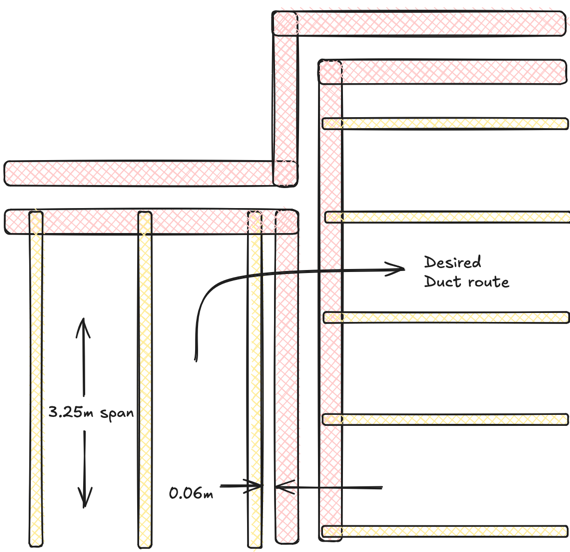
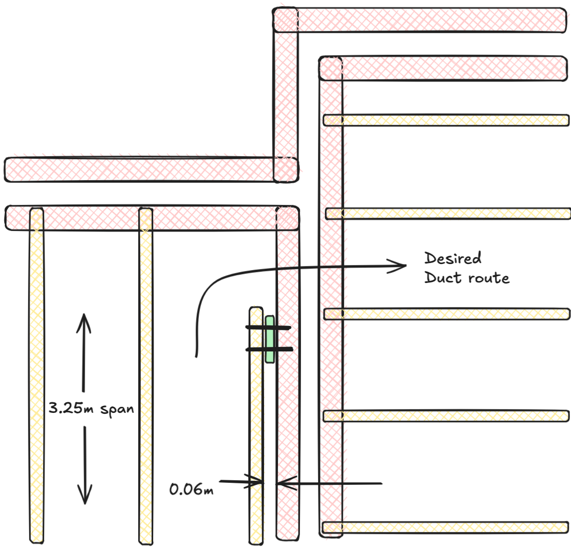
It's 3x 90mm ducts I need to get through (and then core drill through the cavity wall to get into the original part of the house). I'm thinking that three would take too much out of the joist to reinforce it? I may be able to reduce it to 2 and take one another route, but that causes other problems... I like this idea, though the trimmer goes across where I need to run the 3 ducts up before bending right to go through where I've removed the joist Is a metal web joist open enough to get 3x90mm through in a 34cm length? The wall should be okay with the extra load, it's a 1998-built cavity wall, mounting onto the external leaf. The render will need hacking off but is concrete block behind that. That could work so long as it can be bolted. The ones I've seen need screws both sides, and there's no way I can insert those in the 6cm gap! This sounds the easiest way but I know nothing about it. This is like having bolts glued into the wall? If all else fails I could lift the floor above and have the joist replaced with a web joist, but as it's our bedroom I'd be in serious trouble so anything that avoids that is good. Lifting a corner is fine, dismantling the room not so much... -
I have a first floor joist that runs 6cm away from the wall, joist size approx 7 x 2 inches. It's 30-34cm from this joist to the next (working on screw holes), and then 40cm spacing for the rest. I'd like to get my MVHR ducting through here. Is it feasible to shorten the joist by 0.5m and if so what's the best way to fix it? I looked for joist hangers that would fix to a parallel wall but found none. Bolts and packing?
-
If we only knew. I've tried to source offcuts of various ducting to test out connectors, with little success. If forum members have 20cm+ of any ducting lying around - PM me and I'll test for compatibility.
-
The Psychology of Visual Heating
Sparrowhawk replied to ToughButterCup's topic in Other Heating Systems
Or: TV screen. Small radiant heat source next to it for 'effect'. This on loop on -
The Psychology of Visual Heating
Sparrowhawk replied to ToughButterCup's topic in Other Heating Systems
Got gas? We stayed in a holiday cottage in Corbridge a few years back with a modern style gas fire in the loung - like the 3rd photo on https://elainesstoves.com/gas-stoves-fires/ Very effective and didn't put out much heat so I could use it in June. -
Hi @Lewis Hubbard! Just checking - the survey says "heat pumps within East Anglia" - you're happy for people living outside EA to fill it in?
-
Okay, I've been having good luck with Toupret Interior filler mixed to their instructions. If you're only doing small quantities a silicone mixing bowl does make cleanup easier. Have you got filling knives?
-
Anti-Microbial or not?
Sparrowhawk replied to Philxyz's topic in Mechanical Ventilation with Heat Recovery (MVHR)
Anti static seems worth it alone, if you forget to pop a filter into an extract. I wasn't expecting dust in the ducts until I saw https://jimmillerdesign.co.uk/mvhr-maintenance-duct-cleaning/. -
What are the walls currently coated with i.e. what are they managing to dent? And what material behind the current coating? And as @ProDave says how deep are the holes?
-
Leafing through the Frankische catalogue I saw the floor mounted MVHR outlets (as Blauberg, Zehnder, Ubbink et al all sell) and the penny dropped that this would simplify duct runs to the first floor bedrooms, cutting the length of duct runs in half and reducing boxing in and loss of wardrobe space. And it would position the supply at the opposite end of the room to the door, which the skeilings prevent if the outlet is in the ceiling (it has to be halfway across the room towards the door). Every manufacturer sells floor outlets, but hardly anyone talks about them. The only mentions I found on Buildhub were @jack in 2022 and 2017. In theory floor-mounting might result in slightly poorer mixing, or create draughts which wall and ceiling mounting avoid. Though for draughts the floor mounting opening is larger, so lower velocity air. Any real-world experience in addition to @jack's?
-
Design for mull of Galloway. Thoughts?
Sparrowhawk replied to DannyT's topic in New House & Self Build Design
Like the design though unclear why the fish room is central rather than one of those in the flat roofed bit? Wouldn't that central internal room be a good plant room as it'll reduce distances to all other rooms? What software are you using for the 3D modelling and renders, and for the U-Value calculator in -
https://www.engineeringtoolbox.com/salt-humidity-d_1887.html and https://imatrixsys.com/multi-point-relative-humidity-calibration/ I did mine in a marge tub with a small pot of salt and water and multiple sensors next to it. The important thing with NaCl is that for room temperatures, the relative humidity over the salt solution stays pretty constant in the 75-75.75% range. Leave the sensors to reach equilibrium (2-3 days) and record the difference for each sensor and then in HomeAssistant change the offset value.
-
Looks great! You mentioned less sound coming in before; anything else you're noticing now the woodwork's back on?
-
Did you / have you looked at the Siga Hygrobrid one-way membranes? Their data is hidden behind a login wall, the best link I can find is https://www.architectureanddesign.com.au/getattachment/c5861842-768b-451a-badf-fbedef41e1f3/attachment.aspx Alan Budden used the Siga Marjrex single directional vapour control layer in his retrofit and said it allowed extra IWI than moisture calculations without it did. A little more data here on page 9 of this transcript at 21:10.
- 44 replies
-
- 1
-

-
- mvhr
- relative humidity
- (and 3 more)
-
A mix of Zigbee temperature & humidity sensors Aqara, Tuya and a single Sonoff. I calibrated their RH reading last year using the NaCL test. The lounge has the sole Sonoff though, so I've added a Tuya to see if they match. After a night the Tuya is 0.6C / 6% RH lower than the Sonoff, which if it stays that different goes a way to explaining the higher recorded humidity in the lounge compared to the other rooms. Thanks I will play once I have found how to get HomeAssistant to give me the average figure. 👍
-
Watered once a week, but the biggest 2 take 2-3 litres each, and the rest probably another 2-3 litres combined. No greenhouse right now so 3 bougainvilleas are in here, plus 20 5" palm seedlings and a large pointsettia. I keep them away from the radiator but they are at 20C and in sunlight. Yes, everywhere I've had the floor up here is dry, no damp to be noiced on the (unfilled cavity) walls and the chimney has been taken down to loft level so no rain entering it either. And that's my disagreement with the "if you're above 3ACH don't do MVHR" position. Air infiltration aka natural ventilation isn't reliable ventilation. Even Passivhaus trust disagree with the 3ACH cutoff. Force 6 - yep we're on the same calm day scale as you.
-
Up until September the cavity was open one side of the window. I stuffed it with stuff over winter but the curtains would still blow in the wind Edit: our airbricks vent the wall as well as under the floor. They're not sheathed.
-
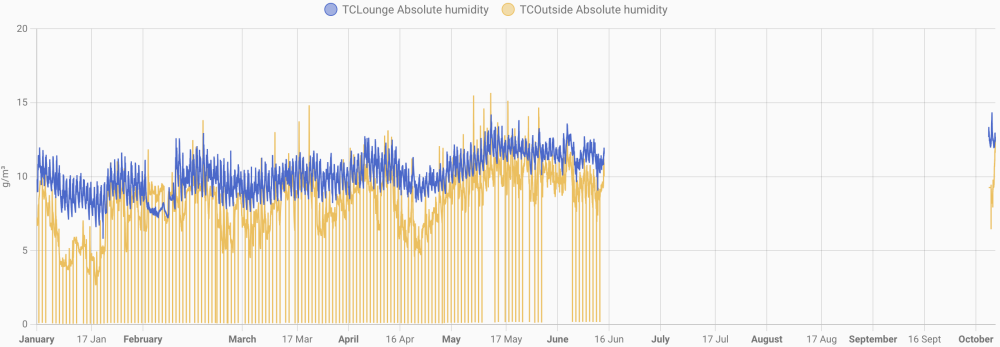
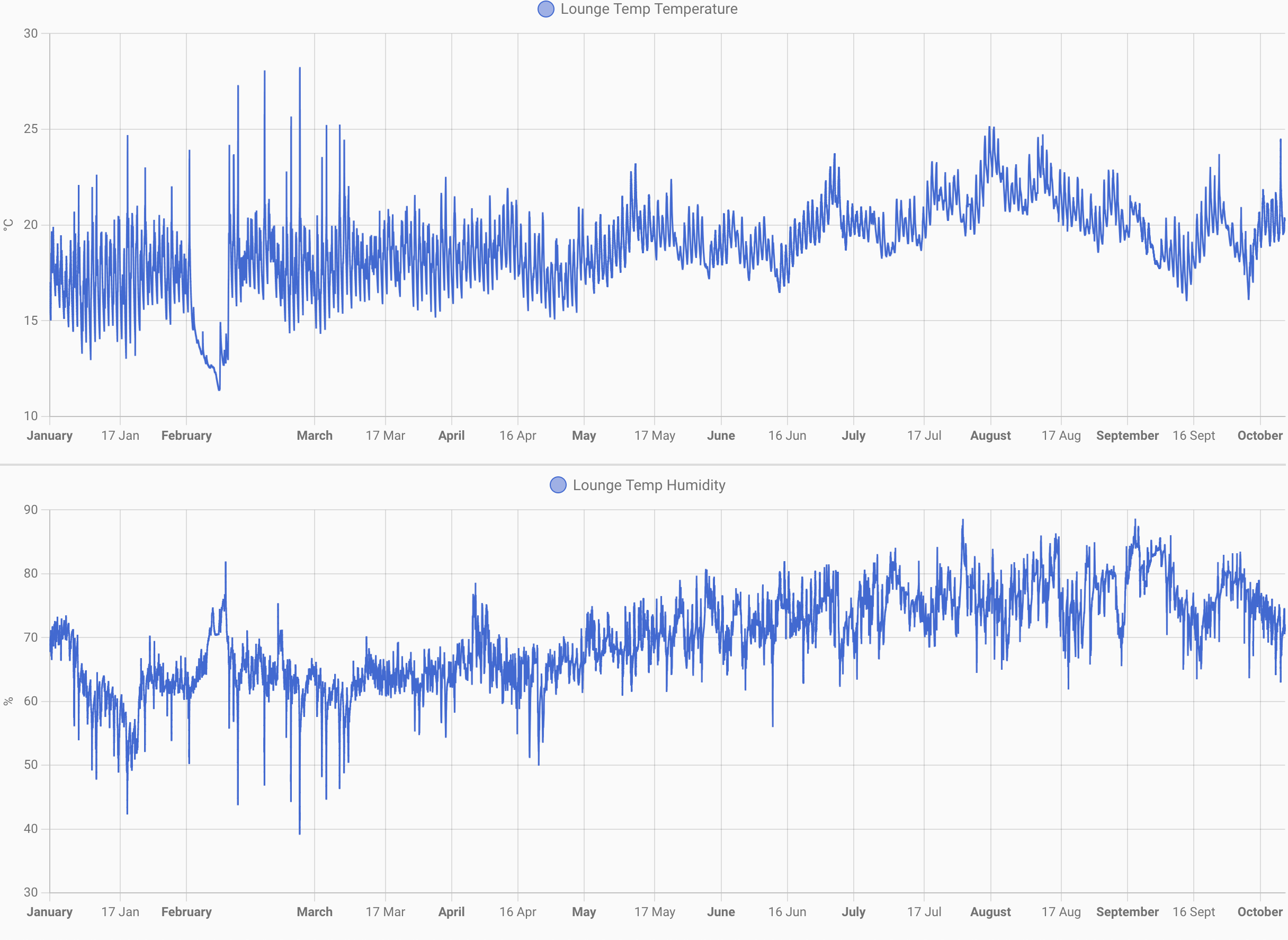
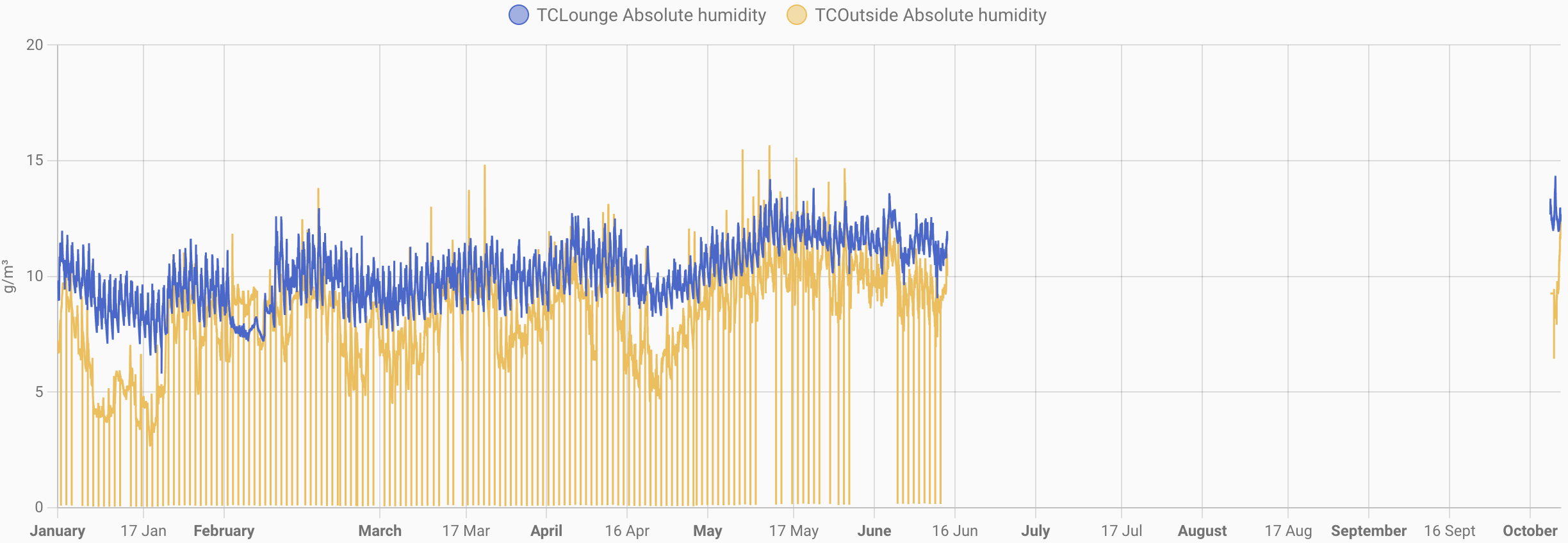
This forum is generally of the opinion that if 3-3.5ACH @ 50Pa is your building's airtightness target then MVHR is pointless, as the air entering through the fabric is bigger than the flow rate of the MVHR and the heated air will be lost faster that the MVHR unit can recover it. My house is nowhere near 3.5ACH yet (a safe guess). So with plenty of air infiltration, why is the humidity averaging 70% in the lounge? Lounge is south facing (spikes are when the sun hit the temperature monitor), no trickle vents, and contains a bunch of house plants. I've been holding out that as we improve the airtightness then adding MVHR will fix this humidity, but if we're already well ventilated and this is the humidity, then MVHR is going to change nothing, right? [For SteamyTea the absolute humidity is lower outside except for mid-summer. Natural ventilation between Sept-May should be bringing in less water vapour than is indoors. Battery ran out over the summer, hence the gap]