Iceverge
-
Posts
4382 -
Joined
-
Last visited
-
Days Won
31
Everything posted by Iceverge
-
Good good. Maybe get a £5 humidistat to get some before and after RH readings. I installed a central. MEV in my parents loft in their uninsulated house. It has reduced the damp in the house for sure. Any chance you’d share some of the thermal pics. I’m interested in purchasing one,
-

Insulating a 1967 timber framed bungalow
Iceverge replied to esalglop1945's topic in Introduce Yourself
I've been thinking about this. I would foam fill the stud bays with a breathable open cell foam like isothane. Importantly don't do the ventilation cavity between the sheathing and the brick. ' I wouldn't put any vapour inboard (I know people will shout at me now!). Doing so would risk trapping moisture within the structure ( because of the plastic membrane outboard).It's only in theory anyway that perfect vapour barriers can be installed. The isothane will allow the wall to dry to the inside. Importantly, if you have a good installer it will provide a very high level of air sealing, ( this will take a diligent installer and maybe a DIY blower fan on site or else a call-back to fill any holes that were missed. Done well, this will prevent air movement through your walls. This is how almost all moisture gets into structures (not diffusion) so it a robust way of keeping your walls rot free. I suspect the membrane outboard is imperfect anyway so some drying can take place that direction. This approach will give an excellent level of airtightness, @Gone West got to PH levels, and good insulation. You will need a mechanical ventilation system of some kind. Maybe some constant volume fans or MVHR if you're enthuastic. A thin layer of pir under a timber floor will make underfoot comfortable. Pump the roof with 300mm of Cellulose. If you want to have very low heating costs an A2A unit mounted somewhere central will do the trick. If you fancy doing the windows I would say a set of white UPVC 3g with good seals ( pref PH certified) is a reasonable priced option. There after the gains made by chasing PH levels in a small house are very marginal. My mantra of thermal upgrades. 1. Airtightness + Mechanical ventilation. 2. Improving U values. ( including windows and thermal bridges) 3. Low energy use mechanicals. 4, Renewables. Good luck! -
New build floorplans - opinions welcome
Iceverge replied to Indy's topic in New House & Self Build Design
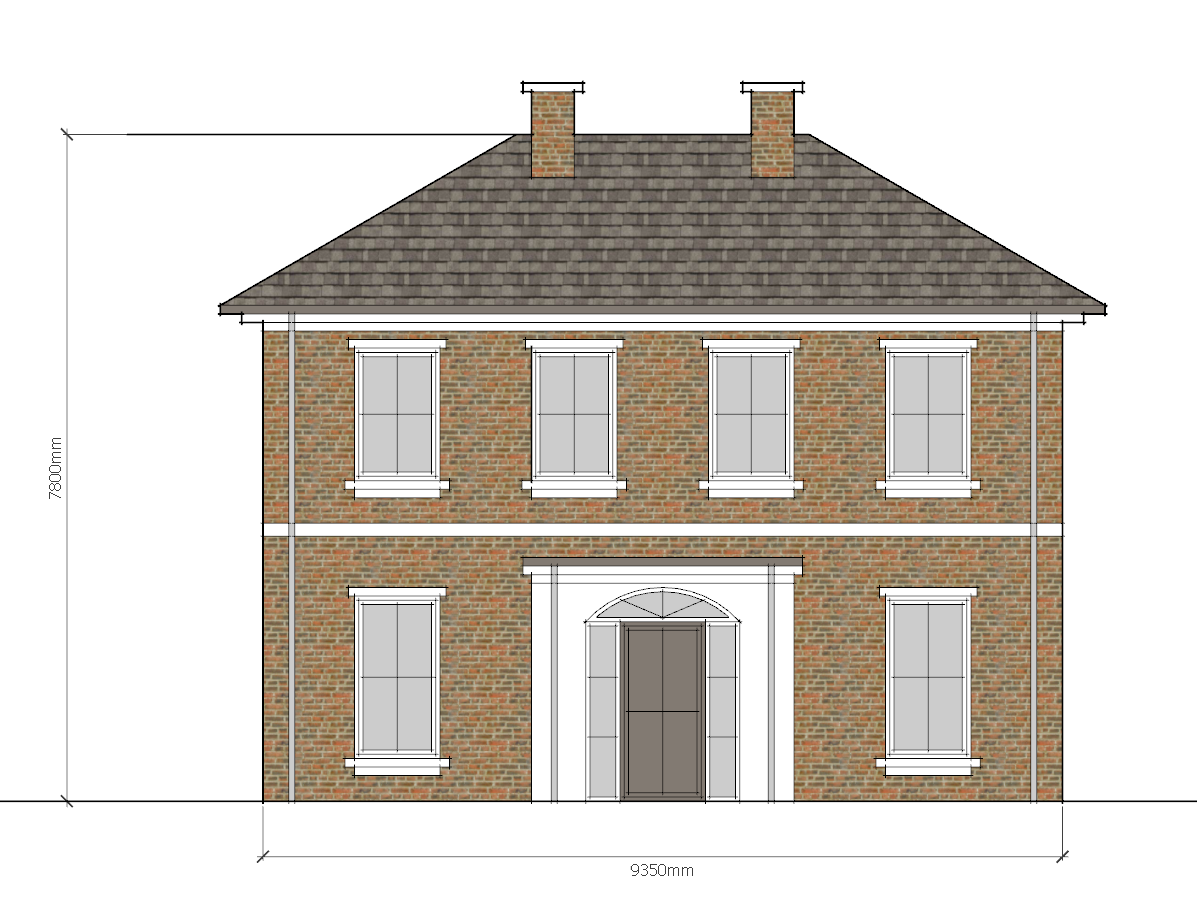
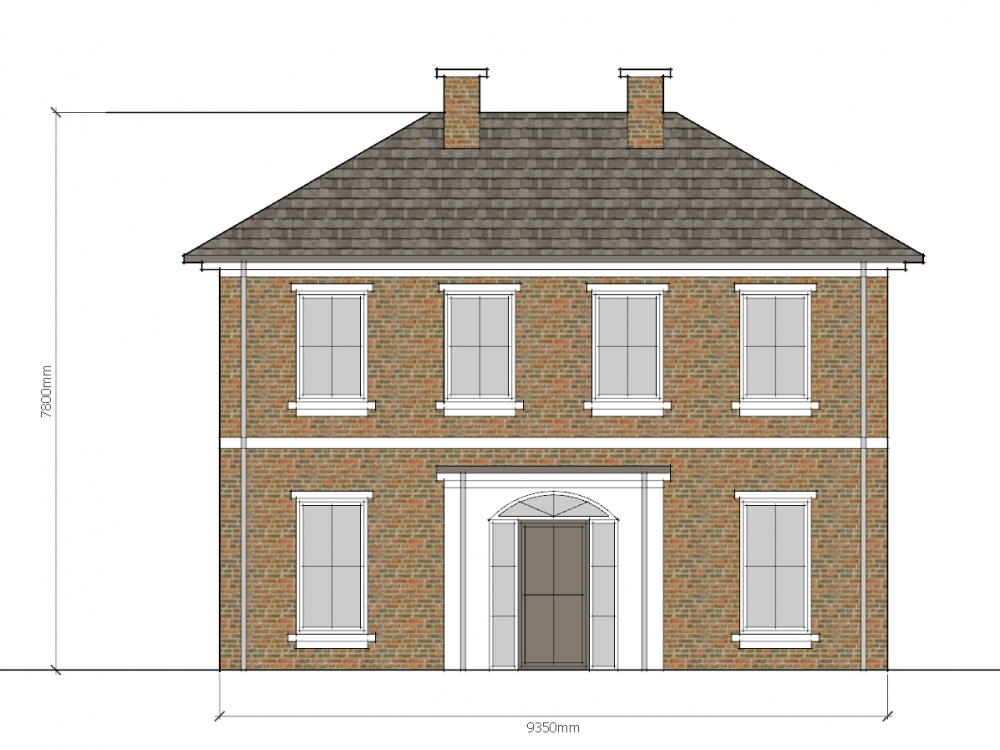
@Indy Right it's taken about 40 iterations ( no exaggeration) to alter the face but I'm reasonably happy with this effort. It will fit in with your exiting plans. I have no idea if the style is to your taste (mock neo Georgian) or importantly the planners and the feel of your location (let us know). However it is symmetrical, relatively straightforward to build, shouldn't suffer from much overheating, fits within the 9.35m width and 7.8m ridge height, and shouldn't make people grimace when they learn you have spent £1m on it. It's got a fairly broad appeal to potential buyers too. The chimneys are optional but always add balance. You can always use them for MVHR or soil stacks to justify them. BEFORE AFTER.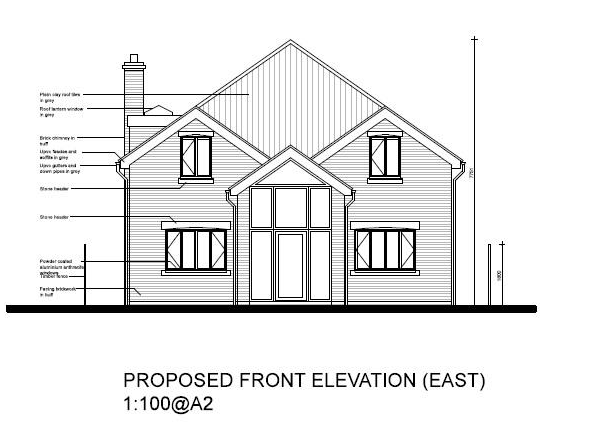
-
New build floorplans - opinions welcome
Iceverge replied to Indy's topic in New House & Self Build Design
@Indy What are you ridge height and overlooking constraints? I'll have a bash at a sketch if I get a chance. -
New build floorplans - opinions welcome
Iceverge replied to Indy's topic in New House & Self Build Design
@Indy Welcome back to the lion's den! Fair play to you for having the guts to do so. A few comments. If you plan to sell the house in the future please have a remodel of the front. Pretty she ain't. It'll be worth it to your pocket long term. Overheating. The mass of glazing on the East and especially the west is bad bad news. The house will be very uncomfortable in the summer. Lack of daylight. Very few southern windows or if these are not possible, skylights to bring in that lovely daylight from the South. It's too wide for the plot. I know it's been mentioned. I would leave access for a small digger beside the house, at least 2.4m at one side in case you ever need to do work at the rear of the house like build a garden Room etc. That ASHP is in a very sheltered alcove. I would be worried about it not getting enough airflow and it being very noisy. Also it creates a tricky little piece to build for very small advantage. If you really need space then I think @Bitpipes suggestion of a basement is a good one. Drop a chalet style former on top with lots of southern skylights and a narrower plan and you're home and dry. The shape could be more "cube"ish which will be good thermally and financially. That balcony will create thermal bridging issues and a potential sources of leaks if masonry built. We have a large room. Great for the daily grand Prix for small kids but it can be noisy. Keep it up. Either way all these comments will galvanized you or inspire you. -
It's a just a constantly running extract fan. Very basic. It'll draw a small of fresh air though the house keeping it much drier and healthier. Induction every time. I've lived with gas and it's even better to cook on. A kitchen extractor will only run a small part of the day taking out very little heat. Your priority must be to get high humidity air outside of the house. It's impossible to feel warm in a damp house. Lol, the predicament of many a renovator. However what you have is something a little special. It might be worth the effort once you're all done. Remember all that stone work , detailing and "character" would be very expensive to replicate in a new build.
-
Don't forget about the first floor ceilings. A cheapish upgrade from 12.5mm standard to 15mm sound block plasterboard would be a good start. Carpets +curtains do a good job of dampening sound. Our hard floored rooms with no curtains are much noiser. Back to back sockets on a stud wall will need treatment. Beware undercuts of doors into plant rooms/laundries ets for machine noise. Our extractor fan is mounted on a sheet of MDF as part of the kitchen. It makes a racket. Some fridges are louder than advertised. I think someone on here wisely put some acoustic foam in the recess behind it. We can hear the roofing membrane flapping in the wind. We wouldn't if we sheathed the roof first I imagine or had a warm roof. Plastic pipes all the way every day every time. Less water hammer too. Also you need to make sure you get your recommended daily dose of microplastics. You can't simply rely on the MDPE water mains, plastic food containers, additives to detergents, synthetic clothing materials, dust from car tyres, plastic drinking bottles, tea bags, cosmetics, facial scrubs, and disposable face masks to provide all that wonderful plasticky goodness.........................
-
I did my own thermal detailing and the builder was happy to follow it. Normally it would be a part of the job of the architect+team. The structural engineer's main concern will be to ensure the building doesn't fall down. If you want to get a professional to undertake it I would seek out a passivhaus architectural technician. Have you considered the option of external insulation, ICF or timber frame. These methods make it easier to cope with any thermal bridges etc but you will need brick slips or similar for the facade/ If you choose to stick with masonry cavity walls a couple of things might make it easier to deal with the steel bridging. 1. Proprietary insulating connections for balconies +columns etc. 2. Using precast concrete beams in place of steel ( cheaper and less than 10% as conductive) 3. Using Marmox thermoblock, perisol or similar as a thermal break above the beams and outer walls. Beware most of those 90 pages will be standard issue not specific to your house. As for the construction drawings I can't be much help as we have a different process re BC etc in Ireland. Good luck!
-
Yes, windtight membranes + airtight membrane and mineral wool batts. It's about striking a balance between low wall U-Value and making the sandstone wall outboard of the insulation too cold and suffering from frost and damp. The wall will have a reasonable contribution to insulative value as long as it's dry. 60mm Wood fiber would be fine IMO. Maybe someone else will correct me. You must use breathable render and paint however. Look at study below of the effect on wall humidity by not using breathable materials. PIR and emulsion paint perform the worst. Cork lime and hemp lime render the best. Wood fiber would be similar. http://www.tara.tcd.ie/bitstream/handle/2262/79420/CERI draft RW SP final.pdf?sequence=1&isAllowed=y Not really, it can be as simple as replacing intermittent bathroom fans with constant volume ones. They'll run at a low and inaudible level all day keeping the internal humidity under control, unlike bathroom ones which are frequently too noisy and get turned off.


-
I wouldn't complicate it. The pods once occupied will require very little heating, provided you do an excellent job on airtightness. Put in a fused spur for a small electric heater. Allow another spur for a split A2A unit if you're really cautious. A timber floor will be comfortable underfoot in any case. I'd use a large central UVC for the water, heated on E7. Bigger the better as you won't want customers to be running out of water. An alternative might be a couple of electric showers and an under sink water heater but I have a niggle in my brain about electrical limits. Maybe a friendly sparky can tell me off...…! I'd have some kind of continuous mechanical ventilation in the pods. Small spaces can get stuff quickly without it. Maybe something like this. https://www.bpcventilation.com/xpelair-simply-silent-contour-cv4 For info out set up in a 185m2 passive house is one portable 2kw rad and a 300l direct UVC. It's working fine so far. The payback on anything more complicated was marginal. Maybe an A2A might make sense. I'll know soon.
-
Such a pretty house. Congrats. From the ground up. 1. A really comprehensive French drain. 2. Dig out the floors. Put in as much insulation as you can fit. 150mm minimum will allow for UFH. Cover with 100mm powerfloated concrete. 3. Woodfiber or Hemp based internal wall insulation with a breathable lime based plaster as your airtightness layer. Be cautious about making it too thick as the stone wall will get too cold and may suffer from decay. 4 New triple glazed windows. 5. Diligently seal all the ceilings. I don't know the current state of repair of them but if poor take them down. Put an airtight membrane and return it to the lime plastered walls. Then a 22mm service cavity and plasterboard. 6. Reinsulate the attic. 7. Ensure that you have a continuous mechanical ventilation system. PIV is a start, MEV/DCV is good. MVHR is best.
-
EPS beads vs blown glass mineral vs cavity batts
Iceverge replied to SBMS's topic in Heat Insulation
250mm EPS beads here. I would consider batts if I could put them in myself or use a trusted builder. There's a pretty comprehensive thread here. -
First Self Build - Paragraph 79 Home in AONB
Iceverge replied to thefoxesmaltings's topic in Introduce Yourself
Amazing looking house. Congratulation. Have you run PHPP on your project, specifically re overheating, looks to be a lot of glass on the southern elevation. -
I've had this fight a couple of time on here. DO IT BEFORE YOU NEED IT. It's less than 1m2. You can use it to store junk once it's done but for heavens sake build it while you can. https://www.rte.ie/radio/doconone/1243580-ill-send-you-butterflies#:~:text=I'll Send You Butterflies tells the story of a,active woman in her seventies. Listen for 2 minutes from 21:21 about this very discussion. About a poor woman who with ME who faced trying to remodel the house in the middle of a terminal illness. Anyway without the gloom of succumbing to a nasty disease it's perfectly possible you'll need to avoid stairs for a week. I did a couple of years ago when I came off my road bike and bashed my knee. Washing yourself with a cloth in the sink soon gets old.
-
Hard luck on not getting planning. It's a frustration but if they've only asked you for 3m it's a roundabout way of saying yes! It looks generally fine apart from a couple of things. Mind you I'm a pedant so don't take any of the below to heart. 1.No accessible shower on the ground floor. 2.No southern windows in the open plan living room. 3. Utility looks a but small for the size of the house. Also the shape is lightly to lead to it becoming very cluttered unless you run your house with military discipline. 4. Given the new porch+hallway is the main entry it's a little un generous given the scale of the house. 5. Both hallways are lightly to be very dark. 6. Maybe it's a mistake but the master bed has no windows. 7. The doors from the snug to the kitchen will become the main thoroughfare as the alternate route North of the stairs is twice the distance. The snug will feel like a corridor.
-
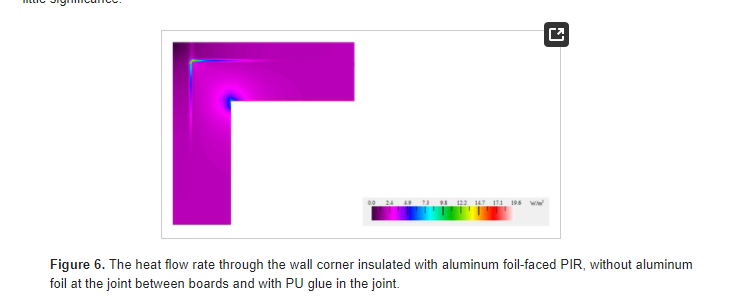
Unless you're prepared to pay a brickie twice as much it just takes too much time to get an absolutely perfect fit. Too many mortar droppings, irregularities in the blocks and boards and then having to fit around cavity ties. To get anywhere near the labelled performance you would need to build one leaf first, the apply the boards, foaming the back and taping the joints as you go. Almost like an EWI job. Then build the second leaf, Preferably you would need to pre age the boards to ensure they had already shrunk before installation. Take care to carefully tape all nicks and cracks in the foil facing to prevent gas migration. Also you would need to account for the thermal bridging of the foil face of the insulation at corners. While you were at it it would be prudent to apply the PIR in 2 layers with all joints staggered. It would be tricky to do as they cavity ties will dictate the location of the boards and they might need drilling foaming and taping afterwards. Of course there's the issue then of getting everything to fit tight around windows and doors. Ideally the boards will be fitted and individually foamed to create a continuous insulation layer between all windows doors pile penetrations etc. If you can find a builder who is willing to do all this for a regular price let us know. Otherwise just full fill the cavity with diligently placed batts, EPS beads or closed cell foam. TLDR. Realistically it's impossible fit PIR to the perform even close to the theoretical design. Dritherm37 is £7.50/m2 for 125mm and will practically outperform Celotex @75mm for £17.50/m2.
-
@SBMS Assuming you're not building this house for someone you really don't like I'd bin any thought of rigid boards in the wall. Full fill mineral wool or beads would be better.
-
Picture to make you feel very uneasy
Iceverge replied to Russell griffiths's topic in General Self Build & DIY Discussion
Heart-breaking and maybe wallet breaking but hopefully that's all. A sad event in any case. -
I reckon a reasonable building cost formula is. (Site value £) + (£1000/m2(materials+labour)) +(£100,000 (professional fees, levy's, furnishings +decoration, landscaping, builders profit)) You won't be able to change the first two much unless you supply uncosted labour at your own expense. The last one can be adjusted. You might be a professional yourself, or employ the bare minimum you can get away with. You can do without furniture or paint. Landing scaping can be left au naturale, you can do the builders job (again this only works if your own time is worth nothing). Off grid isn't a cheap option unless you choose to live a life of 100+ years ago, boiling your knickers in a pot over a stove and sending malnourished children up the chimney to get rid of the soot! There are of course innovative ways of finding funding like @Jenki has in his introduction post. Unfortunately I think your budget is too modest in the south of the UK unless you already have a site.
-
It certainly looks similar with connections on the top and a rounded square design. Do you have the Heatstream @dpmiller? My only concern is the headstream would run out of puff very quickly with only 210l. I must admit I like the polyethylene casing and stainless steel coils. It sounds very durable. Unfortunately no solid fuel connection is possible which is one of the big advantages of thermal stores if you like burning stuff.
-
I often wonder what useful info I push out by keeping all this nonsense in my brain.
-
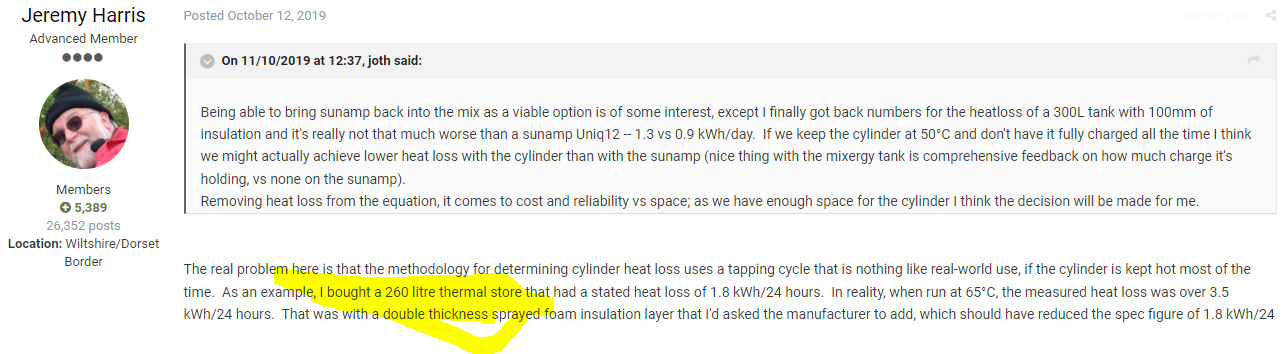
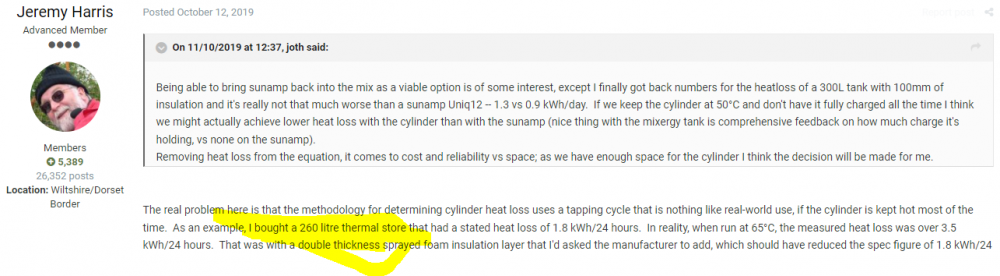
HOLD PRESS!! No need to reinvent the wheel. Thermal Stores and heat pumps are already a thing. https://www.thenaturalenergycompany.co.uk/shop/index.php?route=product/product&product_id=300 Physiologically I like the idea of not keeping 300l of hot water at 3 bar all day every day in an UVC. Relying on over temp and over pressure valves for safety seems like it's an inherently less safe solution than an open vented Thermal store in the case of run away immersion etc. While the case for solar PV over thermal is well proven the thought of being able to pick up a couple of cheap panels and a pump and rig a drainback system is nice. However I don't know of anyone who uses a thermal store with a heat pump. @Jeremy Harris had issues but I think that was probably because his TS was too small (210l or 250l I think) for an ASHP (needed to be run at high temps for sufficient hot water) and suffered high heat losses in a very low energy demand house leading to overheating.
-
Immersion for DHW. Maybe a Willis heater for UFH like @TerryE's system. I haven't seen it done but maybe install a large UVC with a coil for ASHP. Then use that coil to take heat from the cylinder heated from immersion. It would give you the option to retrofit an ASHP if that became a more economical option. We have no G3 in Ireland so I did my own UVC. ( I did a topic somewhere if you search) It's really not too tricky. This man explains all. If you have a good plumber they'll check and sign off on your install I'm sure. Smaller thermal stores like the 250l one you mention work best with high temp heat sources like fossil fuel boilers. However I do like the principle. Maybe a very large coil in tank thermal store (>500l) run at a lower temperature would work. I'm sure some of our plumbing gurus can advise. Infact I'm keen to know myself.
-
Fiber cement board over and then a cavity a synthetic render is probably the most straight forward answer. This isn't fool proof however. I think @Bitpipe had some issues with ballooning boards. BTW I love small houses. Building the pods first is an excellent idea. Accommodation during the build, income and you get to refine your build process before the house. Tremendous. You have really top U values and will be almost thermal bridge free. I wouldn't be surprised if a direct electric approach to DHW and space heating was the most economical rather than a heat pump.
-
Insulating a 1967 timber framed bungalow
Iceverge replied to esalglop1945's topic in Introduce Yourself
What a nice project. I'm optimistic about keeping it for 3 reasons. 1. It's pretty and appears to be well kept. 2. It was never altered meaning it must function well and also doesn't suffer from conflicting build methods of different eras. 3. The builder was unlikely to make a hash of their own house. Might you perhaps be able to sketch a cut through of the wall please with dimensions.