Jeremy Harris
-
Posts
26430 -
Joined
-
Last visited
-
Days Won
360
Everything posted by Jeremy Harris
-
The max wire size for the pass through current is 13mm². The 2.5mm² terminals are for the pulse output, used to connect to other monitoring equipment if needed.
-
That looks fine, as it seems to have approval for billing, and Rayleigh have been around a long time, so I'd trust them.
-
Portpatrick was always a bit of a retirement village, with loads of people from the North West of England moving there to retire. Sitting in the bar at the Crown of an evening you could be forgiven for thinking you were in the North of England, from many of the accents. There were also always lots of B&Bs in the place, that seemed to do reasonably well with holiday business, but I'd guess the single biggest local employer was MoD, with the creamery in Stranraer being a close second. Places like the Crown, and one or other hotels in the village, probably survived on trials teams staying for a week or two at a time, and when we pulled out all that business would have gone, as well as a lot of local employment. Last time I went back we stayed in the Fernhill, and it was practically empty, in early summer.
-
It's warm there, even if it's a bit windy. Logan Gardens are just a few miles down the coast, and have tropical species growing outdoors all year around. One problem they may have is the ravine to the South of the house. Whilst I was running that place the ravine opened up about 30ft or so during one big storm, making the rocky peninsular that the GMS was on a bit less secure. We had a survey done, probably around 1995/6, that suggested that the grassy area in front of our old building (now the courtyard at the front of this house) was likely to fall into the sea within the next 30 to 40 years. In a big storm, waves funnel up that ravine and tend to wash away the access road. The public footpath that runs up there was moved to the opposite side, alongside the golf course boundary, and safety notices were put up, as there was concern that a large wave might wash someone off the path.
-
As long as the DIN rail mount meter has the right approval, then there shouldn't be a problem. Might be more expensive, as a lot of the cheaper DIN rail mount meters don't seem to be approved to the same standard as normal ones, and normal ones are very cheap (typically less than £30), probably because they sell large numbers of them. The measurement accuracy standard is EN62053-21:2003 A1:2017, Electricity metering equipment (A.C.) Static meters for active energy (classes 1 and 2). It's a bit questionable as to whether some of the popular DIN rail meters from the far east actually comply with this, I suspect, as one or two I've bought don't comply with other aspects of EU certification (they work OK, but the CE marks are fake).
-
I'd second getting one with blocks. We have a Harvey that uses block salt and it's pretty clean and easy to handle. You can also store packs of blocks a bit more easily, as each refill is separately packaged.
-

Structural Warranties, NHBC, LABC, etc etc ..
Jeremy Harris replied to Ed_MK's topic in New House & Structural Warranties
I've mentioned before our experience when buying a new house with serious defects that had an NHBC warranty. It was a completely meaningless piece of paper, because, in reality, NHBC just do all they can to avoid having to pay out, and it was blindingly obvious in our case that no one had properly inspected the construction to ensure it was OK. The only reason for having one of these useless bits of paper is as above, if a lender needs it. Quite what benefit it is to lenders I don't know, as there are so many tales of these warranties not being worth the paper they are written on that I'd have thought that lenders would have picked up this by now. -
We had to evacuate the GMS a fair few times, when the weather just got too damned dangerous to be able to drive back down the track to the radio station. From the radio station down to the village was OK, as it's out of the wind a bit. We lived down in the village of Portpatrick, on the site of the old railway line, up the hill behind the church, facing West, like the GMS, and I used to have to hose the salt off the windows two or three times a week in winter. They will be washing their windows up there two or three times a day, just to see out. We bricked up most of the original windows in the GMS, leaving just one looking out from the control room and one facing inland to the car park, not because of the cleaning, but because the bending of the glass from the wind used to unsettle the staff up there...
-
Looks like it's on the site of my old GMS at Portpatrick, next to the golf course, just past the radio station. The GMS was really just a cedar prefab, that had been clad with a rendered block wall, so wasn't very substantial. They had better watch out for golf balls, as we used to regularly have staff members cars hit by them, from mis-hits, when parked up there. Gets pretty damned rough up there in winter.
-
Sunamp UniQ HW+i experience? Charge via ASHP?
Jeremy Harris replied to oranjeboom's topic in Energy Storage
The preheat system is just a 70 litre buffer tank that's heated to ~40°C by the ASHP, and this has a flow and return to a plate heat exchanger, with a small Wilo pump as the circulator. The plate heat exchanger is above the buffer tank, so there's a bit of thermosyphon action that keeps it warm. I have a flow switch fitted in the cold supply to the hot water system, so when a hot tap is opened the circulator pump turns on, pulling warm water through the primary side of the heat exchanger. Cold water to the hot water system flows through the other side, and comes out at around 30 to 35°C, before flowing to the Sunamp. The Sunamp then only needs to boost this by around 20 to 25°C to get the ~55°C hot water to the house, rather than having to boost it by around 47°C if the Sunamp was fed with cold water. In practice there is plenty of capacity in the Sunamp, so the preheating system isn't needed at all. With the benefit of hindsight it would have been better not to fit the buffer tank downstairs, and to have installed the Sunamp where than sits, as it would have saved a great deal of pain and grief in getting the Sunamp upstairs (it weighs around 150kg or so). -
Sunamp UniQ HW+i experience? Charge via ASHP?
Jeremy Harris replied to oranjeboom's topic in Energy Storage
I'm afraid I don't. There aren't many ASHPs that will deliver water at ~65°C efficiently, although the hybrid units, like the Daikin Altherma seem to do a good job, and I believe have been used by Sunamp as a heat source: https://www.daikin.co.uk/en_gb/product-group/hybrid-heat-pump.html Because most of our hot water comes from excess PV generation, overall the energy use from the grid just for hot water is pretty tiny. Our hot water has been solely provided by solar generation since about March this year, and even in winter maybe 30% to 50% of it probably comes from solar generation. Because using electricity to heat the thing is so simple and easy, I've not bothered to look at other solutions, in fact I've been thinking about removing our ASHP DHW pre-heat system altogether, as we don't use it and it just seems a bit of unnecessary added complexity. -
From 2005 until last year I've owned various Toyota hybrids. They were all really reliable, despite them stopping and starting the engine many, many times during every journey. They had the engine stop/start thing so refined that there was no way to tell inside the car when the engine stopped or started, other than by looking at the central display. They'd cracked the smooth starting problem by having the car start on one cylinder at a time, with the exhaust valves held open on the cylinders that weren't firing. They also did away with the starter motor, and started the engine using a direct drive electric motor on the crankshaft, that doubled up as a generator, so was permanently coupled to the engine all the time.
-
We fitted off white Corian in the office coffee making areas at work and they stained badly, but some of that may well have been because those surfaces often sat with tea/coffee spills on them for some time. Whatever the cleaners used didn't seem to be able to tackle the staining, but they may have just been using the wrong stuff. We have Silestone in the kitchen here and it's very good indeed. Doesn't seem to mark at all, and definitely a lot tougher than Corian (but also a fair bit more expensive, I think).
-
Sunamp UniQ HW+i experience? Charge via ASHP?
Jeremy Harris replied to oranjeboom's topic in Energy Storage
In essence, the Sunamp doesn't really start to store much heat at all until it is heated to the phase transition temperature of the PCM, so heating it to, say, 50°C won't do much, it might put around 10% of the heat capacity into the thing, if that. The major part of the heat stored comes from the phase change, and that won't start until the PCM is heated to about 58°C, and to do that probably needs a flow temperature of over 60°C, perhaps around 65°C, because there will be a small temperature loss across the internal heat exchanger, and through the melted PCM close to the heat exchanger. -
I guess it depends on the TF manufacturer, and the time it takes to erect, but for us TF was a LOT cheaper than traditional construction. The initial quotes we had for traditional construction were over 50% higher than for TF, and also had no airtightness guarantee, and slightly worse insulation levels.
-
Welcome, @SimDav. Sustainability really means getting away from energy and CO2 intensive construction materials, IMHO. I'm not sure how ICF really meets that requirement, as many forms of ICF use plastic insulation, plus ICF uses fairly large amounts of concrete, which is very energy and CO2 intensive, both in manufacture and transport. Probably the best approach to sustainable housing, and one that meets the requirement to build houses quickly, would be timber frame construction. The ability to manufacture closed panel timber cassettes, in a controlled indoor environment, and quickly erect them on site meets the need to build houses rapidly. The relatively low CO2 involved in felling and processing timber, plus the carbon that remains sequestered in the timber itself, makes this about as low a carbon construction method as there is. This sort of construction method also fits well with the use of low CO2 insulation materials, like wood fibre or blown cellulose, so reducing the carbon footprint still further. Coupled with a foundation system that uses only modest amounts of CO2 intensive material, it's perfectly possible to get a house that goes from bare ground to watertight, insulated and airtight shell inside two or three weeks, something that is a useful attribute given the variability of the weather here in the UK.
-
You really need to factor in very large duct sizes to make this work. Warm air heating/cooling systems use ducts that are very much larger than MVHR ducting, typically they will be rectangular and typically be between about 200mm x 200mm up to maybe 200mm x 500mm. The large duct sizes are needed in order to be able to move the high air volume needed around without increasing the velocity to the point where it starts to get both noisy and cause high duct flow losses.
-
Not hard to do some quick calcs to show how strong any fastenings need to be. The force from wind on a louvre that was in free air (worst case, as in your situation the louvres are going to partially shelter each other) is given by the projected area of the louvre (i.e. the face perpendicular to the wind) and the wind velocity. The equation is the standard drag equation: F = 0.5·ρ·CD·A·V² Where: F = force (in Newtons) ρ = air density in kg/m³ ( normally about 1.225 kq/m³) CD = drag coefficient, assume this is 1 to make the sums simpler A = projected area (largest face of the louvre) in m² V = maximum anticipated wind speed, in m/s So, for a 100mm wide louvre, 4m long, facing a wind speed of 100mph (~45/m/s), the force imposed by the wind would be 0.5·1.225·(0.1·4)·45² = ~496 N, or around 50.6 kgf. Taking an extreme case, where the louvre was fastened with a single 6mm diameter bolt in tension at top and bottom, and ignoring the possibility of bolt break out through the timber, then each bolt has a maximum tensile strength of about 10 kN, so two M6 316 stainless bolts in tension could withstand around 20 kN, or around 40 times the force exerted by a 100mph wind on a 4 metre long louvre. So, the short answer is that pretty much any fastening is going to be an absolutely massive overkill in terms of ultimate strength versus wind loading on these louvres, so don't worry an SE with it, just bolt the things in place. The more significant issue is really stiffness - if fixed so they don't flex much they will be absolutely rock solid in terms of fixing strength to resist wind loading.
-
Not really, as the maximum flow velocity in the MVHR ducts needs to be kept below about 2.5m/s, just to stop it creating too much flow noise.
-
The key thing here is to compare the air flow rate from an MVHR supply duct with that from an indoor air conditioning unit. The normal flow rate from an MVHR supply terminal would be around 6 to 12l/s. The normal flow rate through the indoor part of an air conditioning unit would be around 150 to 200l/s. Does this help explain why MVHR isn't that great at moving heat?
-
We don't use the MVHR for heating at all, only for a small amount of supplementary hot weather cooling (the air-to-air heat pump within the unit can heat or cool). Our heating is by UFH on the ground floor, run from an ASHP. The capacity of our heating system is significantly greater than the house will ever need, as it a larger than needed ASHP became available at the right price. The cooling capacity of a single supply duct from the MVHR, when in active cooling mode and running at a normal ventilation rate, is less than 100 W, so just about enough to offset the heat produced by one person in that room.
-
There are some fundamental points about the way MVHR works, and what it can and cannot do, that are probably worth making: 1. A normal MVHR system only changes the air in the house about once every 2 to 3 hours. The air flow rate is low, and barely perceptible if you place your hand over one of the terminals. 2. The low air flow rate means that MVHR cannot move much heat, as air has a pretty low heat capacity. 3. With a normal MVHR (i.e. one that does not have any additional means to heat or cool the supply air to the house) the fresh air supply to the house will always be cooler than the temperature of the air in the house, in cool weather. 4. It is possible to heat a passive house with an MVHR system that has some form of post-heating system built in to the fresh air supply ducting, but it will never be a lot of heat. For example, our MVHR has an internal air-to-air heat pump, that can heat the fresh air supply, but even running at maximum it can only supply about 1.5 kW of heat, to the whole house. This is OK for a very low energy passive house, and it's also an expensive way to provide heat (in terms of capital cost). 5. If opting to heat a passive house with some form of duct heating built in to the MVHR system, then the response time will be slow, unless the MVHR ventilation rate is significantly increased, just because the MVHR only changes the air in the house every two to three hours normally.
-
In our case it was because, more often than not, the tractor battery was so knackered that once you'd started it in the morning you didn't dare turn it off, because it wouldn't have been able to restart...
-
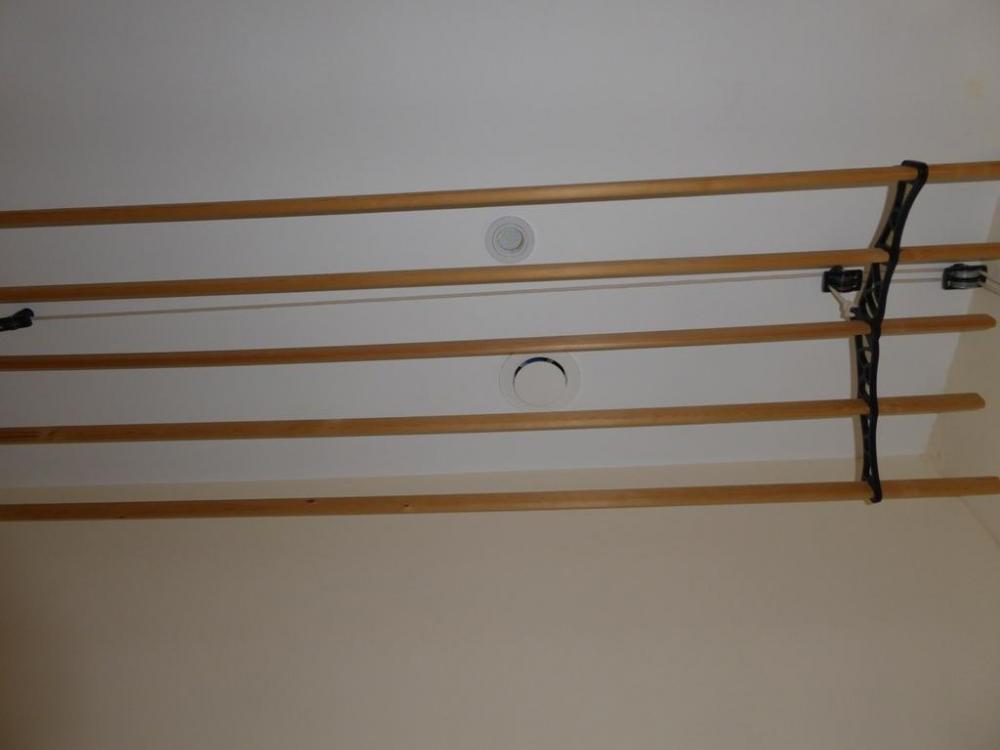
Similarly, we have a drying area in the utility room, and I fitted an MVHR extract into the ceiling above one of those hoist up clothes racks. Works extremely well, and dries stuff very quickly:
-
I saw that programme too, and was similarly pleased to see them still there. Interesting to see that Kevin McCloud's choice for the best design was the one built from shipping containers in NI. The architect behind that design seemed to me to be one of the better ones they've had on the show. It was also a design that I think thoroughly deserved to win.