Jeremy Harris
-
Posts
26430 -
Joined
-
Last visited
-
Days Won
360
Everything posted by Jeremy Harris
-

14th International Dark Sky Reserve
Jeremy Harris replied to Jeremy Harris's topic in Environmental Building Politics
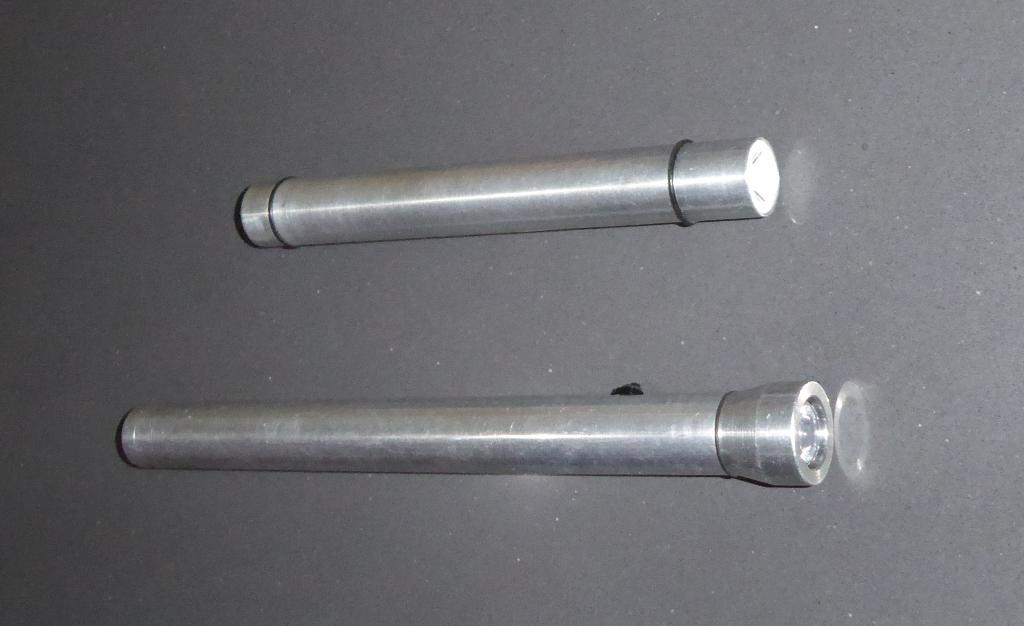
Yes, but being a cheapskate I just bought some high power LEDs and lenses, plus drivers and a few 18650 cells and made my own. They have standard power sockets recessed into the end to charge them up from a home made charger. The aluminium was left over offcuts from machining up some aircraft wing strut attachments, 6082-T6, nice stuff to machine and reasonably tough. These are around 5 or 6 years old now, and I recently had to replace the battery in the smaller one, as it had a lot of use during the house build. -
14th International Dark Sky Reserve
Jeremy Harris replied to Jeremy Harris's topic in Environmental Building Politics
Nice idea. Last time the left over torch was pink, with flower decorations, and luckily we only have one councillor that any of us could imagine would own a pink torch... My torches are easy to spot, they are all home made, machined from aluminium, like these: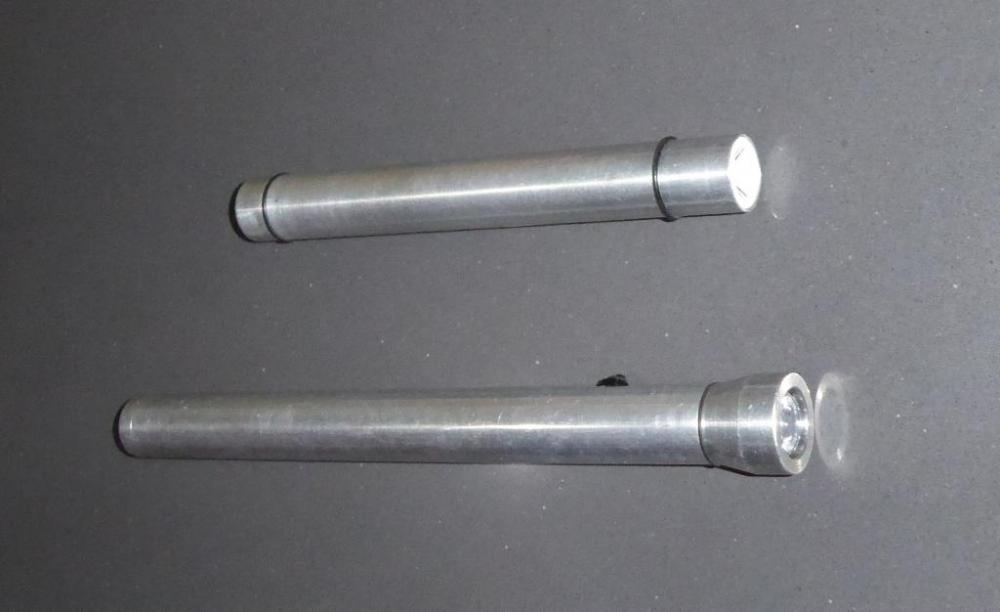
-
Harvey’s Dualflo water softener - is it too small?
Jeremy Harris replied to Weebles's topic in General Plumbing
The flow rate of that model is the same as ours, 50 litres/minute. That's enough to run about 4 or 5 showers simultaneously, I think, as our shower runs at a bit under 10 litres/minute. Only thing to check is the size of the connecting pipes used. The flexible pipes supplied with our Harvey softener had a very small bore, so I swapped them for larger bore flexis, to improve the flow rate. -
14th International Dark Sky Reserve
Jeremy Harris replied to Jeremy Harris's topic in Environmental Building Politics
We have much the same at PC meetings in winter. All the torches end up in a row on the window cill. The problem is that we sometimes seem to have one left over, and have to play guess the owner. I think it's because people arrive individually, but often walk home in twos or threes. -
14th International Dark Sky Reserve
Jeremy Harris replied to Jeremy Harris's topic in Environmental Building Politics
Where we used to live we had a running battle between two neighbours, involving an outside light and an air rifle... -
14th International Dark Sky Reserve
Jeremy Harris replied to Jeremy Harris's topic in Environmental Building Politics
It really can be so dark on a cloudy night that you literally can't see your hand in front of your face sometimes. Being down in the bottom of a valley, plus having high hedges alongside the lane, don't help much. Twice I've been caught out without a torch when it's been really dark, and both times it was more a matter of navigating by feel than sight. Maybe I need to eat more carrots... -
14th International Dark Sky Reserve
Jeremy Harris replied to Jeremy Harris's topic in Environmental Building Politics
The Parish Council regularly gets requests from people, usually those that have just moved here, to get street lights erected. Hard to explain to them that we've spent years getting lights changed or removed... We do have a reporting mechanism here to try to get people who leave outdoor lights on to change them so they are PIR activated, although we have one or two who stubbornly refuse, and one who leaves a light on 24/7 all year around. Thankfully the majority have adapted to our "always carry a torch" culture, although it's easy to get caught out when the nights start drawing in. I went to a PC meeting in September, and didn't think to take my torch. Had an interesting stumble home, in total darkness, trying hard not to fall into the stream that runs alongside the lane. -
VAT for dummies
Jeremy Harris replied to Davidkw's topic in Self Build VAT, Community Infrastructure Levy (CIL), S106 & Tax
+100 to this ^^^ I dearly wish I'd had the foresight (and time) to organise all the receipts into a VAT-friendly filing system as I went along, rather than stuff them all in a box until I came to make the VAT claim around 3 years later... -
Got broken in to last night ....
Jeremy Harris replied to ToughButterCup's topic in General Self Build & DIY Discussion
Doesn't make up for the stress and heartache of knowing your home has been invaded, but it's very good news to hear that they have received money that's come directly from those found guilty. I wonder how often this happens? If it's a fairly common thing, then it really deserves a bit more publicity. People seem only too willing to be critical of the police, so a bit of good news relating to the hard work they do should be made more public, IMHO. -
At long last, as of today, our area has now become the 14th in the world to obtain International Dark Sky Reserve status: http://www.ccwwdaonb.org.uk/news/141/39/Cranborne-Chase-AONB-becomes-an-International-Dark-Sky-Reserve/ It's involved a fair bit of work to remove unnecessary street lighting, persuade people to not leave outdoor lights on etc, and has meant everyone adopting a winter culture of always carrying a torch, but it does mean we get great views of the stars on a clear night.

-
I've been following the Octopus variable rates, Go tariff, etc for a while, but can't get the sums to add up for our pattern of use. I also suspect that these tariffs are very much an inducement to get more people to have "smart" meters, so that tariffs can be made more complex, and harder to compare in terms of value for money. One problem is that we need most of the 7 hours E7 off peak period in order to charge up the floor slab, and this isn't something that can be speeded up by just increasing the power input, as doing that increases the flow temperature, which then tends to cause a temperature overshoot. Battery storage helps a tiny bit, but not as much as might be thought at first, as the cost of re-using the stored cheap rate electricity is about 1.2 times the unit cost, because of round-trip losses. That makes the 8.148p/kWh E7 off-peak rate really 9.78p/kWh for us. The Go tariff is marginally better, but again the 4 hour time slot is tight, allowing for the slow down in charge rate of batteries during the balancing phase (a 10 kWh battery storage system may only charge at a mean rate of around 2 to 2.5 kW in practice) and allowing for the 30 min period of uncertainty in timing at either end of the 4 hour period (makes the 4 hour slot effectively around 3 hours, until such time as some means of accurately syncing meter 30 minute tariff rate change periods with loads is implemented).
-
Insurance was mentioned to me as a possible option by the planning officer, during a site meeting, when we we trying to put some bounds on cost, but it was difficult to obtain for a single plot, and because artefacts had already been uncovered during the pre-planning work, the premium was estimated as being very high (I couldn't get a firm quote, though - the brokers had never dealt with insurance like this for a single plot before). Had we gone ahead, my plan was to use screw piles to significantly reduce the depth of excavation on site. At the time I found some stuff about the way screw piles had been used in the past to avoid too much disturbance to buried archaeology, so even though the cost was a bit greater than that of conventional foundations, the reduction in likely archaeological cost would have swung very much in favour of using them.
-
So, for us the export payment would be a bit less than the current export payment we get under the FiT scheme (that's currently 5.38p/kWh). Assuming we export 50% of our generation, then at 5p/kWh we'd get around £150/year for our 6.25 kWp PV array. The value of our self-consumption is a lot more, as it's all at peak rate, so, again assuming 50% of generation is self-consumed, that's worth about £472/year. Adding the two together gives a net benefit of around £622/year, so not bad. That's still enough to recover the net cost of our in-roof PV installation after about 10 years.
-
That makes sense. I'd guess that a couple of hundred £k of work on a site that's potentially worth a few million is a very different scale to the same amount on a site worth only £100k.
-
Not sure how much scope a self-builder has to manage anyone in this position, TBH, even with more experience of having worked with archaeologists. Outline planning consent had been granted, with a condition that all excavation work had to be overseen by an archaeologist, and when I spoke with the team that had carried out the initial, pre-planning, work, they made it clear that they had the authority to close the site down at any time, if anything was found, for as long as it took to properly investigate it. It was also made clear that we would have to pay for this work. This is what I meant when I referred to us not having any power to be able to veto further work and just walk away. It seemed that, if we went ahead, we'd have been accepting a risk that could have absorbed all of our build funds (and more, perhaps) just in doing archaeological work.
-
Yes, I did, you said that they did more work at the feasibility and pre-planning stage. My experience was that the work that had already been done at this stage (by the plot vendors) raised more questions than answers. As I mentioned, the archaeologists seemed unable to be able to give any reasonable answer as to what might lie under the site, or how much it might cost to investigate. Presumably the answer is to do a full investigation, at considerable cost, before planning. I'd imagine that this is the sort of thing that may happen a fair bit, when dealing with "unknown unknowns".
-
Do big developers just include the full cost of a complete archaeological investigation into the initial budgetary estimates they do when assessing viability? I can see that working on a larger site, where the archaeological costs might not be such a massive chunk of the site cost. The concern I had was that no one, at least no one within the University of Bristol based field archaeology group, who had already dug two exploratory trenches on the site as a part of the pre-planning work, could give any estimate as to what might be there, or how long it might take to excavate, record and protect/recover anything found. The most optimistic answer was that a watching brief may not find anything of sufficient interest to warrant further work, but they felt that was unlikely given the cobbled floor and artefacts from the old mill that had already been uncovered. When I tried to get a feel for the most likely cost, things seemed very vague, as the team that had undertaken the exploratory work seemed to have no real idea as to how extensive the area of archaeological interest may be, or how much it might cost to explore in full. The best guess I could make was that the cost seemed to lie somewhere between about £2k for the most optimistic estimate, to over £200k for a pessimistic estimate. Trying to pin down a more realistic cost somewhere in the middle seemed to be impossible. As the chap at Bristol told me, it was a "how long is a bit of string?" question. It also seemed clear that we would be required to foot the bill for all, and any, archaeological work done on the site, which I found a bit worrying, as I'd have hoped we might have been able to have some sort of power to veto further work and walk away.
-
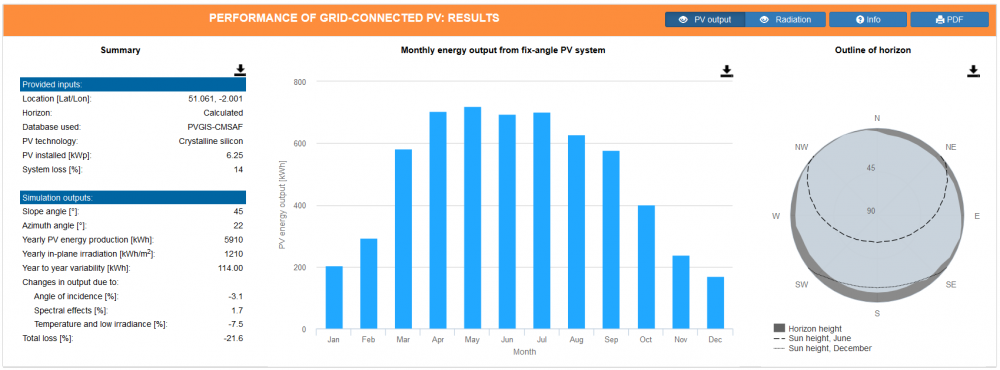
Welcome. There's a pretty useful website that allows you to put in your location, the orientation of the panels and the number of panels and will give you the estimated generation over the course of a year, month by month, PVGIS: https://re.jrc.ec.europa.eu/pvg_tools/en/tools.html For example, this is the estimate it provides for our PV installation, which is pretty close to what we actually get in practice (we tend to get a few percent more than PVGIS indicates, our average is very close to 6,000 kWh/year over the last five years):
-
Do artstone cills have a structural core?
Jeremy Harris replied to epsilonGreedy's topic in General Construction Issues
Yes it does, and will possibly form a condensation locus I suspect, unless something is included to mitigate the thermal bridge inside the cill. -
Buildings insurance on a renovation job
Jeremy Harris replied to Lets's topic in New House & Structural Warranties
I think we also had insurance that was a modified renovation policy. I've just dug out the policy and it was with Versatile, https://www.versatileinsurance.co.uk/ It was a modified renovation policy to cover a part-completed self-build, that was outwith the terms for a normal self-build policy. -
Another vote for the Irwin Quick Grip clamps. Really useful if you were born with only two arms, as they can be used with one hand, leaving the other free to hold whatever it is you're clamping in place.
-
The first plot we looked at had already had a preliminary archaeological investigation, with some early industrial age stuff being found. When I tried to pin down the costs of the watching brief, and any consequential costs arising from anything uncovered, I found it was a bit like giving them an open cheque book, with all the blank cheques already signed... Because they didn't know what might be under the site, they couldn't give us a price for the archaeological work. The lowest estimate was for a few days spent looking at excavations and not finding anything to look more closely at, the highest estimate was open ended, as they wanted us to pay for what could turn out to be several weeks of detailed work, uncovering, recording and preserving whatever they found. Be interesting to hear how the big developers deal with risks like this, as they must have ways of being able to put some realistic bounds on the likely cost. I didn't pursue this further at the time, as a major boundary error, plus the unlawful relocation of a right of way, effectively put the kibosh on the purchase.
-
I haven't implied anything to anyone. You can choose to believe otherwise, that's your prerogative.
-
Which is not at all what I was doing... At no time did I even hint that a simple assessment could cost as much as a complex assessment, in fact I've emphasised (twice) that the FRA should be as the EA advised, " site specific and proportionate". Not sure what bit of that isn't clear, TBH.
-
Setting out DIY
Jeremy Harris commented on Patrick's blog entry in Timber Portal Frame - but stick built
I wholly agree with the idea of doing as much yourself as you can, for much the same reason, learning something new. I had a fair bit of worry over our setting out, despite having checked and double checked that the critical stuff was in the right place. Just as well I was so concerned about getting things in the right place, as we ended up with a foul drain stack coming up closer to the inside edge of a wall than I really wanted. My fault for thinking that having it within ~±30mm would be OK, it really needed to be within about ±10mm of where it needed to be.