Jeremy Harris
-
Posts
26430 -
Joined
-
Last visited
-
Days Won
360
Everything posted by Jeremy Harris
-

(smart?) things that should be in every room
Jeremy Harris replied to puntloos's topic in New House & Self Build Design
Not actually true, though. It is true that the only speech recognition feature built in to a smart speaker is the ability to detect the keyword, but the mic is always active and the unit is always recording audio in a loop. It has to, in order to try and get the false alert frequency down to an acceptable level. If the onboard speech recognition detects what it thinks is the keyword ("Alexa" or whatever) then digitised audio both detected and recorded by the device from just before the keyword detection, to a period of time after it, is transmitted to the company servers. These have the "heavy lifting" processing capability to do two things. Firstly, the keyword recognition is checked. If this hasn't been correctly identified by the fairly limited capability within the device, then no action is taken by the company running the system to act on any audio after the keyword, however they may still keep the audio recording, as they are always trying to train their systems to be more accurate. This may mean that other people, most probably outwith the UK and our privacy laws, may listen to these false alert recordings, in order to try and determine how best to tweak their algorithms/AI systems. The second thing that happens is that, if the keyword turns out to have been correctly detected by the device, then the rest of the audio will be processed and acted on, both in respect to what the system believes is being requested, and what the system knows about that particular user's preferences, age, gender, buying habits, TV/radio/streaming preferences, purchase history etc. Just to be absolutely clear, the microphone of all these smart speakers IS on all time, IS recording a short audio loop all the time and can be activated to send audio to the companies servers at any time, not just when a valid keyword is detected. They all make this fairly clear in their terms and conditions, although it isn't immediately obvious that any audio, at any time, can, and does, get sent back to the main servers. Putting a packet sniffer on the output of one of these (Wireshark, or similar) reveals that there is usually a significant amount of traffic going back and forth all the time, even when the device is apparently not being keyword activated. There's an interesting legal question that these things raise, too. There's no reason at all that I can see why someone shouldn't choose to buy and use one of these smart speakers if they wish. By doing so they will have accepted all the terms and conditions, and so be comfortable with any audio within range of the device being recorded and sent back to the companies servers, at any time that the device is powered on. However, what about visitors or guests? They most probably won't have signed up and accepted the same terms and conditions, and may be unaware that anything they say within range of such a device may be recorded and transmitted to a third party. Ordinarily, consent needs to be explicitly granted for this sort of audio monitoring, so it would seem that anyone that has one of these devices may have a legal obligation to inform any visitor or guest that they are subject to audio monitoring when in their house. Not sure the law has kept up with technology yet. Even a chap from Google said that he felt there was probably a legal requirement for disclosure, and that he would not enter the house of anyone who had one of Google's own devices connected. -
Solar DHW with UniQ and PV Diversion
Jeremy Harris replied to DamonHD's topic in Boilers & Hot Water Tanks
I think that, rather luckily, any enforced delay to your plans, @DamonHD, may well have worked in your favour, at least as far as the ups and downs of the Sunamp UniQ range have been concerned. As you know, I bought an original Sunamp PV (as have a few others here) and found that, in general, it worked very well. There were a few very minor teething troubles, but nothing significant. The same, sadly, wasn't true when I opted to swap my Sunamp PV for a bigger Sunamp UniQ. I, and a few others, have had a fair few problems with the early UniQ models, ranging from some issues with the design of the case etc being inadequately stiff to deal with the loads imposed by the heat cells, through to a range of issues with the control system and even the PCM itself, for one of the low temperature models. Right now, our PCM58 unit is, at last, working reliably, but there is still an issue with there being zero information available as to the operating status of the unit (for example there's no way of knowing whether it's ready to accept charge, is fully charged, has power available either to the control side or the charge side, etc). This is a major issue for me, as, having experienced a few "cold water events" (i.e. no hot water for a shower) I very much like to be able to see at a glance whether the Sunamp is functioning as it should, or not. My work around (not at all recommended) is to leave the control unit cover off, as, rather bizarrely, there are a some extremely useful LED status indicators hidden behind the (opaque) steel lid of the enclosure. Quite why these LEDs aren't external visible is a complete mystery, given how important they are. A similar array of LED indicators was externally visible on the Sunamp PV, and were very useful, so omitting to make them visible on the UniQ range seems an odd decision to have made. The good news is that pretty much all the bugs that plagued the early UniQ units have now been ironed out I think. There are a handful of us here with them, and I think that most of them are now working as intended. -
I think we're mixing up measures of efficiency here. Ion exchange resin doesn't behave any differently, to any significant (or measurable) degree between being fully "charged" with sodium ions and being almost depleted of sodium ions, with most available binding sites occupied by calcium ions. The softener will work just as well, as long as there are still enough sodium ions available to be preferentially exchanged with incoming calcium ions - the softening efficiency doesn't change to any measurable degree. The only two measures of efficiency that are possible (for a non-electric softener) are: 1. How much water does the unit waste as a proportion of the water that it treats? 2. How much salt solution does the unit waste as a proportion of the sodium ion exchange per cycle? All ion exchange softeners waste water and waste salt solution, because all, without exception, use an excess of salt solution during regeneration in order to ensure that all available binding sites are occupied with sodium ions. There are other arguments relating to aspects that aren't related to efficiency, like twin tank units being able to provide softened water 24/7, 365 days a year, because they do not have to interrupt the flow of softened water during regeneration, as well as aspects like the tiny amount of electricity that an electric unit will use to run the timer unit. Clearly using a metered softener (of any type) that is set to regenerate too frequently for the local water hardness is inefficient, yet such units are always set to err a bit on the side of caution, to ensure that the sodium ion content of the resin doesn't become fully depleted before regeneration starts, as that would lead to non-softened water being delivered towards the end of each cycle. In some areas, though, there is also a marked variation in water hardness with the season. Where we used to live the hardness would increase significantly in mid-summer, when more of the mains supply was being drawn from the deep chalk aquifer, and decrease by as much as 50 to 80 mg/l CaCO3 equivalent in winter, when the supply came from alternative sources. Any softener regeneration volume setting would have to be set for the summer hardness level, with the user accepting the poorer efficiency (more wasted water and salt solution) in winter. Our borehole supply is always the same hardness all year around, because we're drawing from a fairly deep greensand aquifer, that is replenished very slowly (hundreds of years, rather than tens of years) from chalk ground water, held above a gault aquatard, that percolates very slowly down into the greensand. It was exactly the same when I measured it a few weeks ago as it was when we drilled the borehole back in 2013, which at leaks made setting up our softener simple and allows it to run more efficiently (less wasted water and salt solution).
-
Relatives working on site.
Jeremy Harris replied to ToughButterCup's topic in General Self Build & DIY Discussion
A while ago I got severely reprimanded on another forum for suggesting that it was easy to make up a robust, heavy duty, extension lead that would make low rate car charging easier when staying away somewhere. I made up such a lead when I first got the Prius Plug-in back in 2013, and had found it invaluable. On that forum I just gave a list that included an RCD protected plug, H07RN-F cable and a suitable IP68 socket I'd found that was big enough to close over the largest moulded-on plug (the low rate chargers that all electric cars come with often have larger than normal 13 A plugs for some reason), with no instructions on how to wire up the plug or socket (I assumed everyone would just know how to do this). The forum admin moderated my post, and warned me that if I had given instructions on how to wire up a plug and socket my post would be viewed as being llegal, as that no one other than a fully qualified electrician should attempt such a thing. Needless to say I just quit and deleted my content, as there was no point arguing about it. Like you, @ProDave, my mother taught me how to wire a plug. Although it doesn't apply now, every time I do wire one up I can hear her voice reminding me to put the "red on the right". -
Relatives working on site.
Jeremy Harris replied to ToughButterCup's topic in General Self Build & DIY Discussion
I've found it easy to offend people by refusing offers of help, but experience has taught me that often I'd spend more time showing someone how to do something, and checking that they are doing it properly and safely, than I would if I just did the job myself, without help. -
For a new build, and perhaps for a conversion, levels are normally referenced as metres (often to two or three decimal places) AOD, Above Ordnance Datum (which happens to be a line on the harbour wall at Newlyn, Cornwall for most of the UK). Often there will be a local datum mark somewhere nearby, maybe a benchmark carved into an older building or church (looks like a broad arrow with a line above) or may be a spot height nail that happens to be visible (we had one hammered into the lane outside our entrance for a time, left over from a detailed survey and marked as a spot height on OS maps). The normal process would be for the initial site topographical survey to have heights referenced to Ordnance Datum by prominent features around the plot, often boundaries, trees, power or 'phone poles etc. The height of the building on the approved plans should be references to the same Ordnance Datum ideally (just makes checking and laying out a bit easier) but it may possibly be referenced to some other local datum. We put a local temporary datum in the corner of our plot, where it wouldn't be disturbed, from which was could reference everything in all three dimensions whilst laying everything out. In our case we had an issue getting planning consent for a two storey house, so ended up building a 1 1/2 storey house, with an imposed condition limiting the maximum height of the roof ridge (it's clearly marked as not to exceed 90.60m AOD). There was an anonymous complaint made to the planners that our house had been built too high, and was not compliant with our planning consent. I checked it, and thought that it was, if anything, a bit lower than we were allowed, but the planning enforcement chap insisted on visiting. I borrowed a Total Station for his visit and set it up over the spot height nail in the lane, and proved to him that our ridge height was around 80mm below the approved maximum. He was happy enough with that, and said he had more issues with people complaining about the height and size of houses being built than anything else. He and I chatted for a while and were of the same opinion - most people just aren't very good at reading planning drawings properly.
-
Not sure this is technically correct, TBH. There's not really any such thing as "resin efficiency", the ion exchange process is pretty simple and as long as there are enough sodium ions present on the resin they will be exchanged for calcium ions in the water. All ion exchange softeners are identical in terms of how efficiently the ion exchange process works (assuming the tanks are correctly sized for the flow rate), as it's just pretty simple, very well understood, chemistry (well, technically, not really chemistry). The only two factors that relate in some way to efficiency are how much water is wasted during the regeneration process (some machines can waste a great deal more water than others) and how much salt solution is wasted during regeneration (again, some can waste a great deal more than others). The key factor regarding both salt and water wastage, over and above the amount of salt (or more specifically sodium ions) required to regenerate the ion exchange resin, is set by the "hardness" adjustments on some units, although technically these setting make absolutely no difference to the water coming from the unit at all (as long as they are set conservatively, to provide a slight excess of sodium ion capacity remaining on the resin at regeneration time). What the settings do is either adjust how much water passes through the resin tank before regeneration starts, or how much time has passed since the last regeneration in the case of electric timer models. Clearly the latter has the potential to be inherently more wasteful of both water and salt solution, as a timer has no way of knowing how much water has passed through the unit, and hence how depleted of sodium ions the resin has become. It makes sense to use softeners with water metering, as a general point, as in the majority of cases they will always waste less water and salt solution. When it comes to metering setting then it gets more complicated, as, although the Harvey meter only has four sets of gear trains that can be selected when the unit is built (these set the volume of water used per tank before regeneration starts), the Havey meter is a great deal more sensitive at low flow rates than the Kinetico one, so meters much more accurately in general. Kinetico have double the number of settings in their water meter gearing primarily to overcome the inability of their water meter design to measure low flow rates (typically the sort of low flow when wash basins are used at a trickle). Whether there is much practical difference between the water and salt solution wastage between either the Harvey or Kinetico units will depend almost entirely on how any measurement schedule is devised. I've no doubt that Harvey use a test and measurement cycle that is biased towards showing up the improved sensitivity of their water meter, but whether this is realistic for any household is going to depend very much on how that compares to the actual pattern of use. The bottom line is that all ion exchange water softeners can soften equally well, and all water softeners will waste water and salt solution. All timer-based ion exchange softeners are likely to be much more wasteful at times than water meter type softeners[1]. I strongly suspect that any difference in wastage between softeners like the Harvey and Kinetico are more likely to be influenced by differences in water usage pattern than they are by the design of the water meters they use. [1] As an example as to why this is, take our water filtration (uses a water softener type electric timer valve to operate the backwash and flush system). This is set to backwash the filter bed once every 4 days, at 2.00am. This is generally fine, but we were away for three days over Christmas, so the unit would have wasted about 75% of the backwash and flush water, as it doesn't actually measure how much water has passed through the filter bed, so doesn't know whether or not it really needs a backwash and flush. A timer controlled softener will similarly be very wasteful under the same circumstances, it will just flush loads of unused salt solution down the drain.
-
It's taken about 3 years for my registration to complete!
Jeremy Harris replied to DamonHD's topic in Introduce Yourself
There's some stuff here: https://forum.buildhub.org.uk/guidelines/ and the terms and conditions are here: https://forum.buildhub.org.uk/terms/ -
It's taken about 3 years for my registration to complete!
Jeremy Harris replied to DamonHD's topic in Introduce Yourself
TBH, we've only managed to get the forum contact email to work in "receive" mode very recently; before then I had no way of seeing what was coming in via that route. We still have to fix the forum email "send" functionality, not at all sure why that doesn't work, but it's not for want of trying to fix it. -
It's taken about 3 years for my registration to complete!
Jeremy Harris replied to DamonHD's topic in Introduce Yourself
Hi Damon, and welcome, Sorry for the glitch and long delay, but glad to see that we managed to finally get things working. -
The video posted earlier shows a tear down of one. Just need to find a similar tear down for the Makita equivalent to compare the two.
-
If it's the same as the one I've just bought, then I reckon you may find it as good as a genuine Makita. Mine's identical to the one in the vijeo by Uncle Bumblef*ck above, and he beat the living daylights out of the thing and it carried on working. I doubt mine will get a massive amount of use, but just knowing it will easily whizz off really tight wheel nuts makes it worth having. I already have a set of deep impact sockets left over from when my ancient (at least 40 year old) air impact gun was still in the land of the living, so I've not had to shell out for any extras.
-
The impact driver arrived this morning. Seems every bit as good as shown in that video by AvE. Although it is advertised as being a 1/2" square drive machine (which it is) what isn't clear is that it also has a standard 1/4" hex socket in the square drive, so works fine with screwdriver bits, without an adapter (handy, as it keeps the front to back profile short). I bought from this "UK" eBay seller: https://www.ebay.co.uk/itm/372853575848?_sp=p2488212.m41214.l9765 for the princely sum of £25.98, including delivery, but I see they've now upped delivery to £9.99, so one will now cost a whopping £33.58. I've given the thing a quick test, with both genuine Makita and Makita clone battery packs and reckon it's probably pretty close to the quoted spec. Had no problem loosening the wheel nuts on my car as a test, and they were done up pretty tight (needed to get the torque wrench out to tighten them back up correctly, though)
-
Failed septic tank & soakaway - replacement issues!
Jeremy Harris replied to Caroline E's topic in Waste & Sewerage
Pumping up an incline to a head of 10m or so isn't usually a problem. The pump on our unit is the lowest rated one they do and will easily pump to 8m head: https://webuildit-ltd.co.uk/product/bio-pure-1-pumped-outlet/- 29 replies
-
- 1
-

-
- septic tank
- soakaway
- (and 4 more)
-
Failed septic tank & soakaway - replacement issues!
Jeremy Harris replied to Caroline E's topic in Waste & Sewerage
We have a treatment plant, that drains to a small stream. Getting consent from the EA to do that here in England was dead easy, but @ProDave had more of a struggle getting consent from SEPA to do the same, although I believe that things may now be easier there than they used to be, especially if there's no other practical solution. Our treatment plant has a pumped outlet - just needs a run of 50mm MDPE pipe out to the stream, ditch or whatever, so not a major engineering job to install. IIRC our treatment plant, with the pumped outlet option, cost around £2.5k, plus installation. -
MVHR is Largely Bogus
Jeremy Harris replied to DavidHughes's topic in Mechanical Ventilation with Heat Recovery (MVHR)
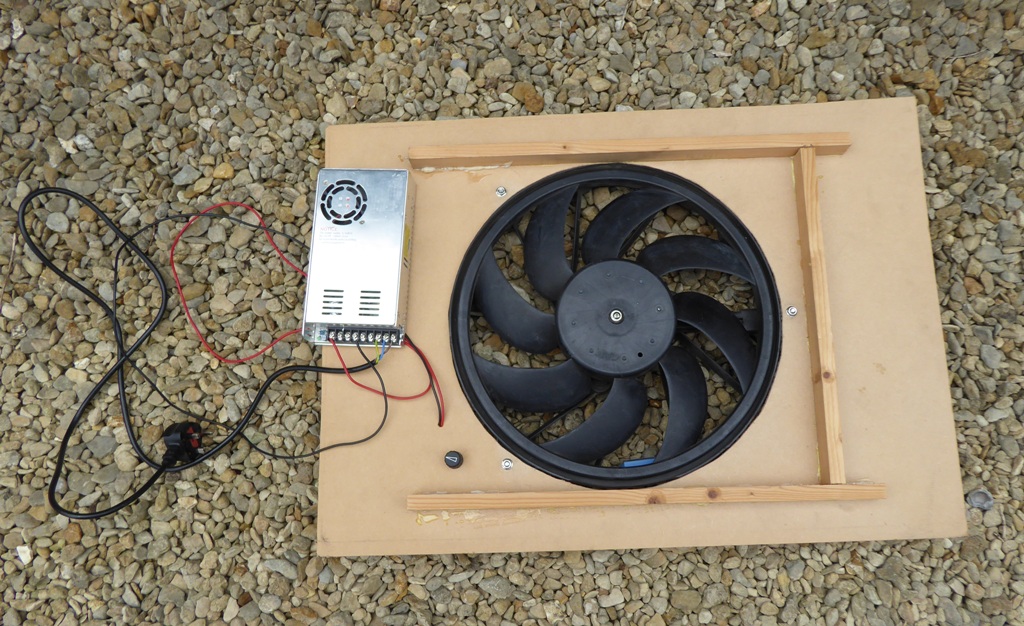
Spot on, this is what I made up to find air leaks in our old house: It's made up from an old car radiator fan, fitted to a bit of MDF that was cut to be a tight fit into an open window. I had to replace the motor, as the original was rusted up, so fitted a model aircraft brushless DC motor, with speed controller. This gave pretty fine control of fan speed, which turned out to be quite useful. I did try to make a differential pressure measurement unit, together with a pitot-type flow sensor, with the intention of being able to display and log leakage, but the leakage from the old house was so great, even after replacing all the doors and windows, and sealing up around all the leakage areas I could find, that I felt it just wasn't worth the effort. The unit was very useful for finding all the many leaks, though. Some made their presence felt by the noise they made, others had to be pinned down using smoke (I used some joss sticks for this). After weeks of work I never did manage to make our old early 1980's built, block and brick, bungalow very airtight, as there were just too many big, inaccessible leaks.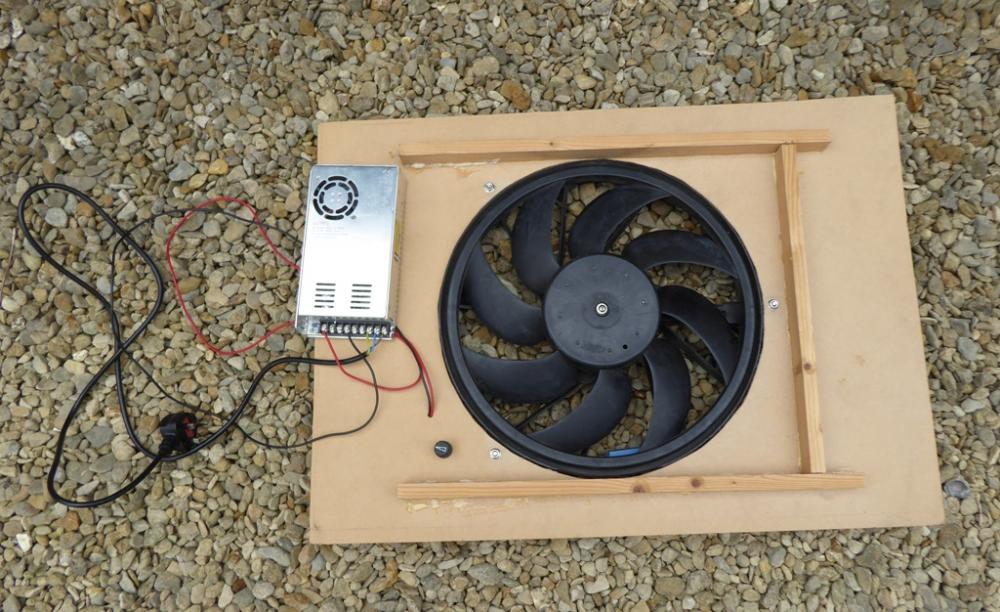
-
MVHR is Largely Bogus
Jeremy Harris replied to DavidHughes's topic in Mechanical Ventilation with Heat Recovery (MVHR)
All the data is in the spreadsheet linked to earlier in this thread. IIRC I used an MVHR efficiency of 85%, which is pretty typical for most units. The ventilation rate is as given, 0.43 ACH. The temperature differential is shown on the plots, and the spreadsheet includes monthly data for our location (from the nearest Met Office weather station, although it's in error slightly for our sheltered location). SHC can be considered pretty constant, as it makes very little difference when comparing heat recovery ventilation versus non-heat recovery ventilation. Again the figure used is in the spreadsheet, 1210 J.m³.K. You can easily change this if you want to see the impact - the cells aren't locked. I didn't bother with cost, as that is very highly dependent on the heating fuel used, the efficiency of any heating system, plus things like variable tariff rates (almost all our heating is from E7, via an ASHP, for example, so the cost is ~ 2.5p/kWh, so cheaper than pretty much any other fuel I suspect). -
Anyone used online 3D printing services
Jeremy Harris replied to Gone West's topic in Tools & Equipment
In general, resin printers give a finer surface finish (layer height is ~25µ to 100µ) but only have a small print volume, or more specifically a small print base area (mine's limited to 115mm x 65mm for the base and up to 155mm high). FDM printers can generally print bigger things, but the layer height is usually around 50µ to 300µ, plus, in practice, the diameter of the nozzle has an effect on surface finish, as the smallest is often around 400µ. There have been a few times when I've wanted a bigger print volume, though, as having to print multiple smaller parts and then bond them together is a bit of a pain. I could also do without the smell of the resin. It's unpleasant enough that my printer lives out in the workshop, as it's both too smelly and too messy when washing prints to remove excess resin after printing, cleaning up the printer with IPA etc. I also have to wear gloves when using it, as the uncured resin isn't good for your skin. -
Anyone used online 3D printing services
Jeremy Harris replied to Gone West's topic in Tools & Equipment
There's not really a fill percentage with resin printers, unless you design the part to be hollow. Parts like this are always printed as 100% solid by default. -
Anyone used online 3D printing services
Jeremy Harris replied to Gone West's topic in Tools & Equipment
Not sure if it's the same for FDM printers as it is for resin printers, but I've found that levelling the build platform (bed for an FDM printer) is hyper critical. From what I've read, with FDM printers there are also other tricks to ensure that the base layer adheres well. -
It very definitely would be. The first plot we were looking to buy was challenging, mainly because, although it was around 1/3rd of an acre the space available to put a house on it was very limited. Luckily, the planning officer was very helpful, drove over to meet us at the plot and talk through what we wanted and what he felt would be acceptable. In the space of about an hour on site we had a pretty clear idea of what we probably could and could not do. Sadly it seems that this is very much the exception rather than the rule, as planning officers just don't seem to have the time to do this any more. It's a pity, as I suspect that if they made a bit of time available up front like this, they may well save a great deal more time later in the process.
-
The main problem is that health and safety legislation is aimed at everyone, not just those who can actually be trained to work more safely. There are people around who, no matter how much effort is put in to trying to train them to do things safely , will just ignore it and carry on. Best example I can think of is a friend of mine, left the RAF as a Chief Tech Armourer and got a job in the Middle East as an armaments instructor, working for a well-known ME air force. He terminated his contract early and came back to the UK, for one reason only; he was expected to train dickheads for whom no amount of training was ever going to enable them to work safely. The final straw was after he'd spent weeks trying to train a team of armourers to safely load missiles to underwing rails. There's a sizing procedure that has to be followed to ensure the correct tolerance between the rail and the missile, so it can both be installed safely and will fire away from the rail cleanly at launch. No matter how many times he tried to train the guys to gauge the rails and missiles to ensure the right fit, they never seemed to get it. The day he walked away was when he saw one of them using a mallet to force a (live) missile on to a rail, as the fit was too tight. He lost a fair bit of money by walking away, but reckoned that if he'd stayed there for 100 years those guys would never have been able to work safely. His view was that the bottom line was that they had a very strong, fatalistic, view of when their own lives would end. The use of the phrase "insha'Allah" is commonplace there, and viewed by many as being a bit like the Cornish word "drekly", but in his view the guys he was training literally viewed it as if they could never be responsible for the time of their own passing, it was literally down to the will of Allah.
-
I keep meaning to buy some of Uncle Bumbef*ck's stickers: Available from here: https://www.etsy.com/ca/listing/687412636/warning-stickers-mk-ii


-
Anyone used online 3D printing services
Jeremy Harris replied to Gone West's topic in Tools & Equipment
The standard post-cure for resin printed parts is to heat them to ~80°C for about an hour, whilst exposing them to UV light. Before doing this they tend to still remain a bit soft, as the post-cure process finishes off the cross-linking of the photo polymer that's started off during the printing process. I have a bodged up post-cure oven with a UV floodlight set into it that I use. Heating the parts up again won't do any harm, though. -
MVHR is Largely Bogus
Jeremy Harris replied to DavidHughes's topic in Mechanical Ventilation with Heat Recovery (MVHR)
We comment on this often, as, although the house temperature is very stable, there are some days when we feel cooler, or warmer, than other days. I've ruled out humidity, as that doesn't seem to change much, and an pretty much convinced that it's a psychological response to what we see outside. Days like today (wet, mild, gloomy, a bit windy) seem subjectively cooler indoors than days that are very much colder outside. Part of my reasoning is that neither of us notices that it "feels" cooler until we've opened the blinds and can see what the weather's like outside. What is odd, is that I don't remember noticing this before; it seems to have only been something we've both commented on since moving in to this house. I suspect it may be related to the way we've become more sensitive to small temperature changes in some way.