Jeremy Harris
-
Posts
26430 -
Joined
-
Last visited
-
Days Won
360
Everything posted by Jeremy Harris
-
I'd be inclined to dump it, if it were me. They do cause a reduction in flow rate that was quite noticeable when I took ours out. I put it in originally because we were running the borehole pump at around 4.5 bar, but left it there, set to 3.5 bar when I reduced the water treatment plant operating pressure. TBH. I didn't notice the flow reduction it was creating until I removed it, when I took out the thermal store and fitted the Sunamp PV, it was the improvement in flow rate after I removed it that was noticeable. As an aside, I've found that fitting flow rate reducers on all the taps, except the bath, has not only made those taps more user-friendly (less splashing and easier flow control) but it has also reduced the impact on the shower flow rate when a tap is turned on to the point where it's virtually undetectable. It wasn't my choice to fit these flow restrictors, it was a building regs requirement to comply with the water usage bit of the regs, but if I was starting again I'd fit them as a matter of course to all the non-flow critical taps..
-
The maximum our slab (also MBC) surface temperature reaches, with the UFH running, is about 23 deg C, there's some data here from some recent measurements:
-

Modelling the "Chunk" Heating of a Passive Slab
Jeremy Harris replied to TerryE's topic in Boffin's Corner
You're right about the MVHR, I haven't logged data from it, but the control unit displays the exhaust air temperatures before and after the heat exchanger, and the inlet air temperatures before and after it as well. Whenever I've looked at it in winter the exhaust air before the heat exchanger is typically around 21 deg C or so and the fresh air feed to the rooms is usually around 18 deg C or so. So the MVHR is always working to cool the house a bit in winter, but very much less than normal ventilation would. -
Help me deal with a neighbour!
Jeremy Harris replied to hmpmarketing's topic in General Self Build & DIY Discussion
It's definitely a "rogue" parking bay, no question about it, and arguably defacing the road and pavement is the same, legally, as graffiti. Parking on the pavement so as to cause an obstruction (as that van does when parked in that bay) is also an offence, I believe. I'm going to hazard a guess here, from looking at the photos, that the drive alongside number 14 is a bit narrow, and not that easy to get the van in and out of, which is why he's decided to park on the road. The parking bay looks suspiciously like it's been marked to the size of the van! The only long term answer here is for the owner of number 14 to accept that his parking bay has no legal standing, that the council have said it should be removed and for him to sort out how he's going to park his van in future. Bear in mind that the fire service will need to be able to get their vehicles within a given distance of the furthest part of your new build, too, and they may well insist that the area in front of your entrance be kept clear so a fire engine can get to it. If I lived in number 14 I think I'd have a look at whether the drive could be widened so as to allow better access. It looks easy enough to do to me. I'd not offer to do any work for the owner of number 14, as they knew when they bought the house that there was planning permission for the plot that was once their garden, and that the obvious access to that would be used at some future date and so would need to be kept clear. If you don't want to get confrontational with the owner of number 14, then you could ask the fire service if they would advise you as to the access they require, and use that as a lever to get the owner of number 14 to understand the problem he'd cause if he carries of restricting the access to your plot. -
Modelling the "Chunk" Heating of a Passive Slab
Jeremy Harris replied to TerryE's topic in Boffin's Corner
Thanks again for this, ST. Car charging can easily wait until the afternoon, so shifting the ASHP programming to get it to turn on later wouldn't be a problem at all. Also, the ASHP only draws a few hundred watts, so doesn't need as much PV output as the car charger and could make better use of the relatively low early morning PV power. I'll re-programme the ASHP times later and see what practical impact it has on the house temperature -
Help me with my little penetrations, please.
Jeremy Harris replied to ToughButterCup's topic in General Structural Issues
Sounds like finger trouble on the key pad! The offsets have to be manually entered into the total station, plus if doing a closed traverse base line then that needs manual entry too. -
Help me with my little penetrations, please.
Jeremy Harris replied to ToughButterCup's topic in General Structural Issues
The triangles are fixed survey positions, known as control stations, in your case GPS1 (top right) and GPS2 (bottom centre) seem to be the GPS-fixed control stations, which will be to a 3D accuracy of around +/-20mm or so for a decent survey GPS. The control stations marked "AP" may mean that they an assessed position from one or more of the GPS-fixed control stations, fixed using the Total Station on one of the GPS control stations, I think. All the other points are measurements relative to the closed-loop traverse datum established from the fixed survey control stations (the errors are corrected by closing a 3D loop around all the control stations, usually using a least squares method to evenly distribute any small errors). I suspect that your site needed several control stations, perhaps because the Total Station had to be moved around in order to "see" the prism on the survey staff. Total Stations are now pretty much one-man machines, that will automatically track the prism on the staff. The Total Station is set up on a control station and then the surveyor can just walk around the site with the staff and the Total Station will log the 3D position of the prism on command, taking account of the height of the tripod that it's mounted on and the height of the prism on the survey staff. Each surveyed position is marked with a "+" on the survey. -
Assessing the quality of a laid tile floor
Jeremy Harris replied to Fallingditch's topic in Floor Tiles & Tiling
FWIW, our tiler spent around 40 minutes checking the floor levels before starting, as he wanted to be sure that he started at the highest point, and where the lowest point was, and how much lower it was. He reckoned that he could make up for a few mm here and there with the adhesive OK, but it turned out that the slab was dead level and flat everywhere. He did warn us right at the start, when he gave us the price for the job, that if there was a problem he'd have to level the slab with levelling compound before he could start laying the stone. The adhesive thickness allowance was 6mm for estimating quantity, IIRC, but we ended up using a lot less, as our slab was dead flat and level, having been power floated when laid. We ended up with around half the adhesive I'd bought left over. A lot of self builders have to buy the materials, in order to be able to claim the VAT back, as a lot of trades people aren't VAT registered, as in our case, and if doing this there needs to be a clear understanding as to whether or not the person using those materials is happy wth them, before they start work, not afterwards. As above, there's no excuse here at all. If there was a problem with the tiles then the tiler should have raised it before laying them, not just carried on. Likewise, it's the PMs responsibility to make sure that subcontractors do a decent job, even if they happen to be friends or relatives. -
It's all to do with pressure. If the buffer is at mains pressure then it's an unvented cylinder, and that's not really a DIY proposition, as it needs Part G3 sign off for the installation plus annual inspections, which is why I went for a low pressure system that doesn't need any paperwork.
-
Is the buffer tank being heated by a heat pump? If so, then use a buffer tank with a solar coil fitted, with the coil plumbed to the heat pump, as that significantly reduces the amount of expensive antifreeze needed. Our system uses an indirect cylinder like this as the buffer, with the buffer filled with inhibited water. The top of the buffer feeds a plate heat exchanger for DHW pre-heat, and to reduce the waiting time I fitted the PHE on the first floor, above the buffer, so it is warmed by thermosyphon action before the circulating pump kicks in. The circulating pump is controlled by a flow switch in the cold supply to the DHW system, so as soon as a hot tap is turned on the pump starts to circulate water from the buffer to the PHE and back to the buffer. The ASHP is controlled by a thermostat half way up the side of the buffer tank, and the switching is such that a buffer heat call takes priority over the UFH, so that hot water has priority at all times. In practice, our preheat system delivers water at around 30 to 35 deg C to the boost heaters, either the Sunamp PV if it's charged of an instant water heater if the Sunamp has run out of stored heat. The effective hot water availability of this arrangement exceeds that of a 200 litre unvented cylinder running at around 65 deg C. Edited to add: Here's a link to our build blog entry that has a diagram of the system: http://www.mayfly.eu/2015/10/part-thirty-nine-getting-into-hot-water-episode-one/
-
Modelling the "Chunk" Heating of a Passive Slab
Jeremy Harris replied to TerryE's topic in Boffin's Corner
You're right, sunshine has the biggest impact on internal temperature, certainly seems to be a greater impact that just the outside air temperature. I'm sure we'll need to tweak the time switch settings a bit, as they are just set to what I thought would be about right ages ago, when I didn't really know how the house responded to heat inputs at all well. I tried weather compensation ages ago, with the slab temperature control system, but because it was just reactive it didn't work well. If it had been able to use the predicted temperature/sunlight for the following day it may well have worked OK, but the long delay between heat input and maximum heat output, together with the relative insensitivity of the slab sensor (it needed to be better than the ~ 0.1 deg C resolution of the slab sensor, ideally) meant that I couldn't come up with a compensation method that worked as well as the current system. The simple room thermostat seems to do a pretty reasonable job of controlling the internal temperature, and is certainly a better long-term solution, as it's an off-the-shelf part. -
Modelling the "Chunk" Heating of a Passive Slab
Jeremy Harris replied to TerryE's topic in Boffin's Corner
The UFH circulation pump turns off early evening and on again in the early hours, using a time switch. The buffer and PHE are pretty well insulated, but there will be thermosyphon pipe losses, as the PHE is upstairs and the buffer downstairs, so it's likely that the pipe losses are the main heat loss path, even though the pipes are as well insulated as I could make them. -
Modelling the "Chunk" Heating of a Passive Slab
Jeremy Harris replied to TerryE's topic in Boffin's Corner
Thanks for doing this, ST, much appreciated. I'm far better at making stuff to gather data than I am at analysing it afterwards in a meaningful way! -
Assessing the quality of a laid tile floor
Jeremy Harris replied to Fallingditch's topic in Floor Tiles & Tiling
That's bloody awful! I'm a rank amateur when it comes to floor tiling, but if I'd laid a floor like that I'd be ashamed of myself. Even given the small dimensional differences between tiles due to the manufacturing tolerance, it isn't usually hard to gently change the joint lines to accommodate them before they build up to the level of misalignment you've got. If it were our floor then it would be all coming up and be done again properly. -
Bath Surround / Boxing In, and concealed pipework
Jeremy Harris replied to Onoff's topic in Bathrooms, Ensuites & Wetrooms
I'm no expert, but I've always just tightened them up as they are, and I have a fair few fittings like this around. If it's inaccessible I sometimes change the rubber washer for a fibre one, but that's only because of one experience I had years ago where an almost impossible to get to tap connector developed a leak from a perished rubber washer. I took the view, rightly or wrongly, that a fibre washer was likely to have a longer life. Not sure that it's worth worrying about, really, though. -
The main thing is to ensure that the crushed stone under the foundation can eventually freely drain somewhere, it doesn't much matter where as long as water can't collect in the depression where the stone sits and just stay there. Our soil was pretty rock hard and impermeable gault, so without a drain the 150mm deep area filled with stone would just end up full of water. We fitted perforated land drains around the edge, at the bottom of the stone layer, and connected them to our big Aquacell surge tank/soakaway, but that's always above the water table. In heavy rain a fair bit of water will find it's way under our slab, I'm sure, the main thing is to allow it to drain away somewhere slowly, without washing away anything, which isn't very likely anyway, as water is really just slowly percolating into that area and slowly draining back out again. In your case, I'd be inclined to just make sure there's a porous route for water to get out to the ditch, perhaps a French drain down to the ditch, that would allow water to trickle through but act as a bit of a barrier if the water backs up might be the best solution.
-
Assessing the quality of a laid tile floor
Jeremy Harris replied to Fallingditch's topic in Floor Tiles & Tiling
@Nickfromwales, my first experience of Wickes brand floor tiles was much the same, I took back around 5 boxes of tiles that were clearly bowed and just not flat, out of 7 boxes I bought. I spent around half an hour going through their stock to find flat tiles, as I'd already started laying the floor when I found the bent tiles. These were rectangular tiles, 600 x 300, which I think was part of the problem, as they were all bowed up on the long axis. When I tiled the WC a couple of months ago I used Wickes 300 x 300 floor tiles and they were all fine. When it came to buying the travertine for the new house, the supplier guaranteed that it was all honed to a consistent size and thickness, and although it was a couple of pounds per m² more, it was worth it, as the tiler laid it all very quickly and without any problems at all. -
Help me with my little penetrations, please.
Jeremy Harris replied to ToughButterCup's topic in General Structural Issues
Our ground works guy had one, one of the reasons he, and a couple of others, were shortlisted. Because our plot was a steep slope originally, from which we had to remove around 900 tonnes of spoil, marking out the site would have been a fair bit harder without one. We were lucky, in that there's an ordnance survey spot height nail in the lane right by the drive entrance, so we already had a known datum to work from, one that could "see" the whole plot and was fixed pretty permanently. -
Help me with my little penetrations, please.
Jeremy Harris replied to ToughButterCup's topic in General Structural Issues
Ours were so deep that the bends were all around 500mm down, so the vertical bit was already well supported by the packed backfill and 150mm thick layer of crushed stone. The MBC guys cut neat holes in the insulation around where the ducts and pipe came up, and that helped hold the flexible ducts in place. -
Our travertine is all 600 x 400 IIRC, laid on standard set Mapei white, flexible, adhesive, with cream grout. The whole lot was sealed with some silicone sealer that was applied once before grouting, then again after grouting, and seems to do a reasonable job. I think they recommend re-sealing the floor every year or two, which isn't much of a chore as the sealant is very thin and is quick and easy to apply. It's been down for a couple of years, and goes through four doorways on the ground floor, with no thresholds, just tiled straight through. The coefficient of linear thermal expansion of limestone/travertine flooring is nearly identical to that of structural concrete, so they won't move differentially at all over a small temperature range. Problems only really arise when laying something that has a coefficient of linear thermal expansion that is significantly different to the base it's laid on, like hard fired porcelain, that has about half the coefficient of linear thermal expansion of structural concrete.
-
Help me with my little penetrations, please.
Jeremy Harris replied to ToughButterCup's topic in General Structural Issues
The tolerance I gave to my ground works guy was +50mm, -20mm on the absolute positions of the ducts and pipes coming up through where the slab was going. He thought I was barking mad, but I really should have tightened this tolerance up a bit, as the soil pipe ended up about 10mm too close to the wall. All our pipe and duct positions had to be fixed with the Total Station, as we couldn't get them to that tolerance by just measuring. However, worth bearing in mind that our house was largely prefabricated, so we didn't have much scope for any errors at all. -
Modelling the "Chunk" Heating of a Passive Slab
Jeremy Harris replied to TerryE's topic in Boffin's Corner
Thanks Terry, I've been crunching the numbers a bit to see what the heat power and energy input is, and have made this little table: The cost column on the right isn't exact, because I've assumed a heat pump COP of 3, when in reality it may well be over 3 some of the time, or even under 3 occasionally, plus the cost assumes 100% import, which isn't that likely; the chances are that at least some of the heat pump power is coming from the PV array, even on dull days. Even so, it looks like the house will only cost around £1 or so per week to maintain at a fairly steady 20 to 21 deg C, which is pretty good. The room thermostat was set to 20.5 deg C, with a 0.1 deg C hysteresis. The house is empty most of the time, with just me there for a few hours each weekday, and no cooking, showers etc to contribute to heating the house, so this is close to a worst case, in terms of heat requirement. For the benefit of any statistics whizz reading this, the daily arithmetic means were calculated by summing the 6 minute sample values and dividing by the number of samples per day. It's interesting to see the way that the relatively cold 24th February didn't really impact the heat input until the 25th February, due to the long thermal time constant. For those reading this and thinking about "thermal mass", it's worth noting that this house is a lightweight construction, entirely made from timber, with the exception of the 100mm thick concrete slab and the ~15mm plasterboard and plaster skin inside; even the insulation is made from wood, in the form of blown-in cellulose.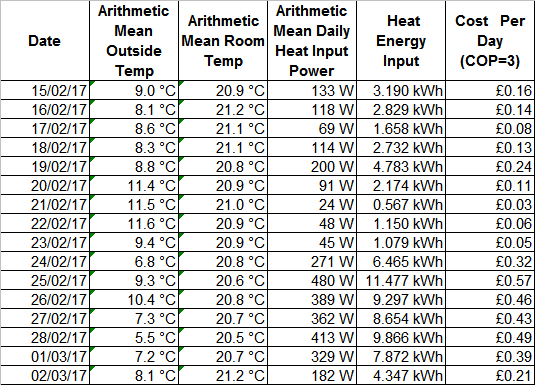
-
Modelling the "Chunk" Heating of a Passive Slab
Jeremy Harris replied to TerryE's topic in Boffin's Corner
I switched the loggers off yesterday, only really because the floor sensor was getting to be a bit of a nuisance (it was stuck to the floor surface, held down by a small bit of foam and sticky tape, and I kept nearly tripping over the thing). I've concatenated the two data sets, and both clocks were still within a few seconds of each other when I turned them off, so it's reasonable to assume that the 6 minute sample times are synchronised to within a few seconds of each other. The full data set is attached as a .txt file, but in reality it's a .xls Excel file, so just change the extension after downloading it. What's clear is that I wasn't noticing the ASHP fire up, as it seems to come on every morning for a couple of hours, and I thought it only came on every one or two days. What's also clear are my visits over to the new house in the afternoons; you can see the CO2 increase when I'm in the house quite clearly. The relative humidity is on the low side, but that may well be just because we're not living there yet; I'm splitting my time between working on our old house and clearing out stuff and going over to make sure the new house is OK. The ASHP flow temperature sensor is located very close to where the flow pipe enters the house, so is a pretty reliable indicator of when the ASHP is running. It's set to deliver 40 deg C, and when it turns off the temperature can take a fair time to get back close to room temperature, but the sharp drop when it turns off is reasonably clear when the data are plotted out. The slab temperature sensor is embedded on the North side of the slab, around 200 to 300mm away from the nearest UFH pipe and with the slab area from it's position to the edge of the slab unheated, as it's underneath units. As a consequence this sensor under-reads the core slab temperature, I really should have fitted it nearer the centre of the slab, but it's too late to change that now. I've been doing some playing with the data, as I think I can calculate the actual heat delivery into the house from the slab surface temperature to room temperature differential, using the standard UFH formula of P (W/m²) = 8.92 * (floor surface temp - room temp)^1.1 Logged Data Feb - Mar 2017.txt -
Not sure if this may help, but I've just remembered that the insulation under our slab isn't laid on sand blinding over the stone sub-base, but is laid on sharp grit. I suspect that ants may be less attracted to sharp grit than sand. The grit looks like the stuff our permeable pavers are laid on for the drive, and that hasn't yet attracted any ants, despite being pretty warm in summer.
-
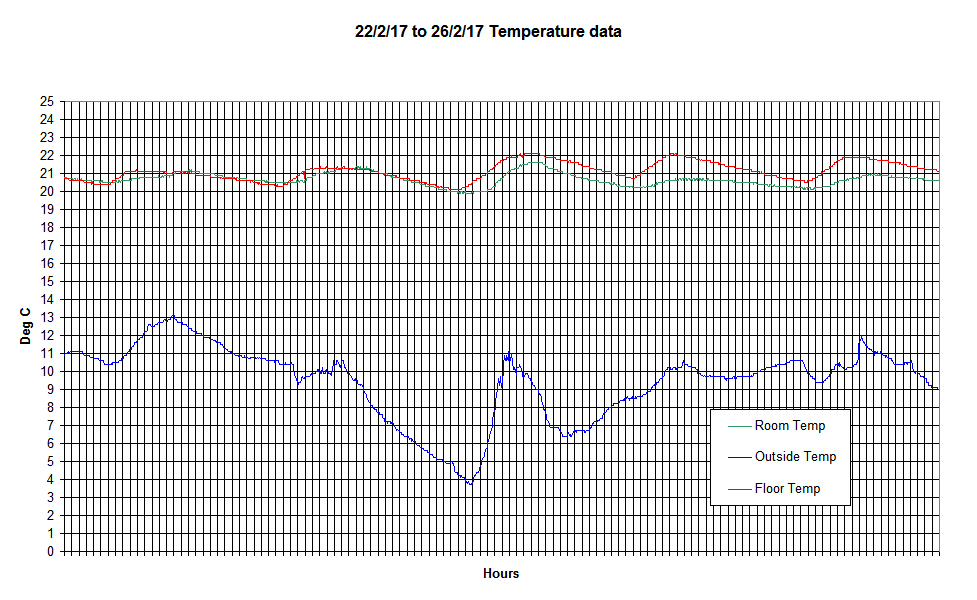
I think there's a great deal of over-thinking going on here! A heated slab like this in a highly energy efficient house simply will never get "hot" as such, it will get very, very slightly warmer than the room. We have travertine over a lot of our ground floor, through doorways etc as a continuous run. There is not even the slightest possibility that it will crack when laid on a steel reinforced slab like this, both because there's no significant temperature changes between the two elements and because the steel fabric in the concrete means that the structural slab can't crack (if it did it would cause problems, as it's load-bearing and supports the whole house). To illustrate this, this is a rough cut from some data collected over the last couple of weeks for the coldest four days we had. The slab surface temperature rearely gets more than 1 deg C above the room temperature, and most of the time stays well below that: The data above is a bit rough, I'm still tidying up the plot, but the horizontal scale is hours, starting at midnight 21/2/17 on the left and ending at midnight 26/2/17 on the right. The red line in the floor surface temperature (travertine) and the green line is the room air temperature. You can see when the UFH has come on for an hour or two from the small peaks; most of the time the UFH is off. We didn't get any really cold weather when I was doing this lot of monitoring, which is a nuisance, as I was hoping to get more data on the relationship between heat input and outside temperature. Anyway, you can see from this that the floor isn't going to get at all hot from the UFH, it will get far hotter from the sun shining on it in summer.