Jeremy Harris
-
Posts
26430 -
Joined
-
Last visited
-
Days Won
360
Everything posted by Jeremy Harris
-
Could be cost. The very cheapest sprinkler install for our (much smaller) house was going to add over £4k, plus the cost of additional back up power to keep the water pump going if the mains power was cut off. It was recommended by the fire officer, but even though I'd have liked to fit a system, the cost was just way too high.
-
Not sure if this helps, but the underside of the Kytun dry verge we fitted has a shallow drip bead that encourages water to run down the underside of the verge, rather than drip off. A smooth bit of lead sealant, to remove as much as possible of the lip at the joint, as @Onoff suggests, would almost certainly do as good a job. FWIW, we have a similar problem with rain drops dripping from the top of the French windows on to the allow cill. It makes a surprising loud noise inside the house, and I'm looking to see if I can find a way to stop it, too.
-

Renting an anemometer
Jeremy Harris replied to Jayobn's topic in Mechanical Ventilation with Heat Recovery (MVHR)
Mine is currently on loan, but you're welcome to be the next on the list to borrow it if you wish. @DH202020 has it at the moment, but it may be that he will have finished with it by the time you need to do some measurements. It's a Testo hot wire anemometer, fitted to a short duct that can be held over the terminals, one by one, like this: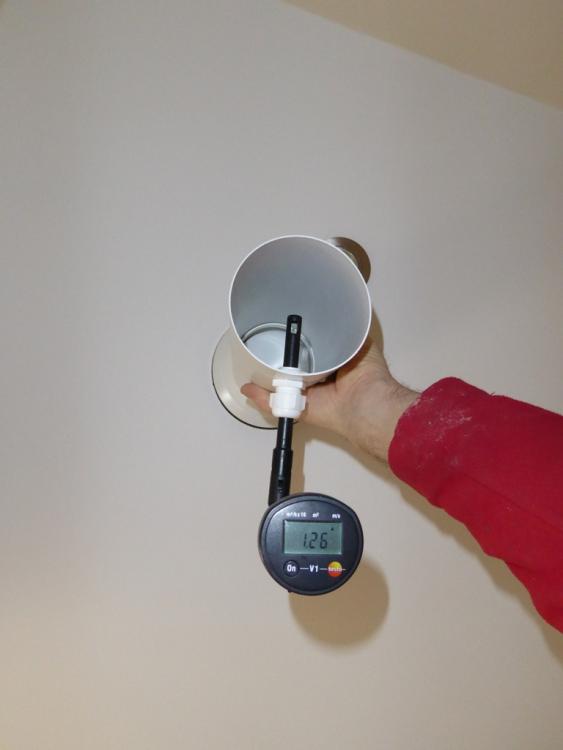
-
Dead easy to do, electrolysis is about as simple a process as you can get, and reasonably efficient. The snag is finding a way to store the hydrogen and, ideally, the oxygen, too. If you could store both and then feed them into a fuel cell you have a pretty efficient energy storage system. Dangerous as hell, mind................
-
DER/TER is a complete joke for our new build as it is. The system can't cope well with a house that has CO2 "emissions" of -0.9 tonnes per year................... (to put that into perspective, it's about the same, in CO2 terms, as having well over 40 mature trees on our plot, instead of the house. It would be physically impossibly to grow 40+ mature trees in the space available...................)
-
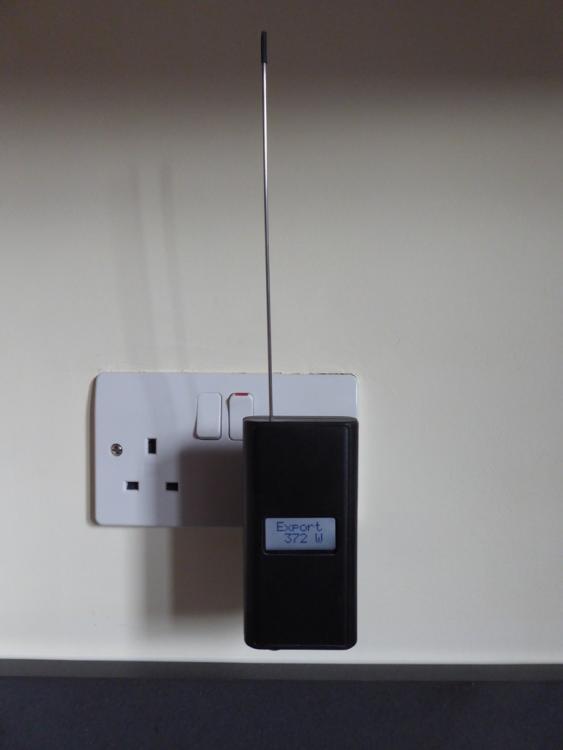
Interestingly, I've found that having an energy display that shows whether we're importing or exporting, and by how much, is all that's really needed to change behaviour a fair bit. Mine's a very simple home-made affair: but is plenty good enough to give as much info as you need. I tend to use it at the moment to decide when to charge the car (I could make this automatic, and probably will one day), but equally it's a good enough indicator as to whether to turn on the washing machine, etc. There's no real need for anything more complex, I think. If it were more complex then the chances are it would be more confusing for some.
-
My personal wish is that we had more investment in appropriate small scale energy storage. Lithium-based cells are a poor choice for this, but are being used because of the massive amount of money being spent on electric vehicles (where Lithium-based chemistry is a very good match to the requirement). Being able to actively peak-shave generation demand at a local level, would significantly reduce the peak generation requirement, and so allow events like "zero coal day" to become more frequent. Very often it seems to be peak generation requirements that shape how the grid operates, and being able to level out demand seems to me to be a very good thing, for a number of reasons. It takes stress off the distribution network, by reducing peak demand, it reduces the need for expensive (and dirty) short term grid stiffening generation (fields full of diesel generators) and would allow better generation planning for the slow to ramp up generation sources. It could well improve utilisation of renewables, too, by reducing, or removing the need to shut down wind turbines at times of excess generation capacity.
-
In terms of the chemistry and mechanical stuff, then yes, I'd say they could be DIY'able. The core technology isn't new, it's a basic zinc/bromine flow battery, with the energy stored in the deposited zinc plate on the anode. Redflow seem to have tweaked the chemistry to better control the zinc deposition process, but most of the work they have done seems to be in engineering the electrolyte tanks and pumps, together with the control systems.
-
I think you're right. I'm very seriously watching the development of Redflow battery storage systems right now. The technology is robust (very long cell lifetime, near-zero power loss over time, no reduction in capacity through life), but cost seems to be the main sticking point. They are cheaper than systems like the Tesla Powerwall, in terms of whole life cost, but seem to have the potential to come down in cost a great deal more as the technology matures and manufacturing capacity increases. It's a near-perfect technology for home energy storage, but not at all well matched to use in vehicles, something that I'm sure will slow development.
-
It's a good point, though, Ian. When we started drifting into the (interesting) discussion about creating a business in order to self-build, perhaps one of us (i.e me......) should have suggested breaking the discussion off to a fresh thread, both to keep things tidy and to aid anyone who comes along later trying to find that elusive little gem of information! I think it's reasonable to assume that CDM 2015 is a useful bit of legislation to know about, if only to understand that it will not apply to the majority of self-builders. It's taken a fair bit of research to reach that conclusion, and personally I'm not best pleased with the way that the Statutory Instrument has been worded, but there seems little we can do to prevent the powers-that-be writing poorly worded legislation. If you want a real challenge then try interpreting the two sets of parallel legislation that govern the legality of electrically assisted bicycles used on UK public throughfares - that really IS a minefield, as there are two parallel statutes, both of equal legal standing, and both with differing definitions................
-
The link that @Onoff has posted is exactly the same as the PDF I got from SSE when I applied to shift some cables underground.
-
I spotted this yesterday, too. It's quite impressive just how much has been achieved in such a relatively short period of time. I think one of the reasons is down to how quickly things like large PV arrays can be built. I watched one going in at a farm a couple of years ago and it was less than two months from starting work to the whole solar farm finished and generating. That's massively quicker than building a power station. If we can sort out a viable and economical storage solution, we could almost certainly get a heck of a lot more utilisation from the installed renewable generation capacity we have now. Our house switched from being a net importer to being a net exporter about a month ago; we're unlikely to be a net importer again until around October/November. If I could fit an affordable storage solution I reckon I could knock around two more months off the year when we're a net importer, and that's for a house that only has a PV array. Sadly, I could never, realistically, stop being a net importer during December and January, as the cost and size of that much storage capacity would be just too great.
-
Thanks Peter. So, the problem seems to be that you swap the advantage of being able to get the VAT back earlier for the possible penalty of having to pay capital gains tax and stamp duty. The latter I can recall being discussed before when this came up. The last option, of lending the business the money initially, then getting the house back as repayment at the end, seems possible. Most of the cost of our build was met from savings, so I could probably have arranged things this way had I known about it. Nice thought, but I'm a little too financially risk averse to try something like this! @Ferdinand Thanks very much for the comprehensive explanation. I think I may need to read it a few times to get things clear, though! Sorry for dragging things off-topic, but it seemed a very useful thing to explore, as I've not seen such a full and complete breakdown of the pros and cons of creating a business in order to build your own home before. As mentioned above, it's a topic that has come up from time to time, and has always been dismissed, I believe, hence my comment earlier in this thread where I mentioned that I thought it was too expensive an option. I was wrong, it may not be too expensive at all, but it does seem to require some detailed knowledge as to how to make such an arrangement tax and duty efficient.
-
Best ask @Construction Channel, he's our local "Essex girl" expert............
-
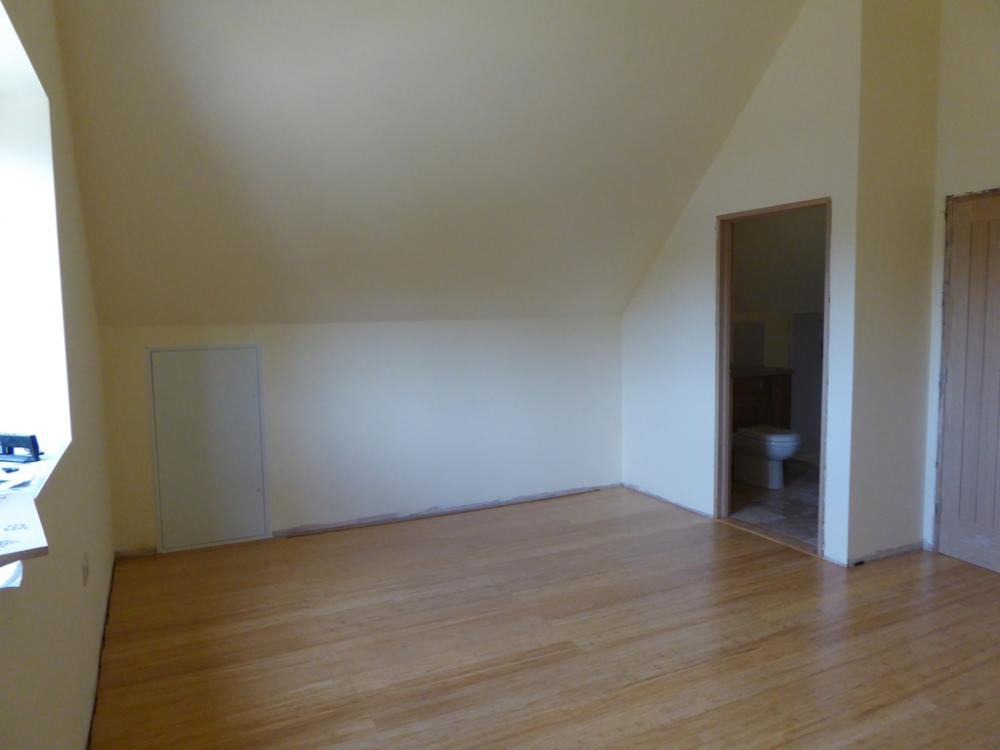
Here's what our (cheap) steel fire resistant doors look like: :
-
Yes they are short 15mm fittings, but the things work like a dream, far, far better than an immersion in the cylinder, We stayed in a cottage up in the Antrim Glens a few years ago, lovely place, miles from any other house, All the hot water came from a cylinder with a Willis heater sat in the bottom of the hot press. The really great thing about the Willis is that you get enough hot water to do the washing up after maybe five to ten minutes, as it always heats the very top of the tank first. I'd strongly recommend one, based on our couple of weeks of using one. As a side note, I just really love North Antrim, one of my favourite place in the UK.
-
Our space is around 1.4m high at the room wall, tapering to around 0.5m at the outside, and around 1.5m wide. Each space is around 4.5 m long. I fitted a full height access door at the end of each space, and it's easy enough to crawl down them. I found some cheap carpet runners and laid them along the space, to make it easier on the knees. We've standardised on open B&Q plastic storage crates (about a tenner for three) and they stack neatly and are a good size to move around. We can get around 8 or 9 of them in each eaves space, so around 30 in all, including part of the service access space, I think these crates are about 32 litres, so that's a bit short of 1000 litres of additional storage, plus there;s still room to get all our suitcases, rucksacks, climbing boots, ropes etc in there as well.
-
I think it's well worth thinking about fitting eaves storage space. I'm glad I took the trouble to put access doors into this space, as it's turned out to be quite a sizeable volume, and more importantly it's easy to access, so ideal for things like suitcases and Christmas decorations.
-
Being blessed with a slightly perverse mind, the image that an "Essex flange" conjures up is definitely not safe for this forum...........
-
Thanks again, and sorry to sound a bit dim, but I'm struggling to get my head around this a bit. So, a self builder cannot be a VAT registered sole trader, which rules out one option. Is there is another mechanism by which a self builder can be a business and so recover the VAT early? Even recovering VAT every quarter would be a very significant cash flow benefit; for example, many of our VAT reclaim invoices were incurred in the early stages of the build, where we used non-VAT registered businesses to do things like fix the exterior timber cladding, do the first and second fix electrical installation, do the plaster boarding and plastering, lay the stone flooring, doing the painting and decorating etc. For all these (plus the plumbing, heating and ventilation work I did myself) we had to buy all the materials for the trades involved, so that I could claim the VAT back after completion. At a guess this was over half the total VAT claim, probably in the first six months of the build. Being able to get that VAT back early could easily have knocked a year off our build time, which would have also saved is a fair bit in overheads on keeping two houses going at the same time. Sorry for all the questions, but in the past I'd just assumed that becoming a business for the purpose of optimising the VAT position for a self builder was a non-starter, and am now kicking myself a bit for not having looked at it in more depth.
-
@warby, thanks very much for this, it's something I'd always just put in the "too difficult" box. So, if a self builder wanted to set up a business just to build themselves a home, can they just set themselves up as a VAT registered sole trader (not sure that's the right term), and then put all the VAT they pay through their own books to reclaim it every month? Assuming that the self builder has no spare personal tax allowance (I'm being selfish here and assuming my own, retired, in receipt of a pension, circumstances) then does it matter if they make zero income from this business they have set up, for the duration of the build? I know that my mother ran her farm at a loss for several years when she was setting it up, and seem to remember that there was some sort of delay between the year of making a loss and the way tax was accounted for (sorry, I can't remember, or never knew, the details, as it was after I'd left home when she set the pig unit up). The ability to recover VAT early would be a massive benefit. We were out of pocket to the tune of around £12k for a couple of years, and towards the end that really did impact my progress, as I could only use my pension each month to try and finish the build, as we wanted to try and get as much VAT back as possible (we still ended up "losing" around £500 worth of VAT, on work we had done after we'd reclaimed the VAT, which we paid for from the VAT reclaim money!).
-
Building over a live cable supply
Jeremy Harris replied to lakelandfolk's topic in Electrics - Other
Provided the supply cable is at a safe depth (your DNO will let you know their preferred or mandated depths, they vary a bit from one region to another it seems) then there's no real problem. Our supply cable runs right under our slab, for example. The main issues are making sure the cable is protected during building work, and that the builder/ground worker understands the risks. Our ground work company had to uncover a fairly big (95mm2) three phase cable that feeds several houses further up the lane, and which ran right across our plot. They carefully dug it out and lifted it to the surface, until the DNO came along to re-lay it in ducts the ground works guys had laid around the edge of the site. It might be a good idea to think about relocating the meter and putting a duct in under the new extension for your supply cable. Not essential, but it would add a bit of future-proofing if there was ever a problem with that cable, and it would also mean that the cable under the new extension was yours, rather than the DNOs, which in itself could make life easier in future. -
I've only just seen this thread. Back on Ebuild, when my trusty old 140mm (?) Black and Decker circular saw burned out, just as I was finishing laying the bamboo flooring, someone there (who's probably here now) recommended the 165mm cordless Makita. I already had battery packs (all 3 Ah ones) and a charger, so I bought just the bare saw. I can say that it's the very best circular saw I've owned, light and easy to use, and powerful enough to do surprisingly heavy work. The two slight downsides are that it's cack-handed, with the larger bed to the right, rather than the left. Not a major issue, it has just taken a bit of getting used to, as all the other saws I've had have been the other way around. The other slight downside is that it is a bit heavy on batteries. Luckily I have five 3Ah packs, so pretty much always have a couple of charged spares. If I only had a single pack for the saw then I think it would be quite limiting. On the topic of ebay battery packs, I bought a pack of two non-Makita packs from a German seller, maybe the same one that @Crofter used. They have been every bit as good as the genuine Makita packs, for less than half the price.
-
I think a fair few here have opted to have the meter box in a remote location, with a separately switched and fused feed to the consumer unit in the house. My layout is detailed in a couple of blog posts, and may help. It's a bit more complex, as I have fed several external circuits from the externally mounted meter box, in addition to the main feed to the house consumer unit: http://www.mayfly.eu/2017/01/domestic-electrical-installation-earthing-and-circuit-protection-part-1/ http://www.mayfly.eu/2017/02/domestic-electrical-installation-earthing-and-circuit-protection-part-2/ These articles are a bit general, but include the way our system was wired.
-
As I replied earlier, I really don't recall all the ins and outs of the previous debates about setting up a business solely in order to build a principal private residence, so I'm not sure how to answer, and not surprised that I'm mistaken at all! @Temp knows more about this than I do, by far, and hope he may be able to shed some light on the pros and cons. @warby, Perhaps you could help us understand why there is an advantage in setting up a business in order to build a "principal private residence", in HMRC speak? It would help a lot, as I know the topic has been discussed before, and would also guess that very few self builders seem to choose this route. That may well be "fear of the unknown", in which case your experience could be very helpful. I know that I wouldn't have a clue as to how to go about setting myself up as a business; it's not something I've ever really thought about, to be honest.