Jeremy Harris
-
Posts
26430 -
Joined
-
Last visited
-
Days Won
360
Everything posted by Jeremy Harris
-

Hot water system for the garden room
Jeremy Harris replied to MikeSharp01's topic in General Plumbing
I think that one issue with just a single thermal cell would be the maximum power output. The heat exchanger in each cell can deliver something like 15 kW, I think. The two cells in a Sunamp PV are in parallel, so the max power is around 30 kW, around the same as many combi boilers. 15 kW is certainly better than an electric shower, though, by a fair margin, and there's enough energy stored in a single cell for one modest shower. The downside would really be cost, as a single cell Sunamp PV would still have much of the same internal hardware as the standard two cell version. My guess is that a single cell unit may well be around 80% of the cost of a standard 2 cell unit, even if Sunamp could be persuaded to make one. -
I have both a hot knife and a hot wire cutter, both home made. Not that hard to make, and there are bound to be some tutorials around on the web, as lots of people use them. I use mine for cutting and carving XPS, when making lost foam composite parts, but EPS cuts just as easily as XPS. It might be worth checking what the foam is in the SIPS, though, as some use PUR foam, and it would be pretty hazardous to try and hot wire cut that, as heating it gives off very toxic fumes.
-
Bear in mind that a room source heat pump water heater like that will only be running for around 2 to 4 hours a day, and as soon as the tank is up to temperature it will turn off. It may be that this is enough to cool a well-insulated cool room down, but that cool room will need to be lined with a material that has a high heat capacity, so that when cooled it can stay cool for the many hours between being actively cooled.
-
Hot water system for the garden room
Jeremy Harris replied to MikeSharp01's topic in General Plumbing
You run into supply capacity problems then. Two of the 9.6 kW models can be used in series, as they accept a warm water input, but the current required would be around 83A or so. Apart from needing a large cable, most domestic supplies are fused at 100A; some are fused at 80A, or even occasionally 60A, so there would be little headroom for any other consumption. -
Sorry, I forgot to welcome you over here! We created this forum just over a year ago, when Ebuild fell over, and we tried to find as many of the old members as we could; pity we didn't manage to find you sooner!
-
Hot water system for the garden room
Jeremy Harris replied to MikeSharp01's topic in General Plumbing
At full chat the Steibel Eltron DHC-E (9.6 kW model) can raise the temperature by just under 14 deg C at 10 l/m. At 5 l/m it can raise the temperature by double this figure, so a bit under 28 deg C. This is the uplift above the incoming feed water temperature. I'm using an acceptable minimum preheat temperature of 29 deg C to ensure that we have hot water that's a bit over 42 deg C at 10 l/m; our shower flow rate is a bit under 10 l/m. -
From my reading of the regs, there's no requirement for a bathroom downstairs (in England and Wales), just an "entrance level WC". Scotland is different, in that I believe they require that there be sufficient provision to allow at least a shower to be fitted on the entrance level, in addition to a WC. Even then, I'm pretty sure you don't actually have to fit it, just allow space for one to be retrofitted. Both of these regs apply to new builds, and generally things are more relaxed when it comes to renovation work. I'm near 100% certain that removing the downstairs WC would be fine.
-
Lifting and Lowering (useful "rule of thumb")
Jeremy Harris replied to B52s's topic in Project & Site Management
Guidance is great, it informs and educates, and with luck may well be followed. Sadly regulation is not so good, as there are just far too many situations where a job would never get done if the regulations were followed to the letter. There's also a massive variation between one person and another in terms of what is safe to lift. One chap I've used a fair bit to do a lot of the landscaping can lift 900 x 600 sandstone slabs all day without breaking sweat - I struggle to move half a dozen before I'm knackered! I worked alone on a lot of stuff, and had no choice but to shift things like a 60kg shower tray, or the 70kg MVHR, and similar mass Sunamp PV, up to the first floor on my own. I did devise ways to do this relatively safely, with a block and tackle for the MVHR, and slings to help shift the other stuff. H&S&W didn't apply, as it was me working on our own house, but it's interesting that the obviously risky stuff, like lifting heavy stuff, hasn't been the cause of any minor injuries. Those have come from seemingly safe looking jobs, where I didn't think through how to tackle them properly beforehand. I ended up with a persistent wrist injury from moving planks of left over larch, for example. None were very heavy, but the twisting motion when shifting the pile from one side of the drive to the other managed to cause an injury to a tendon that took months to heal properly. -
I just cable tied the duct to the posijoist webs, and used 200mm of rockwool as acoustic insulation. We don't have any detectable noise from either the MVHR or transmitted through the ducting.
-
For comparison, our whole house heating requirement, including the heat gain allowance from appliances and occupants, works out to be about 7W/m² for the same conditions, with the bedroom heating requirements being significantly lower than this (so low that we don't have bedroom heating at all, as the occupants provide more than enough heating).
-
500W for a single room seems massive, even for a house that barely meets building regs heat loss requirements. Are you sure that the heat loss calcs are accurate? As an example our entire 130m2 house only needs around that much heat in cool weather, perhaps double that in really cold weather.
-
Moving from Outlook 2003 to Thunderbird
Jeremy Harris replied to Triassic's topic in Boffin's Corner
One way is to fit a UPS, but it's not that efficient, as the battery voltage from the internal UPS battery is converted up to mains voltage, and the NAS power supply then converts that back down to a DC voltage that's probably close to the battery voltage. What I've done is build a battery-backed DC power supply, that supplies the modem, router, switch and a small file server. I'm using a 12V DC power supply, adjusted to run at 13.4V, connected directly to a 12V 100Ah battery, that was bought second hand; it came from a server farm back up supply, and they get changed every couple of years just to be certain they will still have full capacity. I tested mine and it still seems to be close to 100Ah, and being a sealed gel type battery it's OK indoors. The DC from the battery is fed, via a latching relay*** to some switched mode DC-DC voltage regulators. I have a couple of 5V, 5A ones, plus a couple of 12V boost/buck ones. These give me two 5V supplies and two 12V supplies, that are then fed directly to the bits of kit needed to keep the network and internet connection up during a power cut. *** The latching relay is driven by a small power monitor circuit, that disconnects the battery when it's voltage drops below about 11.5V. This is to protect the battery from over-discharge. In practice, the battery will run the entire system for around two days, which I think is enough for an emergency backup. -
So, what would you do differently next time?
Jeremy Harris replied to Kuro507's topic in General Self Build & DIY Discussion
Spot on. Our experience has been the same, that there are a lot of people around calling themselves tradesmen who have little or no proper training in their trade. Sadly, many of these have bits of paper that proclaim that they are qualified in some way, but it seems that often these bits of paper are meaningless. We were lucky to find some really good people, but that was pure luck in the main. Most of them were the result of personal recommendation from another very good tradesperson, so if you can get just one good person onboard then you have an in to a pool of potentially good people. We found that good people didn't recommend people that had lower standards than their own, as a general rule. -
If it were me than I think I'd just fit thermostatic radiator valves. Simple, cheap and effective.
-
Overheating
Jeremy Harris replied to Stones's topic in Energy Efficient & Sustainable Design Concepts
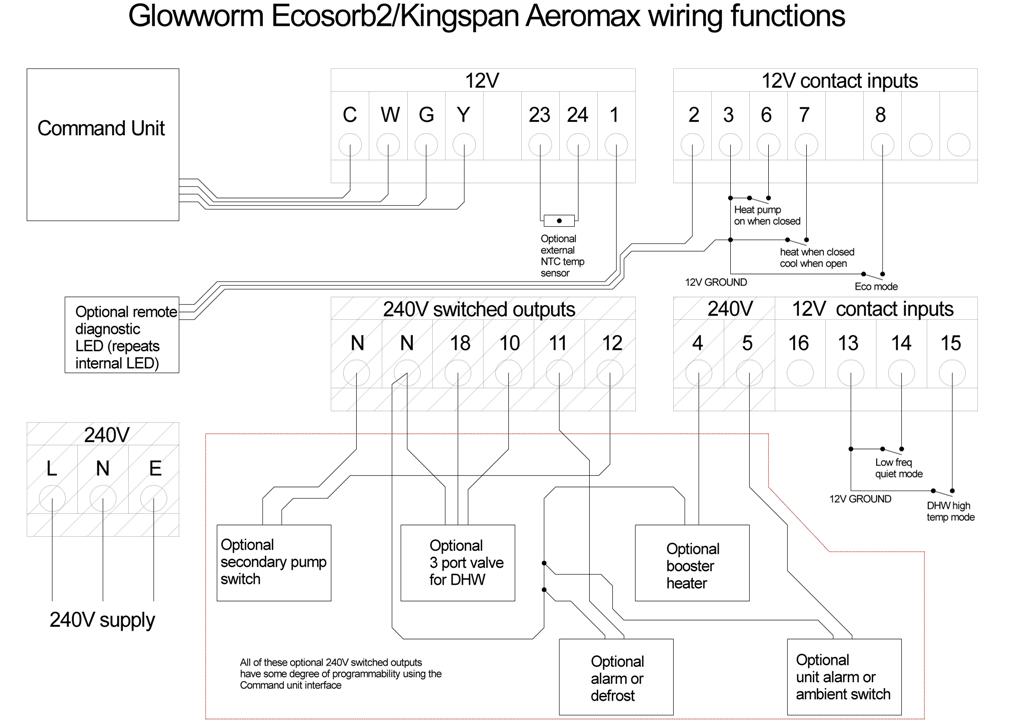
Attached is the wiring diagram I drew up for our 7kW Glowworm, which is really a re-badged Carrier, and that was also sold here as the Kingspan Aeromax. Control is via dry 12V contacts accessed from a terminal strip inside the unit. Adding remote switch/relay contacts as shown activates the various functions. This diagram also shows the optional switched mains outlets are available, to control motorised valves, pumps etc. I ran a multicore control cable out to the unit, together with the mains power cable, with a small box with some relays to activate the various functions.
-
Overheating
Jeremy Harris replied to Stones's topic in Energy Efficient & Sustainable Design Concepts
We know that all the Carrier models can, which is Carrier, Kingspan, Glowworm and a few others, plus all the Panasonic models will, as well. I'm sure that the Samsung will, but the key will be finding data from outside the UK, as, because of the RHI, manufacturers are not exactly forthcoming with regard to the full capabilities of models they sell as heating systems. Often the heating system models will use the same control systems as the air con models (they almost certainly use the same core heat pump), so there may be a way to identify how to run cooling mode by looking at similar spec air con units. -
Overheating
Jeremy Harris replied to Stones's topic in Energy Efficient & Sustainable Design Concepts
They will all cool and heat, as they have to switch to cooling mode in order to defrost when in heating mode. The key is finding out how to enable cooling, as the manufacturers keep quiet about it, as any ASHP that can run in cooling mode isn't eligible for RHI payments. -
Overheating
Jeremy Harris replied to Stones's topic in Energy Efficient & Sustainable Design Concepts
Dave, you probable have the perfect demonstration of the massive importance of decrement delay, with your mobile home that has a very low decrement delay, and your new build with a pretty long decrement delay. I'm personally very convinced that having a high decrement delay results in a far more comfortable home. I suspect that gradually this will filter down and become common knowledge. -
I have a feeling that distributed generation can cause the grid frequency to do some odd things, as most grid tie inverters use frequency as an indicator of load, I believe. I would hazard a guess that having significant power inputs, from generators that have virtually no "flywheel effect" might cause the grid frequency to do some unusual things, as might the impact of HVDC distribution, with local AC conversion. Not sure about any of this, but I recall reading an article some time ago that suggested that grid frequency stability might be impacted by lots of small scale generators.
-
A final update. I faffed around for hours trying to get TOR to run on the Pi Zero W, as an Onion router, to no avail. I can still use the Pi Zero W as an access point for the IP camera subnet, and it works well doing that, and doing this reduces the amount of wireless traffic on the main wireless router, which is running on a different subnet. I'll probably get around to writing up how I've used some cheap Chinese outdoor IP cameras, to connect to this subnet, and then to a Raspberry Pi 3 CCTV server, running MotioneyeOS, at some point. Suffice to say that it works well in this role, and significantly extends the outdoor WiFi range. To resolve the desire to run TOR on a router, I discovered that the OpenWrt team had ported a version that runs on a very cheap and small, mini-router, the WT3020 series. I bought a WT3020F, which has both a LAN and WAN Ethernet port, plus WiFi and a USB storage port, for less than £15 delivered, from Banggood: https://www.banggood.com/NEXX-WT3020F-300Mbps-Portable-Mini-Wireless-WIFI-NAS-Router-AP-Reapeater-Support-USB-Flash-Drive-p-1108743.html The mini-router arrived this morning (took around two weeks to get here) and I set about connecting to it (it has a firmware coded back door that you can Telnet into) and installing first OpenWrt, then installing OnionWRT. After around 10 minutes or so I had a working TOR router, that I can connect to via a separate wireless subnet, and that routes all traffic via the TOR network. It's pretty secure, but is only as private as you make it, as unless used with care your identity can still be leaked. Having said that, TOR can be pretty private if used carefully, and it's certainly a heck of a lot more secure than normal web use. The WT3020 is believed to be free from any hard-coded backdoors, and a quick look that I did with a packet sniffer (Wireshark) shows there's no obvious unusual traffic, so I think it's probably safe enough. I'm sure that if there was an issue with these then some of those that have been hacking them would have spotted it by now. I've written up some instructions as a text file (so the commands should be easy to cut and paste into a Telnet terminal), that illustrate, step by step what I did to get this working. Nothing I've done was my own work; all I've done is filter some of the out of date information on hacking these mini-routers and use some up to date links (there are a lot of dead links and out of date information around for these things, I found) . WT3020F TOR mini router.txt
-
Overheating
Jeremy Harris replied to Stones's topic in Energy Efficient & Sustainable Design Concepts
It depends which film you choose as to how noticeable it is. The film we have on the front gable glazing is deliberately noticeable, as we wanted to add some privacy as well, so opted for a stainless steel like finish, that turns that glazing into a dull mirror from outside. The bedroom window glazing film is a barely detectable film, that most people wouldn't notice unless it was pointed out to them. @PeterStarck has had the same almost clear film fitted to some of his glazing, I believe, so may be able to give another opinion. Our experience is that the almost clear film is as effective at blocking excess solar gain as the visibly reflective stuff, but it is a fair bit more expensive. There is some more detail in these threads: -
Overheating
Jeremy Harris replied to Stones's topic in Energy Efficient & Sustainable Design Concepts
Generally, we've had outside air temperatures that have been far warmer than the desired room temperature for much of the day over the past week, it's only after the sun goes down that the outside air temperature has been lower than the desired room temperature. Opening the windows during the day just makes the house warmer, as the MVHR will act to cool incoming warm air early in the day, because the heat exchanger is bidirectional. What happens is that when the exhaust air from the house is cooler than the incoming fresh air, the incoming fresh air is cooled a bit, so the air delivered to the house will be slightly cooler than the outside air. This is only a relatively short duration effect, as soon as the house warms up there will be little cooling. At night, when the air outside is cooler, then it makes sense to switch the MVHR to bypass, to night purge the house with cooler air, or perhaps open windows to achieve a similar effect. As soon as the outside air temperature increases to be greater than the desired room temperature then the bypass needs to be closed, and windows closed as well. Failure to do this will just result in warmer air being brought into the house, heating it up. Adding active cooling to the MVHR, either by using a unit like ours with a built in air to air heatpump, or by fitting a chilled water duct cooler, has a modest impact. It isn't enough to cool the house when it's already far too hot, but is is able to maintain a reasonable (around 21 to 22 deg C) temperature if the solar gain is limited, and if we don't open the windows or doors for any length of time. I did leave the front door open earlier this week, because I was going in and out a lot, and that pushed the house up towards 23 deg C, from the hot air that came in from outside. It was noticeable that the MVHR, in active cooling mode, wasn't able to reduce the temperature then, it just stopped it from getting any warmer. At a guess I'd say the outside temperature was around 26 deg C at the time. The heat reflective window film has to go on the outside, so that it reflects long wavelength IR before it can get in and heat up the inner glazing pane. We have a 3M film fitted, which is extremely effective, the inner pane of the glazing that has it barely gets above room temperature, even in bright sunshine. Before the film was fitted the inner pane would reach 35 deg C or so on sunny days, so contributing a fair bit to the slight overheating problem we used to have. -
Overheating
Jeremy Harris replied to Stones's topic in Energy Efficient & Sustainable Design Concepts
My experience has been that running the UFH/C pump to just recirculate water around works pretty well, in terms of moving heat from warmer areas to cooler areas. The rooms to the North of our house get virtually no solar gain, so it's useful to shift heat from warmer areas to cooler areas. This doesn't make a massive difference during prolonged spells of warm weather, the main benefit seems to be in maintaining an even temperature during periods when the outside temperature varies a lot. Actively cooling the floor with the ASHP is very effective, surprisingly so, given that heat rises. It's more effective at keeping the house cool than the active MVHR unit we have, and is quieter, too. It never seems to use close to the full capacity of the ASHP, either, that seems to draw around 400 to 600W when it's in cooling mode, and it's only ever in cooling mode on warm days, when the chances are that the PV system is generating a lot more power than this, making the cooling system running costs near zero. -
Interesting to see that coal is generating practically nothing and that CCGT is doing the load balancing, ramping up and down pretty rapidly to meet the changing demand as solar and wind kicks in. Looks like three near-perfect solar days, too.
-
The negative pricing was something that was predicted as a possibility when the open wholesale generation market was created. As I understand it, the price paid to generators varies a great deal, hour by hour, as demand changes. It's a classic supply and demand model, but taken to a pretty fine degree, so generators that can't reduce capacity quickly (as in a few tens of minutes) get penalised because the wholesale price just plummets. I'm not convinced that such a volatile market is a particularly good way to ensure that there is a robust supply, but it may be OK. There's enough money to be made during high demand, low generation capacity, periods that generation companies can afford to have fields full of standby diesel generators sat idle, to be turned on only when the price makes it profitable to run them.