Jeremy Harris
-
Posts
26430 -
Joined
-
Last visited
-
Days Won
360
Everything posted by Jeremy Harris
-
I'm interested in a workable solution for this problem, too. We have a stream along the front of the house and a lake just behind the hedge opposite, and bugs fly in the moment a door is opened, let alone a window. For some reason the bugs all end up in the bedrooms upstairs, where they die on the window cills................ We also have lots of cluster flies, and at certain times of the year hordes of them will fly in when any door is opened, even for just a few minutes. I'm in the habit of always quickly closing doors when I go in an out to try and minimise the problem. It's a bit like a house we had years ago that was next to a farm, and where we had cattle grazing right up to our garden fence. That house was similarly full of flies in summer. We were in a cafe recently that had some aluminium chains dangling down like a curtain across the door, and they seemed pretty effective, but didn't look that great. MVHR pre-filtering is a good idea. The intake filter box on ours is always full of flies, every time I change the filter I have to clean it out, although very few end up on the filter itself; it seems they die and just drop to the bottom of the box that the filter slides into.
-
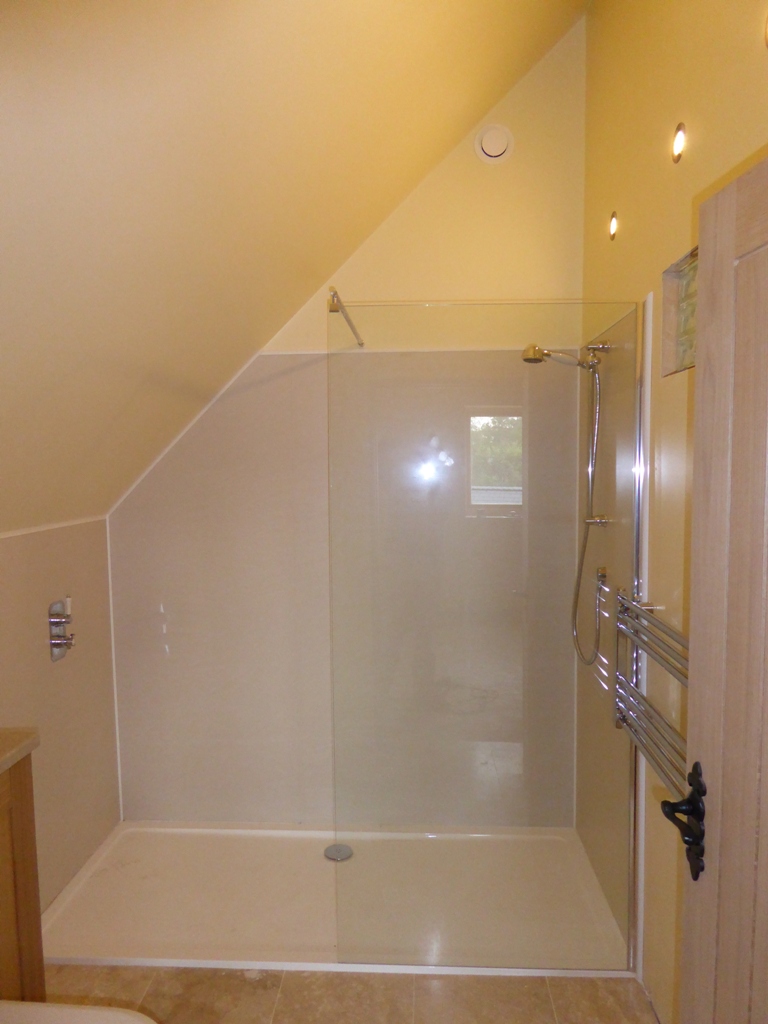
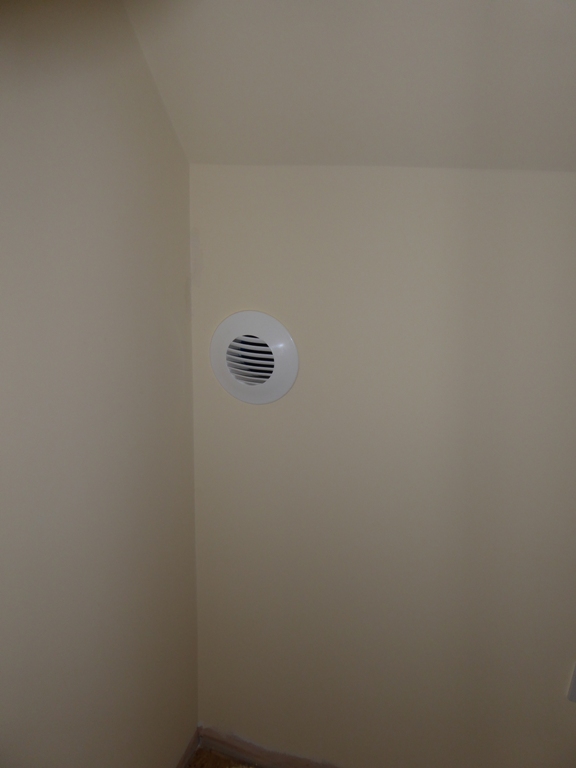
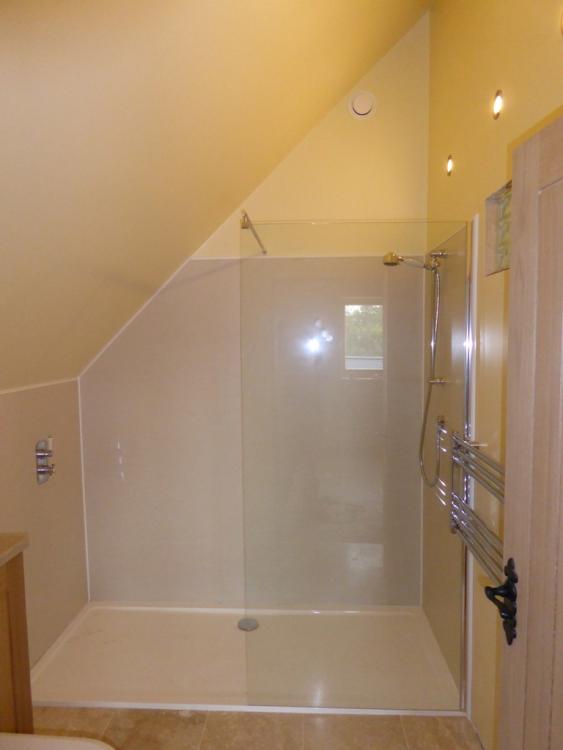
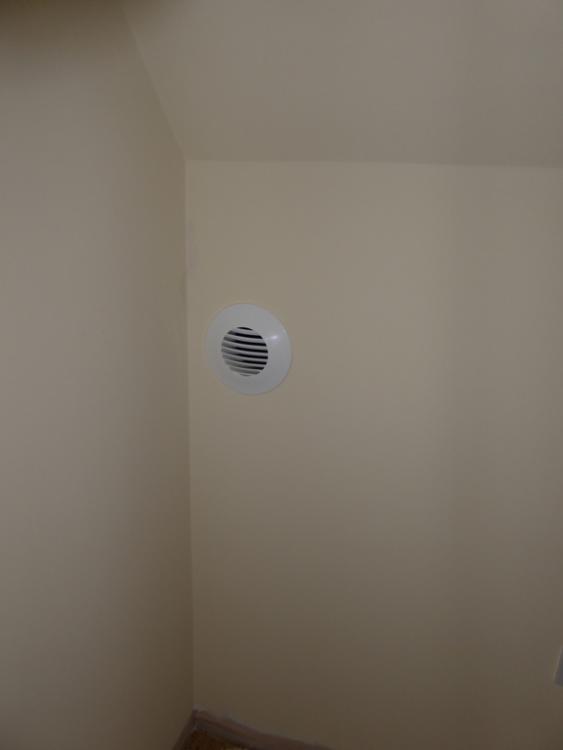
We have vaulted ceilings in the bedrooms and just fitted the fresh air feed terminals in the low walls at either side, with directional vanes to blow air upwards: Others have fitted the terminals in the floor with good results, I believe. The majority of the effect of MVHR is by diffusion, not active air flow, so it doesn't really matter too much where fresh air feed terminals are placed. It does matter where extract ducts are placed, though, these need to be as high as you can get them. In our case, this was relatively easy in the vaulted sections, as there were dividing walls where ducts could run to high level terminals, like this extract terminal in the very top corner of our shower room:
-
FWIW, I run our UFH with a flow temperature of around 25 tp 26 deg C, binned the weather compensation because it was a waste of time and did nothing useful and I run the ASHP at a constant 40 deg C in order to get best efficiency (long story told elsewhere here, but I experimented a lot and found a massive variation in COP due to defrost cycling). If we had gas I'd have used it, as it would be cheaper and simpler, would give us a good hot water solution, plus would probably cost less to run than an ASHP. Heat pumps are really for those who don't have access to mains gas, in my view. The cost premium for an MCS install in order to claim the RHI for 7 years is daft - for us we would have paid around an extra £2k in order to save around £80 a year for 7 years, barking mad, really. The floor surface is typically a heck of a lot cooler than with a conventional, high heat loss, house fitted with UFH. Typically our slab surface will never be more than about 2 deg C above room temperature in extremely cold weather, and most of the time it will be a lot lower than this. Because of the very low overall heating demand (typically we need around 500 to 600 W for the whole house in cold weather), zoning becomes pointless, mainly because so much heat flows around the house through open doors and natural convection. One thing I found wasn't needed at all was complex heating controls. I started off going down that route, with a control system that took account of the floor temperature, room temperature, outside air temperature, flow temperature and return temperature. I spent months trying to fine tune this, then binned it and fitted a sensitive (0.1 deg C hysteresis) wall thermostat in the hall and a simple time switch to turn the heating system on in the morning and off in the evening. The simple system works brilliantly well, and was cheap - less than £100 all in for controls. I've just discovered that I can probably bin the thermostatic mixer valve, too, as I've recently fitted a Salus actuator (around £15) to replace the slow thermal actuator that used to turn the UFH on and off with one that maintains a constant 6 deg C or so temperature difference across the flow and return, and that happens to be very close to perfect in terms of keeping our UFH temperatures about right. @Nickfromwales put me on to them, in this thread:
-
We're on clay. too, also with an MBC passive slab, so there are ways around laying a slab on clay and no need to go for the thermal inefficiency of a suspended floor (poorer because the space under the floor can be a lot colder than the ground temperature in very cold weather - so greater heat loss).
-

Do Not Appeal (sometimes); apply for a Variation on a Planning Condition
Jeremy Harris commented on Ferdinand's blog entry in God is in the Details
This is a useful point, and one that came close to causing me pain and grief. I was very lucky, in that our planning officer wrote the Decision Notice (it didn't go to committee in the end) a few days before Christmas, but the senior planning officer who had to sign it off was on holiday and wouldn't be back for two weeks. This would have meant that their target for dealing with the application would have been missed, so the planning officer emailed me an unofficial copy of the Decision Notice, assuring me that he'd spoken with his boss before he went on leave and that there would be no problem with it just being signed and released. The unofficial copy of the Decision Notice had clearly been edited from one of the many previous Decision Notices for this site, and still contained a condition removing PD rights. I couldn't see how the reasons stated for this still applied, as they were based on the developed footprint area of the site, something we had significantly reduced by reducing the house footprint by around 20% (and making it 1 1/2 storey) and getting rid of a very large secure motorhome parking area. I rang the planning officer, explained that I didn't think it was fair to leave the removal of PD rights condition in and he agreed and removed it. Had we not had the good fortune of the Christmas holiday being in the way, plus the senior planning officer being away on holiday, we would never have seen this condition until the Decision Notice had been signed and issued. By then we would have had to do as you did, and apply retrospectively to have the condition removed. It's only pure luck, and the thoughtfulness of the planning officer, who felt we would like to know the outcome of our application before Christmas, that gave us warning of this condition. Most would be completely unaware of such a think, as you were with yours. Perhaps there should be a change to the process, so that the draft Decision Notice is released to the applicant before it is signed off. It seems clear that they don't write these things from scratch, but just cut and paste them together (at least our local authority seem to). As a consequence, it seems fairly common to have conditions that are either no really valid, or that are contradictory. One I didn't spot until after we'd built the house and were putting in the drive was that the conditions from the highways department on the drive gradient was incompatible with the condition from the Environment Agency on the finished drive level. The planners just blithely cut and pasted the text from these consultees into the Decision Notice without looking at the site plan at all...........................- 2 comments
-
- 2
-

-

-
- planning variation
- planning application
- (and 4 more)
-
He was an RAF corporal who worked for me, as a torpedo armourer. At the time I was his acting Divisional Officer, as the RN Lt post was gapped for a few months. He was caught at the gate and I was called back in. I spoke to him and he said he'd been down to Porthkerris OP, doing routine maintenance that day and had used his own car. I suggested that the WD 40 could possibly have have fallen out of his tool kit. He agreed and gave a statement to the NP and was released. I gave a statement saying that I'd authorised his trip down to Porthkerris and agreed with his explanation. Early the next morning, the NP called me in, saying that the corporal had admitted theft and that he'd made up the story about going to Porthkerris OP, making me look like a prat. I wasn't charged, but had my car searched every day for months, just because they knew full well I'd been trying to help the corporal out. The funny thing was that the corporal was posted to Belize as punishment, yet he was a very keen scuba diver, so it was a brilliant posting for him...............
-
Reminds me of the way I paid for our honeymoon. Driving past the scrap compound, I spotted a used Mk44 torpedo battery (from a trials weapon - fired with and exercise head, rather than a warhead). I knew that these batteries were based on magnesium and silver chloride, so went and asked if I could buy it, at scrap value. After much looking at it (they are a real mess after being used, from internal corrosion) the accounts people concluded that, as long as I cleaned up all traces of it they would give me a property pass to take it out the gate at no charge. I spent hours stripping apart hundreds of alternating very corroded magnesium plates from soft and crumb silver chloride plates. I then put all the silver chloride plates in a crucible, added some washing soda and heated the whole lot up on a bodged up charcoal hearth. This extracted all the raw silver, which I then sold to a precious metals scrap dealer in the Forest of Dean for around £800. In 1986, this pretty much paid for our whole honeymoon, touring the West Coast of Ireland............. The left over bin bag full of magnesium plates went into the base of the local bonfire on fireworks night. It was pretty impressive, apart from the fumes that hit those downwind..........
-
Cleaning out solvent based adhesive will cost more than the container, for sure. First you have to identify the adhesive, then find a suitable solvent, then clean and rinse out the container with tens of litres of solvent, then you have to safely dispose of the washings....................
-
I'm pretty sure that the Farnborough arrangement was really intended for firewood, too. As an aside, I collect my UKAEA pension later this week................
-
Same here. There was a standing arrangement at Farnborough that anyone could take home wood from an area outside the main stores on the last Friday of every month, with the only limitation being that it had to be able to be fitted in, or on, your car. You were given a property pass to allow you to take the stuff out through the main gate, if challenged.
-
If so, then that is completely and absolutely barking mad, in fact it's insanity personified. How on earth can ANY self build be constrained by a crap foundation that comes as a part of the plot? It's nuts, and makes no sense whatsoever. If a vendor tried to impose such an unworkable, expensive and ludicrous condition of sale on any plot I was interested in I'd just walk away, as it would mean making far too many compromises and inevitably result in poor thermal performance.
-
Also, you still have the foundations and frame separately costed. Bear in mind that, if going for an MBC frame it will include a passive slab foundation (and usually UFH pipes).
-
There seems to be an endemic problem with some UK contractors, where they consider that leaving problems for the next trade on site is completely normal. Every trade seems to have stories of others having caused them a load of hassle, yet nothing much changes. Another area where we could have had problems was the positioning of all the electrical fittings. I made sure that all the metal back boxes were fitted so that they protruded around 5mm or so into the plasterboard. There were two reasons for this, one was that you're not supposed to have a gap between the back box edge and the rear face of the plasterboard (something that's widely ignored) and the second was that it meant that the plasterers could put a board in position, bash it where the back box was and it would leave an indent in the back of the plasterboard, marking where they had to make the cut out. That way we ended up with fairly neat cutouts, with no need to fill gaps around badly cut out holes. All it takes is a bit of planning and forethought to get this stuff right. Another example is the order of doing things. Waste pipe runs are pretty fixed, and can't easily be relocated. MVHR semi-rigid duct has slightly more placement flexibility, as does water pipe work. Electrical cabling generally has the most positioning flexibility, so can generally work around everything else. Organise and plan things in the right order and there is least hassle for each trade that works on site. Do things in the wrong order and it just makes everyone's job more difficult.
-
When I did the drawings for the duct and pipe placements where they were going to come up through the MBC slab, my ground works bloke thought I was nuts, I'm sure. I specified a fixed reference (a steel peg we'd put in the corner of the plot, that was easily accessed and had been very accurately surveyed using a Total Station) and then gave offsets from this for the pipe and duct positions. On the drawing I put a tolerance of +50mm -20mm on the critical vertical pipe locations, and the ground works chap thought I was going completely OTT, and that they would normally stick them within about a foot of where they thought they should go. On the last day they were there, when all the pipes and ducts were poking up out of the ground, I insisted that we measured the locations of all of them to check they were in the right place. One was out by around 30mm, and they were not happy at me getting it moved.............
-
If there's going to be a scratch coat and skim, then that should ensure pretty good airtightness. The internal parge coat method is really for making the inside face of a wall that's going to be dry lined airtight.
-
Best way to remove or cover artex
Jeremy Harris replied to Jml's topic in General Construction Issues
That was my conclusion. I resisted the idea of taking the ceiling down for ages, had a couple of goes at getting the artex off, then realised that taking the whole ceiling down was going to be a great deal quicker. -
What's the internal finish going to be? Parge coating works inside OK, and also works on the outside face if there is going to be a cavity.
-
I found that the waste fitting in the basin for one of ours was a lot longer than it needed to be, and poked down so far as to take up space from the shelf in the unit. My fix was to stick the chrome-plated threaded bit in the lathe (with some masking tape to protect the finish) and turn off about an inch of excess. This worked well, and lifted the trap up so that it's almost tucked up under the unit fascia panel. It may be that they make waste fittings in different lengths for just this reason - ours came supplied with the basin, so I didn't think to have a look around.
-
Best way to remove or cover artex
Jeremy Harris replied to Jml's topic in General Construction Issues
Not for us, there is a plaster and plasterboard skip at the local recycling centre, plus when we were building the new house the skip people were fine with plasterboard, as long as we kept it separate in the skip from the other waste (we used a bit of scrap plasterboard to make a barrier in the skip so all the plasterboard waste went in one end). -
Best way to remove or cover artex
Jeremy Harris replied to Jml's topic in General Construction Issues
Yes, with care. Don't try and break or saw the boards if you can help it. our ceiling had a few popped nails, and I was able to get a Stanley knife in around the very edge and cut the board, then lever a bit away. Once I had a hole, then getting in behind the board and levering the board away from the joists where it was nailed was pretty easy. A fair few of the nails pulled through the plasterboard, but in the main it all stayed pretty much intact as it came down. The biggest job was cleaning up the mess. I did take the precaution of spraying the ceiling to wet it, using water and a spray bottle, in the hope that this would keep the dust down. I also wore a Tyvek suit, gloves and a respirator, but 99% of the dust came from the crap in the ceiling void, not the plasterboard. -
Best way to remove or cover artex
Jeremy Harris replied to Jml's topic in General Construction Issues
Not a lot of Artex that's still around will have asbestos in it, plus, as long as you don't try and sand it off then the risk is pretty low. Any "wet" method, like steaming, will be pretty safe, but if it's well-bonded on then frankly it may cheaper, quicker and easier to just replace the ceiling, if the area's not too large. Our old bathroom ceiling was artexed, not in swirls, more like dimples, and the stuff was very well adhered to the underlying plasterboard. As the ceilings in that house were just boarded, taped and filled, I opted to just rip the ceiling down, take the opportunity to add some insulation under a part of it that extended under a small flat roof and re-board it. All told it was about half an hour of making a bloody awful mess, plus cleaning up, then maybe two hours to put new plasterboard up and tape and fill the joints. After that it was just a matter of decorating from a new surface, which was a doddle, even for me, who hates painting with a passion. -
Worth remembering that the Royal Navy, and all the commercial sailing vessels that enabled the British Empire to establish, relied on hemp for years, both for all the ropes and for caulking their ships to keep them watertight. At one time there was a pretty massive hemp growing industry, supplying a wide range of hemp fibre for a wide range of purposes. When I was a teenager you could still just buy large bags of hemp seed. It was amazing just how much interest there was in "biology projects" back then. I well remember germinating the plants in the airing cupboard, with my mother's blessing, then planting them out in pots on the balcony outside my bedroom window. By mid-summer there was a veritable forest of the stuff growing out there, with not the slightest suspicion from my mother than anything was not as it should be...............
-
It was certainly an experience! The worst part (apart from two runs of units that simply would never have fitted the space available, and didn't conform to their drawings at all) was the island. This was a joke. Essentially they supplied some oak panels, a wide drawer unit, some oak corner posts and that was it. No fixings, no indication as to how it should be assembled, and not even consistency in things like the panel heights (the rear panel was around 3mm taller than the side panels, for some obscure reason). I ended up building a frame out from the wide drawer unit, adding some oak mouldings to the top of the side and rear panels to hide the height difference and basically build the island from scratch. It all came together OK in the end, but that was more a consequence of me spending three weeks assembling it than anything the supplier did. They ceased trading not long afterwards, and much later, when I was getting the big shower tray for one of the bathrooms (from a local supplier, just down the road from the old kitchen place) he had a few choice tales to tell about them. Apparently one of the chaps that installs his show bathrooms had also worked for the kitchen place, doing some of their displays, and his experience was much the same as mine with stuff not fitting properly. The stupid thing is that the quality of 99% of the components is very good indeed.
-
That also makes more sense for our kitchen, as there is a certain French style to the "rustic" solid oak doors, so I suspect they may also originate from France. Judging from the complete lack of technical support from our supplier, and their incompetence, I suspect they were sourcing components from several manufacturers and then trying to put together a product as if it were their own. Not altogether bad, the cabinets and doors and pretty well made and finished, and all the internal accessories are very good indeed, it was more the way that they just didn't seem to know how to actually put all the parts together. In the end I redesigned the kitchen and got them to exchange the cabinets and doors that just would never have fitted, plus got them to supply the right number of handles, hinges, legs etc, all of which were wrong when the original order arrived.
-
It'd be interesting to try and estimate how much money this forum has saved members, just from sharing experience. I strongly suspect it's a pretty hefty figure.