Jeremy Harris
-
Posts
26430 -
Joined
-
Last visited
-
Days Won
360
Everything posted by Jeremy Harris
-

Any experience of the GS200 small ASHP?
Jeremy Harris replied to DamonHD's topic in Boilers & Hot Water Tanks
Seems to be a relatively common problem. I believe there are a couple of issues that contribute to this. The first is that there is a sacrificial anode fitted inside the cylinder, that needs to be replaced regularly. If this isn't done, then the cylinder may fail. The second issue is with the vitreous lining failing. The cylinders are, I believe, enamelled internally for corrosion protection, and this enamel has been known to crack. The solution seems to be to mate the Chinese heat pump technology, with its pretty efficient direct refrigerant to water heat exchanger, with well-proven British cylinder design and construction. This may well be what the British companies selling this type of unit are now doing. ESP were originally just importing complete units from China, making them safe to use, and compliant with our regs, and then re-selling them. I believe they switched to doing assembly here at some stage, perhaps to overcome some of the issues that were arising. As the longest standing importer of these things, I'd suggest that ESP probably has more knowledge of them than most, so they might be a slightly better bet than the other companies that seem to be importing them, or at least importing the key sub-assemblies. The whole area surrounding the import and re-badging of stuff like this seems a bit fraught, as it can be really challenging to know just what any supposed UK "manufacturer" is actually manufacturing, and how much they are just buying in as almost complete assemblies. A friend makes custom bicycles, fairly high end stuff, and buys parts from China (technically Taiwan). His biggest single problem is getting manufacturers to stick to his specifications, as he's found that they will always try to reduce cost, thinking that's what he really needs. He's resorted to using the services of a Brit living in Taiwan as a quality manager, to go around and physically check that cheaper materials aren't being substituted in his parts. -
I built a new house today...
Jeremy Harris replied to NSS's topic in General Self Build & DIY Discussion
This old BBC News article tries to check the old (and false) adage about "never being more than 6ft away from a rat": https://www.bbc.co.uk/news/magazine-20716625 That suggests that there are a fair number of rats in rural areas, mainly associated with farming activities. That fits with my experience; we always had loads of rats around the farm, and even more around my uncle's farm, as being a mixed farm he always had grain around, as well as cattle feed and chickens. Chickens seem to attract rats more than anything else; whenever we went on a rat population reduction spree we always focussed on the chicken sheds, as we knew that's where most of them would be. We have a big shooting estate a mile or so away, so we're practically inundated with pheasants, and there seems to be a fair few rats around, probably attracted by the feed put out in the pheasant pens. The rats seems to follow the stream, or at least we only seem to see them around the lane alongside the stream. Not sure why, though. The presence of rats doesn't seem to cause any serious harm, although it seems I've once been infected with Weil's disease (leptospirosis), so I have reason to not particularly like them. I gave a voluntary blood sample at a cave research association conference years ago, as part of a project to see how widespread this was in cavers, and it turned out I had antibodies to it. Thinking back I recall being a bit unwell after a caving trip in the Mendips, and as all three of us from that trip tested positive, it seems likely we picked it up there, most probably in a cave called Goatchurch, which is known to have water run off from the farms on the top of the Mendip plateau. Weil's disease is often transmitted from rat urine getting into scratches in the skin, apparently. The interesting thing was that the majority of cavers that tested positive didn't have any recollection of being seriously ill. -
Any experience of the GS200 small ASHP?
Jeremy Harris replied to DamonHD's topic in Boilers & Hot Water Tanks
I looked closely at the Ecocent some years ago and it wasn't very noisy. Admittedly I only stood next to it running on their stand at the Swindon show, but it didn't seem to be any noisier than something like a bathroom extract fan. I would guess that all these heat pump cylinders most probably use a very similar design, maybe even identical components, as seems very commonplace in Chinese made products of this type, so would guess that they are all pretty similar in terms of noise level. None, as far as I know, are inverter controlled, as for just heating water this doesn't really offer any advantages, so they are pretty simple devices, really not much different to a freezer compressor working in reverse. -
Ban on Sale of Coal / Wet Wood
Jeremy Harris replied to Ferdinand's topic in Stoves, Fires & Fireplaces
The first section of this seems to make the reasons for doing it pretty clear: This legislation is a bit late, IMHO, as we have been trying to control smaller sources of air pollution, like vehicle emissions, and emissions from power stations, for decades, yet we have seemingly failed to act on what is now the single greatest cause until now. -
Ban on Sale of Coal / Wet Wood
Jeremy Harris replied to Ferdinand's topic in Stoves, Fires & Fireplaces
Pretty much what happens. The water vapour tends to condense out on the cool parts of the flue and run back down as a sort of watery, creosote-like liquid, that then either takes more heat from the stove to vaporise again, or leaks out of the flue at any bends, perhaps. The heat from the phase change from vapour to liquid is given up higher up the flue, usually, and then more heat is taken from the stove to re-vaporise it. It might be possible to make some sort of heat exchanger to extract heat to cool water, so warming it, but the environment in a wood stove flue is fairly harsh, as many of the products of combustion are both toxic and corrosive. -
Any experience of the GS200 small ASHP?
Jeremy Harris replied to DamonHD's topic in Boilers & Hot Water Tanks
Looks to be very similar to the Ecocent and all the dozens of Chinese integrated heat pump cylinders. They've been around for well over 10 years now in China, with many manufacturers of the components. -
Ban on Sale of Coal / Wet Wood
Jeremy Harris replied to Ferdinand's topic in Stoves, Fires & Fireplaces
Isn't it just! We had some self-seed whilst our garden was still a building site (it grows along the side of the stream next to us). I didn't worry about it, until I came to try and uproot all the saplings. They had roots going down to the centre of the earth, it seemed. A couple of the larger ones (but only about 3 years old) we had to take out with a digger. -
I built a new house today...
Jeremy Harris replied to NSS's topic in General Self Build & DIY Discussion
I'm pretty sure that rats are just something we have all around us, it's just that most of the time we don't know they are there. Around here the only evidence they are around are the occasional dead one on the roads, or sometimes one scurrying across the road at night. -
Ban on Sale of Coal / Wet Wood
Jeremy Harris replied to Ferdinand's topic in Stoves, Fires & Fireplaces
Just to be clear, they weren't my figures, but were taken from the quoted references. A reasonable common sense cross-check is to look at the heating energy requirement for a house. Our house has a pretty low heating requirement, it's under the passive house limit, at about 12 kWh/m2/year. A typical house in the UK might need 3 or 4 times this much heat energy. We need around 1,600 kWh/year for winter heating, which if we heated the house using a wood burning stove would need about 533kg of dry logs, or a bit over the annual growth of 5 trees. If that much wood is needed to heat a passive house, then it seems likely that 3 to 4 times as much would be needed to heat a pretty average house. -
Ban on Sale of Coal / Wet Wood
Jeremy Harris replied to Ferdinand's topic in Stoves, Fires & Fireplaces
China are at least behind a massive move to reduce air pollution, after decades of it getting worse and worse. There are more electric vehicles in China than in any other country on the planet, which is a start, plus they make more heat pumps than any other country, but they have a very long way to go to get their emissions levels even close to those here. One thing we have studied and found hard evidence for is the detrimental impact of poor air quality on human life, but what doesn't seem to have been looked at closely is the impact it may have on plant and animal life. -
Ban on Sale of Coal / Wet Wood
Jeremy Harris replied to Ferdinand's topic in Stoves, Fires & Fireplaces
I was going on the data from the DECC study, that suggested an average of about 20 hours use per week for a 6 kW wood burner as being reasonable: My guess is that much of your heating comes from the ASHP and UFH, and that your wood burner is used as a supplementary heat source. Your house also has a pretty low heating requirement when compared to the average across the UK, I suspect.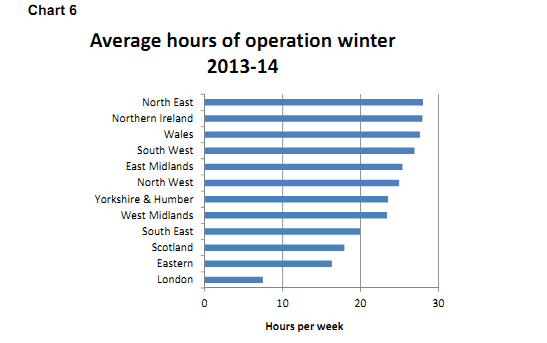
-
Grade II Listed cottage with leaky wall
Jeremy Harris replied to greyknight's topic in Introduce Yourself
I wonder if the original lime mortar may have been replaced with cement-based mortar during some of the earlier repairs? Lime mortar has a degree of flexibility that cement-based mortar doesn't, so might be more able to tolerate a bit of movement. -
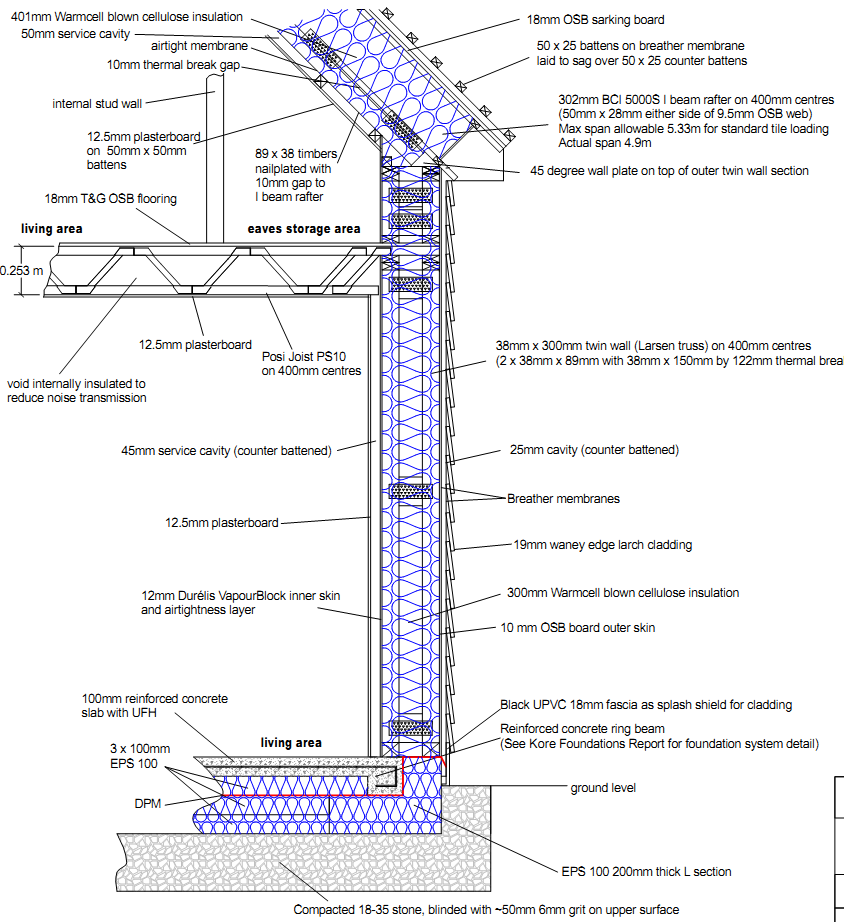
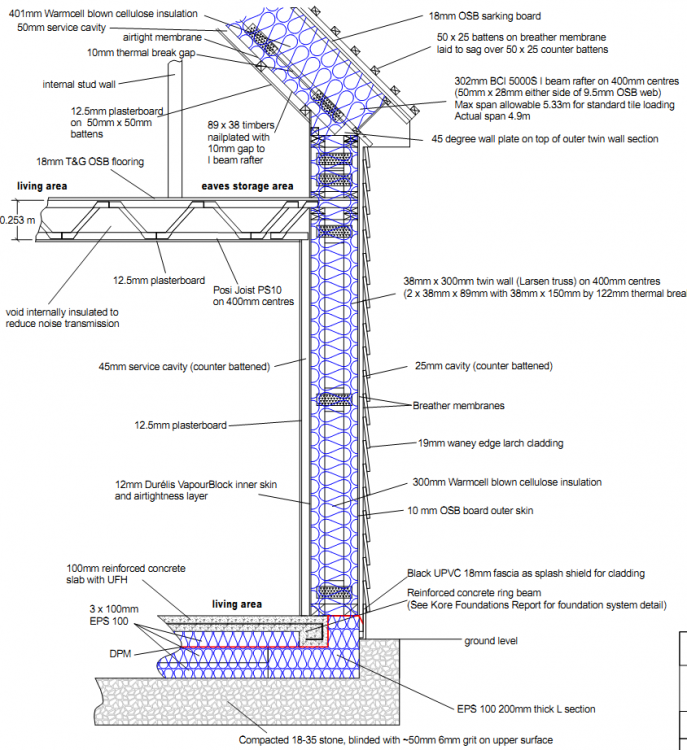
Our external walls are a different form of twin stud construction, but seem to be extremely effective at attenuating sound. This is a section though the wall: The ~300mm wide void between the skins is filled with dense pressure-blown cellulose, and is pretty heavy and solid. The construction is inherently very airtight, as is has been designed to be the external walls for a passive house. It should be pretty easy to substitute this type of wall for a standard stud wall, albeit with a fair increase in wall thickness.
-
Ban on Sale of Coal / Wet Wood
Jeremy Harris replied to Ferdinand's topic in Stoves, Fires & Fireplaces
The issue of "sustainable wood" for a wood burning stove is worth exploring a bit. A mature tree gains dry mass faster than a young tree, around 100kg/year. Very roughly, a wood stove rated at 6 kW will burn around 2kg of logs per hour, so will consume one mature tree's worth of annual growth every 50 hours of use. If a wood stove is used for 20 hours per week, from mid-October to mid-March, then that one stove would be burning the equivalent to the annual growth of about 8 trees in a five month period, or 8 years growth for a single mature tree in five months. Assuming that an average tree has a mass of ~3 tonnes when felled at the end of a 70 year life, then to provide a single wood burning stove with fuel needs roughly one 70 year old tree to be felled every 3.75 years. If a woodland has a full range of trees, from saplings to mature trees, then we probably need a woodland with between 18 and 20 trees to fuel a single wood burning stove sustainably. I would suggest that for the majority of the population of the UK, this could not be considered sustainable. Data sources include this DECC report from 2016 that looked at wood fuel use for domestic heating and hot water across the UK: https://assets.publishing.service.gov.uk/government/uploads/system/uploads/attachment_data/file/517572/Summary_results_of_the_domestic_wood_use_survey_.pdf plus some data from Engineering Toolbox: https://www.engineeringtoolbox.com/wood-biomass-combustion-heat-d_440.html -
External electric and gas meter boxes in single skin walls
Jeremy Harris replied to Moonshine's topic in Electrics - Other
One thing that seems consistent is that utility companies are rarely consistent! They sent me a pamphlet when I first enquired about getting a supply, listing all their requirements. As well as their insistence that the meter box be in an external wall, they also insisted that their underground cables had to be laid in 150mm diameter black Rigiduct. Luckily, their local chap turned up on site before we'd bought the duct and declared that he'd rather just give us a big wooden reel of Wavecon 95 and have us bury it directly in the trench, with no ducting. . . -
Any experience of the GS200 small ASHP?
Jeremy Harris replied to DamonHD's topic in Boilers & Hot Water Tanks
The Ecocent could just be ducted outside, I believe that is how the very similar units are often used in China. I'm pretty sure it was just an ESP idea to use air from inside the house, as they came up with a way of combining the Ecocent with their MVHR unit. -
Any experience of the GS200 small ASHP?
Jeremy Harris replied to DamonHD's topic in Boilers & Hot Water Tanks
Looks like a variation on the popular integrated heat pump and water cylinder units that are common in China. ESP do a similar unit, the Ecocent, that I looked at a few years ago (at that time the Ecocent was definitely a re-badged Chinese unit). Lots of similar units on places like Alibaba:


-
External electric and gas meter boxes in single skin walls
Jeremy Harris replied to Moonshine's topic in Electrics - Other
We had the same, SSE refused to allow a new supply head and meter inside the house. One of the issues I had was how to avoid the thermal bridge that putting a ~150mm deep cabinet in an external wall would create. For us it would have meant about a 40% reduction in insulation where the cabinet was, had we set it into the house wall. This, more than anything else, drove the decision to use an external meter cabinet, located in a fence, and run a thick cable from there into the house. -
Ban on Sale of Coal / Wet Wood
Jeremy Harris replied to Ferdinand's topic in Stoves, Fires & Fireplaces
My primary concern is that the impact of wood burning stoves is on people who have no choice as to whether they breathe that polluted air or not. In our case, a handful of homes with wood burning stoves are polluting the air for ~ 500 people, and that seems to me to be unreasonable. The BMJ published an article back in 2015 that showed that domestic wood burning was the single largest source of PM2.5s in the UK, 2.4 times greater than that from vehicle exhausts: https://www.bmj.com/content/350/bmj.h2757/rr-1 This is an excerpt from that BMJ article: The cited reference [6] is this: Those that smoke primarily impact their own health, and those very close to them (and I can choose to not be near a person smoking). People who choose a particular diet are similarly only affecting their own health. I have no problem at all with people choosing to do things that only endanger their own health; we should all be free to do as we wish if it doesn't harm others. -
Ban on Sale of Coal / Wet Wood
Jeremy Harris replied to Ferdinand's topic in Stoves, Fires & Fireplaces
In the past people used arsenic in medicines and rubbed it on their skin to "enhance their complexion", used mercury in the manufacture of hats and as a medicine, and we even believed that smoking was good for health until about 50 or 60 years ago, just as we thought it was OK to use the naturally occurring mineral asbestos for a wide range of purposes. Just because something seems "natural", doesn't necessarily mean that it's safe. -
Ban on Sale of Coal / Wet Wood
Jeremy Harris replied to Ferdinand's topic in Stoves, Fires & Fireplaces
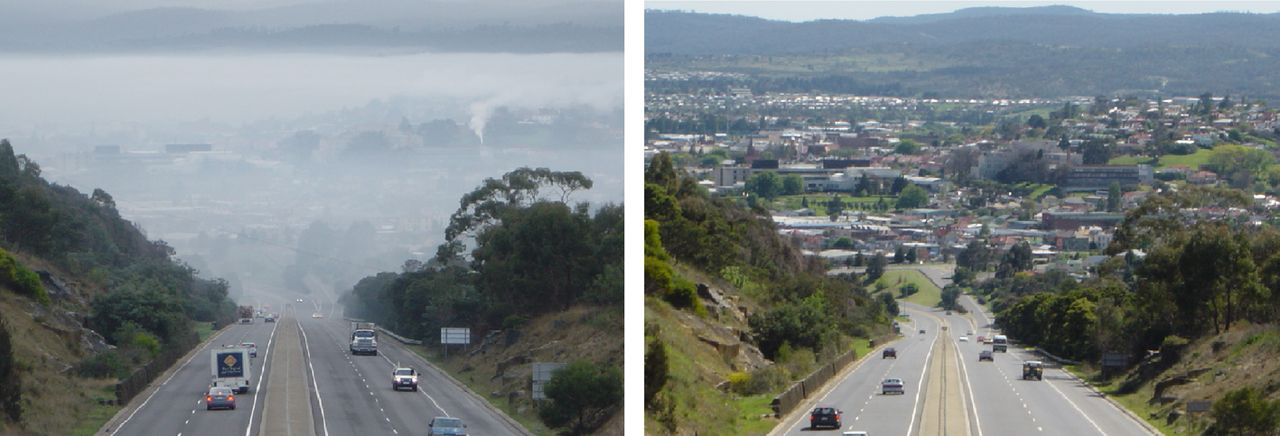
Given that only very few trees ever fall across roads or railways, I doubt it's significant when compared to the number of trees felled for firewood, TBH. Just pulling a fallen tree clear of a road or railway and letting it decay would usually be an option, anyway. The town in that BMJ article, Launceston, Tasmania, only has a population of 67,000, which is slightly less than that of Inverness. These two photos from that article illustrate the problem faced by even fairly small settlements when some people decide it's OK to burn wood in their homes: This is exactly what happens in our village on a still night in winter; the valley just fills up with acrid smog. Out of the ~200 houses in our village, there are only a handful that burn wood now, yet that handful of houses can very easily pollute the air that's breathed in by ~500 other residents, by filling the valley with smoke and smog. The other issue with burning wood in homes is that in the open countryside it probably won't be the household burning the stuff that suffer ill effects on their health, it will be those downwind who have no choice but to breathe in the pollutants.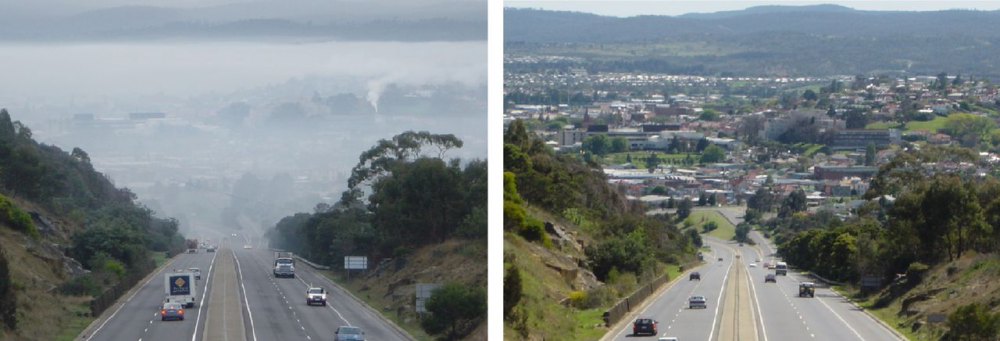
-
No problem with passing on a personal recommendation, IMHO.
-
Ban on Sale of Coal / Wet Wood
Jeremy Harris replied to Ferdinand's topic in Stoves, Fires & Fireplaces
In terms of what's best for the environment, then leaving fallen trees where they fall is undoubtedly better in many ways than burning them. Trees will take many years to rot down, providing nutrients and habitats for a wide range of organisms as they do so, and keeping the CO2 that they've sequestered through the decades that they've been growing locked up for another few decades as they decay. Apart from the harmful particulates problem, burning trees releases many decades worth of sequestered CO2 in a very short period of time, weeks or months, rather than years. The evidence of the harm to health from wood and coal combustion is compelling. The impact on health has been measured, and has been known about for decades. Back in the 1950s legislation was passed to ban the use of coal in open fires, because of the high loss of life associated with the winter combination of fog and smoke. This event (happened to be the year I was born): https://en.wikipedia.org/wiki/Great_Smog_of_London triggered this legislation: https://en.wikipedia.org/wiki/Clean_Air_Act_1956 , for example. More recently, the popularity of wood burning stoves has led to a significant increase in disease and mortality. This BMJ article about a study of wood burning in Launceston, Tasmania, and the surrounding area, illustrates the impact on health: https://www.bmj.com/content/346/bmj.e8446 Even the USA has been trying to educate about, and in some areas legislate against, wood burning for domestic heating for some time now: https://www.epa.gov/burnwise/wood-smoke-and-your-health and https://phys.org/news/2020-02-restrictions-wood-utah-air-quality.html -
Ban on Sale of Coal / Wet Wood
Jeremy Harris replied to Ferdinand's topic in Stoves, Fires & Fireplaces
Yes, I bought one, and am planning to use it to make an air quality monitor. The snag is that might need a fair bit of trial and error to accurately detect harmful stuff, rather than harmless stuff, as all it does is count the number of particles of a particular size over time. The harmful stuff tends to be the toxic particles that are 2.5µ or less in diameter, but there are some types of pollen that may be down around 2µ, and they might cause false alerts. The smoke gets through the F7 filter on the MVHR, or at least the smell does. It may be that the filter is taking out a fair proportion of the particulates, as it should be about 80% to 90% effective at filtering out particulates in the ~1µ range. I'm not sure how much of the harmful PM2.5 stuff is down below 1µ, though, as the definition often used is 0µ to 2.5µ for PM2.5s. There is now a PM1 category, though, for particulates that are below 1µ in diameter, so newer sensors should be able to categorise PM1, PM2.5 and PM10 particle numbers, rather than just the PM2.5 and PM10 categories that the sensor I have can measure. -
Ban on Sale of Coal / Wet Wood
Jeremy Harris replied to Ferdinand's topic in Stoves, Fires & Fireplaces
The problem we have is that the valley where we live fills with smoke from wood burning stoves on a cold, still night, and the MVHR then sucks the thick smog into the house, making everything smell like smoked kippers for a day or two. We try and turn the MVHR off if we detect the problem before going to bed, but often the thick smog only develops late at night, as the temperature drops. Burning anything is never better for the environment than just leaving it unburned, especially wood, as fallen and dead trees both keep a fair bit of carbon sequestered for a few years and provide a valuable habitat. I've never understood the logic behind the argument that burning trees is a "green" thing to do, as it flies in the face of all the available evidence.