


Jeremy Harris
-
Posts
26430 -
Joined
-
Last visited
-
Days Won
360
Everything posted by Jeremy Harris
-
There are problems that come up time and time again with people not realising that they are actually project managing their build and expecting contractors to deal with things that really should be managed. I think the main issue is that building trades and contractors have tended to work in glorious isolation from each other. They turn up, expect to be given some guidance/plans/instructions on what needs to be done then they crack on and do it. The snag is that it's pretty rare to get any one trade that thinks outside their own bit of the job. Someone has to do all the coordinating, to make sure that things go in the right place, for example, because if that's not done they will end up in the easiest place to fit. There are a few "turnkey" companies around, who will manage the entire build, but they tend to be expensive and not always that great in terms of detail - you're really unlikely to get a house that's much better than one made by a major developer, with a couple of notable exceptions.
-

Guaranteed to cause a row....
Jeremy Harris replied to Jeremy Harris's topic in Electrics - Kitchen & Bathroom
You're right. It only bothers me because I was a bit shocked to find it when we moved in, it not having been noted on the survey. What bothered me most was that there was no RCD in the house, so as a quick fix I just changed the socket for one with an integral RCD, just for peace of mind. As it happens, it's useful, I plug my electric trimmers in there for the monthly beard trim and my wife plugs her hair drier in there too. In the case of my trimmers, they are iffy, legally, as they are professional barbers ones with a lead that's long enough to reach Zone 2, but like other countries (and barbers shops here) I just use common sense. My wife's hair dryer has a much shorter lead, so I had to fit a mirror on the back of the cupboard door. There's no way that her hair drier could get within 1m of Zone 2 when plugged in, and the same would apply to pretty much any other domestic appliance, as they are usually supplied with pretty short leads. -
Guaranteed to cause a row....
Jeremy Harris replied to Jeremy Harris's topic in Electrics - Kitchen & Bathroom
No, it's right down low, about a foot of the floor level, pretty much the same height as all the other sockets in the house. The old airing cupboard, off the hall, has both a radial for the immersion switched fuse and also a single outlet on the power ring final, for some odd reason, both next to each other, and about half way up the wall. I've never quite worked out why the original builder decided to stick a single outlet in there, but then I've never understood why at least half the outlets in the house were singles, either. I went around shortly after we bought the place converting most of the singles to double gang. I think you're right, I probably am worrying too much. I'm just a bit desperate to make sure nothing holds up the sale of this old house, as we're both sick and tired of it. Cover it up with cleaning stuff seems to be the answer - that sits in a plastic box on the shelf above, but can easily be moved down to floor level when the surveyor comes. -
Guaranteed to cause a row....
Jeremy Harris replied to Jeremy Harris's topic in Electrics - Kitchen & Bathroom
Could do, I guess, although there's already one on the wall. I reckon I'll just pile stuff in front of it. It's wired with red and black cable that's clearly a part of the original ring final, as there's no junction in the loft above, the two legs of the ring run out either side, one to the hall socket, one on to the bedroom. Just arrange the slats to hide the socket, perhaps? -
Guaranteed to cause a row....
Jeremy Harris replied to Jeremy Harris's topic in Electrics - Kitchen & Bathroom
But there are plumbed in hand held showers on every basin, with normal shower mixers! The risk is actually more severe with a hand-held shower that can be directed at a customer's head and splash the adjacent outlets. Sometimes the regs just don't make a lot of sense to me, and I've been reading them (and teaching them for a time) for over 40 years now. The cupboard is well outside Zone 2, even with the door wide open, and the socket has a built in RCD, which is why I'm convinced it complies with the letter of the regs, but I doubt that carries any weight if faced with a pedantic surveyor... Not now, the airing cupboard, as built, was on the opposite side of the hall and used to house a cylinder with immersion. However, we know that the bathroom design was changed a lot part way through the build, as we have the original plans, plus the resubmitted plans, and although they don't have names by these spaces, it does look as if the original intention was to make this cupboard the airing cupboard. -
Guaranteed to cause a row....
Jeremy Harris replied to Jeremy Harris's topic in Electrics - Kitchen & Bathroom
Sadly it's a solid block wall, plastered both sides, with a radiator on the hall wall right where a direct knock-through would go. I think the UK is probably one of the only countries with a "no sockets in the bathroom" rule, although to be fair, the regs have been gradually relaxing over the years and are less restrictive now than they used to be. Technically, I'm convinced this socket is legal, in as much as it meets the letter of the regs, but there are so many people who are just bloody pedantic when it comes to stuff like this that it's almost a dead cert that a surveyor will pick it up. One thing has always amused me about the regs, and their application in commercial premises, like a barbers shop. The barber I've used for years had his shop completely refitted a couple of years ago, with a continuous work surface along the wall in front of the barber's chairs, three basins fitted with shower heads, rows of sockets for clippers, dryers etc along the wall and hooks and loops to hang these on when they aren't being used. All the sockets are standard two gang ones, at a guess there must be over a dozen outlets along that wall, most with clippers, rechargeable clipper charging units and hair dryers plugged in. All this was professionally fitted, so presumably intended to comply with the regs, but for the life of me I can't see how any of it does. -
Guaranteed to cause a row....
Jeremy Harris replied to Jeremy Harris's topic in Electrics - Kitchen & Bathroom
I have to say that's my preferred approach - I can't face the hassle of taking all the cable out of the wall and making good again , especially as I don't have any enthusiasm for doing more work on this old place I'd thought of that, but it looks even more suspicious, and technically I suspect the blanking plate needs to be at least IP55 or above (not sure you can get them, TBH). Legally I suspect it's OK as it is. I don't like it at all, but it's well outside Zones 1 or 2, is inside a cupboard, right at the very back, and may as well be on the hall wall just the other side of the wall it's on, as far as the regs are concerned. I'm pretty sure I could argue the point, and win, that it's compliant with the letter of the regs, with the only point being that anyone who connects something to it has a responsibility to ensure that the lead cannot stretch as far as one of the zones. That's no different to someone running an extension lead into a bathroom though, really. The daft thing is the bathroom used to have a fixed hair dryer fused outlet, just to the side of this cupboard, as the previous owners had one of those hotel-style wired hair-dryers fitted to the wall. They took it with them, and I got rid of the outlet and cables when I redid the bathroom a few years ago. Pity I didn't knock down the cupboard and get rid of that socket at the same time... -
Ventilation Rates Issue
Jeremy Harris replied to worldwidewebs's topic in Mechanical Ventilation with Heat Recovery (MVHR)
From all I've heard they are a pretty good company, but saying that any fan-driven system needs back pressure to improve flow rate is a pretty fundamental misunderstanding. There is an issue the other way around, when back pressure gets too high, but that's caused by fan blade stall, and causes the fan RPM to increase, the fan power to decrease and the flow rate to drop to a very low level. Maybe they got confused. -
One rather nasty thing that was fitted to our old house when we bought it, was a single socket inside a cupboard in the bathroom, about 3m from Zone One. The previous owners had a small (500mm wide) tumbler dryer in there, apparently, as there was a vent pipe that ran up and directly into the loft space (!) when we bought the place. Given the house doesn't have an RCD, I replaced the socket years ago with one with the built in RCD, and whilst aware that it was borderline with the regs, it's been handy to have access to power in there. Now it's time to sell, I've been debating taking it out. The problem is that the cable was put in when the house was built, so is on the main ring final and chased into the wall. To do a proper removal job means taking the cables out of the wall, reconnecting the ring final in the loft above and then making good. Strictly speaking, this socket is probably legal, as there's no way that water can get sprayed on it (it's at the back of a 600mm deep floor to ceiling cupboard), it's protected by an RCD and it's more than 3m from the bath/shower. However, I personally don't like it, and although our surveyor never picked it up when we bought the house (despite the tumble dryer being fitted at the time of his survey) I'm acutely aware that things are a lot tighter now when it comes to surveys. I've contemplated fitting an (admittedly ugly) IP66 socket box in there, fitted with the existing RCD single socket. Technically I think that should be legal, notwithstanding the fact that I still don't like it, but if anything the IP66 housing would make it more noticeable. I'm tempted to just leave it as it is and put some stuff on the shelf that's now just below it so that it can't be seen when the surveyor comes around, and let the purchaser deal with it if they feel they need to. Anyone any thoughts?
-
The tale of the sale of our old house
Jeremy Harris replied to Jeremy Harris's topic in General Self Build & DIY Discussion
I would guess so, it's pretty much what developers are doing. Lots of new houses being built around here have half a dozen PV panels on the roof, presumably because it's cheaper to fit them than bother to improve insulation or airtightness, so is an easy win to get through SAP... For landlords I'd guess it makes even more sense, as they can get the modest fit a generation payments for 25 years, for doing something they'd need to do to get their lettings up to the minimum required standard. -
Ventilation Rates Issue
Jeremy Harris replied to worldwidewebs's topic in Mechanical Ventilation with Heat Recovery (MVHR)
Having windows open is likely to have a pretty big effect, especially if there is any breeze blowing. Sadly the "having all the vents open causing a loss of back pressure which reduces flow rate" is pure and utter BS, and I'd have expected a lot better of an apparently well respected company. All you need to do is look at the fan curves that are published in the data for any MVHR to see that this is patently untrue - I suggest they read the manuals for the products they sell, familiarise themselves with the relationship between fan RPM, flow rate and pressure and then re-think the advice they give to customers in future... By way of an example, here is the pressure vs flow rate fan curve for the 50% lower capacity version of our Genvex, which has a pretty typical backward-blade centrifugal fans fitted to either side: As you can see, as back pressure increases, flow rate decreases, and this is a common characteristic for every type of fan or propeller.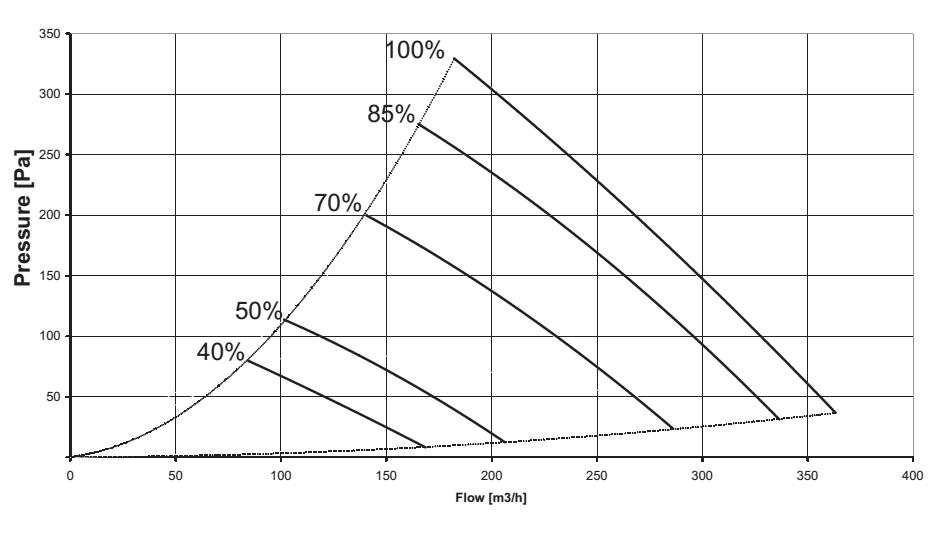
-
The tale of the sale of our old house
Jeremy Harris replied to Jeremy Harris's topic in General Self Build & DIY Discussion
It's not that hard to get a better EPC on an older house though, and needn't even be that costly in the overall scheme of things. I'm not sure what errors the assessor made when doing this EPC, but I do know that the true EPC should be C71, rather than the D58 he gave it. That's a pretty big difference just from assessor finger trouble, or perhaps carelessness. Curiously, his EPC gives the potential improvement that could be made as being to C74, not that far off the true figure of C71. Overall there aren't any "easy wins" left with our old house. It has about as much loft insulation as is sensible, it has reasonably decent double glazing, the best CWI that could be installed and a boiler that is still a good choice today (and is still a current model). The next main benefit would be to get rid of the solid concrete floor, that has no insulation underneath it, as there is a heck of a lot of heat being lost through that, especially as the central heating pipes are embedded in it and run in a loop right around the outer perimeter of the slab. That's a major job, though, ans would mean ripping out all the floors, and taking out the existing central heating pipework, digging down and fitting insulation and perhaps replacing the radiators with UFH. Not a cheap or easy job, but realistically there's nothing cheap or easy left to do in order to make the house more energy efficient. -
Is acidic water an issue with all plastic/stainless?
Jeremy Harris replied to sam's topic in General Plumbing
For UV lamps buying in bulk from these people is around half the price of getting them from any UK supplier I found, and the lamps they supply seem to be very good: http://www.uvebay.com/ For pH correction media it's hard to beat the service from GAPS Water, who are really helpful and have a tame chemist to consult. They may not always be the cheapest, but I've found their service and advice to be second to none: http://gapswater.co.uk/ They do a range of pH correction media here: http://gapswater.co.uk/acatalog/copy_of_pH_Neutralisation_Systems__To_increase_pH_.html Juraperle seems ideal for your conditions, but I'm still not convinced there's a need for backwashing unless there are dissolved metals like iron and manganese in the spring water. Channelling is a problem in fine sand filters, that reduces filtration effectiveness, but isn't a problem with something like Juraperle, AFAIK, and anyway you're not using this as a filter. I can't see any benefit in agitating the media unless you really need to wash out insoluble metal salts. Gaps sell just the Juraperle media here, in 25kg bags: http://gapswater.co.uk/acatalog/Juraperle--pH-correction-media--25-kg-x-10-6934.html#SID=698 I'd not risk using bird grit, as you really have no idea what's in it - it may be fine for birds, but what else might be in it as a potentially harmful contaminant? -
Finally got around to pulling the old Byron/Homeeasy remote switches out and replacing them with the Quinetic remote switches. All I can say is that they do as they say on the box, and work perfectly. Before fixing one of the remote switches to the wall I wandered around the house with it, as a range check. It would work from anywhere inside the house, so in practical terms at least 10 times better than the Byron/Homeeasy stuff. The other big advantage is never having to replace the batteries in the switches. All around I'm pretty impressed, they look neat, are easy to wire up, have proper wire protection over the terminals (unlike the Byron/Homeeasy receivers) and have a good range. It's nice to have kitchen lights that actually switch on reliably, rather than being hit and miss.
-
What do people recommend
Jeremy Harris replied to jpinthehouse's topic in Mechanical Ventilation with Heat Recovery (MVHR)
Really need to know two things: The house total volume (as it's volume, rather than floor area, that determines the capacity of the MVHR). If the ceiling heights are "standard" then this can vary from around 2.3m to 2.5m, but assuming 2.4m ceiling height then you're looking at a total volume of around 744m³. The other question is do you want a standard MVHR or one with integral comfort cooling? The latter is an expensive option and there are, IMHO, better ways to get comfort cooling than using the MVHR. To meet building regs background ventilation you're going to need a unit that can trickle ventilate at around 335m³/hr, and boost to around 2 to 3 times this figure. -
JG Thermostats disco lighting - gone bonkers
Jeremy Harris replied to readiescards's topic in Other Heating Systems
I agree with @MikeSharp01, it sounds as if they've somehow managed to lose the connection to the coordinator, or perhaps lost it for a time and now the link won't re-establish, perhaps because one or more of the pairings has been lost. In theory the pairing should be retained over things like interference or loss of battery power, but odd things can happen with wireless systems like this, especially as this version of a Zigbee network relies on a star configuration, where all the network devices are connected through the coordinator. If there's a problem with the coordinator, then all the connected devices may find themselves unable to communicate. -
The tale of the sale of our old house
Jeremy Harris replied to Jeremy Harris's topic in General Self Build & DIY Discussion
I probably have, but he'll be one of hundreds who are just as careless. I know that a neighbour, who was getting a RdSAP done in order to fit PV and claim FIT, was told by her assessor that he'd just make sure the result was good enough for her to qualify. This was on a 1970's built house with wooden sash window frames, single glazing, night storage heaters for heating and just 100mm of very old fibreglass in the loft. At a guess it would really have been a Band F, maybe even a G, and there's no way it could have been good enough to qualify for FIT (for which you're supposed to be Band D or above, IIRC). Bit like a mortgage valuation we had done years ago, where the valuer asked how much we needed the house to be worth in order to get the loan we needed... -
The tale of the sale of our old house
Jeremy Harris replied to Jeremy Harris's topic in General Self Build & DIY Discussion
Yes, the EPC I have is marked as having been produced by the Stroma software. RdSAP does restrict a lot of inputs, but given that I can't see any of the input data, except the floor area (which is 10% greater than it should be), I can't judge where the input errors have been made. RdSAp doesn't allow for the actual boiler efficiency, I know, it makes an assumption based on the age of the unit. It does the same for glazing as well, although in our case the age of the glazing coincides with the actual mean Uw that RdSAP assumes, so the error shouldn't be there. FWIW there is now a 100% low energy lighting option, and that seems to be one aspect he got right. -
The tale of the sale of our old house
Jeremy Harris replied to Jeremy Harris's topic in General Self Build & DIY Discussion
Just got the EPC, and can confirm it's a joke. I've run the house real spec through the Stroma software and have an EPC using that of C71. The one I've just received gives an EPC of D58. The only obvious error I can see straight off is that the floor area is out (not sure how he made that error, as he didn't measure anything at all in the house, and I gave him a scale drawing with the floor area marked on it, as measured using AutoCad). The new EPC has the energy costs as around £200 a year more than they really are, so clearly something's awry there in what he's actually entered on the worksheet (our actual energy costs tally reasonably well with the C71 value). The assessor has used exactly the same software as I have, from Stroma, so had he just put in the same data as I did he'd have had the same result. Not sure where he's screwed up, as there's no worksheet to look at to trace the errors. Just sloppy work, pretty much as I suspected from his approach to the job - money for old rope, really. I'm sure it won't make a jot of difference, as no one buying houses takes any notice of EPCs anyway... -
Ventilation Rates Issue
Jeremy Harris replied to worldwidewebs's topic in Mechanical Ventilation with Heat Recovery (MVHR)
I found that the flow rate was pretty non-linear with fan speed. That figures, as it depends on the fan pressure/flow curve. I definitely don't get double the flow rate for doubling the fan speed, though. -
Ventilation Rates Issue
Jeremy Harris replied to worldwidewebs's topic in Mechanical Ventilation with Heat Recovery (MVHR)
The results look odd, as on boost I would have expected the MVHR to be able to run pretty close to it's rated maximum, probably at least 550 to 600m³/hr, allowing for some duct losses. Either the measurements are out, or something seems to be restricting the flow a great deal. The sums seem correct in the spreadsheet, in that the velocities do equate to the right flow rates, but the boost rates seem low to me. Our MVHR has a lower maximum capacity, about 470m³/hr, but the flow rates I measured were a lot higher than yours. For example, our kitchen extract (which has a double duct run to get the required high flow rate) gave a velocity of 4.04m/s on full boost, which equates to a flow rate of 31.73l/s, way over the 13l/s the regs require. Our system gives a total ventilation rate in normal background ventilation mode of 45.79l/s and a total ventilation rate in boost mode of 115.3l/s. In boost mode it's running at a total flow rate of 415 m³/hr. so is not meeting its max rating, but that's down to the flow resistance of the ducts - I'm pretty sure they specify the maximum flow rate for a fairly low flow resistance system. -
I found it interesting that the normal way to fit timber cladding in Scotland was vertical, with overlapping planks over the joints, whilst the normal way to fit cladding in England seems to be horizontal, with weatherboard, overlapping planks (like our waney edge) or tongue and groove, fitted with the grooves pointing down. I first came across this when I bought a locally made shed kit when living in Scotland. The walls were close planked with 6" x 1" vertical planks, with a nail's width between boards to allow for movement, then these vertical joints were covered by 3" x 2" planks nailed on the outside, only down the centre line, into the frame beneath. I have to say it makes for a very weathertight structure, and given the weather in Scotland perhaps this is why the vertical plank system has become normal.
-
Which ASHP are set up to cool
Jeremy Harris replied to Triassic's topic in Air Source Heat Pumps (ASHP)
They can all cool as well as heat, as they have to in order to defrost. The question boils down to how easy it is to over-ride any MCS/RHI restrictions that may have been made to the unit for the UK market (you can't claim RHI if the unit has an easy way to cool without changing non-user settings). In the case of my Carrier unit, the cooling just wasn't documented, and as supplied the unit only had the heating and hot water controls identified, and all the wiring diagrams for the options excluded any cooling option. It was only by looking at the connections for the control wiring that I spotted an unused terminal that happened to be the one that switches the unit into cooling mode. I believe the other units are broadly similar. @jack found that the cooling function could be enabled by going into the settings on his unit, I believe. I have ours set up with two thermostats, one controls heating the other controls cooling, which is pretty simply in terms of wiring. -
As @PeterW says, it needs to go a LOT lower than that. I never. ever, have our flow to the UFH above about 24 to 25deg C, any more and the house just over shoots the set temperature when the heating turns off.
-
I have a wet diamond disc tile cutter, with a nearly new blade in it, that you can have for free if you want it, as I'm only going to bin it when we move.

