Jeremy Harris
-
Posts
26430 -
Joined
-
Last visited
-
Days Won
360
Everything posted by Jeremy Harris
-

SUDS drainage design quote? High?
Jeremy Harris replied to Dreadnaught's topic in Rainwater, Guttering & SuDS
I did ours myself. Not hard to do, as it'll pretty much be dictated by the layout and topography of the plot and the soil conditions. My choices were pretty non-existent, as there was really only one possible solution, dig a big hole under where the drive was going to go and stick 20 crates in it, together with pipes out to all the downpipes. -
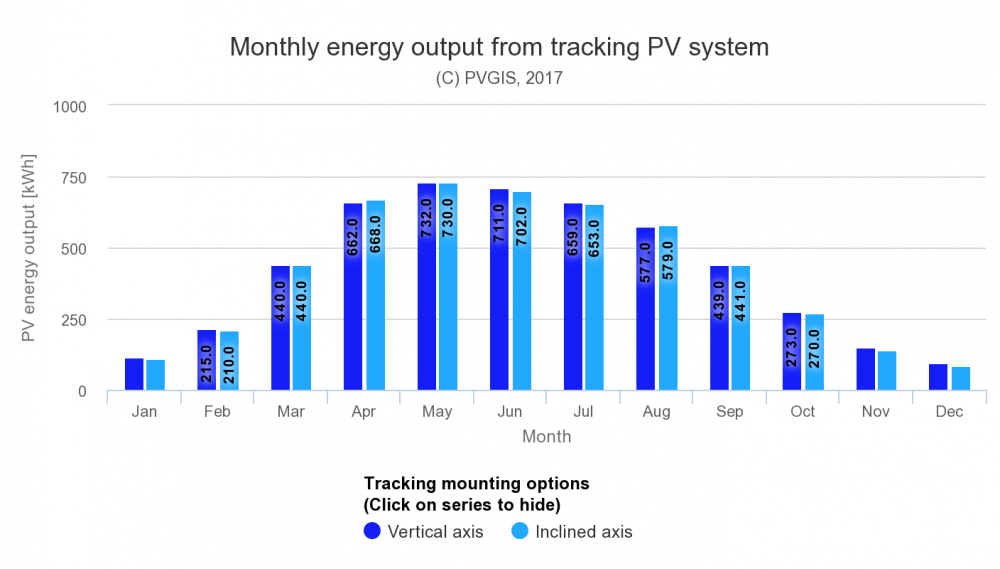
Vertical will usually give a lower overall output than any other inclination, but the difference tends to reduce as you go North (or South if in the Southern hemisphere). @Stones is up in Orkney, so the difference there may well be smaller than for somewhere further South. It also depends a bit on the local horizon. The location I chose to use is partially set down in the valley at Portpatrick (it's on the old railway line, about 100ft above sea level) so has a clear view to the West, but the horizon to the South and East is higher, which probably impacts the winter generation a bit. For completeness, this is what the same array would probably give if mounted on a two axis tracker:
-
Just measured ours, and I set the edge of the architrave back 5mm from the face of the lining, so your 6mm top layer should end up just behind the architrave if you do the same.
-
I'm afraid I think the prices you have are about as good as you're going to get. I was a bit shocked at the high cost of oak door linings, especially when compared to the cost of the oak doors. We bought all ours from Door Deals( https://www.doordeals.co.uk/products/door-frames-and-mouldings/internal-door-frames.aspx ), but they aren't likely to be any cheaper for you, due to your location and the higher delivery charges, I think.
-
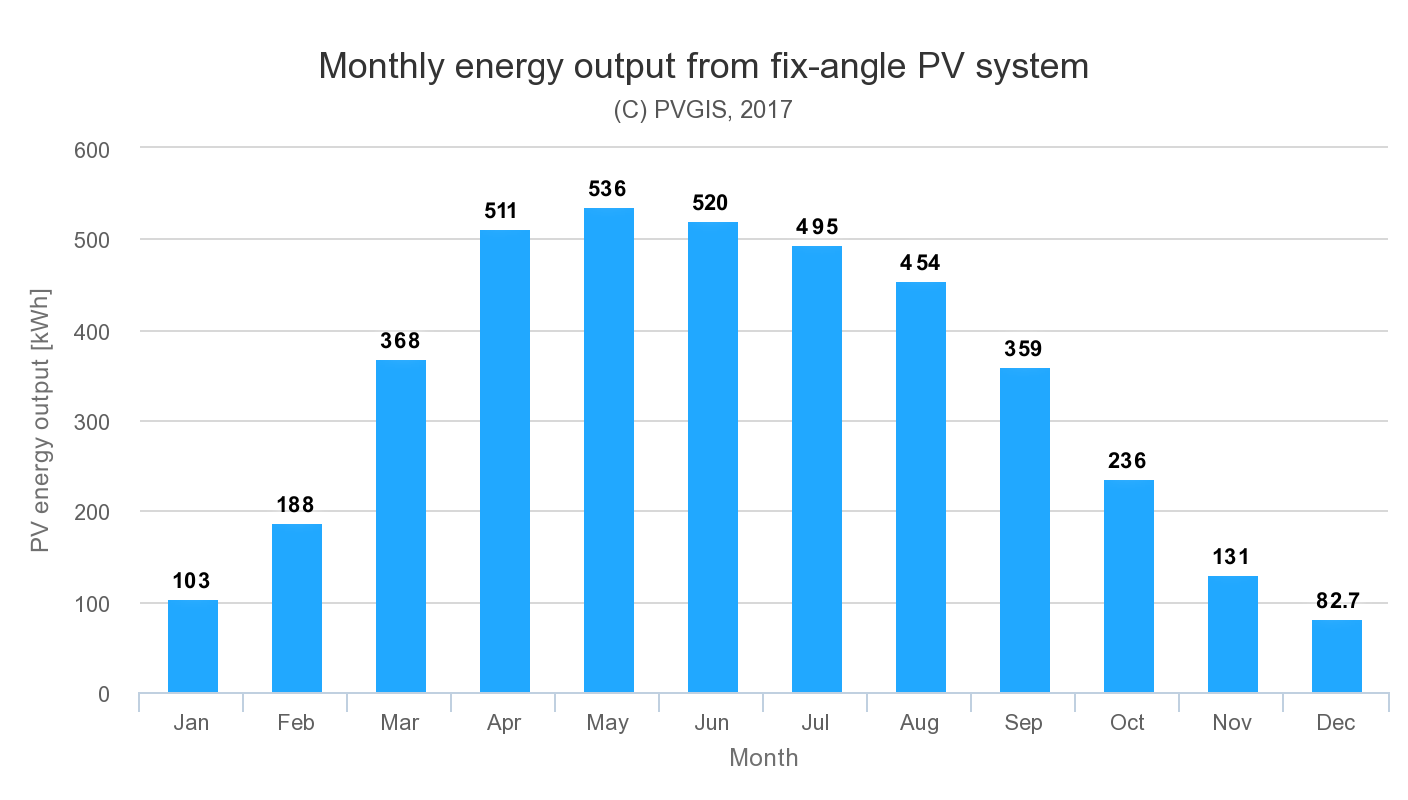
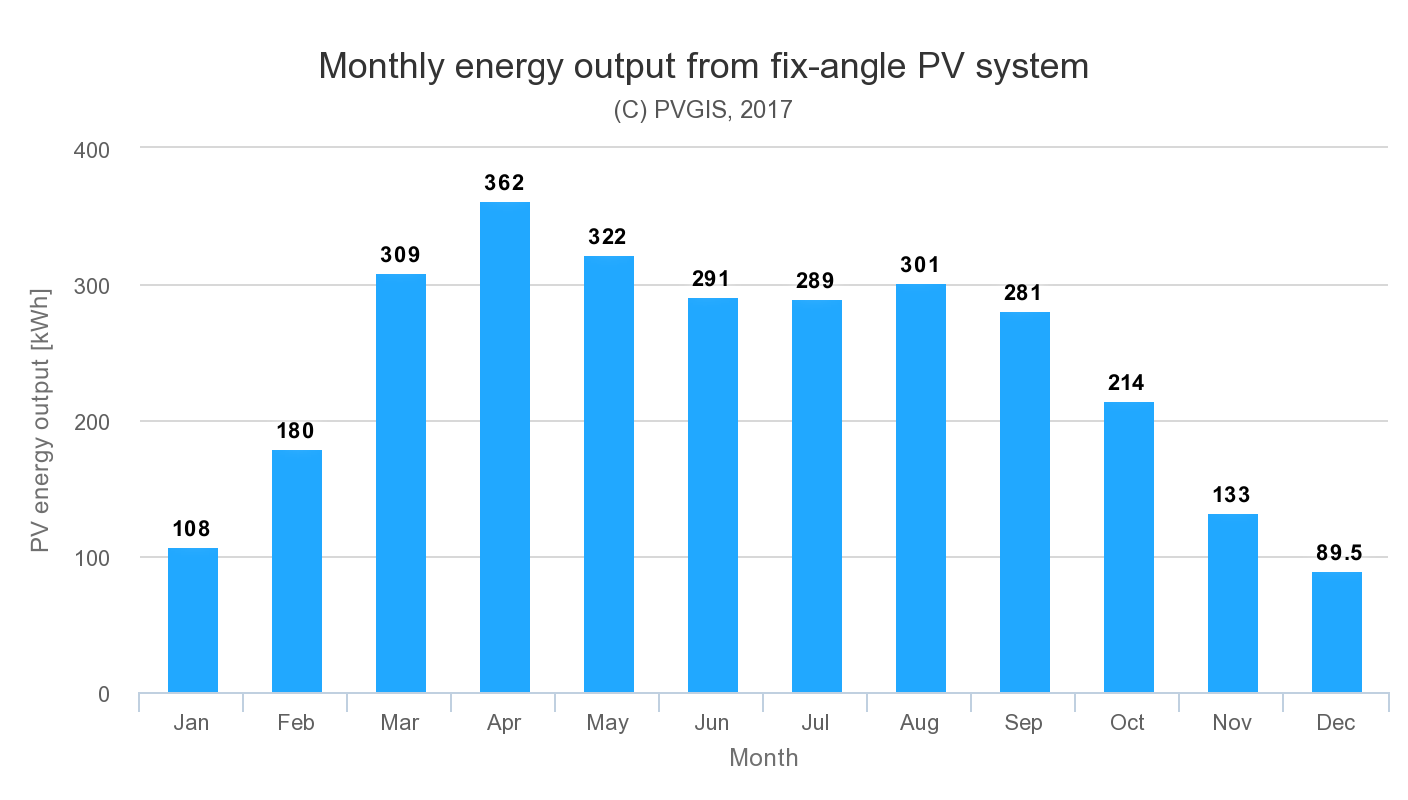
It varies a lot with location and orientation, so the best bet is to go to PVGIS here: http://re.jrc.ec.europa.eu/pvg_tools/en/tools.html#PVP and start by putting in your location. There are initial instructions here: http://re.jrc.ec.europa.eu/pvg_static/en/intro.html . You can then just change the orientation and do another run to get a set of predictions for a year, month by month. There is an option in PVGIS to model a tracking system for any location as well. For example,for our old house in Portpatrick, with a fixed 4 kWp array facing South, then this would be the likely output with the panels at 45°: and this would be the likely output for the same array mounted vertically:
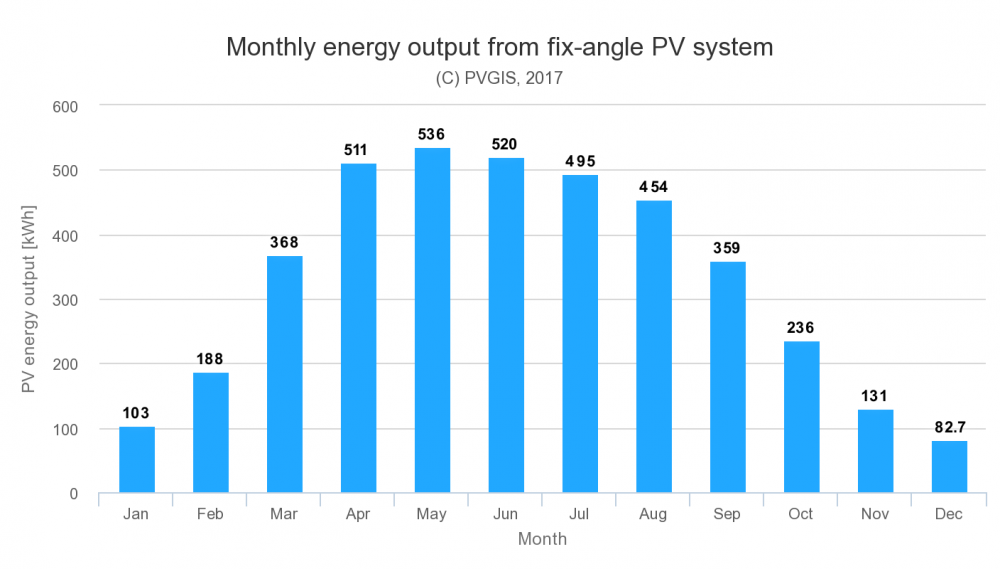
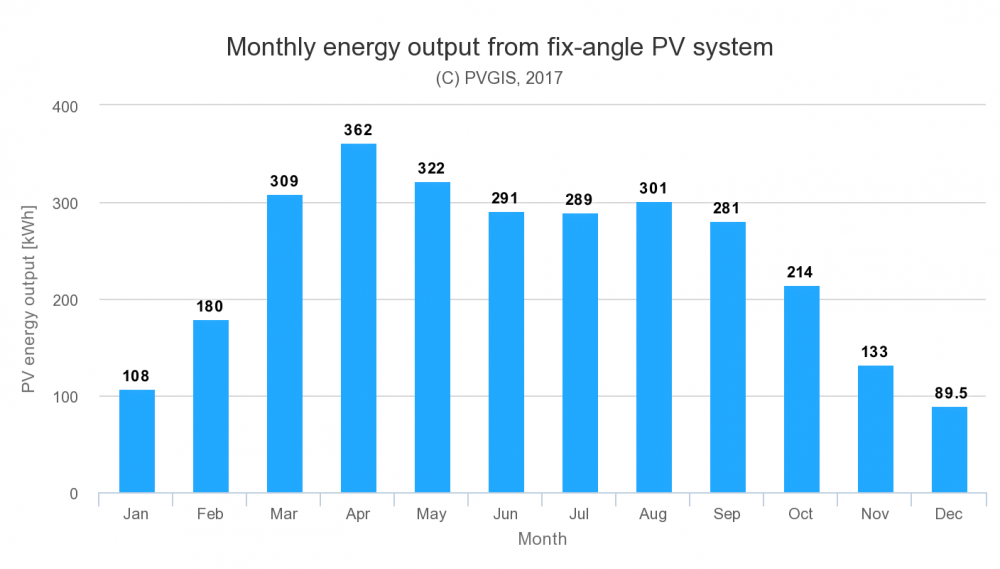
-
I'd second just doubling up on plasterboard layers for any walls where you're concerned about noise transmission. If the inside of the wall is filled with dense acoustic insulation as well then it should perform pretty well. We're finding that just standard timber studs on 400mm centres, with the cavity filled with rockwool and skimmed plasterboard either side is pretty good. More noise escapes from the doors than the walls, although even then it's not much. My study is next to the living room, and with the living room door to the hall closed I can't hear the TV in my study, even with my study door open.
-
If maximising self-generation is the aim then I think an East/West set up may well be better, even if the total generation is a bit lower. Our demand tends to have two peaks, first thing in the morning then again late afternoon/early evening. For much of the year an East/West system would be a better match, especially if at a fairly steep angle so that it makes better use of low angle sun.
-
Contractor welfare - site caravan?
Jeremy Harris replied to DreamHouseDreamer's topic in Project & Site Management
Our ground works contractor was on site for about 6 weeks, and he just brought his own small steel container. Not sure what size it was, but it had been reinforced with welded on steel bars and multiple locks, and looked to be one that he just moved from site to site on his truck. -
Easy enough to check with PVGIS for any location. Just stick in your location, the direction the panels will face and set the inclination to vertical and it will give you the predicted output over a year. It seems to be pretty accurate as far as I can tell. For us it predicted our total annual generation to within better than about 5%.
-
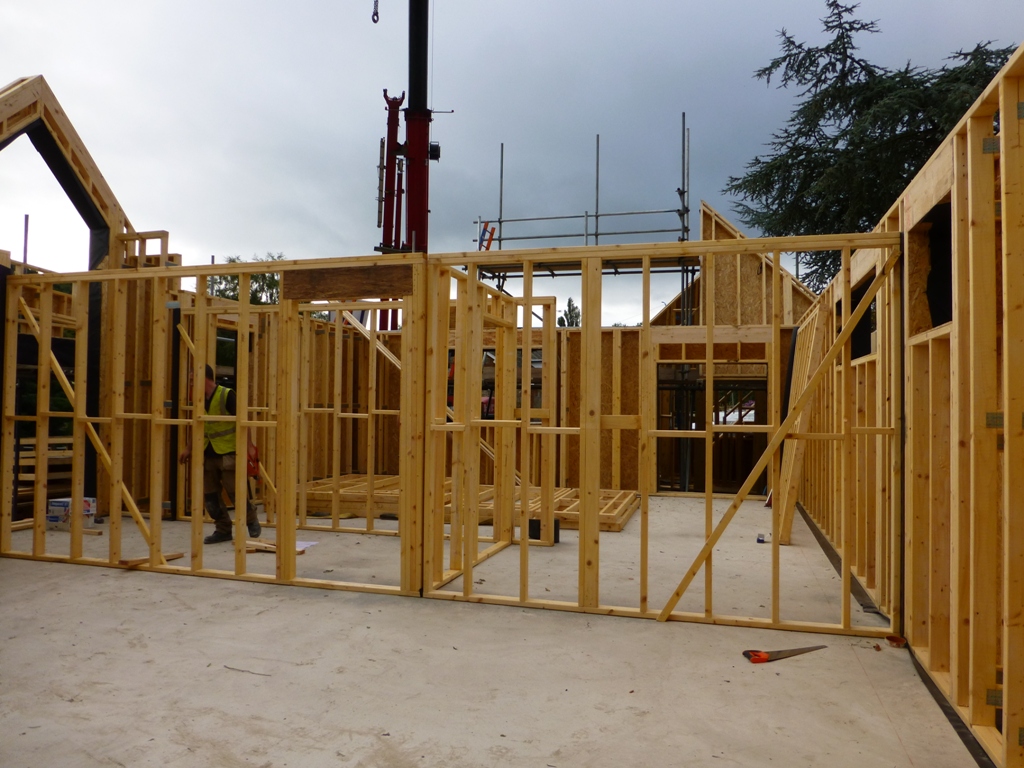
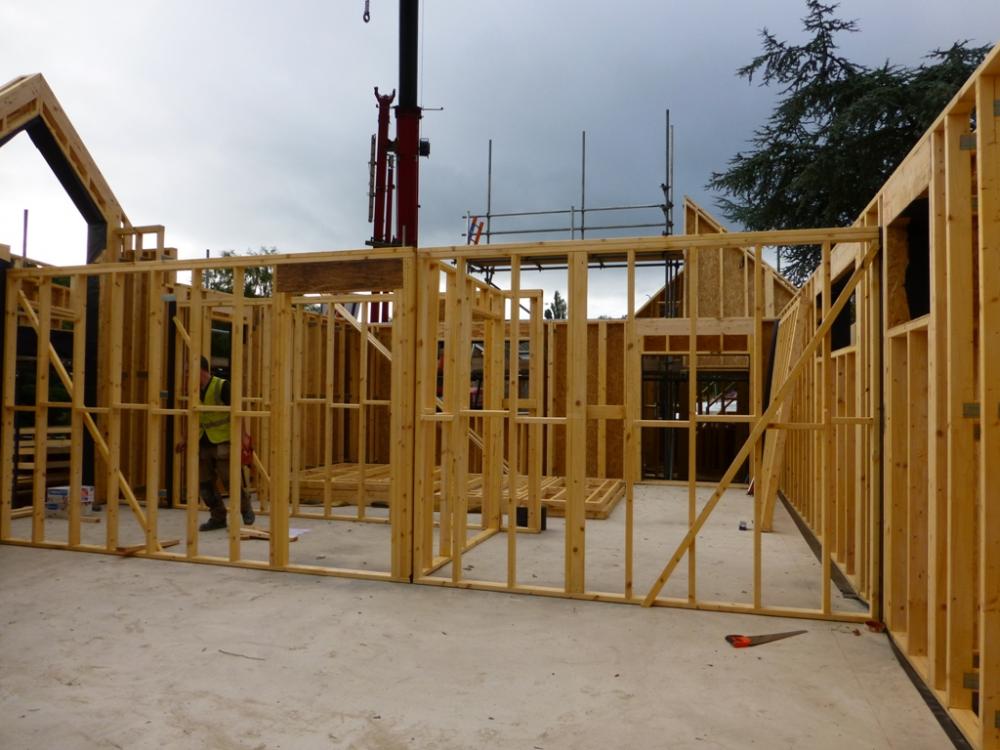
TBH I don't know. I've liked the idea of steel studs ever since seeing them in France, when a friend was renovating his house there. Looked a lot easier to get straight walls than when using timber. Having said that, all the internal stud walls for our frame came pre-assembled and were dropped in by crane along with the other panels for the frame, so all our ground floor stud walls were in place by 4pm on the first day of the frame going up. They were all dead straight and square, too. This photo was taken a bit earlier during the afternoon of the first day of the frame going up. You can see some of the internal walls that haven't been installed in a stack at the back:
- 21 replies
-
- 1
-

-
- metal studs
- timber frame
- (and 3 more)
-
Contractor welfare - site caravan?
Jeremy Harris replied to DreamHouseDreamer's topic in Project & Site Management
I just informed everyone that worked on site, in writing, that I wouldn't take any responsibility at all for tools left on site. Our insurance only had limited cover for theft, and I just didn't want the hassle of having to deal with any claim for stolen tools, especially as it's a relatively common problem on building sites. -
Depends whether or not the timber frame needs structural internal walls. We have two structural internal walls that support the ridge beam, and these walls both run right across the house from front to back.
- 21 replies
-
- 1
-
-
- metal studs
- timber frame
- (and 3 more)
-
Spatial planning of renewables system
Jeremy Harris replied to Rendall's topic in General Alternative Energy Issues
Paul Camelli's experience with his (very definitely not "Mickey Mouse") hydro installation, plus that of his neighbours at the Old Schoolhouse, Torran, seems to indicate that small turbines of around 500 W can be very useful and reliable long-term ways of providing constant power to an off-grid house. His has been running for several years now (I gave the link earlier). As mentioned by @Miek, 500 W of continuous generation is 12 kWh per day, enough to meet the needs of an off-grid house that has heating and hot water provided by another means. -
They don't have a 4 way valve usually, so can't reverse cycle. My guess is that they probably just turn off and wait if icing is detected, which may well be why there is a +5°C minimum outside temperature operating restriction.
-
Finding a blockage in a 50mm mdpe pipe ?
Jeremy Harris replied to ProDave's topic in Waste & Sewerage
Is there any way you can do a crude test to see what sort of head the pump can deliver? Perhaps pointing a (restricted) pipe up vertically to see how high it will raise a fountain might give an indication of how well it performs with the outlet restricted? -
MVHR Duct Design
Jeremy Harris replied to Triassic's topic in Mechanical Ventilation with Heat Recovery (MVHR)
If you can get the terminals spaced horizontally from each other by anything over a couple of metres it would probably be fine. Alternatively, you could look at through-roof terminals, perhaps. -
Spatial planning of renewables system
Jeremy Harris replied to Rendall's topic in General Alternative Energy Issues
Mine all those years ago (early 1990's) had a positive displacement pump, that just pulled oil up from the tank. It worked fine, but did need to be run for a while during commissioning to pull oil through for the first time. It also needed good joints on the feed pipe, as I remember having a problem initially with a joint that was oil-tight, but which allowed air to be sucked in (the boiler didn't have either a return pipe or tiger loop fitted). -
Spatial planning of renewables system
Jeremy Harris replied to Rendall's topic in General Alternative Energy Issues
Very true. I fitted an in-wall-mounted oil boiler to our house in Scotland, with the tank just sat on concrete blocks in the garden, with the oil level perhaps 1.5m or so below the boiler. The pressure jet pump never had any problem in lifting oil up that high. Rayburn's used to have to have a small head of oil, though, as back when we had one in the 1980's the burner used a thing like a carburettor on the side to control the oil flow to the evaporation-type burner. -
Nothing really. They may well have a heat exchanger that's optimised fro higher flow rates and a higher flow to return temperature differential, but without looking at one and playing with it it would be hard to be definitive about how it might behave running something like UFH. One point worth noting is that pool ASHPs don't modulate, they are designed to run flat out all the time. That means they probably aren't going to be as quiet or efficient running something like UFH as an inverter driven unit.
-
Spatial planning of renewables system
Jeremy Harris replied to Rendall's topic in General Alternative Energy Issues
Worth looking at Paul Camelli's hydro setup at his off-grid house up on Raasay: https://lifeattheendoftheroad.wordpress.com/ IIRC his micro-hydro system is around 500 W, and it's fed by a long length of MDPE pipe, scrounged from a fish farm and towed by boat to Raasay. The pipe he used was 750m long, 90mm diameter MDPE, the entry about him getting it in place is here:https://lifeattheendoftheroad.wordpress.com/category/hydro/page/36/. -
Avoiding kitchen duct noise
Jeremy Harris replied to MJNewton's topic in Mechanical Ventilation with Heat Recovery (MVHR)
I doubled up on the run to the kitchen extract, to get the flow velocity down. It's silent except when running at full boost, when it makes a slight noise, but not anywhere near as loud as an extractor fan. -
There is a massive variation in tariff with location, and it's not at all consistent AFAICS. I keep hearing about "really great" tariffs, only to find when I check for our post code that they are uncompetitive. The only one that seems consistent over a wide area (it seems to be the same everywhere) is Octopus Go. It's a good deal if you are OK with a smart meter and can shift most of your consumption into the 4 hour off-peak period, from 12:00 to 04:00, IIRC.
-
good video on net zero energy home
Jeremy Harris replied to scottishjohn's topic in General Self Build & DIY Discussion
If someone wants to define some units to measure it and get the Système International (d'unités) to accept those units, so that they have international acceptance, like those for heat capacity, thermal conductivity, etc, then I can't see a problem, other than the fact that the term "mass" is misleading. We already have all the units we need to define the comfort level of a house (and this is about perceived comfort, not energy conservation, no one considers "thermal mass" to be a measure of efficiency, AFAIK), perhaps the one most people might relate to is the thermal time constant, which is roughly how long it takes for the temperature inside the house to change when there is a change in outside temperature. Many would accept that living in a caravan can be uncomfortable because it heats up quickly on hot days and cools down quickly on cold days, and we tend to perceive that temperature variation as being uncomfortable. On the other hand, a stone building that stays at roughly the same temperature no matter what happens outside (within reason) is often seen as being more comfortable. The stone building isn't more thermally efficient than the caravan, it may well be a lot less thermally efficient, but it has a high heat capacity and that tends to even out variations in temperature, even though it may need a greater heat input to stay comfortable. -
Finding a blockage in a 50mm mdpe pipe ?
Jeremy Harris replied to ProDave's topic in Waste & Sewerage
Wooden bung with a hole in it jammed into the pipe? Doesn't need much, and something just held together by hand might do the job. Even a couple of bar from a hose would be around 20m head, so a fair bit more than the pump can shove out. The pump may well stall if obstructed, too, which possibly reduces the pressure available to less than the rated head. -
Electric Vehicle Tariffs
Jeremy Harris replied to Triassic's topic in General Alternative Energy Issues
These have been around for a while, but you need to look closely at the tariff to see whether or not it works for you. Often the tariff is in conjunction with one of the public charge point operators, for example the Ecotricity offering, which is OK as long as you happen to use routes where those charge points are available (I don't, so the Ecotricity tariif doesn't make sense for me). Other companies are using what look to be "loss leader" tariffs to attract people to fit smart meters. These can look quite attractive if you can use enough energy during the very cheap off-peak rate. For example, Octopus Energy have their Go tariff, which offers electricity at just 5p/kWh for four hours in the middle of the night. If you can switch most of your consumption into that off-peak slot, and are happy to have a smart meter that enables this tariff to function, then you may well save money. For us Octopus Go doesn't work, and E7 is slightly cheaper, but it does depend very much on how much you can re-schedule your peak use. I'm also more than a little concerned that once you've had a smart meter installed, because of attractive offers like Octopus Go, then you'll find that tariffs become gradually far more complex, with variable rate charging that becomes very challenging to see if it is actually offering good value.