Jeremy Harris
-
Posts
26430 -
Joined
-
Last visited
-
Days Won
360
Everything posted by Jeremy Harris
-
There's no reason why SWA cannot be terminated with a plastic cable gland when the armour should not be connected to the local earth. Just trim the armour back to level with the outer sheath and secure that in the cable gland, with the double insulated inner core coming through to wherever the line and neutral connections need to be made off.
-

Save the world, install an LPG tank.
Jeremy Harris replied to epsilonGreedy's topic in Environmental Building Politics
Having spent ~35 years working in science I'd be the first to say that scientists are all different, with a few observations as to the sort of people that are attracted to a career in science. Firstly, the pay is pretty poor. People don't generally become scientists to earn a decent salary, most decide on a career in science because it's fascinating, probably one of the most interesting jobs going, as you have no way of knowing what may lie ahead. As a consequence I'd say that the majority of scientists I knew weren't really interested in money. Secondly, as a part of the programme we ran to try and understand why scientists were so reluctant to collaborate with each other, our psychologists (who were running this programme) found that ~75% of the thousand or so that we looked at in our lab were on the autistic spectrum. I think we probably already knew that this might be the case, from anecdotal tales of behaviour, but having it confirmed did go some way towards explaining why collaboration was so difficult and also why communicating with non-scientists was often far less effective than it could be. I'm not convinced that the offer of either money or fast cars would be that tempting to the majority, to be honest. An offer of enhanced status over their peers would be more enticing, I'm sure, as we had far more heated debates about job titles than we ever did about pay. As an example of just how daft the job title thing can get, before I shifted into management my job title was Senior Principal Scientific Officer. Before that I'd been a Scientific Assistant, Scientific Officer, Higher Scientific Officer, Senior Scientific Officer, and Principal Scientific Officer, how mad is that? I should add that as a PSO in the 1990s I was paid around £28k, so not exactly a high earner. -
Save the world, install an LPG tank.
Jeremy Harris replied to epsilonGreedy's topic in Environmental Building Politics
The idea of a conspiracy by scientists can only have been dreamt up by someone with no knowledge of the behaviour of scientists! Getting scientists to collaborate on anything is damned difficult, and one reason that the few successful collaborations tend to attract media attraction. One of the programmes I ran shortly before I retired was aimed at encouraging better collaboration within the same lab, as it was recognised that there was a strong tendency to not wish to work with others, a tendency that was hampering an interdisciplinary approach to research. The process of peer review prior to publication encourages scientists to be as critical as possible when looking at the work of others, and builds up a level of healthy scepticism, where there is virtually no implicit trust; everything has to be checked and proven to be valid before it's accepted. As for young people protesting, then frankly protesting is cheap and easy. Anyone can stand on a soapbox and be critical of others; what's needed is for dedicated people to get off their protest soapboxes and make the effort to get into government to bring about the changes they want. That's nowhere near as easy as just creating sound bites for the media, as it takes hard work and dedication for years. -
If doing this then there's no point in running three core, as the PE conductor in the core won't be doing anything. All that's needed is two core, with the armour connected only at the supply end.
-
Save the world, install an LPG tank.
Jeremy Harris replied to epsilonGreedy's topic in Environmental Building Politics
I've just found a graphical representation of the NOAA data, showing the corrected and uncorrected figures, which makes it clear that the uncorrected data does indeed show a slightly larger increase in temperature than the corrected data: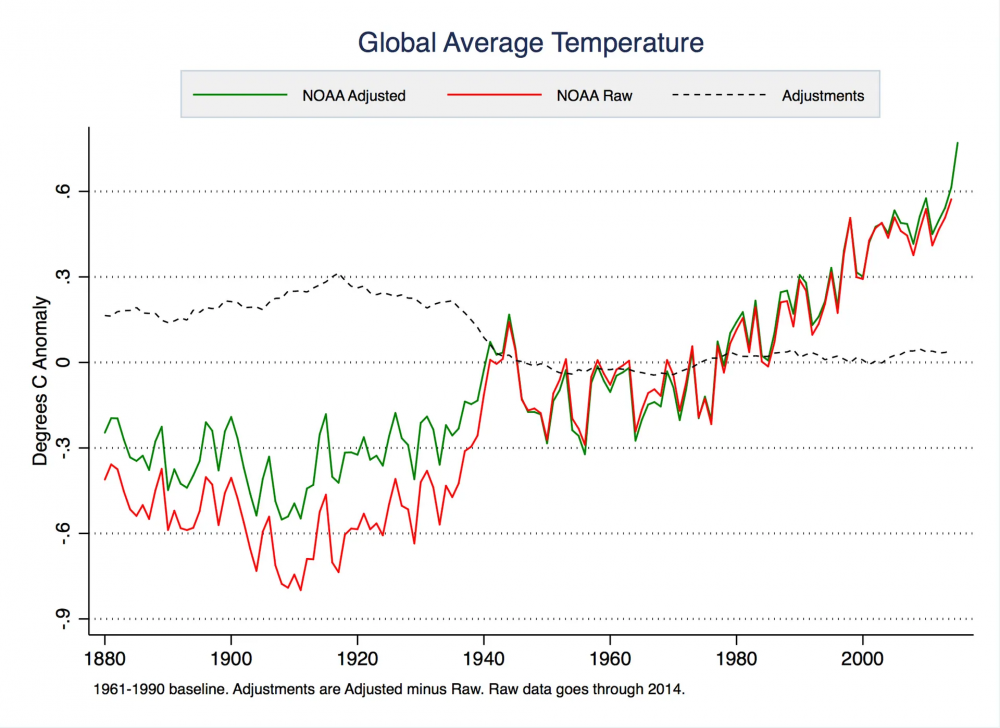
-
Save the world, install an LPG tank.
Jeremy Harris replied to epsilonGreedy's topic in Environmental Building Politics
When I was asking lots of questions about climate modelling, and trying (in vain) to get my head around it, my former colleague used an analogy that I could get my head around (well, to some degree) which was trying to model the flow of air around a hand-held fan. In still air this is a (relatively) simple CFD solvable problem (although it needs a fair bit of computing power to do it in 3D just for a room-sized model). In normal air conditions, where the initial conditions for the model will vary over a wide range (due to convection currents, draughts, small scale temperature fluctuations etc) the model gets to be hellishly complex, and will tend to produce a different result for every run. The fact that the model is damned difficult to refine, and has a result with a fair degree of uncertainty, doesn't change the overall conclusion, which is that waving a fan moves air. -
Save the world, install an LPG tank.
Jeremy Harris replied to epsilonGreedy's topic in Environmental Building Politics
No, I've not just accepted any single source explanation at all, I took the time to look at half a dozen raw data sources and the corrections that were applied. Was I mislead? I doubt it, if only because the corrections were far from all being in the same direction. Some made the historical record fit more closely with the current climate model, and some made the historical records fit even further away from the current climate model. The most obvious variation away from agreement with the current model seemed to be the corrections applied to historical oceanic temperatures, which tend to make the ocean temperature predictions look less accurate. Overall, the corrections that were applied haven't made a significant difference, in as much as the corrections were still within the normal error bounds for the measurements, as far as I can see. I'd be the first to say that I really don't know what is and is not significant, but corrections that just fine tune a data point within the pre-existing error bounds don't seem to me to be that significant. -
Save the world, install an LPG tank.
Jeremy Harris replied to epsilonGreedy's topic in Environmental Building Politics
This wasn't something I was familiar with, so I've spent some time (including ten minutes on the phone) to try and understand what actually happened with the re-baselining of historical measurements. The first reason for adjusting historical records seems to be because the observation locations have not been consistent. The true location of named observation stations has changed over the years, and although there are records of where the observation stations were located, no one has previously sought to see if there was a variation in recorded values as a consequence of precise location. In addition to location, there have been local environmental changes introduced by things like the growth of towns and cities around observation stations. When the impact of location and local environmental changes were quantified a set of correction factors were generated that were applied to the historical data set, so that all the measurements were referenced to a common location and local environmental change baseline, in as far as was reasonably practical. The next factor relates to the absolute accuracy of the instruments used, and the calibration standards that were applied. Over the years these have changed, as the science of metrology has pinned down both units and measurement methods. Another set of correction factors was applied to the historical data to allow for the changes in instrument types and calibration standards. The final set of corrections seem to relate to temporal differences, as observation practices changed over the years. Some observations were recorded once a day at manual recording stations and the time of day when the measurements were made varied, with periods when observations were made in the early morning, periods when observations were made in the evening and then more recent recordings that have been more frequent, perhaps many times a day. I can find no evidence that there was any political or other bias in producing these corrections, especially as it seems that several different teams were involved, each looking at different aspects of recorded data accuracy. The corrections seem to have attracted a lot of scrutiny, too, which has helped to substantiate the methodology that was used and show that it was robust. I can't see a causal link between the various observation record re-calibration initiatives and any alleged desire to make historical data fit a modern climate model, especially as the corrections applied to historical sea temperature measurements, as a part of this overall measurement error correction initiative, tended to slightly reduce the evidence for global warming. -
Should I tile Ensuite Wall?
Jeremy Harris replied to ultramods's topic in Bathrooms, Ensuites & Wetrooms
I used AB Multipanel instead of tiles, for exactly the same reason as @joe90: You can't see the panel join unless you look really closely, and even then you'd need reading glasses on!
-
Save the world, install an LPG tank.
Jeremy Harris replied to epsilonGreedy's topic in Environmental Building Politics
Actually it looks like the annual figure for renewable electricity generation is a fair bit higher than the spot value I quoted earlier of 28.41%. The most recent data I could find (from here: https://assets.publishing.service.gov.uk/government/uploads/system/uploads/attachment_data/file/789370/Renewables_March_2019.pdf) gives the provisional 2018 renewable generation percentage as 33.3% of the total, with renewable generation having increased by 11.8% for 2018, compared with 2017, largely as a result of increased capacity. -
Save the world, install an LPG tank.
Jeremy Harris replied to epsilonGreedy's topic in Environmental Building Politics
The study of climate science, like that of many other subjects, tends to have a degree of uncertainty, but that doesn't make it unreliable. Clear conclusions as to general trends can be reached, even if we are unable to put hard numbers on the predicted outcome. Climate modelling uses estimates, based on a limited amount of evidence, to try and draw conclusions as to how an extremely complex system may behave in response to specific changes. This modelling can only be improved and made less uncertain by the normal process of observation and measurement, and arguably may never be 100% accurate. After all, we've been studying meteorology for centuries, and despite this being significantly simpler than global climate, we still can't predict weather without a degree of uncertainty . One example of the uncertain nature of climate modelling recently occurred as a result of seemingly anomalous measurements of atmospheric CO2, over a couple of decades, which didn't seem to be following the previous climate model predictions. This led to more study and a revision in the global model to better account for the impact of the oceanic CO2 sink, a factor that had not been as accurately modelled in the past. As I understand it, the climate model has been refined in this way pretty much continuously, and continues to be refined further, in the light of new observations and measurements. It will probably always have some degree of uncertainty, but that doesn't make it unreliable, or less useful for decision making, we just have to remember that there are fairly large error bounds on current predictions. -
Save the world, install an LPG tank.
Jeremy Harris replied to epsilonGreedy's topic in Environmental Building Politics
It's worth looking at where the UK electricity grid gets its primary energy, too. Gridwatch has a reasonably clear presentation of the various energy sources being used: http://gridwatch.co.uk/ Right now it seems that the grid primary energy split is (roughly): Renewables 28.41% Gas 42.1% Coal 2.7% Nuclear 18.2% Interconnects 8% (the small error in the sum is due to rounding plus things like a tiny amount of pumped hydro, I think) -
The direct burial thing is just another difference between the regs that apply to electricians (BS7671) and those that apply to the DNOs, AFAIK. The DNOs don't have to comply with the same physical protection requirements as anyone else, or at least their interpretation of the level of physical protection required is different. BS7671 isn't very clear about levels of protection, either, which has led to people erring on the side of caution, which has now become custom and practice. If anyone did want to directly bury concentric, rather than run SWA, then there'd always the get out that if the cable manufacturer specifies it's suitable then that should trump whatever is in the regs. I remember having a similar argument with an electrician years ago over the use of NYY-J, supplying power to a garden shed, that was clipped directly to a garden wall. He argued it needed to be SWA, I argued that, as NYY-J was specified by the manufacturer as being suitable for use outdoors, or underground come to that, it was fine. Interestingly, it seems that NYY-J is now the standard cable used for car charge point installations. I was tempted to use 25mm² split concentric instead of SWA for the run from our meter box into the house, as it's smaller and more flexible. That run is well protected, as it's inside a duct that's buried underneath a path and the house slab. In my view the added protection of SWA wasn't really needed, but in the interest of not having something that might be considered contentious I ended up just using SWA. .
-
Save the world, install an LPG tank.
Jeremy Harris replied to epsilonGreedy's topic in Environmental Building Politics
My mother ran a dual fuel Volvo 245 many years ago. The main problem with it was getting hold of LPG, as not many filling stations had LPG pumps. The local dairy ran their vans on LPG, so she'd fill up from there a lot of the time. From what I can remember the car did run very cleanly on LPG, too. -
Save the world, install an LPG tank.
Jeremy Harris replied to epsilonGreedy's topic in Environmental Building Politics
You seem to be far, far better aware and educated than the climate scientist I worked with back around 2006. He'd spent a fair part of his career working in the Hadley Centre, climate science had been his PhD subject, and yet, when he tried to explain the complexity of the issues it was fairly clear to me that, even if I spent several years reading up on the subject I wouldn't be in a position to be able to be confident in linking cause and effect. The mathematical models alone dwarfed anything that I had ever used back when I routinely used CFD to try and better understand complex airflow. One thing that was clear was that there are few, if any, hard scientific facts with regard to historical climate. There is a large amount of evidence that provides clues as to what the past climate may have been, such that there is a fair degree of confidence that the estimates (not facts) are reasonably accurate, but it's important to remember that this is all based on modelling, and that always has a degree of uncertainty. Climate science is all about probabilities, rather than certainties, and as I mentioned earlier in this thread, the best we can do is review the models and apply Occam's Razor as to how likely any particular outcome may be to a future reality. -
It may well be that your recirculation system is causing the PCM to change phase, I think. Our unit stays pretty cool, the case never feels warm to the touch, and the only place I can feel heat is at the mixer valve (all the other pipes are lagged).
-
I pulled 3 core 25mm² SWA through the duct from our meter box outside, under the slab and up to our first floor OK on my own, with no real problems. I'd also go with @ProDave's suggestion, it's what I did with my workshop, which is only around 40m or so from the meter box - I didn't like the idea of exporting the earth that far.
-
Bear in mind that they will be cool if the PCM is liquid, as the heat is released as it changes phase to solid. They can sit charged and liquid for a long time (several days when I swapped out the old Sunamp PV).
-
If you have the same firmware that we have, then the earliest that charge will start (assuming the controller is set to "50%") will be when around 40% discharged (60% charge remaining). If the controller is set to "90%" then it should start to accept a charge when it has about 10% charge remaining. The new firmware seems to improve the "50%" setting so that charging starts after around 15% has been used, so around 85% charge remaining.
-
EPS (a.k.a Jablite) would seem to be relatively cheap, moisture resistant and easy to cut to fit. A squirt of low expansion can foam around the edges would hold it securely into the timber floor framing, although it looks as if it might be OK just resting on the brick ledges.
-
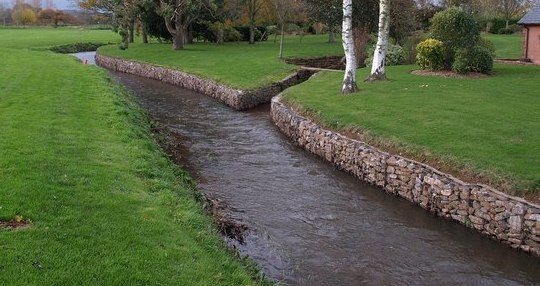
Gabions need to sit on a compacted base, something like MOT 1, whacked down. They seem to work OK as a way of controlling bank erosion along streams and rivers:
-
Pretty much. Here's a video showing a Finnish system being installed by hand:
-
In your position, I think I'd either use gabions, if I didn't mind the work involved in digging out flat areas for them, and filling them with stone, or I'd look at using screw minipiles, and putting them in by hand. The latter would probably be a lot less work, but might incur a higher cost.
-
Save the world, install an LPG tank.
Jeremy Harris replied to epsilonGreedy's topic in Environmental Building Politics
That link illustrates one of the major frustrations that many scientists have with the way conclusions are publicised. There are always caveats and bounds around any prediction, yet the majority of media reports will ignore those caveats completely, and without them the reported numbers are often meaningless. Science often deals with the probability of any outcome, from many possibles, becoming a reality. Often the most likely outcome will change if one or more of the assumptions change. One of the worst examples I've seen, and one I was peripherally linked with, was the infamous paper outlining the probability of Iraq possessing deployable and effective weapons of mass destruction. There was no doubt that the regime had been in possession of a limited quantity of crude chemical weapons, but there was little evidence that they had ever been able to truly weaponise them (as in make them deployable and effectively deliverable) and no evidence that they had the capability to produce large quantities of agent. That finding was presented to government, who then chose to cherry pick the words they felt would support their desire to go to war, whilst ignoring pretty much all the hard evidence. -
Yes, we have a couple of thousand litres of surge storage under the drive, but it's not IBCs, I used 20 off heavy duty Aquacell crates, the blue ones that are OK for up to 44 tonne vehicles: http://aquacell.wavin.co.uk/