


Jeremy Harris
-
Posts
26430 -
Joined
-
Last visited
-
Days Won
360
Everything posted by Jeremy Harris
-
Welcome Mark. The building regulations that apply to doors and thresholds are detailed in Approved Document Part M : https://www.gov.uk/government/uploads/system/uploads/attachment_data/file/540330/BR_PDF_AD_M1_2015_with_2016_amendments_V3.pdf These regulations don't apply retrospectively, unfortunately, but nevertheless they do form a reasonable guide as to what should be provided. The key elements that refer to doorways are that the clear opening width must be at least 775mm and that the threshold should not have a step greater than 15mm high. If your home is classified as being a wheelchair user dwelling then the additional requirements in Section 3 of Part M apply. Hope this helps.
-
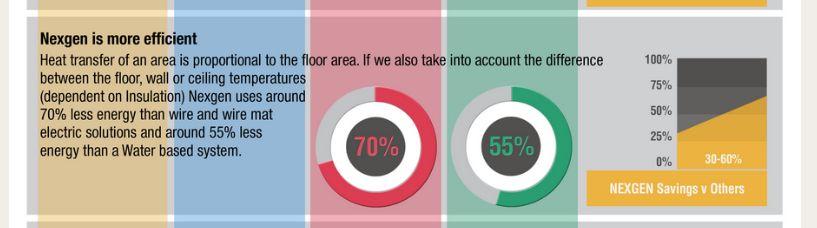
Nexgen heating– Desktop performance comparison with electric wet underfloor heating Nexgen ( @Clive Osborne ) claim in their advertising that their electric resistance heating system uses, quote: “around 55% less energy than a Water based system”. This desk top analysis seeks to examine that claim, using known data. Example used for comparison For simplicity, and because I have hard performance and heat loss data to hand, the house used for this comparison will be my own. This has a wet underfloor heating system, that covers about 85% of the floor area. It is an electrically powered system, so is a fair comparison with the electrically powered Nexgen heating system. In terms of energy efficiency, in the context of primary energy usage versus delivered heat energy output, our electrically heated wet underfloor heating system is comparable to using a gas boiler as the heat source, and slightly more efficient than if it used an oil fired boiler or LPG fired boiler. Primary energy efficiency factors can be found in the BRE definitions that are used in SAP (https://www.bre.co.uk/filelibrary/SAP/2012/Emission-and-primary-factors-2013-2027.pdf) and are: Mains gas = 1.28 Electricity = 3.28 For example, for a house heating system that consumes 1 kWh of energy at the point of entry of the energy source, then for mains gas that would be equivalent to 1.28 kWh of primary energy required, and for electricity it would be equivalent to 3.28 kWh of primary energy required. These ratios are roughly equivalent to cost, so mains gas is currently about 1/3rd the cost of electricity for any given amount of energy. I have a fairly accurate thermal model for the house used in this example. The key data are: Worst case heat loss (-10°C OAT, +21°C room temperature) = 1,672 W Underfloor heating floor surface temperature (for above conditions) = 23.2°C Heat loss to the underlying ground (ground temperature constant 8°C) = 136 W Basic efficiency of wet underfloor heating (ignoring energy source) = 91.87% Heating power required = 1.0885 * 1,672 = 1,820 W Heat source primary efficiency comparison The source of heat for this wet underfloor heating system is a Carrier air source heat pump, and with an outside temperature of -10°C and a flow temperature of 40°C this has a coefficient of performance of 2.7. This directly equates to an efficiency (in terms of electrical power in to heat power out) of 270%. If the heat source was a condensing gas boiler, then typically the efficiency would be about 88% for these operating conditions, perhaps slightly higher due to the low return temperature and high probability of full condensation heat recovery taking place. If the heat source was a direct electric resistance heating element, such as an electric boiler, then the efficiency would be extremely close to 100%. Applying the primary energy efficiency factors to these three fuel sources/heating types gives the following primary power equivalents for the specified conditions: Electricity, via ASHP = 1,820 W * (1/2.7) * 3.28 = 2,211 W Mains gas = 1,820 W * 1.136 * 1.28 = 2,646 W Electricity, direct resistance water heating = 1,820 * 3.28 = 5,970 W Heating system efficiency comparison In the Nexgen advertising material there is a specific efficiency claim, namely that the Nexgen electric resistance heating system uses “around 55% less energy than a Water based system”. If we take the Nexgen advertising claim at face value, and use this with the data from the known performance for the wet underfloor heating system in this example, then “around 55% less energy” implies that the Nexgen heating system only requires around 45% of the energy input for any given heat output. We know, from the data provided by Nexgen, that their heating elements are resistance heaters, and we also know that (ignoring any loss in the mains voltage to low voltage conversion system) that all resistance heaters have an efficiency of very close to 100% [1] . In the comparison below this upper efficiency limit of 100%[1] is used. If we compare the advertised performance of the Nexgen system, with the known performance of the wet underfloor heating system, then we get the following primary power figures for the example house heating requirement: Electricity, via Nexgen heaters = 1,672 W * 3.28 = 5,484 W Converting the primary power from all systems considered here gives the following relative efficiency comparison, in terms of primary power, with electricity via an ASHP being assumed to be 100% : Electricity, via ASHP and wet underfloor heating = 100% Mains gas, via condensing boiler and wet underfloor heating = 83.6% Nexgen heaters = 40.3% Electricity, via direct resistance heating and wet underfloor heating = 37% Conclusions Is the claim made by Nexgen that their heating system uses “around 55% less energy” supported by this evidence? The short answer is that their claim seems to be unrealistic, and very unlikely to be true. In this worked example, for a house that has wet underfloor heating and known heat loss characteristics, then, at best, the Nexgen heating system might be around 3.3% more efficient than direct electrically heated wet underfloor heating. It should be noted that very few wet underfloor heating systems use a direct electric boiler. A more realistic comparison would be with a mains gas heated underfloor heating system, as this is probably the most common arrangement for this type of heating. The Nexgen heating system is 37.2% less efficient than such a heating system. [1] The Nexgen efficiency claim seems to defy the laws of physics. We know that the Nexgen heating elements are of a fairly conventional resistance type, albeit using a non-metallic film as the element. All resistance heating elements, no matter what they are made from, behave in exactly the same way in terms of their efficiency in converting electrical input to heat output. The Nexgen claim amounts to that for an over-unity device, and such a device cannot exist, as it would contradict the First Law of Thermodynamics: https://en.wikipedia.org/wiki/First_law_of_thermodynamics Additionally, the Nexgen system operates at 24 V, so must include some form of voltage conversion unit. Any such unit will be less than 100% efficient, so there will be losses associated with that which reduce the overall system efficiency (unless the voltage conversion unit heat losses contribute to the room heating).
-
I'm part way through doing a desk top study, comparing the efficiency claims made by Nexgen in their advertising, using a specific, known, whole house heating requirement, using hard data for primary energy efficiency and local system conversion efficiency. It'll probably take me an hour or so, as I want to be 100% certain that the data I'm using is valid.
-
I've (repeatedly) asked you a very specific question about efficiency. You have studiously avoided answering it. Will you please state the efficiency of your heaters, in terms of electrical power delivered from the mains to heat output power that is emitted by your heaters. This data should be at your fingertips, as it will have been required when you you undertook product testing for ErP and Lot 20. Just post an image of the energy efficiency label showing the rating if you wish. I would very much like to see the hard data to support this claim from your advertising, please:
-
Sorry, but what exactly did you mean, then, when you quoted my post about efficiency, and added this comment? : I made no mention of running cost at all, you raised that when writing that comment above, and that begs the question about efficiency, as running cost is directly proportional to efficiency (unless someone has re-written the laws of physics recently).
-
This is, frankly, disingenuous. The heat from your heating elements (or any other for that matter) ends up being absorbed by all the materials in the room, barring a part that will be radiated out through windows (even low e coated glazing allows some radiated heat to escape, as I'm sure you know). The amount of heat each surface or material absorbs depends solely on it's surface temperature and emissivity.
-
Sorry, but you seem to be avoiding the question a bit. All this stuff about CO2 emissions is just a red herring, and has no bearing at all when comparing one form of electric resistance heating with any other, as I'm absolutely sure you know. The resistance of the heating element is neither here nor there either, as all that changes is the heat output, or electrical power input, for any given applied voltage, as I'm sure you're already aware. Let's try making it a bit simpler. If your heating elements are supplied with 1 kW of electrical power input, do they give out more than 1 kW of heat?
-
@Clive Osborne, could you please answer the efficiency question? Are your electric resistance heaters any more efficient than any other form of electric resistance heating, and if so, could you please explain why that is? (in terms that this humble scientist can understand).
-
So, would I be correct in assuming that SAP would treat your product in exactly the same way as any other form of electric resistance heating? i.e., if a house had a heating requirement of 4,000 kWh/year, would your electric resistance heaters give a different rating in SAP than, say, any other form of electric resistance heating? If your product is treated differently in SAP, perhaps you could explain why that is, please?
-
Not what I wrote. Try reading it again, perhaps? Are you suggesting that your heaters are greater than 100% efficient? If so, perhaps you might care to explain exactly how you achieve this. Alternatively, perhaps you might wish to try and explain why any other electric resistance heater can be less than 100% efficient, and how that manages to comply with the laws of physics.
- 99 replies
-
- 1
-

-
- pressurised
- vented
- (and 1 more)
-

Your Home Base Load / Background Power Draw
Jeremy Harris replied to MrMagic's topic in Photovoltaics (PV)
Ours is similar, around 150 W to 200 W. The main culprits for us are the treatment plant air pump, the water UV disinfection unit and the fridge/freezer, not things I can reduce. -
We're about 315ft ASL here, so probably near enough the same as you, I think.
-
Right now it's 24.3°C outside on the North (shaded) face of our house. 11/7/2119, 13:53 GMT
-
Yes, a friend had electric radiant ceiling heating in his house in Penryn, which worked in very much the same way. Not a great solution, IMHO, as it tended to result in your head being warm and your feet cold. Not sure what advantage putting heat into the bit of the room that's likely to be the warmest area is, TBH. It seems a lot more sensible to put the heat in the floor, where it is likely to result in a more even spread of temperature in the room. For cooling, ceiling panels work very well. We had them in the office I last worked in, fed with chilled water in summer. Generally very effective, with no noise.
-
If, as in this report, Edinburgh's climate becomes more like Paris, then, given that Paris got to around 40°C a couple of weeks ago, it looks as if Edinburgh could get quite toasty. However, as @SteamyTea says, what actually happens is likely to be a lot different, due to local conditions. The same report says that Leeds will get like Melbourne, Australia, but that's pretty much ignoring the fact that Melbourne is a coastal city and Leeds is inland, amongst other factors.
-
Between half and three quarters of the capacity of a typical UK 4 kWp system, yes, so not that difficult to install. Still expensive though, if installed professionally.
-
The unit that I'm in the process of fitting, according to the paperwork that came with it, has an annual energy use of 153 kWh, so two of them would use about 306 kWh per year. Flat out, when cooling, each unit needs about 780 W, so about 1,560 W for two. A pretty small PV array would cover the power and energy requirements for a couple of these, probably around 2 kWp to 3 kWp should do the job OK.
-
Solid wall block choice, Ytong, Celcon, Thermalite?
Jeremy Harris replied to romario's topic in Brick & Block
IIRC, some ICF companies can supply curved forms, so that might be an easier way to get a well-insulated and relatively easy to build round house. There was a Grand Designs episode years ago, with an ICF build that had a round, spiral, tower in one corner, to a pretty tight radius. -
My guess is that the initial changes we'll see will be the more widespread use of air conditioning systems, a bit like pretty much the whole of the USA. In many ways, a comparison with the USA is probably quite useful, as homes there have had to deal with higher temperature extremes than we ever see ever since the place was settled. When I was working in Southern Maryland we'd get sub-zero (°C) winter temperatures and summer temperatures that were often well over 30°C. The area I was working was just over the river from the location of the first English settlements in the USA in Virginia, and I can really understand how those early colonies nearly didn't make it, largely because of the climate.
-
£290k, believe it or not! Seems they didn't have insurance, as they had a Just Giving campaign that raised over £35k after the fire. Overall, it looks like their five or six years of work paid off for them, as, according to the article, they only had £500 when they started. Even if they get around £200k they will have done reasonably well from the project, an order of magnitude more profit than we have with our five or six year project.
-
Yes. The problem is that the humidity inside the house may well be higher than that outside, so the cold duct may attract condensation on the outside surface.
-
I strongly suspect that the legal test would be the standard one for "reasonableness", "What would be the view of the man on the Clapham omnibus?". That's generally the test that's applied when it comes to judging things like intent. I suspect that the majority of people might judge that building an unlawful development in amongst trees would be considered to be an intention to conceal, but I may be wrong.
-
The application we dealt with last week was just an unlawful development that had been built amongst trees. I'll track it and see what happens, but the legal advice we were given was that building or erecting a dwelling unlawfully, that was hidden by trees, would be considered to be deliberate concealment. For a certificate of lawfulness to be issued would require that the development should be in plain sight, and without attracting any objections for four years. If that changes in the light of the legal bods looking at it I'll post back here, but that won't be for at least two months, I suspect.
-
Yes, that's right. We had a case last week where a certificate of lawfulness application was presented, on the basis of a development that had existed, in some form or another, for about 12 years. It's been referred to legal, as local opinion was that the development was deliberately hidden behind trees. I drove up to look at it, and my (unqualified) opinion is that it was deliberately hidden. In the process our clerk read out the relevant law and case law, and if an unlawful development is deliberately hidden from view then the normal rules that apply when applying for a certificate of lawfulness cease to apply.
-
Welcome. You may get lucky with building an unlawful development and not be noticed for 4 years, but I suspect it's a heck of a long shot. There are (sadly, perhaps) a fair few people around who like nothing better than reporting what they see as unlawful activity, particularly amongst the hardened walking community (IMHO). I doubt more than a month goes by here without a report by some nosey parker being submitted, with a fair few seeming to come from those who must spend hours just looking at Google Earth as soon as a new set of imagery is available. Added to that, our local authority employs someone to just drive around looking for new developments, so they can charge council tax as soon as possible. My experience of one of these people was that they weren't averse to climbing over security fencing in order to try and snoop around. It would be great if more local authorities had policies like those in parts of Wales, aimed at encouraging sustainable development, but it doesn't seem as if many are keen on the idea.