
Nickfromwales
-
Posts
31377 -
Joined
-
Last visited
-
Days Won
345
Everything posted by Nickfromwales
-
Then don’t waste money on the wood burner?!?! You’ll light it once, melt to death, and then use it as an ornament. If you can’t get a wood burner ‘roaring’ then the process of proper combustion and incineration doesn’t occur, so lots of nasties in the glue and off to upset the neighbours. Are you allowing for that to be a room sealed / externally fed appliance?
-
Doesn’t bother anyone, but if there’s nobody coordinating on site then it opens up unnecessary risk. @junglejim, as them to remove the hallway loop and take all the other flows and returns through that thoroughfare, as it doesn’t need its own specific loop. Expand the (return) of the porch loop into the last 1/4 of the hallway and then you can take all feeds through doorways.
-
I’d move the manifold off the wall of the bedroom too!!
-
What cc have they proposed? At less than 200mm cc you cannot perform a U-turn with 16mm (pert-al) metal lined pipe.
-

Unvented hot water cylinder (electric)
Nickfromwales replied to AidanGee93's topic in Boilers & Hot Water Tanks
Correct. I doubt you need to double check, as this is a standard setup. Breaker in the peak rate CU > kitchen switch > RHS switch at cylinder. Breaker in the off peak CU > LHS switch at the cylinder. As said the kitchen switch is for those who fully fill that cupboard with ‘life valuables’ and ergo can’t get in there to easily flick the RHS (aux hot water) switch on / off. -
Concrete floor as a finished surface. The results are in.
Nickfromwales replied to saveasteading's topic in Floor Structures
Porcelanosa in Cardiff delivered 120m2 of 600x600 polished porcelain to a job in had going on. I took one look at them and said ‘send them back’. Clients looked at me as if I was a loony. I got a used teabag and some red wine, and splashed the tile / left teabag on for 5 mins. I said to go clean the tile afterwards and it remained like Gorbachev’s forehead. Teabag stain 90% gone but still notable. Back the tiles went. Clients were hopping mad at the supplier, and very grateful for my intervention. They’d specifically asked about resilience to these things, and were assured outright that zero effect was possible. Don’t believe everything you’re told people. -
Unvented hot water cylinder (electric)
Nickfromwales replied to AidanGee93's topic in Boilers & Hot Water Tanks
2 consumer units, so possibly 2 meters? E7 loads on one, other on the second. Not sure how this could be run off a new supplier / discipline. Off peak immersion via kitchen switch will be E7, and the other immersion will be off peak rate 24/7 CU. -
Concrete floor as a finished surface. The results are in.
Nickfromwales replied to saveasteading's topic in Floor Structures
Having my living room look like a garage is very low on my wish list. Got to wonder what happens when you drop a glass of red wine on a concrete floor, after you’ve forgotten to re-seal it all again, and again, and again, to prevent worry from such spills. -
There are many ways to skin this cat....... You know me..... I'm always expressing an opinion due to my 'lack of varnish'
-
Arms like a fiddler crab afterwards?
-
Mat the force be with you, as grinding concrete with that wonderful looking machine, is a bastard of a job. Check how many 'teeth' you'll go through before taking the leap.
-
Agree in principle, but the widow fitter should have managed expectations here, before money changed hands, and told the OP that it would be a distinct possibility that the gap under the new window could, POSSIBLY, be used as an emergency runway for Heathrow.
-
Just then need to gaffa tape them to the other edge of the board for transport so you don't snap the bastards, lol.
-
Joists have dropped - sister joists & ply??
Nickfromwales replied to dan_cup's topic in General Flooring
May be a good time to spray treat with woodworm / rot preventative chemicals, if it's getting all covered over for the forseeable. -
Be nice to each other and agree an amicable resolve. Simple!
-
@Stratman Mist system saves a load of money on tanks / pumps / bigger incoming cold mains, and only runs for a set 45 mins iirc. The equivalent of you filling a bath and tipping it over, and that's the sum of the water damage vs a sprinkler which will devastate the property by flowing continuously until discovered.
-
Yup. A robot in cyberspace says: Yes, you can fit a water mist system instead of a traditional sprinkler system in Wales, as the regulations require an "automatic fire suppression system" (AFSS) rather than explicitly demanding a traditional sprinkler. However, this alternative must meet specific, strict standards to be accepted by Building Control. Here are the key details regarding the use of mist systems as an alternative to sprinklers in Wales: 1. Regulatory Compliance (Approved Document B - Wales) Mandatory Requirement: Since 2016, all new residential buildings, care homes, and high-rise student accommodation in Wales must have an automatic fire suppression system. Approval Standards: Water mist systems must be designed and tested to recognised standards, typically BS 8458:2015 (Residential and domestic water mist systems). Case-by-Case Assessment: Because mist systems are sometimes considered "engineered solutions" rather than standard prescriptive solutions, they must be validated by a Building Control Body to ensure they are fit for their intended purpose. 2. Benefits of Mist Systems over Sprinklers Mist systems are often chosen as a "direct replacement" because they offer several advantages, especially in retrofits: Less Water Damage: Mist systems use up to 90% less water than traditional sprinklers, reducing post-fire damage. Installation Ease: They can often connect to the existing potable water mains rather than needing a dedicated water tank, making them much easier to retrofit in homes or apartments. Flexibility: They can be used to achieve compliance for open-plan living, loft conversions, and open-plan staircase layouts. 3. Considerations No "Off-the-Shelf" Approval: Unlike standard sprinklers, not all mist systems are suitable for every situation. You must ensure the chosen system has valid third-party certification (e.g., LPCB, IFC). Early Consultation: It is highly recommended to consult with your local Building Control Body in Wales before installation to ensure the system will be approved. System Type: The system must provide full building protection, not just localised, spot-protection. In summary, a properly specified and installed water mist system is a viable and often preferred, compliant alternative to sprinklers in Wales, offering similar safety standards with fewer installation constraints.
-
I'd have rather had a dummy cill slid in under the functional one, than that gap, with that additional one fettled so it follows the angle of the concrete cill! The 25mm of cement infill will be no good, as it'll just give up over time and look terrible. But then the installer would have washed their hands of the job.
-
It'll cost you £24 in the sheds for 2 more P4/5 boards, and then just cut off the female groove to glue and fix down against the male tongue, and use up the boards up the attic or other. You'll get 4.8m off the two ends, and then the remainder off one of the 600mm returns. If you go to a big B&Q they'll cut them down for you in store. Much quicker, and the proper job to infill. FWIW, that close to the edge, I would not be cutting that existing board back at all.
-
@Stratman, have you asked if you can go for a mist system instead?
-
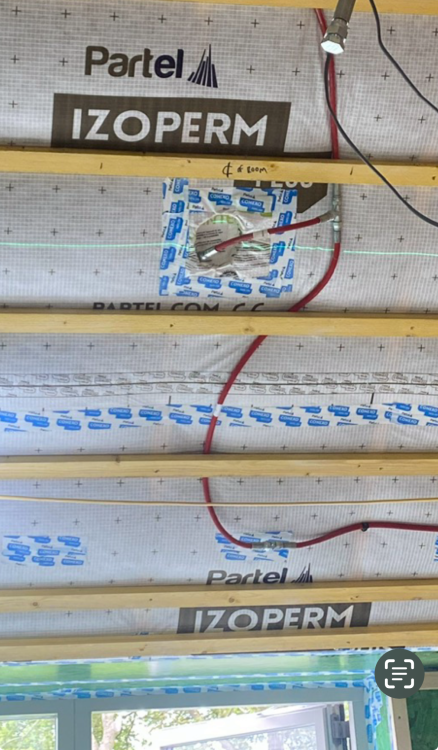
Yup. Done a few with both types (sprinklers and mist) of automatic fire suppression systems. This was what I did on an MBC PH TF client project. I made top hats out of membrane and tape, using an off cut of the 125mm duct (or something round etc) and then set them in to give the required depth. Did the same downstairs when I did the prep for the cinema room speakers to go in (Dolby Atmos ones in the same type of ceiling, under the balcony). Easy enough to sort without adding more battens, if you know beforehand what’s going in etc. I got MBC to specify holes in glulam and steel beams to allow services to get about the superstructure with ease. Makes 1st fix a breeze!
-
Beware how you create the opening, as if it is the thin / old / frail brickwork then disturbing it can be the beginning of a long journey. You may very well need to line this with timber stud frame, and then dress the doorway into that, to give strength back locally to the cut brickwork (drilling fixings into each course, and possibly bonding too). Some pics would help.
-
My thoughts too, , was just trying to be gentle but yea, agreed, go buy some bends and GTF on with it. @hauntedicecreamvan, have you allowed for some attenuators to keep operational noise down at the terminals?
-
The unit you’re buying is a totally different beast to the “bread & butter” Nuaire unit.
-
Look closely at AeroBarrier for getting the airtightness dialled in. If this is a refurb of an existing structure then this can offset a lot of time, labour, and expensive products in one swoop. Just had them on site on a masonry refurb and got a high 0.1 ACH, so deemed a rock solid 0.2. Damn them for not having two decimal places on their software!?! 😤 Oh, and congrats. 🥳