Paulgwat
-
Posts
9 -
Joined
-
Last visited
Paulgwat's Achievements

New Member (2/5)
1
Reputation
-
Assuming you put a level platform directly in front of the front door, create the ramp heading left towards the corner of the property. instead of having the ramps sloping side visible build a level wall to its front most side to replicate the 3 courses of black brick and however many courses of yellow brick you have on the existing frontage - we have a similar issue and we are having the ramp to the left handside and steps to the right, the wall itself will be a thin planter that will include trailing plants to soften the wall - thankfully we are helped in that the slope of our plot actually reduces the amount we need to travel downwards over its length - otherwise it would look like an olympic downhill ski slope! from straight on all you would see is the area to the far left where the ramp would turn onto ground level, the rest would appear to match the existing frontage.
-
Botus thanks for your comments, it is possible that the height of the storm drain connection could be made low enough at the property boundary to facilitate a connection to the gulley but it would involve trenching 20+ metres to a depth of more than 2M by the time I reached the property boundary, which is doable but would be a huge amount of work as it would need to avoid all of the other services running in that area, hence my idea to use a pump to simply lift the water that meter so it can use the existing storm drain connection. Regarding the DPM, that is exactly what I am doing, there shouldn’t be any ground water from the surrounding soil moving into the sunken area, so the only water I need to worry about in my mind is that which falls directly in the area I am concerned with.
-
Alan thanks for your comments, the rainfall data I referenced above is the same as was used when the rain water harvesting tank was sized so I am relatively happy that the amount of water is in the right ball park, SUDS is being taken care of via the attenuation pond that the storm drain feeds in to. My challenge so far has been finding a larger sump that has an in built water capture lid like the one I linked - all of the others seem to require either a separate gulley or channel drain. The vertical lift for the pump is going to be sub 1M in reality. The Tsurumi pumps were my first option as I have used one of them with a chamber to clear water from a patio outside the entrance to a basement flat but they just seem overkill when even the smallest ones can do 12,000 litres per hour at zero lift and are capable of 12M lift. the pump I am looking at using is rated at 3,000 L/hr at 1M and 5,000 L/hr on the flat and is suitable for a max head of 3M so seems like a good compromise whilst only using a 1inch pipe.
-
We are trying to "screen" the seating area from a property to our left that is uphill, a property that is behind us that is significantly down hill where the fence on our side is only about 1.2M high but on their side something closer to 1.8M and a property to the right where the wall is about 1.6 -1.7M our side but probably nearer 2M on the other side. The development is essentially 4 fields the slope into a small valley with the field boundaries left intact but the original developer did nothing to try and make the 4 build areas flatter. I believe anything over the height would need to be a minimum of 1M in from the boundary and as we are trying to get privacy on all 3 sides of the garden we would have to sacrifice a good 20sqm of useable garden to achieve what you describe - we are making use of hard landscapping and using high and low planting etc to disguise the boundaries as much as we can but we still have the privacy issue if the seating area is at ground level. We have been trying to come up with garden plans for the last 3 years and unfortunately we keep coming back to the same conclusion that down is our best option As for costs, the hole is already there so the costs to build are limited to a couple of pallets of blocks and some concrete for the base but this is being done at the same time as the garage floor so the concrete is almost free due to part load costs etc.
-
-
Interesting responses to what I thought was a technical question and definitely not one where I expected my ethics to be questioned!!! I was asking a question on my calculations of water removal only but will fill in the other somewhat irrelevant facts for people This area of garden is located around 10M from the house so unlikely to be causing any issues with the foundations - I would expect more of a concern for my foundations would be the neighbouring house which is approximately a metre away. The main house roof does indeed go into a multi thousand litre rainwater harvesting tank that is also buried in the back garden which will be used for toilet flushing, washing machine and garden irrigation. I have been advised by the manufacturer of the rain water harvesting system that collecting water from the sedum roof on the garage and any flat area of patio should NOT be drained into the rain water harvesting tank due to the high probability of the water being contaminated with debris etc. The water from this area of garden would go into the storm drain (which is also where the overflow of the rain water harvesting tank goes) which will connect to the sites storm water drainage system that feeds into an attenuation pond at the bottom of the hill serving the other 200+ houses on the site and covers something like an acre. There will be a low wall around the sunken area which will prevent run off from our garden (nearest up hill garden boundary 10M away) and in the 3 years I have owned the plot we have never had any issues with run off or standing water flooding on the plot or neighbouring ones. I would be interested to understand where the additional volumes of water would come from? All of the rest of the ground around the plot will be laid to grass or made of permeable materials. My Building regulations company are not interested as they view it the same as if the water was collected on any flat surface, and the response from planning was that it falls under general landscapping and even if it didn't it would be classed as permitted development. The storm drain is not adopted due to the private SUDS pond and they view it the same as if it was a patio or driveway with gulley drains. The one thing the council have stipulated is that all boundary fences, planting etc be a maximum of 1.8M tall ( and they are already in place for houses which pre-date ours - the make up of the site means the fence is 1.8M on the other side but far less our side and also they own the fences) which is where all of this started as the other locations to put a table and seating area would mean zero privacy for us and our neighbours. I will leave it at that as I believe I am doing more to mitigate the impact of my house on the site than most would Regrads Paul
-
Hi all, I am hoping someone can sanity check my thoughts here, we are planning a 4M x 4M sunken garden area in our self-build. Due to the plot layout and height differences versus other properties we would overlook other gardens if the seating area was at garden level. Digging down a metre means we are already in heavy clay so a soakaway isn’t an option. I am trying to get my head around the sizing of a sump and pump for the sunken area as all of the off the shelf solutions I have found seem to be aimed at large basements where any amount of water needs to be contained and removed urgently, lifted many metres vertically and cost ridiculous sums of money given the context. From a bit of googling it seems that 1mm of rain falling on a square meter is 1 litre - for Bristol, where we are, typical rainfall amounts are 0.5mm to 4.00mm per hour with storms reaching 45-50mm /hr Taking the worst case 50mm per hour and our roughly 16sqm sunken area is 800l/hr of rain fall. Given that I am only going to be moving this water about 3M horizontally and less than 1M up (there is a handy storm water drain near by that I can connect into) I am planning on using a 24V submersible pump capable of something in excess of 3,000l /hr pumping @1M vertical as these are commonly available for boats and seems to me a good margin versus expected use and the cost differential to something smaller is negligible. I am using 24V DC as the house has Loxone home automation and we have plenty of 24V already available locally to where the pump will be located So my question is how big should I make the reservoir the pump sits in? Rather than buy some huge tank and putting in perimeter channels I am thinking of using this https://vodaland.co.uk/collections/300x300-catch-basins-and-gullies - nominally it is about 25L capacity but with a couple of spacer rings that can be increased to about 45l quite easily At 4mm/hr it would take about 5mins before there was sufficient water in the catch basin to turn on the pump which would then run for about 10 seconds then wait another 5mins for the catch basin to refill and so on Even at 50mm/hr rainfall the pump would run for about 20 seconds per minute which is well within its specification. I am not too worried if a sudden huge amount of water was to overwhelm the sump as I won't be out there getting my feet wet when it does!!! Am I massively over thinking this or would you do something different? Thanks Paul
-
@Nickfromwales thanks, I have gone back to Potton for them to review the drawings as have had to put the scaffolding back up to look at this and don't want to have to do it again
-
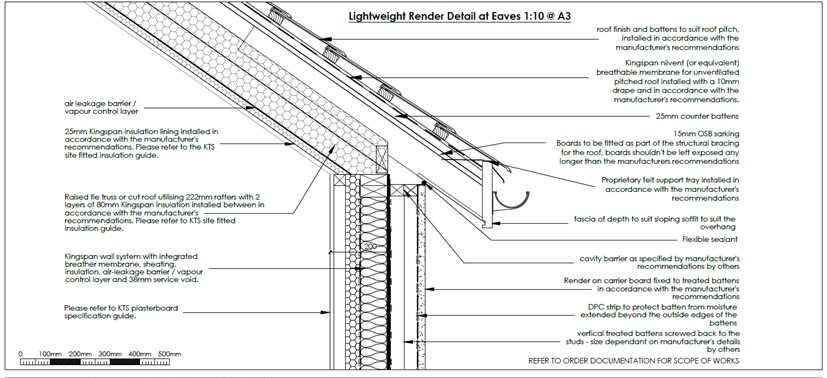
Hi all, I am looking for some help in understanding where i might be going wrong here. We purchased a Potton timber frame and they supplied the attached detail for how the roof should be constructed for the 2nd floor (these are bedrooms and bathrooms with a wall height at the edge of the room of 1.5M and a sloping roof until 2.4M). We have followed the drawing, installing the counter battens as indicated on top of the sarking board and then installed the vapour barrier (Rhinovent Pro) over the top of the counter battens with the 10mm droop as indicate in the install instructions for the membrane. Battens have then been installed on top of the vapour barrier to allow installation of solar panels and roof tiles. We are basically revisiting this as we have issues with water somehow getting in either via the Velux windows or through the membrane itself (to our knowledge there are no rips or tears in the membrane) and running down the sarking boards and finding its way to the wall plate. So my questions are 1. Have i bought a rubbish membrane? What should I use instead? 2. Detail from Potton calls for Kingspan Nilvent (or similar) but all of the information on Nilvent says it should be laid on top of the sarking board and not over the counter battens - which takes precendence here? 3 Does anyone have specific information on how to install a velux window on a sarked roof with counter battening, as we couldn't find anything. I am sure I have left out a bunch of relevant info, so apologies in advance if i have omitted anything important. Thanks in advance Regards Paul