
Nickfromwales
-
Posts
31373 -
Joined
-
Last visited
-
Days Won
345
Everything posted by Nickfromwales
-

Is this a reasonable cost for plumbing first fix?
Nickfromwales replied to Great_scot_selfbuild's topic in General Plumbing
I should have clarified, but I was 3 pints in at that stage. Nobody who gives a feck basically. I think you’re probably right. lol. -
Is this a reasonable cost for plumbing first fix?
Nickfromwales replied to Great_scot_selfbuild's topic in General Plumbing
Point to point, multiples of continuous pipe from A - B, with a pipe for bath hot, a pipe for bath cold, a pipe for shower hot, another for shower cold, another for WC cold, another for sink hot, and cold, and so on until the whole house is plumbed. Each fed from a hot manifold and a cold manifold, so every individual pipe can be isolated independently for service. I put them in the same place to simplify plumbing. -
Is this a reasonable cost for plumbing first fix?
Nickfromwales replied to Great_scot_selfbuild's topic in General Plumbing
You have way too much spare time mate. 😅 -
Is this a reasonable cost for plumbing first fix?
Nickfromwales replied to Great_scot_selfbuild's topic in General Plumbing
Nobody series plumbs anymore, that I know, as it’s just inefficient and introduces bucketloads of hidden joints. 👎. “Radial ‘til I die”. -
That’ll be plenty. Just wipe everything with a cloth to get dust cleaned off, so the tapes stick well. 👍
-
Apologies, on a job that’s keeping me busy atm. I would have said this. Glad they carried on, and you’re making progress.
-
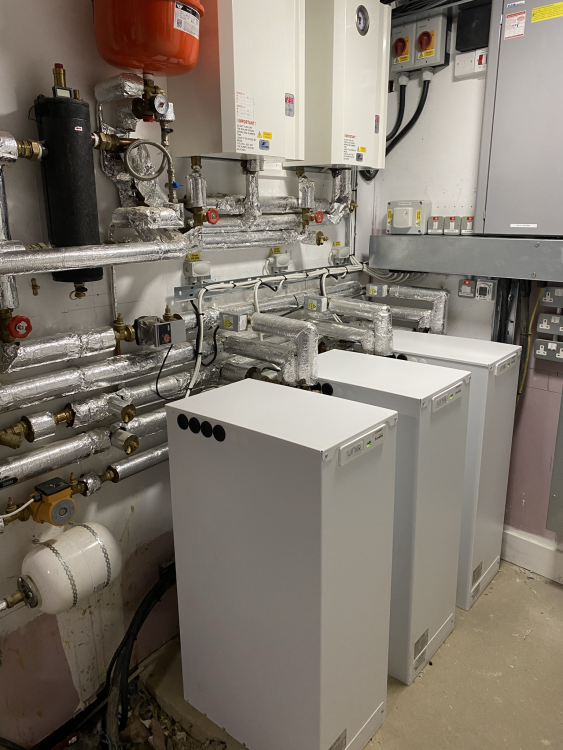
You just need a good plumber who sees things holistically. My jobs are all planned in advance of the construction phase, with a line out done comprehensively; line outs are used for identifying all trades requirements, for pipe and cable pathways / service risers etc, so as to delete any downstream conflicts or ‘feck ups’. A good trade will support you here, but all too many of them expect to have this handed to them on a plate so they can just paint by numbers. Time and money goes down the tubes PDQ when your double handling or moving sideways (or backwards) plus trying to find trades whilst the plates are all spinning is time consuming and stressful, hence I always say to sort this in advance. Designs are wonderful if they’re done by the person responsible for bringing them to life, otherwise they’re largely ignored, or aren’t worth the paper they’re written on. In over 30 years of doing this I’ve never produced a single design as it’s a waste of time and money. I did this plant room out of my brain space, from scratch. Just sat there for 4 hours in silence planning it out, then told my electrician where his cable trays needed to be so I could plumb around them, so he could get started on 1st fix before my kit even arrived. The plans I was given from the supposed M&E designer went straight into the bin, utter garbage, which happens 99% of the time in the domestic sector. Commercial designs are always spot on, but the cost for that kind of setup runs into 5 figures. Architects never detail this, most don’t give a plant space bigger than a phone box, and desktop designs rarely layer the accumulative multiples of disciplines; choke points and interference are often unidentified until they’re staring you in the face and ‘the ship has sailed’. Just get a good (better) plumber, someone used to working more comprehensively, and ask them to help you plan this is my 2 cents.
-
Is this a reasonable cost for plumbing first fix?
Nickfromwales replied to Great_scot_selfbuild's topic in General Plumbing
22mm backbone is fine if there’s a hot return. Otherwise, just painfully slow to get hot water from basin taps. Avoid. -
Totally. For woodcrete I’d get them in before you have boarded, as that will allow you maximum exposure for the magic goop to do its thing. Follow on trades will all need inductions and in agreement to maintain the integrity of that airtight layer. On an Isotex job the client tried a liquid membrane, spray and brush applied, but the woodcrete simply has too open a pore for this to work well on bare woodcrete. Another parged first and got 0.66ACH, but neither were ‘cost effective’ (they were expensive as feck). AB is your friend here, but obvs a certain amount of prep needs doing ahead of their arrival.
-
But……would the pipes not move also?
-
That’s good to hear. They are doing it correctly. 👍
-
As you’ve gone for woodcrete, I would tell you with my last breath, to get AeroBarrier in to get you airtight. Leave all the parge coating etc and just let the magic happen. You’ll thank me later.
-
It took a loooong time to get there, but yes, in a nutshell. lol. 🥳👍
-
IVAR UFH Blending Valve stopped working
Nickfromwales replied to Rob99's topic in Underfloor Heating
Cheap and quick sanity check. Best to start the process of elimination there as it sounds like that’s defo the choke point. -
Bathroom wet UFH floor buildup
Nickfromwales replied to Super_Paulie's topic in Bathrooms, Ensuites & Wetrooms
That’ll work. If it’s 50 a lot, or high 40’s you’ll maybe find it a bit too warm. Perhaps reduce the quantity of pipe to just a squiggle where you’ll be standing when towelling off etc. -
This is getting out of hand lol. There’s is zero chance of pulling all these hypothetical cables, from and to those hypothetical locations, without a padsaw, a hammer, a hole cutter, and shares in Toupret (cos you’ll need a lot of filler). Conduit is the only semi-feasible option, to every box, to a central location. Barmy. Sorry.
-
To answer your original question, you need to work from the invert of the sewer back to the house, unless you're on a STP?
-
IVAR UFH Blending Valve stopped working
Nickfromwales replied to Rob99's topic in Underfloor Heating
Yup. Defo a curious one. So boiler fires up, heat gets to the mixing valve (defo on the flow pipe?), manifold pump is pumping, but no heat getting into the pipes. Can you try operating the zone valve manually, when this is running, and push the lever across so see if there's no resistance (eg that the ZV has fully opened, mechanically). -
Bathroom wet UFH floor buildup
Nickfromwales replied to Super_Paulie's topic in Bathrooms, Ensuites & Wetrooms
At what temp? -
IVAR UFH Blending Valve stopped working
Nickfromwales replied to Rob99's topic in Underfloor Heating
Pump spinning freely? -
Bathroom wet UFH floor buildup
Nickfromwales replied to Super_Paulie's topic in Bathrooms, Ensuites & Wetrooms
Gypsum ones may have issues with adhesion, so triple check those before attempting to stick tiles down. Cement based T&G boards should work well, but I’m always sceptical as these are brittle and are entirely reliant on the joists being straight etc. Wood bends and conforms, so I just prefer that method. Done plenty with alu spreaders under P5 + plywood + tiles. Works well, but needs higher temps than UFH in screed, so some jobs have needed a separate manifold for the FF bathrooms. -
Bathroom wet UFH floor buildup
Nickfromwales replied to Super_Paulie's topic in Bathrooms, Ensuites & Wetrooms
I always use 22mm P5, and then use the plywood as a binder; staggered joints and glued & screwed. P5 for strength, and ply as bulking material and a binder. Never had a floor crack so that’s my preferred method. -
IVAR UFH Blending Valve stopped working
Nickfromwales replied to Rob99's topic in Underfloor Heating
When you take the white control (TRV) head off, does the pin push in and release back out freely? -
I’ve painted a load of new kitchens, on new plaster, with the (cheap?) trade Matt Leyland stuff, no MVHR in a lot of the older jobs, and zero issues whatsoever. It is very chalky, so you can’t scrub it, but I can’t remember the last time anyone scrubbed their kitchen ceiling vs just painting it again. Diamond on the walls is very good, but a pig to sand / key for subsequent coats.
-
Bathroom wet UFH floor buildup
Nickfromwales replied to Super_Paulie's topic in Bathrooms, Ensuites & Wetrooms
I use PVA with a 3mm notched scraper on the P5, and lay the ply down onto that whilst wet. Then screw the ply down with 4.0 x 25mm screws at 100-120mm centres max.