JamesPa
-
Posts
1899 -
Joined
-
Last visited
-
Days Won
2
Everything posted by JamesPa
-
Similar prices here. £15-20K before the 5K BUS. No wonder BUS is not getting much take up. Not sure how this farce ends to be honest. Maybe Octopus will succeed in busting the cowboy's business model, but I doubt that they have the volume to do it alone. The fundamental problem is, I think, the requirement for MCS both for BUS (which is just about understandable) and for permitted development (which is scandalous). MCS expressly forbids separating the contracts for design and installation, otherwise it would be straightforward for a customer to 'buy' a design from someone who specialises just in design and get their favoured plumber to quote (ie the same model as architects/builders). Its almost like MCS and the rules around heat pumps are sponsored by the manufacturers of gas boilers!
-
It only needs to measure flow and return temp which it can do at the boiler. Then it adjusts the pump speed to get the desired deltaT.
-
If it's a monobloc then it comes gassed up. Only splits need gassing. Manufacturers mostly seem to specify that the unit must be installed by one of their certified installers to get an extended warranty (>2-3 yrs) but this does differ from manufacturer to manufacturer.
-
I think the argument works like this: To minimise the flow temp (and thus maximize COP) heat pumps (and CH systems designed to work with heat pumps) are designed for a deltaT across the emitter of 5-7C rather than the 20C gas and oil boilers are historically designed for. So the flow rate needs to be correspondingly higher to achieve that relatively low deltaT for the same heat transfer from emitter to room Simples really.
-
I guess it might help OP to provide a list of key specs (and gotchas) to consider. Here is my starter for 10 (simplest, not necessarily most important, first) Output, specifically Max output at low ambient temperature and your design flow temp – some ‘rated’ outputs are overstated at low ambient Min output at high ambient temps – this matters if you are trying to design with a small or no buffer (but note that system volume for defrost also affects whether a buffer is needed or not) Max flow temp – only matters if you are designing for higher flow temperatures (eg >50), which you shouldn’t be doing. Physical size and placement constraints. All units require space around them and R290 units have some more specific constraints. Have you got somewhere it can go? Also will it meet the permitted development volume constraint if PD is a consideration Appearance – can you tolerate it? Weight – only matters if it is not ground mounted Sound POWER (nb NOT sound pressure which is quoted on an inconsistent basis). Can you meet the noise requirements (eg for permitted development) given the specified sound power? MCS provide a spreadsheet making this easy to calculate. Controls – Weather compensation is a must, certainly for flow temps above 35C. Less important at low flow temps but still highly desirable. Load compensation is desirable unless you have only UFH and/or your house responds very slowly to temperature changes. Night time set back also desirable/essential depending on your control/heating strategy and house time constant. Ideally weather compensation should allow a non-linear/multi point curve to be programmed, very a few do this. However its only worth a % or two in efficiency depending on your specific scenario. Load compensation to some extent negates the need to have non-linear weather comp. As mentioned by @markocosic and if you can find them out (which, mostly, you cant), things like the intelligence in the control strategy when its heating up (as opposed to running in steady state) make a few % difference to efficiency when heating DHW or recovering from setback. Third party controls, eg homely, can mitigate deficiencies but, as others have said, it means being beholden to a third party (or writing some code of your own). Claimed SCOP at your design flow temp - (but possibly treat with a pinch of salt?) Refrigerant - R410a (still around) has a GWP of 2088. With a typical 3kg refrigerant charge thats 6 tonnes of CO2 equivalent if the refrigerant is released(eg on disposal). R32 (very common) has a GWP of 675 (so about 2tonnes CO2 equivalent if 3kg is released) and R290 (the latest available, not universally rolled out) a GWP of 3, ie negligible. By way of comparison heating a typical house with gas emits around 3 tonnes CO2 equivalent per year. I have no idea if refrigerant leak is an actual problem – perhaps others do! Availability and servicing availability – as discussed extensively Quiescent power consumption - some older models (particularly, but not exclusively, Mitsubishi) consume 200W or so when doing nothing, to keep the compressor warm. This problem seems to have been fixed on new models, but there may still be some rogues out there. Expect approx 25W or so. Is it MCS listed if this matters Price None will score top on all of these, but this list will eliminate most for any specific application. Of course that wont stop salespeople trying to convince you that their wholly unsuitable unit is just what you need!
-
From my research, but not yet experience, (and thus based on specs only), they all seem quite similar. The differences are in detail, but in any particular application the detail may matter. Form factor for the required output, the availability or not of load compensation, the availability (or not) of a setback function as well as physical appearance and sound power all vary and, in any particular case, including my own, are determinants. I have personally come to the conclusion that it's horses for courses rather than a case of there being a universal 'best'. Having said that I have to agree with the view that stock is a significant factor, if only to minimise the risk that service and spares become unavailable. These units should last for decades if maintained, it would be frustrating in the extreme if, in say 10-15 years time, most of the unit was still in good condition but it has to be thrown away because spares are unobtainable. Obviously there are no guarantees of spares availability, but it's perhaps more likely for a brand that is popular in this country than for an outlier.
-
Surprised you didn't include Mitsubishi in this list, any particular reason why (it's on my short list for very similar reasons).
-
As. I surmised, a mixing valve is required and there is at least one controller that will deal with it. However does this not mean that the CoP is governed by the higher of the two flow temps, thus losing the principal efficiency advantage of ufh, unless, as @ReedRichardssuggests, the ashp somehow reduces the flow temp when there is no demand from the rads.
-
Maybe Im being thick, but I cant see how any ASHP can, on its own, set different flow temps for different zones to be delivered simultaneously, since there is only one flow pipe coming out of the unit. Different flow temps at different times is possible (eg setback and for DHW) but two flow temps at the same time is not. The only way to achieve the latter is some sort of mixing valve which is what is commonly put in where there is a combo of rads and UFH. In principle this could be controlled by the ASHP, I dont know if any do this. Others may comment on how a rad/ufh combo could best be set up, or it may be in the manual.
-
Over on the ashp forum @Wil says he has batteries and a diverter. His posts imply that the batteries charge first, then the diverter kicks in. This would, having thought about it a bit more, most probably be the behaviour if you don't link them in any way and just instal both as if the other does not exist. You may want to check out his recent posts and think about whether this is the behaviour you desire (or if, indeed, it matters). It's probably the best behaviour if you also have ashp, because it maximises the probability that the water is heated by the ashp (with an efficiency of 200-400%) rather than the immersion (efficiency only 100%).
-
Is there any point given that you already have energy storage, or are you looking for a cheap way to store more energy? In terms of the actual question my first instinct would be that, unless your inverter specifically supports this function, it might be tricky. Solar diverters basically work by measuring the exported electricity using a current clamp and turning up the wick on the immersion to make that equal to zero. Your inverter is trying to do essentially the same, but instead diverting the excess to battery. So the risk is that the two fight. Perhaps you can somehow get the diverter to measure the flow to the battery instead of the flow to the grid. Then it would look, to the inverter, like a regular load and the inverter would only divert to battery once the dhw load is satisfied. Alternatively some solar diverters have a secondary output which triggers once the primary is satisfied. Perhaps this could be used to signal to the inverter that it should now divert excess to battery. Just some initial thoughts given that nobody else has responded yet with a ready made answer.
-
Heat pumps won’t work in old homes, warns Bosch
JamesPa replied to Temp's topic in Air Source Heat Pumps (ASHP)
I haven't followed the hydrogen debate until now, but I'm getting interested. As I understand it the advocates are suggesting we use electricity to generate hydrogen from water, yet it takes more electricity than the energy you get from burning the hydrogen. How can that ever be a sensible way to distribute energy? If I understand it right they are taking us for fools. What did I miss? -
Heat pumps won’t work in old homes, warns Bosch
JamesPa replied to Temp's topic in Air Source Heat Pumps (ASHP)
Yes and no. Whilst penetration of solar remains low, any excess pv generation in one dwelling offsets, with high efficiency, consumption in neighbouring dwellings. The equation changes once pv becomes more commonplace. Having said that I agree that realistic export tarrifs would be a better mechanism to incentivise the necessary behaviours (and would also reduce the artificial incentive to fit batteries). We are heading there, octopus are currently offering 15p/kW, 40% of the import tarrif. If this percentage were to double (say) then the market would truly incentivise community level energy self sufficiency. -
Heat pumps won’t work in old homes, warns Bosch
JamesPa replied to Temp's topic in Air Source Heat Pumps (ASHP)
According to hellohydrogen.com, which is the first hit I got when I googled 'how to make hydrogen', there are two ways to produce hydrogen. ' The first is through electrolysis, which uses renewable power to split hydrogen from water. The second is splitting hydrogen from natural gas and storing the remaining carbon dioxide away.' Now here is the interesting thing. The website features prominently a picture of a boiler branded, guess who, Worcester (Bosch). No further comment on bias needed. -
Heat pumps won’t work in old homes, warns Bosch
JamesPa replied to Temp's topic in Air Source Heat Pumps (ASHP)
That's a good, possibly defining point. Are there cheaper methods. If not then it should be ruled out here and now -
Heat pumps won’t work in old homes, warns Bosch
JamesPa replied to Temp's topic in Air Source Heat Pumps (ASHP)
They are hardly the leading manufacturer in the industry though, somewhat of an also-ran I suspect they make more much money from boilers than from heat pumps! -
Heat pumps won’t work in old homes, warns Bosch
JamesPa replied to Temp's topic in Air Source Heat Pumps (ASHP)
Fundamentally I am in violent agreement with you! At the same time I'm a political realist. What MUST happen simply WON'T happen unless either (a) we become a benevolant dictatorship or (b) a 'package' which is saleable to the readers of the Daily Mail is constructed. (a) isnt going to happen (although I grant we may become a malevolant dictatorship), so it has to be (b). Thus we need some of our best people to work out the options. Fast! Thats absolutely not an excuse for delaying doing what we can do, rather its a mechanism to make this happen on a wider scale. Apologies you are right. -
Heat pumps won’t work in old homes, warns Bosch
JamesPa replied to Temp's topic in Air Source Heat Pumps (ASHP)
Depends what the objective of the EPC is. If its the public objective of incentivising reduced carbon emissions, then the offset due to the solar production is, at least to an extent, valid. If its the private objective of informing people how much their house is going to cost to heat, then your comment is valid. My understanding is that its the former more than the latter. -
Heat pumps won’t work in old homes, warns Bosch
JamesPa replied to Temp's topic in Air Source Heat Pumps (ASHP)
Thats a fair comment I concede. However I do know people who genuinely couldn't afford it and you also have to consider the almost inevitable effect on the poorest members of society if landlords were forced to upgrade at their own expense. True. The UK GDP is about £M600,000. We have 23M houses. So if every house cost 25K to upgrade the total cost would be very roughly equal to GDP. However this is clearly a gross over estimate, we really do need a realistic estimate of total cost to make headway in this argument! I completely agree with the first and last part of this sentence. The middle part is more challenging however, because impediments to property sale, become impediments to workforce flexibility, which is a drag on the economy that we do not need. This is a macro-economic and social challenge as well as a micro-economic one. Some of the the best economists, together with some of the best scientists/engineers, should be figuring out the realistic options (for which they will need some realistic figures). I would love to believe that, somewhere in Government, there is a working party doing just that. -
Heat pumps won’t work in old homes, warns Bosch
JamesPa replied to Temp's topic in Air Source Heat Pumps (ASHP)
er... because many couldn't afford it and there is public benefit as well as private benefit to the upgrade (unlike your car, holiday or diet, from which the public gain no benefit). Practically, if it is to happen (which it must), it will need a mix of public and private funding. Absolutely if you can easily afford it you should pay, but if you can't then there is a strong public interest in a 'helping hand' from taxation. -
Heat pumps won’t work in old homes, warns Bosch
JamesPa replied to Temp's topic in Air Source Heat Pumps (ASHP)
Agreed. Has anyone seen any (reasonably unbiassed) estimates of the total cost of upgrading the housing stock. With the rate of new build its reducing as a proportion of the total stock, thats for certain, and quite a lot of it is in the form of terraces which are relatively efficient by their nature and could potentially be ugraded 'en bloc' Like most problems, once you can dimension it, there is a chance of planning to solve it. Of course there are plenty of people with a vested interest in not knowing how much it would cost to fix this problem (but equally a whole industry, the insulation industry, which has a very strong vested interest in knowing). If this research hasnnt already been done its an interesting piece of work for someone. -
Heat pumps won’t work in old homes, warns Bosch
JamesPa replied to Temp's topic in Air Source Heat Pumps (ASHP)
Isn't this the key point. Hydrogen isn't a viable alternative yet and may never be. Relying on something which doesn't exist to fix a problem which we have allowed to become urgent is a fools game, with the consequences selfishly foisted on our children. Leaky Victorian homes are difficult and expensive to heat irrespective of the heating technology. So insulate them! It's disruptive, but the consequences of global warming are orders of magnitude more disruptive. Then fit a heat pump. Unfortunately there are two many vested interests in prolonging the status quo for another decade or two, by which time the problem will have become even more urgent. -
I pondered this question until one prospective installer, who was otherwise hopeless, pointed out that there are two reasons for a large coil in the dhw tank. The first, and most often quoted, is reheat time. The second is to avoid short cycling. I then did some modelling of heat loss to dhw vs coil size as a function of temp diff between flow and dhw tank. Conclusion was that a 5 C temp diff and a 3sq m coil was ok with my planned hp which modulates down to 4kW
-
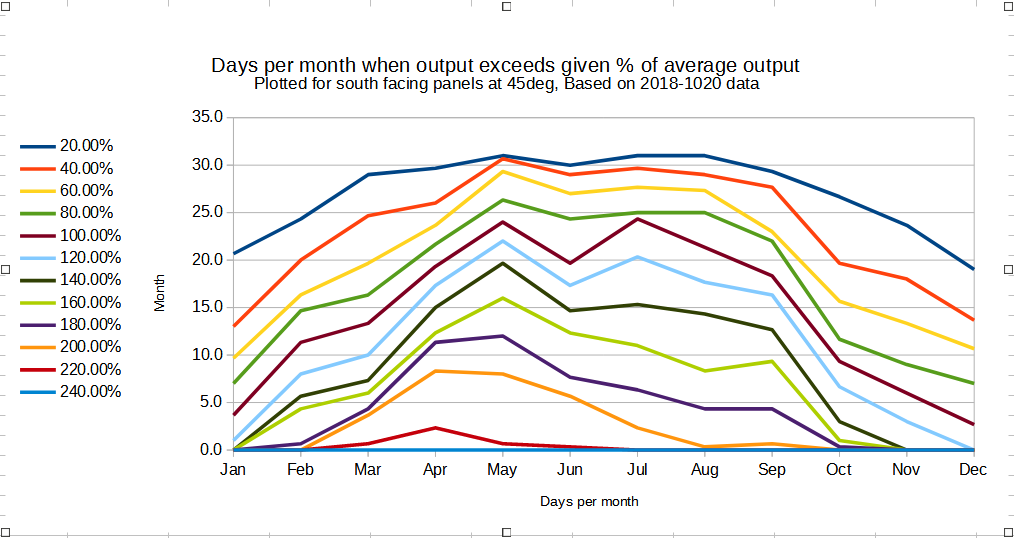
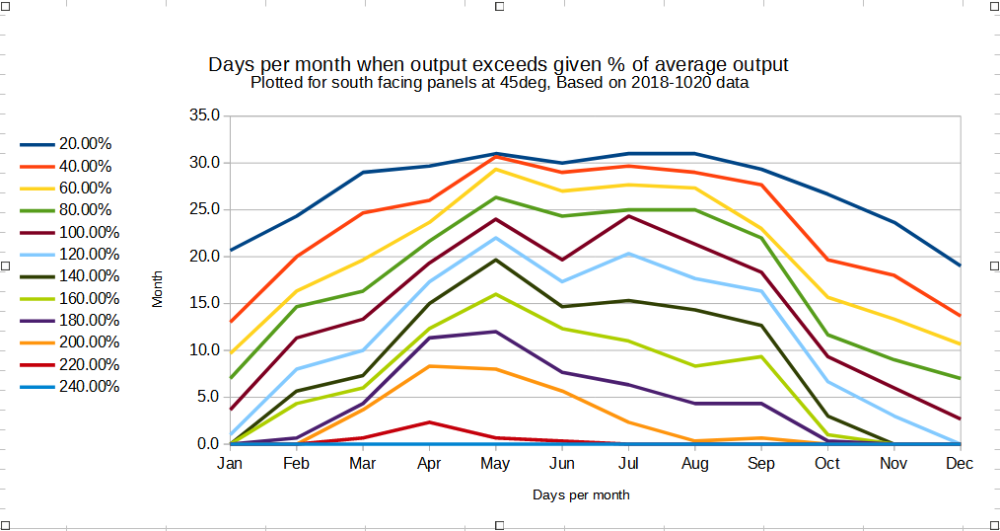
This chart might be of interest and, given your heat demand (and other electricity use), will help you size your array (or, if your array sized is already fixed, work out how many 'free' days you will get). It shows the number of days per month in which the solar PV output exceeds a given %age of the average daily output. Its plotted for south facing panels at 45% to the horizontal. It uses data from PVGIS for 2018-2020. The average daily output for a 1kWp array with these conditions is 2.96kWh (call it 3kWh) So for example in March there is about 1 day when the output exceeds 6kWh (200%), 7 days when the output exceeds 4.2kWh (140%), 16 days when the output exceeds 2.4kWh (80%) etc. In my example calculations above, if your house demand is 3kW at 12C, and the CoP at this temp is, say 4, you need 18kWh to heat the house. A typical house uses about 10kWh/day for purposes other than heating, for a total demand of 28kWh. So if these figures applied to you, the temp were a constant 12C, and you were lucky enough to have a 11.7kWp array (28kWh=80% of average daily o/p), you would be able to cover all your electricity needs on about 16 days in March and 21 days in April. Thats a big array and a big battery, so unless the figures are way out, you have lots of space, or your 10kW HP is well over-sized, you wont do this well. Hope that helps. Apologies, the chart below is identical to the one above except for the title, but I cant seem to delete it. Please ignore the chart below
-
Does the water cool below room temperature during the defrost cycle. I would have expected hps to stop this happening, to avoid the risk of condensation. If water stays above room temperature then no harm is done if it continues to circulate.