JamesPa
-
Posts
1899 -
Joined
-
Last visited
-
Days Won
2
Everything posted by JamesPa
-
Do we know whether the consumption occurs only in standby or whether it's a continuous load even when the compressor is working. If it's the former then potentially it's not so serious provided the system is heating or turned fully off most of the time. I'm not trying to excuse the waste, just trying to understand how big it actually is.
-
This is well scary for a 'green' technology. There is another discussion of standby power consumption here https://heatpumps.co.uk/2013/08/13/stand-by-power-and-air-source-heat-pumps/ Various people have contributed some figures, but some of the posts confuse power and energy so I am not sure how reliable they are. And another here https://forums.moneysavingexpert.com/discussion/6298830/dimplex-ashp-running-cost with figures for Daikin, LG and Dimplex all of which seem to have quite high standby consumption if this post is to be believed.
-
Interesting what the ASHP antifreeze mode does. In fairness my existing gas boiler also switches on when its cold outside, even if there is no heat demand, and it appears to heat to full flow temp, so a similar level of 'inefficiency' (or prudence if you prefer). So your ashp heating to 20C (at which COP will be >5) is consuming much less energy to keep the pipes from freezing than my boiler.
-
Because DPMiller I agree that £100 vs the risk of catastrophic failure is a no brainer (and I don't ski either). However... Because heat pumps have built in frost protection, the scenario you cite will only occur if either a)the heat pump fails or b) power fails for an extended period of time, and there is simultaneously a cold snap. In scenario a) you will return to a house which is unheatable whether or not you have glycol/antifreeze valves! For me this is not about cost, its about system performance. Glycol increases by 5% the amount of liquid that needs to be pumped round the system, because it has a lower heat capacity. Furthermore the following post points out that the effect is worse still, because a glycol/water mix is more viscous than pure water: https://commercial.centralheating.co.nz/assets/resources/The-Effects-of-Propylene-Glycol-on-Pump-Performance-web.pdf Other sources (eg https://metersolution.com/wp-content/uploads/2013/02/Glycol-Pump-Losses.pdf) also confirm that glycol/water mixes are more viscous than water. So we are adding glycol to the system in order to deal with an unlikely (albeit serious) fault condition and by doing so are degrading its operational efficiency. The degradation is admittedly small. The NZ paper suggests that the circulation pump might have to work up to 25% harder. If this is correct then, based on a pump consumption of say 45W, 11W extra is consumed, which equates to 56kWh/Yr based on 7 months operation 24 hrs per day. Ofgem says that the average house needs 12000kWh/annum to heat so with an scop of 4 that's 3000 and the additional load on the pump is 2% of the total. Probably not enough to swing the balance in favour of anti freeze valves, but annoying nevertheless.
-
That's a nice summary. I guess the only other argument one might make is that glycol reduces the heat capacity of the water by about 5percent so the pump will have to work 5percent harder. That's a pretty marginal increase in energy consumption but of course the cost and carbon footprint does accumulate over time. For those of us with a dislike for compromising the 'normal' system operation to deal with a rare fault condition it's an annoying choice to have to make.
-
So are you suggesting not to bother with either glycol or antifreeze valves. It's definitely a very rare event that they are needed
-
Several ashp manufacturers do suggest antifreeze valves as an alternative to glycol, so they are definitely a recognised alternative solution. It sounds like everyone on here has gone for glycol? As several people have said, the additional level of protection offered by either is only really needed in an extreme circumstance such as extended power cut or really major system failure.
-
As I understand it they drain the system if the pipe temperature falls below 4C. They are often combined with a pair of normally shut zone valves (kept open by power but which shut under sprig pressure on power failure) so it's only the outdoor unit which is drained. Refill is manual Both glycol and antifreeze valves are only really necessary in the case of an extended power or major system failure in cold weather). When everything is functioning as it should the antifreeze function of the ashp kicks in as you correctly say. Glycol/antifreeze valves are needed probably once in 10 years!
-
There seem to be two competing ways to ensure a monoblock outdoor unit doesn't freeze on system failure, namely fill with glycol/water mix or use antifreeze valves. Both would seem to have potential advantages, and disadvantages. Has anybody got any experiences and/or reasoning to share for the reasons to choose one over the other?
-
Kevin and GreenPower, that's most helpful. I was aware that any review site risks emphasising the bad, because those with bad experiences are more motivated to write, but I hadn't thought through the monetization strategies. I have heard it said that 'if the product is free, then you are the product'. Not quite applicable here but another salutary warning of the pitfalls of 'free' internet services.
-
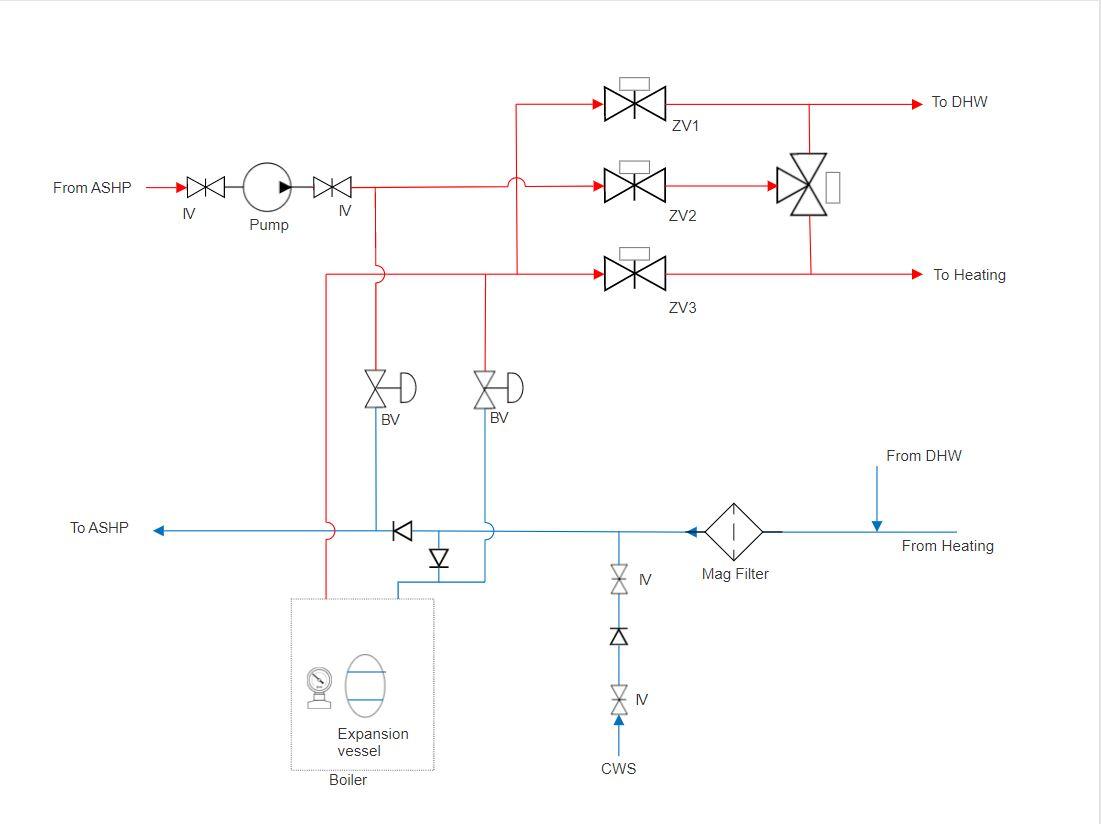
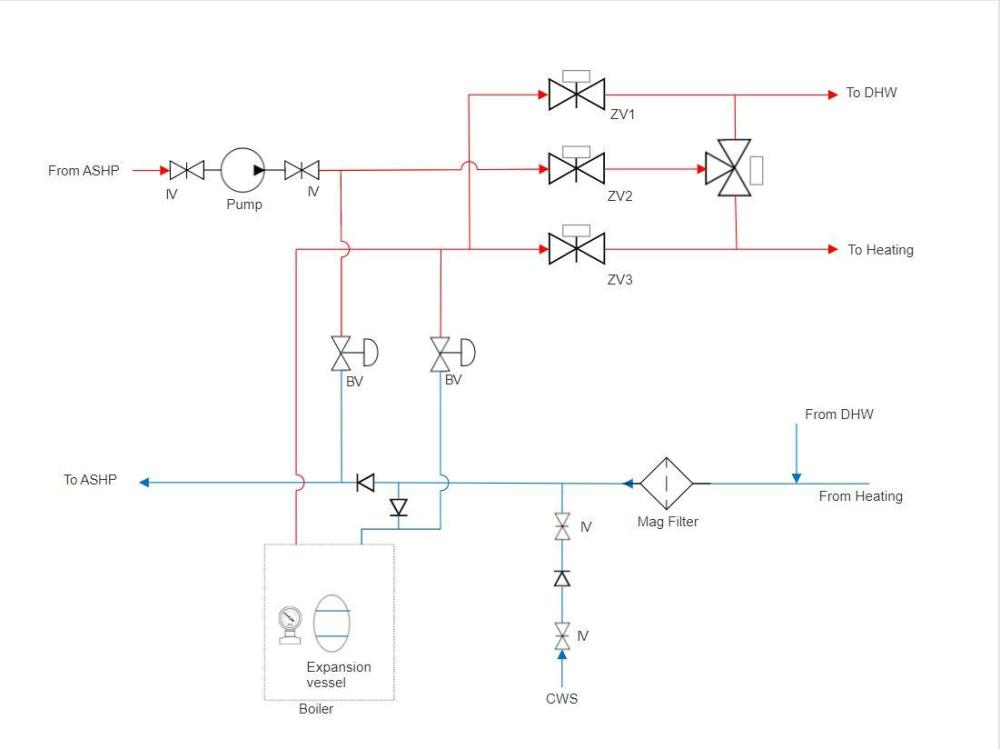
Having more or less settled on using Mitsubishi, Im now thinking about the system design. Rads are becoming obvious - make them big to reduce flow temp, balance properly, use TRVs as limiters only not for temperature control (adjust the flow temperature as low as possible using weather comp). Mitsubushi don't insist on a buffer tank provided there is sufficient system volume (which there is) and Id like to avoid buffer tanks/low loss headers a) because of the space involved and b) because of the flow temperature and hence efficiency loss across them. However I want to have a backup system, at least for the first few years, and the obvious one is my existing boiler (which of course comes complete with pressure gauge and expansion vessel). So I have been trying to come up with an arrangement of valves etc that means that, in normal operation, the heat pump sees exactly what it expects to see, but it can be switched out and a boiler turned on (manually) as a substitute. I currently plan to retain my existing boiler controls in addition to the Mitsubishi, so that the controls for each are totally separate. In principle its not too difficult to come up with an arrangement, until you consider the case where both have to be running at the same time to avoid them freezing up. But I think even this may be achievable. I attach my draft diagram, the key is the three 'zone valves' which need to be wired so that either ZV2 or both ZV1 and ZV3 are disabled (and therefore shut), together with the one way valves preventing backflow when the bypass valves kick in (which should only happen if both turn on to avoid freezing) I am not asking for anybody to comment on the diagram (but of course feel free) - but has anybody else tried a boiler backup without a mixing tank/low loss header or am I either a) breaking new ground or b) being stupid even thinking about doing such a thing?
-
Partially to answer my own question I asked Mitsubishi Tech support a question Sunday evening and received a very helpful reply, including 4 relevant system diagrams, Monday morning. So it seems that their tech support at least are helpful (Q was: I am enquiring about system configurations for Ecodan R32 11.2kW. It seems that, in addition to the outdoor unit, you sell: A flow controller, Various hydroboxes all of which appear to include a flow controller, Various pre-packaged/pre-plumbed cylinders all of which appear to include a flow controller. I understand that there are several combinations of outdoor unit and either hydrobox or cylinder which are permissible, but what is the use for the stand alone flow controller. Can you combine an outdoor unit, stand alone flow controller, and field supplied pump/diverter valve/expansion tank etc. Is there a recommended system diagram for this application?)
-
Having (more or less) narrowed my choices for a new ASHP down to Grant Aerona or Mitsubishi Ecodan (based on a combination of factors including price, capability, raw performance, form factor, weight - the last being important because I will be flat roof or wall-mounting), I'm now thinking about long term maintenance. Mitsubishi get absolutely horrendous reviews on trustpilot https://uk.trustpilot.com/review/les.mitsubishielectric.co.uk, and its not all down to bad system design (which seems to be the predominant reason for ASHP complaints), which is worrying because I'm thinking of ignoring MCS etc and doing a partial diy job. Can I ask what experiences have those on this forum experienced with maintenance and reliability of these units. Does it basically come down to whether or not there is a half decent local maintainer?
-
ReedRichards - similar to my calculated curve (using a rad exponent of 1.3) there is a couple of degrees difference in the middle (which is where the temperature sits most of the time). 2 degrees is noticeable. Its clearly not beyond the wit of man (but maybe beyond the wit of some designers or installers of heat pumps) to implement a multipoint curve, and its hardly the most challenging piece of code ever. Still not perfect of course, because wind makes a difference and possibly also humidity, but still better and possibly able to be tweaked to allow for humidity at least because the most humid days at predictable temperatures. Anyway the roll so far looks like: Vaillant: Selectable (but fixed) non linear curves, adapts flow temp to room temp Mitsubishi: Multipoint curves, claims to adapt flow temp to room temp but not verified experimentally CoolEnergy: Multipoint curves, flow temp does not adapt to room temp Grant/Chofu: Straight line only, flow temp does not adapt to room temp(?). Possibility that multizone function could be 'bodged' to implement night time set back of flow temp in single zone system Anybody know for definite about Daikin, LG, Samsung, Viessmann, Nibe, Hitachi?
-
I am currently looking at which heat pump to install for my 4 bed detached 1930s house (fairly well insulated following lots of work by me). I have read with interest many of the posts on this forum, and also on the renewable heating hub forum and Heat Geek (the latter of which I recommend very highly for anybody who wants actually to understand what affects the efficiency of heating systems and why, rather than trying to sort between often conflicting opinions). I have also read extensively elsewhere and had several quotes (none of which I entirely trust) What is driving me mad now is trying to work out what the candidate systems are actually capable of, more specifically as regards weather compensation. Since this is one of a very small number of factors key to the overall system efficiency, understanding what the heat pumps (or more accurately the heat pump controllers) are capable of is an important factor (at least for me) in any decision. The easily accessible information is mostly marketing hyperbole of one kind or another, so I have been reading the installation/commissioning/user manuals but with only limited success. Almost all heat pumps seem to feature (as a minimum) a user-adjustable linear weather compensation curve. What is not clear is which ones allow a non-linear/multipoint curve to be programmed in, nor is it clear which ones vary the flow temperature if the target room temperature is changed programmatically, eg for night time setback, (this latter feature is sometimes called parallel shifting). I get the impression that the only way to find out may be to own one, which of course is too late! I'm currently particularly interested in the capability of the Grant (Chofu) heat pump as I have identified this as a candidate for other reasons. The manual is clear that the compensation curve is linear only, but does anyone know whether the native Chofu controller implements parallel shifting. It can certainly be programmed for a timed setback ('economy' vs 'comfort'), but the manual is silent on how this is actually achieved . If anybody knows the answer, or has definitive answers for any other common make, I would be interested (and maybe others would too). If I get more than a couple of responses I will compile and post a table.
-
glpinxit's dumb questions- No 1 space requirement
JamesPa replied to GLPinxit's topic in Air Source Heat Pumps (ASHP)
Both halogen and incandescent lamps are certainly much less efficient than LEDs at turning electrical energy into light. However the electrical energy which is not turned into light is instead turned into heat and, during the heating season, this will offset the requirement to heat the house by other means. Now for most people and for most houses, most lighting takes place at the same time as heating, and when this is the case all types of electric lighting are 100% efficient in turning electrical energy into either heat or light. There are obviously exceptions, a small proportion of domestic lighting takes place outside the heating season (summer and early autumn), and of course any lighting in areas which are unheated (garages, outdoors) is also an exception. But its clear that the saving in total energy consumption in a typical domestic situation is nothing like as much as the difference in 'efficiency' would indicate. I have never seen a calculation, but a rough guess might be that the reduction in energy consumption is somewhere around 20-30% of the figure that the crude calculations indicate (on the basis that roughly speaking houses tend to be heated from (say) mid September to mid April, but lights are probably on for about twice as much time in this period as during the summer period. In commercial premises, which are often lit throughout the year, the savings in energy consumption are greater, even more so where the accommodation is cooled in summer. That' not to say that domestic LEDs aren't a good thing, they generally last much longer and there is definitely some energy saving, albeit nothing like as much as the simple calculation based on the comparison of the efficiency with which electrical energy is converted to light, would indicate. If you have gas heating, then shifting the heating load from the 'lights' to the 'heating system' will reduce cost (because gas is cheaper than electricity, not because you are using less energy) and of course if you have ASHP then you also gain because a typical ASHP is 300% efficient at converting electrical energy to heat. EPCs reflect both the expected cost of energy and the expected energy consumption. Depending on the heating type, the switch to LEDs will affect one much more than the other. I have no idea whether EPCs are sufficiently sophisticated to make this distinction however!