


JamesPa
-
Posts
1899 -
Joined
-
Last visited
-
Days Won
2
Everything posted by JamesPa
-
Thanks, ... and provided the temperature of the water circulating in the ch is above the room temperature, it will still give up heat to the room, so letting it continue to circulate is OK.
-
I don't know that it does, simply that it can. I imagine a hp that knows there is a buffer _and_ which has control of both pumps might switch off the ch circulation pump and switch on the buffer pump, so that the energy is taken from the buffer. Once defrost is finished it might then heat the buffer up before switching on the ch circulation pump back on. Having said this provided the temperature of the water circulating in the ch is above the room temperature, it will still give up heat to the room so letting it continue to circulate is likely OK. I really have no idea how heat pumps in practice manage this, particularly if they don't have control of both pumps.
-
The water flow doesn't need to reverse for this to happen. The water can keep circulating in the same direction through the heat exchanger in the hp and, provided the refrigerant is colder than the water, heat will transfer to the refrigerant. Same as when the unit is in cooling mode.
-
The refrigerant flow reverses for defrosting but not the water flow.
-
Eg in mar pvgis says that a south facing 1kWp array at 35deg to horizontal generates about 80kWh per month, an average of 2.6kWh per day. Of course this is an average so some days will be quite a bit more and some days quite a bit less. So if you have space for a typical 4kWp array you will generate 10kWh average, perhaps twice that on good days (???), enough for the example calculation (better than I had guessed when writing the above to be honest). If you were to download the hourly figures you could work out exactly how much is generated on good days and thus how much storage is worth having. I'd work it out this way first, assuming you are constrained in practice by solar capacity. Obviously if you have plenty excess solar capacity then only the hp demand needs to be considered.
-
The easiest way to estimate this is mostly to ignore the Grant spec and just work out how much energy you need to store to heat your house assuming a COP of say 4-5 or whatever seems reasonable at the ambient temp you want it to work at. So if your house needs say 3kW input at say 12C and the cop is 4 at that temp, you need a total of 3*24/4=18kWh. Storage requirement is perhaps 30-40% less because you don't need to store when the solar panels are generating. Also (possibly do this first!) use pvgis to work out how much solar capacity is required to harvest the total energy requirement (in my example 18kWh) at the relevant time of year. Once you have got approx sizing use pvgis again to work out how much actually needs to be stored and how much you will use in real time. Unless your 10kW hp is well oversized for your house or you are prepared to cover a large garden with solar panels I think you may conclude it's not possible to cover anything more than a fraction of the demand with solar, and that only modest storage is needed to shift the daytime peak to the daytime shoulder. This simple calculation is the way to go to scope what's achievable, then you can refine as appropriate.
-
@IanRis absolutely adamant that is not the case, if you follow the thread. So far nobody has posted measurements to confirm either way.,
-
Just over 5k after grant including some radiator upgrades and dhw - if I could get that price in Hertfordshire I'd be over the moon. More like 10-15k after grant here from the MCS installers. Unfortunately octopus won't put an ashp on my flat roof.
-
Nice to see entropy mentioned in this thread, personally I would vote for the repeal of the second law of thermodynamics, but somehow don't expect it to happen any time. There are some quite extensive discussions of buffer tanks in the latter part of this thread and in this this thread. The first eventually got (after a long interaction) to a more-or-less-generally-agreed description of how an 'ideal' buffer tank (ie one with no turbulence) actually operates in a real system, the second deals with sizing and the apparent fact that formulae frequently quoted in UK and US each leave out one of the factors in a seemingly more complete calculation, but its a different factor between UK and US. One of them also introduces the 'ton' as a unit of power often used in the US aircon world (apparently), being the average energy absorbed by 1 ton of ice over 24 hours. About 3kW in real money.
-
I think that if you follow the MCS noise calculation and then all the other stuff in the actual PD regs you are as safe as you can be (without actually getting an MCS designer/Installer to do the job) from a planning perspective. The MCS noise calculations are easy and there is a spreadsheet on the MCS website to do them. As I still haven't actually installed my ASHP yet for the reasons above I don't feel qualified to comment on other booby traps. Others here will though.
-
According to my model that's spot on. At a flow temp of 35C, typical of ufh, the saving due to WC is 5%. At 45C it's more like 15-20%.
-
I don't know who decides what are equivalent standards, but I did ask Flexi-Orb, who are creating/have created alternative standards (to MCS) for solar panels, whether they also had ones for ASHP and their answer was that they intended to work on them but the accreditation process was many months long so it would be some time before these were in place. So I presume that standards are accredited by some accreditation body like BSI. The risk in just proceeding anyway with a development that complies with the PD requirements, other than that it is not installed to MCS standards by an MCS installer, is small. In practice the LPA will only take action if there is a complaint. Most likely, if there is a complaint, the environmental health officer (EHO) would investigate whether planning consent had been given, find that it had not, then could possibly, following further investigation and if there were sufficient evidence, issue a noise abatement notice. Noise abatement notices generally require a log of repeated occasions, and given that long cold spells (triggering the ashp to run at max) occur relatively rarely, it might be difficult to obtain a log. However if they did have sufficient evidence to issue a notice, it would be difficult to avoid complying and a valid notice would, I suspect, trump planning law. Alternatively Planning, having been alerted by the EHO, could issue a planning enforcement notice. You could of course then apply for (retrospective) express permission, which might attract an unworkable noise condition, and you could appeal a noise condition more severe than the PD condition. This would take many months during which Planning would be unlikely to enforce. All of that gives you some time to install some noise mitigation measures, if the site allows it. You could also try to argue that the PD rules are clearly intended to call up the noise related aspects of MCS020 not the other requirements therein i.e. to install to MCS standards and use an MCS installer. However I fear that this argument would not hold up with officialdom, and possibly not even in the courts, unless there is strong evidence in Hansard or other official records to support the argument. All of the above is pretty unlikely to arise if, in fact, there is no noise or minimal nuisance caused. The other risk of course comes when you sell the house. If the conveyancer is on the ball and checks for planning consents, they will find there is none and no amount of spreadsheets that they don't understand is likely to convince them. This could conceivably cause a hiccup or, if the buyer were particularly risk averse, a withdrawal (although the buyer could probably insure against the risk and ask you to pay the premium). if you were installing a gas boiler with noisy flue adjacent to your neighbours window, or a noisy oil boiler ditto, you could just go ahead without all of this discussion and speculation.
-
I wouldn't give up quite yet. Its not obligatory to have MCS to install a heat pump. Its only obligatory if you want to install under permitted development (PD) or a government grant. So one possible route, the route I am attempting to follow, is to seek express planning consent for the installation even though it could be done under PD, and then just self install or get a non-mcs plumber to install (assuming you can find one). The problem I have encountered with this route, is that my LPA has imposed unachievable (and wholly unnecessary) noise constraints (10dB below background, in an area where background is totally inaudible indoors). These go well beyond those which would be required under PD. I have been fighting with them for the past 3 months, and they have finally conceded that they could relax the constraint, but only if I submit another planning application (£204), an application for the variation of a condition (£234), or appeal the decision (£0, but it takes 30+ weeks). They have even gone so far as to suggest that I could install without permission and the probability of enforcement action is very low, albeit that they (obviously) could not recommend this. I don't blame the individual planning officers or the LPA for this obvious nonsense, successive government-imposed cuts to local councils means that the LPA has, for many years, been unable to recruit adequate staff numbers, unable to train the staff adequately, and unable to pay the salary necessary to attract away from developers any but those willing to make significant sacrifices in their own personal wealth in order to benefit the cause of public service. Unfortunately that's the absolutely inevitable consequence of a government which prioritizes tax cuts over effective public service. The relationship between MCS and permitted development in relation to heat pumps is, in my view, a disgrace. Because of the way MCS (a non-governmental body) have written MCS-020, they have imported into planning legislation matters which belong only in building regulations or consumer protection, and in doing so created a near-monopoly. I can tolerate such things when government grants are involved, but not when they affect planning legislation which relates (or should relate) to the effect on others only or on very strategic matters. For my ASHP installation I am probably going to submit another planning application, although I resent the cost. My fear is that either the planning officer or the environmental health officer will change during the interim, and I will be back to the start. Incidentally I am having similar problem to that you quote with my plan to extend my solar panel installation. Solar is currently a boom industry again, and so lots of companies have sprung up offering 'ready made solutions'. That's fine, unless your needs don't fit their 'quick fix, quick buck' model. I am still hoping to find a niche player who isn't in this 'sell your solution and make a quick buck come what may' business. If not the remaining possibility is that the market will eventually cool again, and then only those who can be responsive to actual customer needs will survive.
-
The thread here has a discussion and a model of WC; (scroll down for v2 improved version). Of course model and actual may differ, but order of magnitude I would think this is likely not bad. No allowance is made for pump consumption but, knowing your heat demand and pump power, would enable a rough calculation to be done. Some people have contributed measurements also.
-
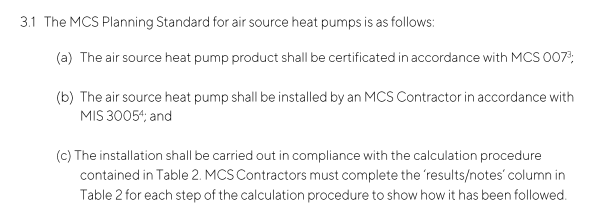
Yes but the point is that this text appears to define 'the MCS planning standards' and thus apply if an installation is to be done under permitted development, thus forcing PD installation to be done by an MCS contractor. Furthermore mis3005 referred to therein requires an installation done by an MCS contractor to be designed according to MCS design rules by an MCS designer. It follows (so far as I can see) to that any installation under permitted development must be done by an MCS installer and designed by an MCS designer. That's great for the MCS fraternity but a gross misuse of a government sanctioned private monopoly, stifles innovation and is bad for the environment.
-
Not so sadly. The requirement in law is that it must comply with 'the MCS planning standards or equivalent standards'. 'The MCS planning standards are defined in MCS020 which reads as follows: MCS have effectively written themselves into planning law!
-
Except that the customers cant choose to go elsewhere if the install is to be done under permitted development or if they wish to claim a government grant. I can just about support the latter, but the former is absolutely scandalous and a barrier to the greening of our economy. Worse still, MCS themselves have been allowed to write the rules that say that an installation under permitted development must be done by an MCS installer and to MCS standards.
-
If neighbours don't complain you will almost certainly get away with it. But if neighbours complain about noise the first thing the EHO will do is check if you have planning consent. If you haven't then quite likely EHO will issue a noise abatement notice and planning a planning enforcement notice. If it went to court then you would have MCS on the side of the LPA defending their monopoly. Most likely the upshot would be a requirement to be 10dB below background, as that seems to be quite a common demand, albeit a stupid one when background is anyway so quiet that it can't be heard indoors. In many cases it's a risk worth taking. I can't see however that the get out of 'equivalent' would fly unless it's a recognised standard. I wish I could, but I can't.
-
Except that the 'MCS planning standards' specifically say that, to meet them, the installation must be by an MCS registered installer'. Currently so far as I have been able to ascertain there are no ' equivalent standards'
-
Ok I'm talking about England (and Wales I think) https://www.legislation.gov.uk/uksi/2015/596/schedule/2/part/14/made
-
This is doubtless true, but the problem goes further. The MCS design standards are quite rigid and so, certainly in my case, more or less force a larger than necessary unit. Furthermore the installers (at least those that have quoted me) want to throw out and replace lots of perfectly good secondary components, adding further cost and contributing to environmental damage. The way the standard is written tends to encourage this. There is probably a way to interpret the MCS standards to avoid this, but why, as an installer, would you bother? I'm not saying MCS is bad, but it clearly has some issues. BUS is, by common consent, not working well (low take up). Perhaps there is a link?
-
MCS is not required for building control but is required for the BUS or if the HP is to be installed under permitted development (ie without express planning consent) Strictly the latter only requires that the install is 'to MCS planning standards' but 'MCS planning standards' (written by MCS) require that the installation be done by an MCS registered contractor to MCS installation standards, and the latter require that the design be done by an MCS registered designer. If you install under express planning consent and don't want a grant MCS isn't needed. However if your LPA is like mine they will require a more rigorous (almost unachievable in my case) noise constraint than the noise constraint that applies if the installation is under permitted development, thus closing off this avenue. If you are lucky enough to have a more sane LPA or it's part of a bigger development so this level of detail gets ignored, then you can install under express consent with no grant and no MCS.
-
From my own experience I'd say this is quite the norm. 15-20K total less the bus so 10-15k net. Unfortunately the MCS stranglehold combined with the shortage of labour caused by the building boom and Brexit means that installers can charge what they want, and indeed do what they want. And woe betide you if you question them in any way, have design preferences, however logical, which differ from their rules, or offer to do any prep work. If you can avoid MCS, as others on this forum have found, then it's apparently possible to get it done for a sane price. I'm still hoping that there are some reasonable MCS installers out there for my own retrofit, but beginning to doubt it. It's no surprise, given this, that the BUS has been a failure. Hopefully octopus will shake the market up.
-
I'm not sure anyone has yet answered directly the question you asked. So far as I can see, if you need an MCS certificate, the answer is yes, real world data is irrelevant. The new standards MIS3005-d (design) and MIS3005-i (installation) appear to require a theoretical design according to a specified methodology, require that an installer issuing an MCS certificate has subcontracted design to or has designed according to MIS3005-d (or vice versa), forbid the customer from separately contracting design and installation, and nowhere mention real world measurements. Oh and just for good measure if manufacturer instructions depart from the standard then the latter is to be applied. Incidentally if you were thinking of reusing a hot water cylinder and the insulation of cylinder and pipes aren't up to latest standards, forget that also. So sorry, if you want an MCS certificate (at least according to my reading of the standards) and wish to take into account real world data or how you use your house, forget it. Resistance is useless! I'm hoping someone on this forum is MCS qualified and tell me I'm wrong.
-
Exactly (so far as I am aware), which is why I asked @Basherswhy he thinks aircon is PD.
