


JamesPa
-
Posts
1899 -
Joined
-
Last visited
-
Days Won
2
Everything posted by JamesPa
-
Cynical though I am I don't think Aircon is permitted development. Why do you think it is?
-
Will they install HP other than those made by Cool Energy (to which I have no particular objection, just that Id pretty much settled on the Mitsubishi and I cant quite get a CE one to tick as many of the boxes in my awkward retrofit) Of course you are absolutely right, but MCS very cleverly wrote the 'MCS planning standards' to specify that the installation must be carried out by an MCS registered installer (as well as meeting the noise spec) One MCS installer quoted me for a system which doesn't meet the noise spec (I told him all the key dimensions when he came round to visit). When I challenged him on this point his response was 'well we will sort that out somehow, would you like me to book you in for the heat loss survey (£350)?'. I think everyone here can guess what my answer was! As it happens I doubt my neighbour will complain. My worry is that I applied for planning consent (hoping to avoid MCS), was granted it, but with an unachievable noise spec (10dB below background, background is ~38dBA). Its nuts of course, even background isn't audible indoors, much less 10dB below, and when the HP is making at its loudest everyone will be indoors. But it puts me on a sticky wicket if there is a complaint and I cannot show that I have conformed to the PD requirements.
-
The MCS planning standards, which must be met for PD, expressly say that the installation must be carried out by an MCS registered installer. Clever eh?
-
I'm taking much the same approach as @Bashers. Measuring a real world consumption of 7.5kW gives me the confidence to go with an 11.2kW unit to match my calculations, rather than a 14kW unit that the MCS bods want to sell me. My only remaining problem is that I need it 'installed to MCS standards' to pass permitted development. So far I haven't found an MCS registered installer who interprets 'installed' as anything other than 'surveyed (chargeable), designed and over-specified (chargeable), installed (chargeable), all existing perfectly good sundry components thrown away and replaced with new, quite possibly not so good, components (chargeable and environmental vandalism), configured (possibly badly but still chargeable), MCS 'consultancy' (chargeable). Hopefully I eventually will!
-
For what its worth my personal experience is this: MCS survey/heat loss calculation based on 'assumed' levels of insulation and costing me £350: 14kW at -2 My heat loss calculation based on the above, but putting in more realistic estimates for the insulation: 11kW at -2 Actual measured gas consumption (I still have gas heating - working on the conversion) when it was -2 outside for 5 days in a row: 7.5kW The last figure was based on leaving the heating on 24x7 which is what would most likely happen with an ASHP. If I turn it off overnight then it shoots up temporarily to about 9-13kW for a couple of hours in the morning (depending on outside temp). My speculation on the differences between my estimates and the actual measured is some of my windows may be better than I assumed (incidentally, swapping out the glazing units in 30 yr old double glazing seems to make a material difference) my ventilation loss may be less than the assumed value But I can't prove either Hope that helps calibrate expectations on the precision of the calculations. I think there are, unfortunately, quite a few unknowns.
-
This is a bone of contention, and a question I have asked of some cylinder manufacturers. I've not seen a reason why the factory fitted T&PRV could not be unscrewed and then relocated to the highest point of the discharging pipework run. Obviously the T part of T&PRV would be ineffective at that point, but why cant we have a capillary wire, like a fire valve of an oil boiler type, to allow remote relocation? Answer is; too many risks associated with human error eg bad / lazy fitters I expect. I guess the answer is that there has to be a visible indication of the discharge. Having said that the regulations only specify what must be achieved not how and its clear that there are multiple ways of achieving it. Obviously the easy way is to follow the guidance or manufacturers instructions and the problem is that if you dont then its ultimately down to building control to determine if the 'how' conforms, which becomes a risk for an installer. No doubt some more innovation is due in how to vent an unvented cylinder.
-
I think people might have misunderstood the question. Im asking about using a vented cylinder (ie the 'old' type with a cold water tank in the loft) with an ASHP as opposed to an unvented one (which most seem to specify). My current cylinder is vented (I have a cold water tank in the loft). To convert to unvented is a pain because the run for the pressure relief 'vent' involves much disruption. So Im wondering about replacing my current vented cylinder with another vented cylinder (retaining all the plumbing) the only difference being a bigger coil. Of course I wont get mains pressure hot water, but I don't at present. Can anyone see a problem?
-
Thanks for the offer. There is a route, but the combination of plumbing through that route and the other changes to the system to go mains pressure is quite disruptive. So Im exploring alternatives while accepting that I may end up with a UVC, hence the question about whether there is any reason to avoid a large coil vented cylinder. I suppose one option might be to put in a uvc, but plumb it vented. Then I could 'upgrade' later!
-
I'm struggling with where (or whether) to put a UVC in my retrofit, because the existing vented cylinder is in the 'middle' of the house (on the first floor) and there is no obvious route for the vent pipe. I do need to replace the cylinder, the existing one has only a 0.7sq m coil and, based on a 55C flow temp, wouldn't get above about 40C before the heat pump starts cycling due to the relatively small transfer to the tank with such a small coil area. So I'm faced with various not very easy and quite disruptive options to fit a UVC, or simply replacing the exiting more or less like for like with a vented cylinder but with a larger coil. Obviously it would be nice to have mains pressure hot water, but it isn't essential and its a lot of disruption. is there any good reason to avoid combining a vented cylinder (with a sufficiently large coil) with an ASHP?
-
Not without significant disruption, otherwise I wouldn't have thought about pumping! Basically its a right mess whatever I try to do. Between this problem, the problem of getting quotes that are anything like half reasonable, and the nonsensical conditions imposed by my Local Planning Authority re noise if I don't go down the PD route (implying MCS and all the associated overhead), my retrofit of an ASHP is proving challenging to say the least. It seems to me that there are forces around deliberately trying to obstruct the mitigation of climate change, presumably because they fear that the necessary actions will somehow harm them in the short term and they don't care a fig about their children. I'm not blaming people for the problems finding a vent route, but the two other major obstructions are people-driven. I guess the alternative to unvented is vented; my current system is vented so replacing the cylinder with one that just has a larger coil does the trick. Of course that rules out the group of installers who refuse to use anything other than the pre plumbed unvented cylinder that ASHP suppliers usually offer. Altogether more than a little frustrating and depressing!
-
Im struggling with where (or whether) to put a UVC in my retrofit, because the existing cylinder is in the 'middle' of the house (on the first floor) and there is no obvious route for the vent pipe. One ASHP installer is suggesting that it is OK to pump the vent (pump being below the tundish) and thus take it out through the loft. I had the impression that the protection methods had to be 'passive', although in fairness the regulations don't actually specify this. I could see an argument that its OK provided that the pump is tested occasionally. The most likely fault scenario which disables the pump is electricity failure - in which case the heating to the UVC is also cut off so it 'fails safe' anyway. Has anyone come across a UVC with this protection method, or indeed any other method which does not involve a passive vent.
-
Im struggling with where (or whether) to put a UVC in my retrofit, because the existing cylinder is in the 'middle' of the house (on the first floor) and there is no obvious route for the vent pipe. One ASHP installer is suggesting that it is OK to pump the vent (pump being below the tundish) and thus take it out through the loft. I had the impression that the protection methods had to be 'passive' although in fairness the regulations don't actually specify this. I could see an argument that its OK provided that the pump is tested occasionally. The most likely fault scenario which disables the pump is electricity failure - in which case the heating to the UVC is also cut off so it 'fails safe' anyway. Has anyone come across a UVC with this protection method, or indeed any other method which does not involve a passive vent.
-
Thanks to everyone who has commented on this. Amazingly SMA have replied to my email and have also confirmed the behaviour is clipping not shutting down. Hopefully the combo of practical experience from this forum and the written confirmation from SMA will be enough to convince an installer or two to quote
-
Assuming the conditions stated by @SteamyTeaare also met, yes.
-
SOL-6K-RHI-48ES-5G-DC: MPPT: 2 according to here: https://www.zerohomebills.com/product/solis-rhi-6k-48es-5g-6kw-hybrid-solar-inverter/ MPPT 2 = 2 strings. Put east facing panels on one string and west on the other
-
ASHP size (don’t sigh I’ve done the calcs)
JamesPa replied to Kelvin's topic in Air Source Heat Pumps (ASHP)
Agreed as regards HP size if it modulates down (which some will). I also speculated that some may also turn up flow temp as a further bid for faster response time, which incurs an efficiency penalty of perhaps 2-4% per deg C based on some modelling posted in another thread. -
ASHP size (don’t sigh I’ve done the calcs)
JamesPa replied to Kelvin's topic in Air Source Heat Pumps (ASHP)
It's easy to imagine that customers, used to switching heating off eg during the day or overnight and the fast warm up time of a well overspecfiied gas boiler, find it difficult to adjust to the much more gentle response of a well matched ashp. Oversizing will mitigate this to some extent, particularly if combined with a higher than strictly necessary flow temp. I would be willing to bet some instalers would opt for the easy life this would deliver and probably many customers ditto. Yes there is an efficiency penalty but many will sacrifice this for perceived comfort, convenience and responsiveness. That could well be the reason. -
Can you clarify what's going on here with the oscillating output. Is this clouds passing or the inverter cutting in and out?
-
Thanks, is this an actual measurement or a prediction from SunnyDesign? If the former can you tell me precisely the inverter model please? Installer very sceptical although all the evidence seems to support the clipping you show.
-
Thanks and noted, however the panels are such that they will exceed the max power specified by the inverter during the middle of the day in the height of the summer. If the behaviour is (2) - clipping, then the lost generation is negligible (Ive run it through PVGIS) but if its (3) - shut down, then its material. Installer reluctant because he says he has experienced another brand that exhibits behaviour (3) although everything I can find about SMA would suggest this is unlikely.
-
Does anyone have any experience of 'oversizing' a SMA SunnyBoy 4000TL (or one of the same series). By oversizing I mean more panel peak power on the DC side than the inverter is specified for, without exceeding the max voltage or current. I am looking at upgrading to 5.5kWp panels on this 4kW inverter. The manual doesn't say how it behaves and I can imagine three possible behaviours 1. Damage to the inverter 2. Clipping of the output at the max 3. Shutting down altogether (1) seems most unlikely; I had hoped it would be (2), but an installer told me today that he has experienced another brand of inverter which does (3). SMA so far have not answered the question although the sunny designer tool seems content.
-
Well he is wrong, but if he wont do what you want then you will either need to accept his view or go elsewhere. perhaps the parts aren't available in France because the usual CH/DHW layout is different to UK.
-
From the PoV of the cylinder the HP is just a source of hot water, as long as hot water passes through the coil the contents of the cylinder will heat up. As far as the HP is concerned I think its as simple as fitting a diverter valve in the flow, running a temp sensor from the DHW tank to the FTC (Mitsubishi control unit), telling the FTC that there is an immersion heater and telling it when you want to set it to heat. Not very different to any gas fired CH system at least in the UK (I don't know how they plumb them in France). The prime difference is that the valve is either/or not one or both, ie either Ch or DHW receives a feed but not both simultaneously. Many people on this forum are using third party cylinders and I plan also to do so. You do ideally need a cylinder with a large coil area (3sq m is often recommended) (because the flow temp is lower) otherwise reheat times might be quite long. Usually you would specify a cylinder with a 3sqm coil and an immersion heater, Joule and Telford make them and doubtless others. This diagram from the Mitsubishi A2W databook https://library.mitsubishielectric.co.uk/pdf/book/Ecodan_ATW_Databook_R32_Vol5_5 illustrates the set up. The Mitsubishi pre-plumbed cylinder includes the diverter valve and tank water temp sensor pre-wired, but otherwise its the same. I would be concerned that your installer doesn't seem to want to do this. It suggests he is not familiar with the technology/not able to read manuals. But i know coming by an installer is difficult so you may have no choice.
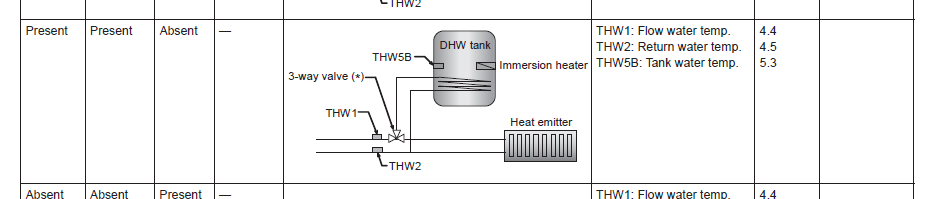
-
So far as I am aware the Mitsubishi packaged systems are just a combo of the heat pump, a cylinder with some pre plumbing, and the flow temp controller. They make it easy for the installer and maybe cheaper, but there is nothing special otherwise which prevents you using the standalone pump with another cylinder.
-
It might, but it's well within the maximum load spec if I use the back to back channel so unlikely. If it does then an additional foot resting on the deck might be necessary, but it seems unlikely. Indeed. Ironically it might be safer _not_ to provide a balustrade and just ensure one of the many removable balustrade systems can be used. PD specs require at least 1m between unit and edge of flat roof, presumably for this reason. Heat pumps on flat roofs, or high up on walls, are pretty much the norm in the commercial world (just wander down the back of your local high street/industrial estate. The ones high up on walls in particular seem precarious, yet somehow they manage.

