


JamesPa
-
Posts
1899 -
Joined
-
Last visited
-
Days Won
2
Everything posted by JamesPa
-
Mad idea for DHW retrofit based on Mixergy?
JamesPa replied to JamesPa's topic in Air Source Heat Pumps (ASHP)
As part of an ashp fit yes, as a standalone job not yet. The latter may turn out cheaper even with the VAT (it's zero rated if done with the ashp but I suspect the MCS markup exceeds 20%). As a minimum it requires taking up floorboards in two rooms (three if they insist on upgrading the feed to 22mm), reconfiguring the airing cupboard and some of the plumbing, and replacing a shower, in addition to the actual UVC. Pump turned off at this point so the additional loss occurs only when it's heating. PHEs come with installation jackets. Some loss desirable as it's an airing cupboard within the heated envelope of the house. -
Mad idea for DHW retrofit based on Mixergy?
JamesPa replied to JamesPa's topic in Air Source Heat Pumps (ASHP)
Why that? If the PHE has sufficient surface area it could actually be more efficient because it could reduce the required deltaT between flow and DHW. I do agree it's more complicated of course, but as a job _less_ complicated than retrofitting a UVC. -
Mad idea for DHW retrofit based on Mixergy?
JamesPa replied to JamesPa's topic in Air Source Heat Pumps (ASHP)
I think this does help, I omitted it from the diagram for simplicity. Agree! In a new build 100% agree. But I'm doing a retrofit with a perfectly satisfactory dhw system that I am considering changing solely to suit the characteristics of a heat pump. Against a UVC in this circumstance is: 2-3K, lots of disruption, loads of stuff thrown away, lost space in the airing cupboard and an annual maintenance fee. That's quite a few cons to offset the pros.' I'm not yet decided to be honest Hmm, not sure I fancy this! -
Well there is the problem right there. Easy to say, not so easy to find one which is my issue in a nut shell. Since i posted last night i have e mailed 4 installers from the .gov website of accredited installers. Lets see what transpires I think that's the point many here are making, as soon as you go down the MCS accredited route the high charges come in and you struggle to find anyone. Alternatively you may well find that a local plumber, not listed on the MCS or gov.uk website will do it, but then you cant claim the grant nor can you (strictly speaking) install under PD. It depends on how much risk/personal involvement you want/have time or skills for.
-
Not necessarily. A couple of the MCS companies I have spoken to tell me they can't get the plumbers. My feeling is that an 'overlay' of MCS companies has developed who subcontract the actual installation. _They_ probably have capacity matched to demand, but the real plumbers are not bothering to engage with them because they have plenty of work that does not require the MCS overhead and cream-off.
-
After receiving about 10 quotes I too have yet to find an MCS installer who I would trust to do the job. As several have said it's a feeding frenzy stimulated by government grants which come and go randomly without any coherent long term strategy or review of effectiveness. My guess is that the 'real' plumbers have plenty of work without having to bother with the hassle of applying for here-one- day-gone-the-next government grants, so won't get involved until the situation stabilises. And MCS is a government mandated private monopoly that has written itself not just into the process for government grants, but also into the planning rules for 'permitted development'. I have just a couple more dice to roll before giving up trying, ignoring MCS, and doing the job myself with the help of a non-mcs electrician. It's clearly an easy job, the real work is in the design which I can do myself (better than a 'professional' because I have detailed knowledge of my house). It means I need express planning consent, but so be it. As a bonus I get a system which is more closely tailored to my requirements as opposed to what the salesmen wants to sell. Most won't bother in the face of this adversity which is doubtless one of the reasons why the uptake on the BUS grant is low and the UK lags much of Europe when it comes to heat pump penetration. Sad really.
-
Mad idea for DHW retrofit based on Mixergy?
JamesPa replied to JamesPa's topic in Air Source Heat Pumps (ASHP)
I know, I was just quoting the nice and intelligent surveyor's preemptive justification for a likely proposal from the installers to do totally unnecessary work! -
Mad idea for DHW retrofit based on Mixergy?
JamesPa replied to JamesPa's topic in Air Source Heat Pumps (ASHP)
Like this? Actually I drew it this way at first, but then got worried that the pump would draw water from the header tank not the DHW tank. I cant quite fathom how to ensure that this doesn't happen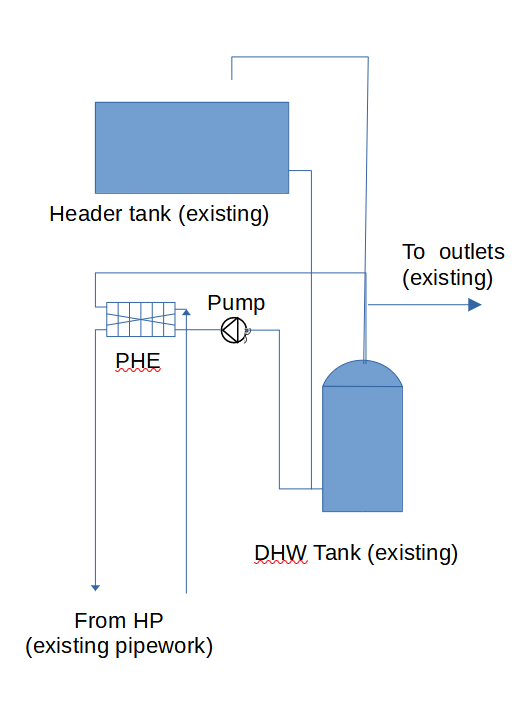
-
Mad idea for DHW retrofit based on Mixergy?
JamesPa replied to JamesPa's topic in Air Source Heat Pumps (ASHP)
Thanks, that's very helpful, I will rethink. On a related, but more philosophical, point, this (interesting but very painful) exercise to retrofit ashp to my house has convinced me that the current 'rip it out and start again according to rigid rules' approach to ASHP won't cut it for much of the retrofit market. Government subsidies can't last forever, and many people either won't, or can't, afford the cost of a complete system rework essentially to replace the boiler. Interestingly upgrading radiators, vitally important in many cases but perceived as difficult, is both cheap and easy, it's the 'peripheral' issues that seem to bug. I think the ASHP manufacturers may be pinning their hopes on high temperature designs which are a drop in replacement, and perhaps the efficiency sacrifice is justified (I personally think they also need to sort modulation ratio, buffer tanks are simply not going to be fitted in many retrofit scenarios or smaller houses). However I suspect we need also both more tools in the armoury (such as the one contemplated in this thread), and a more enlightened workforce, to deal with the myriad of retrofit situations in a way the public can afford/tolerate. On this forum people _are_ themselves experimenting with out of the box things to deal with their specific circumstances, but we need plumbers and heating engineers who can do this for the majority who don't have the design skills themselves. As if to demonstrate this point, today a very nice and clearly intelligent surveyor informed me that the mains water feed to the new UVC they want to put will probably need to be upgraded from 15 mm to 22mm (involving considerable disruption and cost). When I told her that the incoming mains pressure was 9 bar, so flow rate is certainly not a problem, she offered to note it, but told me it would still quite possibly need to be done because 'the cylinder manufacturer recommends it'. I don't doubt this is true, because I have read it myself, but its another example where backside-covering rules-based over specification (I refuse to call it engineering, because it isn't) risks absurd and costly results. Inevitably, unnecessary cost deters many, and unnecessary disposal of perfectly functional equipment is unlikely to be environmentally friendly. More innovation, much better training, more flexibility and just a bit of risk taking is needed if we are to crack this. How to make happen though? Just ramblings for a Wednesday evening, now back to the engineering! -
Mad idea for DHW retrofit based on Mixergy?
JamesPa replied to JamesPa's topic in Air Source Heat Pumps (ASHP)
Mixergy obviously think it will, it's what they do for their 'heat pump cylinder'. Not that I necessarily believe marketing claims, but several on this forum appear at least to have considered them. 3K, lots of disruption, loads of stuff thrown away, lost space in the airing cupboard and an annual maintenance fee. I'm not saying I won't go this route, but sometimes it's a good idea to think out of the box even if only to eliminate it. -
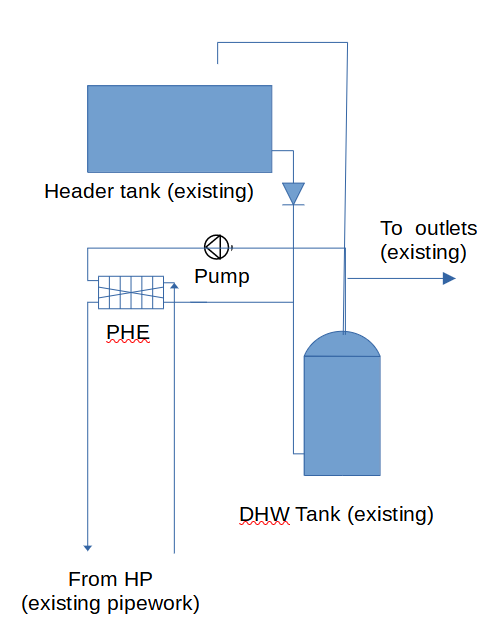
Over on the thread about Chelmer Heating there has been a lively (albeit off-topic) discussion about uses for plate heat exchangers. The Mixergy tank (for heat pumps) uses a plate heat exchanger external to the DHW tank, through which is pumped the DHW, thus exchanging heat with the HP flow efficiently without using a coil or taking up volume in the tank. They claim that their cylinder can be configured vented or unvented. Using a PHE instead of an internal coil has a number of interesting effects, some of which may be good and some bad. The way Mixergy have it configured seems to eliminate stratification the DHW tank, which may be good or bad! Like many, I suspect, I have an exiting, fairly new, vented cylinder, which is otherwise perfectly satisfactory but has a coil which is insufficiently large for a heat pump. I am thus faced with replacing it for a new unvented cylinder, involving lots of disruption and cost. So, following the Mixergy example, I came up with this idea which reuses the tank and existing pipework and involves minimal disturbance. I fear it wont work, because the pump will just draw air in from the vent (although I also feel there should be a way to prevent this) and/or from the outlets if they are switched on whilst the pump is on (I could perhaps defeat this by putting the pump upstream of the feed to the outlets rather than downstream as illustrated). The Mixergy has dedicated tappings for the PHE circulator, unfortunately in a retrofit situation the use of existing cylinder tapings is mandatory. Is it completely mad or worth considering? I'm not a fan of throwing away perfectly functional components!
-
Has anyone had any experience with Chelmer Heating?
JamesPa replied to sharpener's topic in Air Source Heat Pumps (ASHP)
Trying to avoid for reasons of space and also why would I want to buffer at 55C when my CH runs at 45C. Based on these discussions (which are really off-topic) Im going to start a new thread with a related off the wall proposal for people to shoot down. -
Has anyone had any experience with Chelmer Heating?
JamesPa replied to sharpener's topic in Air Source Heat Pumps (ASHP)
I thought this too until one prospective installer, who was otherwise hopeless, pointed out that the current 0.8m coil would cause bad short cycling. I did the math and he was right assuming I stick with a min deltaT between flow temp and target water temp of 5C. The potential problems with a small coil are both re-heat time (which doesn't matter for me) and short cycling (which does). Like you Im loathe to discard a perfectly satisfactory tank, its just not environmentally responsible. -
Has anyone had any experience with Chelmer Heating?
JamesPa replied to sharpener's topic in Air Source Heat Pumps (ASHP)
According to my calculations that's the best I will achieve with the standard 3sq m coil and the minimum operating o/p of my HP (4kW). I suspect the actual will be a bit worse. No idea. I have a vented tank so am now wondering about retaining it and using the PHE trick That's true, but its true also if the coil fails in a regular cylinder. Frankly I don't much like the idea of glycol circulating so plan to use anti freeze valves instead. Having said that CH inhibitor probably isnt very good for you. On the other hand most people don't drink hot water. Perhaps CH water should be treated with a dye, then you could spot cross contamination. -
Has anyone had any experience with Chelmer Heating?
JamesPa replied to sharpener's topic in Air Source Heat Pumps (ASHP)
OK @JohnMo that now makes sense. The idea of a PHE separate to the DHW tank merits some exploration, I feel as it has some interesting properties (albeit that it may be a dead end): Mixergy claim it makes the tank smaller and the the HP more efficient. The first is true, 3sq m of 22mm internal coil (the typical area for a HP) has a volume of 33l which subtracts from the available volume of stored DHW. Thats not the 40% they claim though in most cases. The second is true if you can achieve a lower delta T between flow temp and DHW temp with the PHE. Possibly you can, depending on the heat transfer function of the PHE. I looked at a couple of PHE specs and decided I dont know how to interpret them! The spec for the Mixergy one is below so perhaps someone else does. I guess the 'exchanger rating' tells us about the heat transfer - but under what conditions. Also it says it has an equivalent coil surface area of 3sq m, the same as a typical HP DHW coil, in which case Im not so sure about the claim that HP efficiency is increased. I calculate that a 5C temp difference is required with a 3sqm coil to maintain 4kW heat transfer (a figure chosen because its the minimum output of my target 11.2kW HP), so for a 50C water temp you need a 55C flow temp. It would be good to do better! The pump (presumably) more or less completely de-stratifies the stored DHW (in contrast to the Mixergy tank behaviour when its used without a HP). Im not sure if this is good or bad, but probably does serve to reduce a bit the deltaT between the DHW temp and the flow temp, because you are not relying on convection to shift the hot water away from the coil and replace it with cold water. The two points above, if they can be got to work, will presumably reduce recovery time. Pulling the heat exchanger outside the tank also means that it can be swapped out occasionally without swapping out the tank. In hard water areas that may be a benefit. Against this a PHE will presumably be more susceptible to limescale formation (or will the speed of the water negate this) It would in principle (I think)be possible in principle to locate the PHE at a location remote to the cylinder. This might be useful if the cylinder is, for example, in an airing cupboard next to a bedroom and it was desirable to locate the pump somewhere else to reduce noise nuisance. Last, but not least (and of interest to me and, it seems, @sharpener), its a possible way to retrofit an existing cylinder (with an insufficiently large coil) for HP operation - effectively what Mixergy do with their HP conversion kit. The Mixergy has dedicated tappings for this, an existing cylinder wouldn't, so one would have to find a way to tee off from the existing input and output tappings, which might require a non return valve or two to ensure that the pump did 'the right thing'.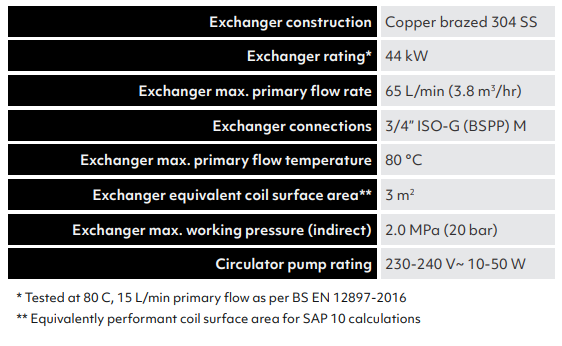
-
Has anyone had any experience with Chelmer Heating?
JamesPa replied to sharpener's topic in Air Source Heat Pumps (ASHP)
Ok @JohnMo that drawing confused me. I assumed you simply pump water out of the cylinder through the phe cold side and then back into the cylinder, and on the hot side of the phe connect up flow and return from the hp, ignoring the coil in the cylinder altogether. Your drawing looks more complex, is there any chance you could explain? -
Has anyone had any experience with Chelmer Heating?
JamesPa replied to sharpener's topic in Air Source Heat Pumps (ASHP)
No it wouldn't. The limiting thermal resistance in the path from HP to DHW will still be the degK/kW of the existing coil, the thermal resistances are all in series just like an electrical circuit. And you have interposed the HX which will introduce an extra temperature drop. Actually @JohnMo has suggested a faintly interesting idea. @sharpener is correct that putting the HX in a loop with the internal coil wont work, but (as I understand it) this is not how mixergy cylinders work either. The HX (in the mixergy) is in a loop with the stored water. This presumably will work provided the HX has sufficient transfer capability. Its making me think about whether to retain my exiting vented cylinder, thus avoiding lots of replumbing, and fit a HX alongside to turn it into a vented mixergy clone for a relatively small cost and lots hassle avoided. Also it means I can 'DiY it' because no G3 requirement. Of course its yet another pump! Has anyone actually done this? I was anyway going to ask what people think of the basic Mixergy idea as it relates to ASHPs. My initial view based on a skim read only was that its silly and that the complex scheduling idea is a gimic, but Im probably missing something -
Oil prices are currently quite low (it is currently and, unusually, cheaper to heat with oil than with gas) and electricity prices at an all time high, so at present that's hardly surprising. However oil is most likely going up and electricity certainly coming down, so the balance is more or less certain to change. The reality of life is that the prices of all three fluctuate a lot, are manipulated by governments, not necessarily logically and are therefore at least in part artificial. Electricity is almost completely devoid of logic - the price is tied to gas prices for historic and now largely irrelevant reasons, but much of the production is very cheap renewables. This being the case the only absolute guaranteed cost comparison is that a heat pump will be cheaper than another form of electric heating. My personal take therefore on the running cost comparison is that a heat pump (with my 45C design flow temp) will be around the same as gas at current prices. Very probably it will be cheaper in the long term, once electricity prices are more closely tied to the actual cost of production, and the fact that can power a HP with solar PV in the shoulder season also helps. For me this is good enough. I'm not fitting one because it saves money, Im fitting one because I have an aging gas boiler which needs replacing anyway, its the right choice socially and environmentally, and it is (to the best approximation reasonably possible) no more expensive to run. As a bonus the 'slow and low' approach to heating is actually more comfortable to live in (I grant that can also be done with gas/oil, however the cost equation tips a bit more towards HP if slow and low is your chosen approach) The only way absolutely to guarantee that you always have the cheapest heating is to have the ability to burn oil, gas, wood and electricity (the latter with a heat pump of course).
-
Mini split instead of a heat pump?
JamesPa replied to anonymous's topic in Air Source Heat Pumps (ASHP)
How many rooms? -
Mini split instead of a heat pump?
JamesPa replied to anonymous's topic in Air Source Heat Pumps (ASHP)
Most probably not but if the heat requirement is small then its not impossible that micro will suffice. Need to do the calcs. Thats on example, there are others -
Mini split instead of a heat pump?
JamesPa replied to anonymous's topic in Air Source Heat Pumps (ASHP)
Air to Air generally has a better CoP that Air to water plus radiators, around the same as A2W plus UFH. So, in terms of your question, the answer is probably yes. DHW is, as you say, an issue. It depends on what you need. There are DHW cylinders with dedicated ASHPs attached, or you could use point of use heating if you can live without large amounts of stored hot water (no bath without a very long wait, just shower). Otherwise its either a small A2W ASHP, immersion or fossil fuel. As you are on this forum I imagine the last of these is not the desired outcome. -
Again I agree with @SteamyTea Having said that the EPC is not so bad as it stands! You have insulated cavity walls, 250mm loft insulation and double glazing. And of course, because its a terrace, two walls have approx zero loss. 7MWh/year space heating is quite low in absolute terms, albeit quite high in relation to floor area. Probably means you need max 8kW ASHP, possibly less. Its at least possible that a lot of this insulation was put in after the current CH system, so your many of your radiators may even be large enough, but without doing the calcs we cant tell. So it really depends on how far you want to go and what sort of approach you want to take. I think I would probably start the approach like this: New build additions - as good as you can make them Additional wall insulation (to existing) - unless all the plaster/skirting is coming off anyway possibly not worthwhile if you genuinely have insulated cavities (I didnt think Victorian houses were built with cavities but apparently Im wrong). It would be good to know the actual wall construction - is there somewhere that the cavity can be exposed? Floor insulation - if the floors are coming up anyway or you are going for UFH then definitely do it, else only a maybe if you really want the absolute best. But consider also ventilation Windows - perhaps consider replacing them with more modern units, they will have better u values (I replaced my panes only and it made a noticeable difference!) Ventilation - if mould is already a problem then you definitely need more. If you insulate the floors or block up vents then you will probably need more. The fundamental problem is that old houses were designed to be leaky and modern innovations seal the leaks. You ideally want whole house MVHR but this may be too much hassle/not practical, in which case consider localised 'dMVHR' - distributed MVHR. Basically fans with heat exchangers which can be fitted in individual rooms or in pairs. Solar PV - as @SteamyTea says. Wouldn't bother with solar water heating, just max out on the PV. E/W facing also works. Heating (DHW/Space) - Most of the recommendations in the EPC amount to 'swap out the heating system', so it sounds like its old. A well designed ASHP system should be capable of doing this quite easily. Is there an obvious location for the outdoor unit? If you are doing a complete strip out anyway Id go for UFH (I don't have it, and I'm envious of those who do). If you are not doing a complete strip out and most of your existing rads are large enough for 45C or less flow temp (they might be - see above) then consider retaining them. If most arent large enough and you arent doing a complete strip out anyway then the cheapest route will probably be to replace rads with larger, but UFH will ultimately be more satisfactory. I would be tempted to ask several of the ASHP brigade round to quote just to see what they say. Its their time not yours! Unless you are happy doing heat loss calcs yourself (they are actually very easy if you know the construction) I would also consider paying pay one to do a full survey (will cost about £300), unless your architect, if you have one, can recommend someone to do the calcs or is doing that as part of the job. Don't believe the sales pitch that the survey is transferable - it isn't in practice, so just regard it as the price for getting some information. The BUS wont actually save you any money, because the MCS brigade just up the price by the same amount (or more). But it may be what is needed to get them involved, unless local plumbers will do it. That's my starter for 10, but the process is iterative, some decisions need to be made before others can be easily finalised.
-
I think @SteamyTeais basically right but, if you post the epc (feel free to redact the address and other details you dont want to disclose), that will give us some info to make some general comments on.
-
They don't (yet?) do ashp, only pv. I emailed them just a few weeks ago to enquire.
-
I suspect that's spot on, hence my lament that it's not possible, within the MCS stranglehold, for the customer to separately contract design and installation. Can't see any prospect of change though. The advisors to govt will likely be mostly MCS and boiler manufacturers, both of which have a vested interest in the status quo.
