


MJNewton
-
Posts
1354 -
Joined
-
Last visited
-
Days Won
1
Everything posted by MJNewton
-

Really disappointed with our worktops...
MJNewton replied to MJNewton's topic in Kitchen Units & Worktops
Yes, we learnt (and were warned to be fair) early on that 10cm samples don't really do much other than give you an impression of the sort of 'features' that particular style has. That said, I don't think we fully appreciated how even the base colour of a 10cm slab doesn't necessarily give you the full impression of what a large piece will look like. We certainly didn't shove it in the darkest corner of the room... even if we had though I don't know if we'd have caused any alarm bells to ring. There's a video here showing how the veined quartz slabs are made. -
Really disappointed with our worktops...
MJNewton replied to MJNewton's topic in Kitchen Units & Worktops
We did visit but before they had our batch in. Instead we saw a 20mm (so apparently definitely a different batch run from our 30mm) slab they had in but it was outside on a bright but overcast day so in hindsight I imagine it made things look white than an indirectly-lit internal room. -
Really disappointed with our worktops...
MJNewton replied to MJNewton's topic in Kitchen Units & Worktops
I should've added some pics really but don't feel able to show it off given how we feel! Sod that though, as you can there are three pieces on total (two ~2.5m x 0.6m lengths and a 1.4m x 0.9m island) and so I am assuming they were cut from two slabs: I don't know how many slabs are in a batch but assuming there's some left I would expect a replacement to match. It might be hard to tell from the photo but you can probably see they're not white-white (like the walls), but then we always knew they weren't... just didn't expect it to be so pronounced once in the room. To be fair the room is definitely darker at this end given the lack of windows (there's a roof lantern and large sliding doors to 4m to the right of the photo above so there's definitely a light gradient across the room during the day). The samples are similar in colour, but perhaps a shade lighter towards white. Again to be fair it probably is within the expected variation of a mixed-ingredient product, particular with what we have no doubts are more towards the budget end of worktops than the more upmarket branded ones. Bowing aside, we're resigning ourselves to thinking we've just got an unfortunate set of circumstances here - perhaps a slightly 'warmer' batch, not the brightest of rooms, brilliant-white walls, bare walls without pictures or ornamental shelves up yet etc. My Dad reckons once the wooden floor is down that'll 'warm' the room up and perhaps give something for the worktop to relate to (I never had my Dad down as a Laurence Llewelyn-Bowen but there you go).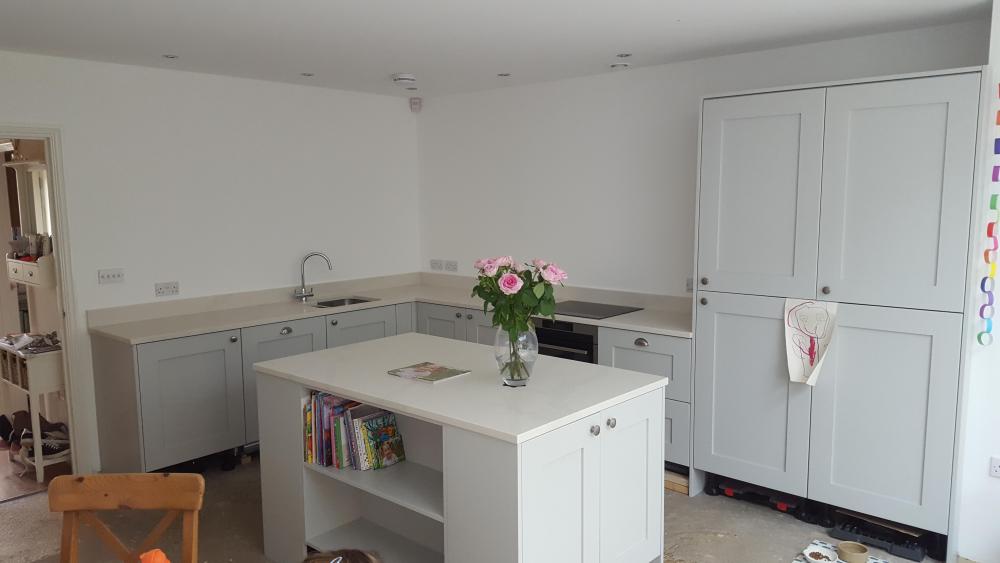
-
Hi everyone, a penny for your thoughts... We're nearing the end of the what must be the world's longest kitchen extension - I think many of you have built entire houses in the time that we've taken extending our ground floor and creating an open-plan kitchen-lounge-diner. Anyway, the quartz worktops were always going to be a centrepiece of the room and so we put a lot of effort into looking at the options, working out what we wanted, finding a supplier etc and despite having to wait 8 months due to Covid-related supply issues we were happy to wait as we'd really pinned this particular worktop down. The worktop is white with slight grey veining - the sort of look you'd expect to be available everywhere but very few of the ones we found ticked all the boxes... Many had veining that was too rich, some had other colours or fleck present that we didn't want, etc. Yesterday came the day of installation and we were dreading it wondering whether the specified overhangs were correct, had there been a misunderstand over what a bevel vs a chamfered edge is, had we mixed up overhang and reveal when it came to the sink, had the templater made an error, would the fitters take a chunk out of the plaster when manhandling the worktops into place... But, no, that all went perfectly! The problem though, (actually there are two) is: 1. We simply don't like the worktops. They're really not white - I'd say yellow, my wife sees/says beige. We mentioned it to the fitters during installation and they talked about the effects of different lighting etc and we convinced ourselves maybe it was just a bit of a 'warm' summer afternoon light biasing the spectrum... but having nearly done a full day cycle now - no - it really is staying its same very-off-white colour. 2. The island worktop has a slight bow to it. I'd spent a long time (weeks in fact!) levelling up the units in what felt like more than three dimesions and so was surprised to find a bit of gap between the units and worktop towards one corner. I thought maybe the sheer weight had squashed the units down a little and maybe I'd just need to tweak up a carcase here and there... but having put a straight edge on the top it turns out there's a 3mm bow measured over only a 600m length! This means it isn't fully supported as much as it could've been, and is very much resting on a corner with little nearby support. I emailed the supplier last night about the bow with some photos, and only casually mentioned the colour not being quite what we expected as we've been trying to convince ourselves it is what it is. Sure, we'd had samples but they're tiny and whilst they weren't perfectly white they weren't quite as yellow/beige as what we've got (it's hard to compare really, to be fair) and the slab we saw in person (quite some distance away so we couldn't become regulars) seemed very white indeed - but then it was outside (under cover) so perhaps everything looks whiter outside and wasn't from our batch anyway. There were going to send out a batch sample a couple of weeks back (just prior to templating) but that didn't actually happen, and whether it would've changed our position I honestly don't know given how small they are. We're really not sure what to do! The bowed island worktop is probably straightforward - if needs be I'm sure I can justify getting them to replace it but, if it's not going to cause any issues from, say, point loading, then we can probably live with that as no one else would notice unless they walk round with a spirit level like I do. It's the colour though... Whilst we can't say for certain we've been missold anything or there's necessarily been any fault of the supplier, we just can't escape the disappointment with the room's centrepiece! Any thoughts? I suppose at the end of the day we could pay another £4k to get some new worktops but that feels drastic on so many levels - cost, waste, embarrassment, not having an obvious alternative option to hand (but we could just search wider)... What would you do?
-
Mvhr settings
MJNewton replied to Pocster's topic in Mechanical Ventilation with Heat Recovery (MVHR)
I'd lower the Indoor Temp threshold slightly (to, say, 20C or perhaps slightly above your heating set temp) so that the bypass cuts in sooner when the right conditions are met (outdoor temp < indoor temp, indoor > 20C, outdoor >14C). Note that if the outdoor temp is greater than indoor temp then the heat exchanger should remain in-circuit as it works in both directions i.e. heat from the (warmer) outside air will be transferred to the outgoing (cooler) inside air hence cooling the supply slightly (I've seen up to -3C in practice recently). Is the humidity screen a measurement or a trigger setting (e.g. for boost)? The presence of an outdoor value is making me think the former. -
On that basis this is non-existent in all honesty, particularly if looking through the glass rather than focusing in on it.
-
Ah, hadn't considered it being a different material. I think I'll just leave it as it is. If the light is right I can just about see it from about a metre away, but only as I know where exactly to look.
-
Thanks all for the thoughts. I might get the windscreen sorted and just see what they say whilst they're here. I may end up just leaving it as now that a few days have passed I can only really find the scratch from remembering roughly where it is.
-
I'm worried I could turn something that is only visible to me into something more blatant! Might there be coating issues to consider, or would any such coating be on the inside of the DG unit? This is the internal pane so whilst there's no self-cleaning coating (like there is on the exterior of our roof lantern glass) it is toughened Pilkington K Glass S 'soft coat' but which surface would that be on?
-
I discovered a 3" scratch the other day on the glazing in our lift and slide doors, and whilst I can't prove it I'm sure our lovely 3yr old daughter might've had something to do with it but I must admit I'm not entirely sure how. I was horrified when I first spotted it (whilst buffing off a hand print) and whilst it really bothered me I eventually realised that the odd cobweb and other blemish on the outside of the windows were far worse and didn't bother me so would should the scratch? It still did though. Anyway, the scratch is easy to feel under a finger/nail and, somewhat optimistically I'm sure, I tried running it with toothpaste but it didn't have any effect. I am nervous about upping the ante with something more abrasive but would welcome any tips/suggestions as to how I might improve/remove it? My wife's windscreen has a small chip in it and I was intending on getting that sorted through the insurance (for £20) and wondered if the repairer of that would be in a position to sort this out too if I bunged them some notes? I know with a previous windscreen repair a small contraption to hold the liquid in/above the chip was used and then UV light to cure, but not sure if that approach would work for a long scratch on a vertical pane? Maybe they've got a whole arsenal of tricks and techniques available to them...
-
The easiest way to spot if your DS18B20 is fake is by its ROM code as all genuine Maxim/Dallas devices have their 64-bit ROM code (consisting of 28<48 bit serial><8 bit CRC>) reporting as: 28 xxxxxxxx0000 xx Fakes don't have the 0000 in the most significant bits of the serial code. There's further information here along with ways of finding out what family of fakes you might have and known deviations from the spec for each.
-
If accuracy is important be aware that practically all DS18B20's on eBay and Amazon Marketplace are fakes and so you can pretty much throw the official datasheet out of the window. Worth buying from a trusted source (eg CPC), although of course they'll cost a bit more.
-
Today's top tip - cat flap.
MJNewton replied to ProDave's topic in General Self Build & DIY Discussion
Yes, that's what we've got. With brush seals it obviously can't be airtight but holding my hands next to it when it's windy certainly shows there's no draught coming through. Our house isn't 'air tight' though so we only had to be sensible with how we made a hole through the wall. It is in an open plan Family Room though - next to a sofa! - so even the slightest of draughts would've been unacceptable. -
Top 3 MVHR brands?
MJNewton replied to ashthekid's topic in Mechanical Ventilation with Heat Recovery (MVHR)
I doubt there's all that much difference between them, not least given many (most?) will be using off-the-shelf components such as the fans (ebm papst being very common) and heat exchangers. That only really leaves control boards and external controllers left to fail which I wouldn't expect to see differences in reliability given modern manufacturing techniques. -
My advice is to cancel - regain control of your money. Settle your final bill with Green manually when the time comes. Any credit you might be due will be passed to EDF and they can either credit your new account, refund via a new DD with them or, if you move to a new supplier, send you a cheque. Just been through all this with Tonik and Scottish Power. Took about 3 months to conclude (and I think I was one of the luckier ones) but just let it run its course.
-
As Rob99 says, cancel the direct debit. It's only their for convenience (and likely theirs in particular once the administrators are appointed).
-
At the risk of not being any use whatsoever it's usually down to the bulbs, the dimmer, or both... ? Joking aside (although that wasn't actually a joke!) if you like the bulbs then I'd look more into what dimmer you've got. Varilight V-Pro are often recommended as being compatible with a wide variety of bulbs, have a couple of different operating modes and are easy to get hold of. (Make sure you get a V-Pro - they have other, sometimes cheaper, models that aren't necessarily as good)
-
Microwave boiler. Early April fool?
MJNewton replied to ProDave's topic in Boilers & Hot Water Tanks
I recall reading of a patent covering a whole-house heating system consisting of a magnetron in the loft that 'gently' heated the occupants below! -
I can't help on the technical front but I did want to say I'm sorry to hear about the passing of your Dad and how lovely a thing it would be to finish what he'd started, particularly when you're not sure how to do it! I could imagine it'd make him very proud!
-
Other than changing filters every six months I don't go near it. There is obviously the installation aspect to consider but that's a one-off.
-
Telescopic support rods like these could be useful to pinpoint the squeeky bits. Not only can they be used to brace different sections of joist/flooring to see if the noise goes, but can also be used to flex sections from below to see if you can trigger the offending parts.
-
Recently built 3-storey home and looking into MVHR systems
MJNewton replied to Jde00's topic in Other Heating Systems
Good question. The kit is the easiest to answer as I've everything in a spreadsheet - £1440 for everything down to the last screw (well, almost). Labour though and consequential costs is virtually impossible though. I did all the work myself and dread to think how many hours I put into it - whether that be real work or planning (procrastinating). I can't even give a ballpark figure... 50 hours? 100 hours? I really don't know. The consequential costs is tough one too as I took a ceiling down for our new 'family room' and replaced a stud wall to hide some ducting. These required new boards and then skimming (plasterer did the skimming) but I was pretty much doing this anyway so it didn't really add to the bill. But, yeah, I love the system and would definitely fit one again. Would I pay someone else to retrofit one? Probably not in all honesty as the costs could spiral and would a builder spend six hours routing a single awkward duct like this idiot...? -
Strange readings and behaviour
MJNewton replied to gc100's topic in Mechanical Ventilation with Heat Recovery (MVHR)
I'm wondering how the house is getting pressurised though if the intake vent is barely pulling a tissue... -
Recently built 3-storey home and looking into MVHR systems
MJNewton replied to Jde00's topic in Other Heating Systems
Okay that's good, as retrofitting MVHR really is a long list of jobs! We open our windows far less than we used to, but it's perfectly fine to do so. Whilst you can have all manner of controls you can still keep it running 24/7 anyway as there are still benefits to be had even when the windows are open eg more thorough ventilation, dust/pollen collection, slight cooling/freshening effect in hot weather etc. Running costs are minimal - we're drawing 15W in continuous background rate which works out at around £20/yr when used 24/7/365. -
Recently built 3-storey home and looking into MVHR systems
MJNewton replied to Jde00's topic in Other Heating Systems
They're just engineered joists made from timber with an OSB web between them (left pic below). Due to their inherent strength they can span longer distances than conventional joists and you can knock huge holes in them if required (bracing can be required in some circumstances). If they're pozi joists (right hand picture) then you really are laughing! I wouldn't bother. If it'll be a DIY job then you'll soon learn exactly how your house is built - indeed you'll end up knowing more than the builders!



