AliG
-
Posts
3211 -
Joined
-
Last visited
-
Days Won
11
Everything posted by AliG
-
Main bedroom suite layout design ideas
AliG replied to Adam2's topic in New House & Self Build Design
A lot depends on how you use the en suite and particularly if there will often be two people there at once. I originally designed our en suite with a walk through shower, but decided it used too much space and also I didn't like the feeling I was on display if someone came into the room. One thing I really try to avoid is the design of the first layout where the WC is directly facing the door, sometimes it cannot be helped but in this design you could look straight through from the bedroom to the WC. I based the final layout on hotel bathrooms. They often separate the shower or WC so that it is easier for two people to be in the room at once. So you might want to consider that. I really like that our WC is separated from the rest of the room. I doubt you would ever use the exit from the shower next to the WC, it is too much in the corner. I would likely move the shower into the corner to free up space. If you freed up more floor space you could have a chair in the en suite. We love having somewhere to sit and get dressed, or to chat to the person in the bath,. Alternatively you could move the WC to the alcove area and put the shower where the WC is, fully hiding the WC in the corner. As to the dressing room, it looks like the distance between the two side on the second plan is only 800mm, I would probably want a minimum of 1m. Also I got 650mm deep cabinets which are a lot easier to hang things in. We do not have a door on our en suite or dressing room. It works fine, but the light can be annoying in the bedroom and it is also noisy when someone runs a bath. In the dressing room I just put the light on a very short timer, but you cannot do that in the bathroom as the light would go off while in the bath. I would probably if I did it again have a door to the en suite, but not the dressing room. If you want to face the window, why not just put the bed back against the dressing room wall, you could even move the wall forward to have more room again in the dressing room and en suite. -
Our house is actually on their website, it wasn't there the last time I looked. https://www.angusandmack.com/projects/job1910 Suffice to say it was not cheap, although not unreasonable for the quality of the work. For the bookcases, the price increased a lot adding the drawers.
-
Cheaper options for bespoke Crittall-style interior doors?
AliG replied to jack's topic in Doors & Door Frames
Sorry, posted in the wrong thread -
Without the extra insulation your U-value would be 0.16. I suspect that strictly calculated the extra insulation would not pay for itself but you would see some benefit in both sound and U-value Normally a timber frame would have a permeable membrane on the outside. I am not sure how adding insulation to this affects it. I just looked this up and in this case the membrane would have to be installed on the outside of the insulation which seems awkward. I ate that no vapour control layer or membrane is shown on the wall drawings which seems odd.
-
Cheaper options for bespoke Crittall-style interior doors?
AliG replied to jack's topic in Doors & Door Frames
Our house is actually on their website https://www.angusandmack.com/projects/job1910 Suffice to say it was not cheap, although not unreasonable for the quality of the work. For the bookcases, the price increased a lot adding the drawers. -
It looks like you have 100mm PIR between the studs already on the inside of the frame. What is the thin layer of insulation on the inside of the studs. Is that another 40/50mm of PIR. I assume it is but it is not labeled. If you already have 140/150mm of PIR you already have a good U-value and there would not be much practical difference between adding a 100mm layer of PIR or fibre insulation. It would give a U-value of 0.12 with fibre and 0.09 with PIR, this would make very little difference to heating costs. I would recommend fibre as not only is it cheaper, but it will improve the sound insulation. I would not be worried re sound transfer with that build up. Also that wall is between two buildings, not an outside wall, so the U-value will be less important again.
-
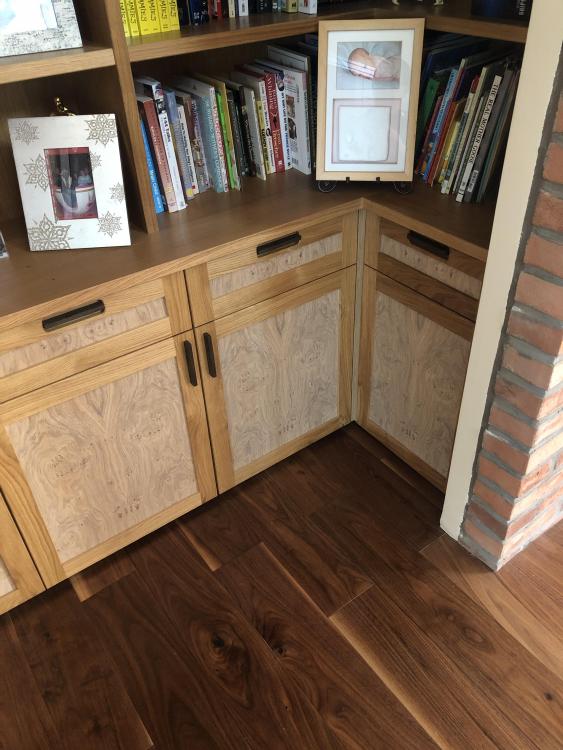
Thanks, I had to look back to the original emails with the maker. The door frames are soaped oak (similar to oiled) , the veneer in the middle of the doors is poppy oak and the handles are smoked oak. If I remember correctly he said he flew to Southampton to look at veneers and then they showed us dozens of thin sheets of veneer and let us pick the ones we liked.
-
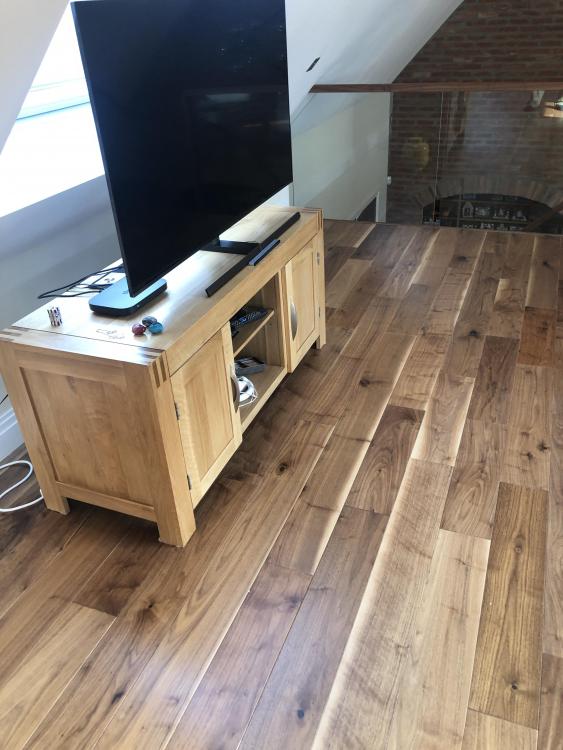
The beauty of wood is that it is usually pretty easy to mix woods together. The general rule is to try and mix similar tones so warm tones eg walnut and oak or grey tones together. We have lots of mixed wood tones.
-
This is a very good piece of advice. It is amazing how, even in a large room, depending on the positions of doors and windows it may not be easy to position furniture where you want to. It is good to think about this whilst you can still change things. The basic layout seems sound, so just a few comments. 1. The lounge is very long at 7m, would you actually use all that space. If not, I would try and shorten it and add the space to the sitting room which is comparatively small. 2. The WC is extremely small relative to the house. If you take the idea above to make the sitting room larger I would then make the WC larger. 3. I would think hard about the kitchen layout. It looks like it is set so that the kitchen units will be where you walk in, then a dining and sitting area at the back. Imagine you are cooking for guests, would you want to take them in past your cooking to the table. 4. We have a larger room than you have there as a gym and it never seems big enough, but we often have three people there at once. I would look to steal space from the laundry/utility area and add to the gym. You need a surprising amount of space for some exercises, especially when on the floor. 5. The laundry/utility area is too large. I cannot think what you would possibly do with all that space. I would probably take the plant room a little bigger and rein the space making the gym larger. You won't hang out in those space so they really only need to be as large as needed for their functions. 6. Upstairs I would make the two small ensuites at least 1.2M wide. 1M is very small especially compared to the size of the house. I would also make the wardrobes in those two rooms larger, probably moving them to the righthand walls of the rooms. 7. I think the suggestion to model the house in 3d to see what it looks like is a good one. I am less of a style expert. I might consider rendering the part where the front door is and having more glass above the front door. 8. Counting the steps on your stairs, is the ground floor only 2.4M high? It really should be 2.7M in this size of house. At the moment you cannot have a longer stair which would prevent this. My wife wanted a split stair, but I persuaded her to go for one really nice stair, we have a curved stair. It looks like the stair has a combination of half landing and winders. It seems a bit fussy and I am not sure it will flow well. I think one stair along the wall where the kitchen door is then turning left would be a much nicer stair to use and then you could have a double door not the kitchen with a sightline right through from the front door.
-
I have often wondered about what does it mean for a fence to be "adjacent" or "next" to a highway as this seems ill defined. In your case an access road is a "highway", a highway is just any kind of road with public access. I found this which contains some case law on the subject https://www.planningresource.co.uk/article/1209017/general-permitted-development-order-part---2-q---dcp-section-434 In truth it doesn't sound like planing would be too concerned about it, at worst they might ask for you to make a retrospective application if someone else complains. Are the trees inside or outside the fence? If there are trees outside the fence then they would probably mark the boundary between the road and your property and two metres would be fine. If they are inside the fence then it might have needed permission unless the verge is extremely wide. I am assuming the fence is taller than the one it replaced, if it is the same height then no change has occurred and no permission is needed. In terms of a fence between properties, they should take the natural ground level where it sits. If there is a big drop on one side, then the higher height would be used. If your neighbour's garden slopes gently away from the fence that is not relevant as it is the height of the ground the fence is on that matters, not a distance away from the fence.
-
To avoid the 110V problem and the need to buy bulbs I bought one of these last year and use it to light the loft. Took me ages to find a 240V version. https://www.mad4tools.com/defender-22m-led-fully-enclosed-festoon-lighting-kit-110v-or-240v?utm_source=google_shopping&c=55856&2269=&gclid=EAIaIQobChMI86vmnrqK8AIVUuN3Ch3hsQcNEAQYASABEgLmIPD_BwE#2269=?
-
MVHR is Largely Bogus
AliG replied to DavidHughes's topic in Mechanical Ventilation with Heat Recovery (MVHR)
For most lights in the house that is true. We have a lot of dusk to dawn lights that are on for hours and 5-8W each. However there are 16 LEDs in my kitchen which the automation say use 185W when they are all on. I put them onto two circuits, but apparently people hate the idea of only one circuit being on. Back on the topic of MVHR. I have turned my MVHR boxes down to level 1 as I didn't think any more air flow than that was needed. Perhaps it is the size of the house, plus lack of airtightness, but I have never seen condensation in a bathroom etc. One thing I note is that MVHR is cheaper than heating up cold outside air, but it still does not heat the air to the inside temperature during winter so it cools down the house if running too hard and increases heating bills. -
MVHR is Largely Bogus
AliG replied to DavidHughes's topic in Mechanical Ventilation with Heat Recovery (MVHR)
The automation guy wanted me to put in extra sensors that could be programmed to put the lights on at a lower brightness level at night, but as I already had sensors going in it was too late and a lot of hassle to change. -
MVHR is Largely Bogus
AliG replied to DavidHughes's topic in Mechanical Ventilation with Heat Recovery (MVHR)
You are right, It wouldn't pay for itself, it only really works if you replace a light switch with a sensor. When my electrician priced it up it was £60 installed for either. This should be standard practice in all new builds, I am surprised it hasn't been put in the building regs. -
MVHR is Largely Bogus
AliG replied to DavidHughes's topic in Mechanical Ventilation with Heat Recovery (MVHR)
I have all these rooms on sensors. I noticed in our last house that whenever we had visitors they never turned off the en suite lights. These were also connected to an extractor fan so that would be left running for hours as well. I don't know why it is not standard to have bathroom, utility room lights etc on a sensor. Not only does it save electricity but you don't need to install switches and root around for lights in the dark. -
MVHR is Largely Bogus
AliG replied to DavidHughes's topic in Mechanical Ventilation with Heat Recovery (MVHR)
I have set the automation to switch off all of the lights at 8.10am and then again at 10pm so that it switches off all the lights (or at least the ones that are automated) during the school run in the morning and after everyone has gone to bed. My daughter absolutely insists that she needs all the lights on in the kitchen whenever she is in there, no matter how bright it is outside. I also find TVs on in empty rooms all the time. Clearly things have changed since my mum was younger. -
Proposed garage (car maintenance) in the field opposite my house
AliG replied to newhome's topic in Planning Permission
I had a look around and found the planning application. I can see why you would want to object, but in truth I doubt it will have much of an impact on you. Considering the proximity of the A1 and railway line, I doubt objections re noise will be entertained. From a planning perspective, the council will argue that moving an operation from somewhere where they park cars all over the place on the road to somewhere where they have all the cars in a compound is an improvement overall. It isn't for you, but from the council's perspective it would be better. Thus complaints re the current parking position will not necessarily help, if anything they may be supportive of the new application. But considering the parking situation, it may be worthwhile to ask for yellow lines to be placed to stop cars being parked outside the development, pointing to current issues. I suspect this is one of your main worries, that the business gets bigger and cars start to spill out onto the road. I would also ask that they screen planting on the side of the site towards your house is at least 2M high. Looking at the site history they have a lapsed permission to build even closer to your house in 2007 and they were refused permission to build where they now propose to build in 2005. I think they are actually using your house as an argument to go back to the 2005 position. I would be worried that they go back to the 2007 position if they are turned down here. However, understanding that you would rather not have it near to your house, I would try and find out why it was refused at planning and appeal in 2005. My suspicion is that it was because it was next to the cemetery and it looks like the community council may have objected at the time and it may be worth asking what has changed. They might say that the business is larger and more of a nuisance now so it is the lesser of two evils. The piece of land is surely too small for agricultural use so I doubt that objection works either. -
Proposed garage (car maintenance) in the field opposite my house
AliG replied to newhome's topic in Planning Permission
Is the supporting statement a lie then? Supporting them moving away is meaningless in planning terms. They don't need planning permission to move, they need permission for the new premises. If the CC just supports that they go away that is not the same at all as supporting the new development. Did this cause it to be moved closer to you? Did the council actually encourage them to move closer to living people to benefit dead people? -
MVHR is Largely Bogus
AliG replied to DavidHughes's topic in Mechanical Ventilation with Heat Recovery (MVHR)
Oh I know. Other times she will be wildly generous. She doesn't seem to have any perspective on the amounts involved. I still remember dragging our suitcases home from the station after our holiday one year ,when I was around 10, as it was only about a 12 minute walk and taking a taxi was considered beyond the pale. In fairness my parents have ended up very comfortably off relative to what they earned and my dad was able to retire when he was 58 so it has its benefits. -
Proposed garage (car maintenance) in the field opposite my house
AliG replied to newhome's topic in Planning Permission
The community council have helped you out in a way. If they are supporting it as the garage is ugly and they don't want to see it then visual amenity is a valid reason to object, i.e. it is ugly. I would take pictures of the current situation and use them in the objection. Is there enough parking for customers in the new area? Parking, traffic and road safety are valid objections. Noise and disturbance is a valid objection, as said tools are much noisier than traffic. What hours do they work? Again is this being complained about at the moment? How is the land classified in the local plan? The community council round here objected to my house and my parents'. Their objection to ours included it was the biggest house built in the area in over 50 years. They are a law unto themselves, often not objecting to other houses that breach local planning guidelines. I have wanted to have a go at them for a while. If your community council wants to move a nuisance from one part of the area to annoy people somewhere else, what exactly is their argument? No doubt someone on the council or a mate lives near the garage. I would actually ask them to withdraw their support as I suspect it is very biased. -
MVHR is Largely Bogus
AliG replied to DavidHughes's topic in Mechanical Ventilation with Heat Recovery (MVHR)
My dad likes to say that my mum never found a switch she didn't want to turn off. They don't have MVHR currently, but they have trickle vents and a central air extraction unit for the kitchen and bathrooms. She keeps turning it off because she says the noise keeps her up. I don't believe her, it is because she thinks it costs money to run. I can tell as soon as I go into the place that she has turned toff as the air is stale. She also likes to close the trickle vents. The other day she was complaining that a neighbour in the block of flats was running his Karcher off the communal electricity supply. The fact I pointed out that this was unlikely to even cost her 1p didn't seem to matter. He was being cheeky and she would never use everyone's electricity like that. Their new place will have an ASHP and MVHR. I am trying to think of a way to stop her turning them off! -
I have the same spreadsheet still from my original order. They filled it in with some standard numbers and never redid it for the actual numbers for the house. I calculated it myself using the JSHArris heat loss calculator. Looking at the calculation though, it is indeed based the structural heat losses of the room. The way the pool makes a difference is that it requires more ventilation than a normal room which loses energy from the evaporated water. Otherwise it is the same calculation. It looks like yours is in a basement? No windows in the calculation. Looking back at my calculation there was an allowance for the electricity for the dehumidification and filter pump. They would be around £450 (3000kWh each) a year each which seems about right. Actually i tried to work out my electricity consumption a while ago and I had the dehumidifier at just under 3000 and the pump at just over which is almost exactly what is in the original calculation. I think I calculated the pump use from its specs.
-
In terms of heat loss from a pool, when I calculated it, the loss is really the heat loss from the pool room. The losses to the ground are much smaller. Although I do have EPS under and around the pool. The reason pools used to cost a fortune to heat is that they need quite large rooms and people would often put them in rooms not much better than sheds.
-
12.5k for what is suggested seems a bit high. I would think more like 8. I guess a pitched roof is a bit more expensive.
-
I gave that number purely as an indication of how to size the ASHP as it is defined by the worst days. We use 75,000 total a year. That is around 20,000 for the pool, 15,000 for hot water (we use too much hot water) and 40,000 for heating. I have never got round checking on days when it is and is not used. It would depend how long it is open for, but I suspect it is 5-10kWh. I will see if I can check this. It shouldn't matter. You just need to run a certain amount of water a day through the filter. I am sure it could run bit less, but the pool is lovely and clear. The pool guy set it up to run during the day so it did not disturb people at night. But you cannot hear it upstairs, so I would rather it ran at night anyway. It is quite noisy when you are in the pool room (it kicks into a higher speed when the pool is open). He tried to change it once and it didn't work, but I think I could probably change the settings myself if I had a smart meter. It looks like the system is set up to maximise self use and they have total control of the system. I have 5kW of solar. The savings on their calculator seem to go down with more solar. For a simple calculation, say you use £2000 a year in electricity. Reducing your cost from 15p/kWh to 11p/kWh will save £500 a year. The Powerwall is £10k and only has a useful life of 10 years at best. Most of the cost is the Powerwall itself, so you won't be able to save much. It does indeed, but I doubt it would produce half of the pool's heating costs as they don't produce as much during winter. The equation is slightly different with gas as although PV produces less energy it displaces electricity which is a lot more expensive than gas. Still with a ASHP water heating costs around 4p/kWh versus pure electricity at around 15p. Thus PV might still produce better or similar savings. I am not sure this would be worthwhile. When your solar thermal is generating it should all be eaten up by the pool using 50kWh a day. It is an even larger buffer. You will need a smaller one to manage the heat transfer, but I don't think an enormous one. You'd only need a large buffer if there were days the solar thermal generated more than you need for the pool and hot water which seems unlikely.