Roger440
-
Posts
2026 -
Joined
-
Last visited
-
Days Won
6
Everything posted by Roger440
-

An introduction... Renovation + 1950s + subsidence = a challenge!
Roger440 replied to alfaTom's topic in Introduce Yourself
Interesting stuff! -
We need a chemist: Portland cement and Lime.
Roger440 replied to SteamyTea's topic in Research Resources
Well, theres not much point in using lime for pointing, for example, if you then cover it in a layer of less breathable material. Anything with cement is less breathable. Likewise gypsum, though gypsum is a bit more complicated. Where it gets complicated is how breathable does it need to be? There are plenty of armchair experts who will tell you lime isnt necessary, and, for example, gypsum will work as it is resonanly breathable. That statement, taken in isolation is of course true. But the problem with messing around with old walls is that no one really knows just how much moisture is moving through it. So at a practical level, if in doubt, use lime, is a pragmatic solution with the highest chance of success. There is no better performing material for this particular purpose. If you ask anyone who specifies something else in an old, non DPC wall, they will not guarntee their idea/build up will work. Funnily enough, the onus is on you, not them, if, subesquently there are damp issues. Anyone wanting to spend money on alternative scheme, good for them, but ill spend it on the option most likely to succed. Unless, and until someone comes up with a bullt proof way of analysing individual walls accurately, i cant see much change. If you have established you need a breathable build up, and id make sure that you really do, then you have to understand the performance of each layer all the way to the wallpaper covering and glue. Or paint. If it helps, working with lime is so much easier than cement or gypsum, mainly as you are not time limited in the same way. -
Old Roof & Building Regs - Will it take the strain?
Roger440 replied to RobertG's topic in Roofing, Tiling & Slating
Understand the wall issues, and with render, then all the more important. There are, afterall, only types of render, render thats cracked, and render thats going to crack! Which is why i cringe everytime i see EWI covered in render. The long term outcome can surely only go one way. But your roof build up is exactly the same as a modern house, so breathable products here are just spending money for no benefit. -
We need a chemist: Portland cement and Lime.
Roger440 replied to SteamyTea's topic in Research Resources
Good luck with that! You may be some time................................................... -
Old Roof & Building Regs - Will it take the strain?
Roger440 replied to RobertG's topic in Roofing, Tiling & Slating
When you say the walls were sopping wet, do you mean downstairs, or was it wet upstairs? If so, that, surely must be an ingress issue. I see no reason to use "breathable" materials up here. Its no different in contruction to a modern house. They are all fine. Id be doing, and in fact am, what nod and saveasteading are suggesting. Out of interest, there appears to be an error on your drawing for the sloped part. It says to batten to leave a 50mm air gap, then 100mm insulation betweebn the rafters. That suggests they are 150mm deep. The pic, unless its very decieving suggest 75 or 100mm. -
Ooooops Spray foam gets a thumbs down from UK lenders
Roger440 replied to MikeSharp01's topic in Heat Insulation
Shutting the industry down is a nonsense. There are plenty of perfectly valid applications for spray foam. No doubt there are cowboys, so do something about them instead. Stop giving government grants to them would be a good starting point. -
We need a chemist: Portland cement and Lime.
Roger440 replied to SteamyTea's topic in Research Resources
What exactly are you hoping to achieve/learn here? If you ever feel the need to come to wales, ill happily show you a real life example of lime V cement on a wall with no DPC. I was sceptical, i have to admit. But 2 houses later, real world experience tells me what i need to know. None of it is helped by the "hardcore" lime-ists though, who would have you believe its the answer to every problem. There was one on a group im in fitting a kitchen work top wanting to know what breathable sealant he should use where it meets the wall, as though a 5mm bead of silicone was going to make any difference to anything. -
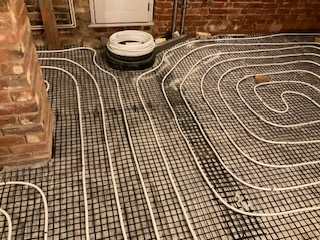
Ive used it, and your description of "shoggled" is about right. Its nothing like whacking down type 1. Significant voids or gaps remain afterwards. A geotextile membrane was then laid before concrete/lime crete. If you didnt, the voids are such that the concrete would fall down into the voids, negating its insulating properties. The main reason i used it aside from being "breathable" (old house) if i can use that term is that it reduced excavation as it is both the sub base and insulating layer combined. Im not one for taking pics, heres a shot with geocell, membrane and heating pipes down
-
Scotland - Ban on stoves in new build houses lifted.
Roger440 replied to ProDave's topic in Stoves, Fires & Fireplaces
I think looking for logic isnt likely to get you far. Its government. Worse still, its the scottish government. One does have to conclude that the wood burining stove lobby are highly effective. -
Foamed glass is easy to move as it weighs next to nothing.
-
Scotland - Ban on stoves in new build houses lifted.
Roger440 replied to ProDave's topic in Stoves, Fires & Fireplaces
Its 15 mins work to fit an isolater. Though you do still need to remember to isolate the incoming before you turn it on. -
Scotland - Ban on stoves in new build houses lifted.
Roger440 replied to ProDave's topic in Stoves, Fires & Fireplaces
Exactly what i am doing. Boiler is oil, but clearly, still needs power to run. So a small diesel genset does that. If i ever get my forklift to be my battery bank, thats more than enough to keep the boiler running. My primary reason for sorting all this stuff out isnt power cuts, though we do a get a fair few usually no more than a few hours, its protecting myself and not being a victim of Ed's bonkers ideas and the inevitable power rationing that follows. -
road planings --experience of them over time AS
Roger440 replied to scottishjohn's topic in Driveways
Good summary of the madness of road laying. -
Scotland - Ban on stoves in new build houses lifted.
Roger440 replied to ProDave's topic in Stoves, Fires & Fireplaces
Government signals and actions suggest it is. I think you will find the public at large think it is too. Everyone who comes to our house, which now has the original fireplace opened up, ask if we are fitting a wood burner. Without exception, when i say no, they think we are mad, if i try to explain why, they think im madder still and some sort of conspiracy theorist. There is literally no understanding or concept of the consequences of burning wood inside your house. -
Ive got this now. Surprisingly effective. But only in the living room, not the kitchen. Can have carpet in the kitchen! Nothing matches UFH for comfort. The costs are negligible, some UFH pipe and £200 or so in hire for the machine. Not doing it doesnt stop the heat loss through the uninsulated slab, though, accepted it will be less of a loss than with UFH.
-
I did the whole excavation thing at my last place, though primarily for other reasons, but insulated and fitted UFH along the way. To do this to my current place, even with me doing a lot of the work i reckon it will be circa £5k by the time im done. Significantly more if i paid to have it done. Thats an awful lot of heating oil.
-
Id suggest it will be fine. Yes, i didnt want the shallow step. On the face of it, its not much, but you do notice it in use. Bizarre really, your wouldnt think that would happen.
-
Very interesting. Thanks for posting.
-
Ill be doing it myself. You can hire the slot grinding machine, so straight forward enough, if tedious. Ive looked at an overlay, but given id be doing the whole ground floor, it causes to many issues with doors, thresholds and the stairs, so ive discounted it. My house is 1800's solid wall with no DPC, so im not overly concerned about "warming" the wall as it will help push the moisture outwards, but im gussing yours is rather more conventional? Im not convinced it will need to run at an overly high temp, but clearly it will be a slow to respond heating system. The one i did in my last house was semi insulated with foamed glass, but pipes right at the bottom of the slab. It worked really well and ran at 35 degrees.
-
Im in the same position. Without ANY insulation under. I intend to do likewise, just set it into the existing concrete. Of course, its a long way from ideal, it will cost more money to run than if it has proper insulation. Quite a bit more. Its all very well people saying dig up the floor, but that costs. A lot. I ran some crude numbers. Id need to live to well over 100 years old to see payback. Not happening. Got better things to spend my money on. The reality is, its makes no economic sense. Unless you are 12. Dont take my word for it though, crunch the numbers yourself. Use the Jeremy spreadsheet on here to help figure it out. Id imagine with 25mm insulation under, your payback will be even longer. Of course, it will be better done right. If i had unlimited funds id do it right.
-
Light refurb/renovation & building regs
Roger440 replied to Roger440's topic in Building Regulations
You make a good point. Wasnt aware i can hang it out as long as it takes me. Which would indeed be quite a while! I do still have the issue of cost and risk of doing it with approval, which, seems, unless someone says different, inescapable. -
Light refurb/renovation & building regs
Roger440 replied to Roger440's topic in Building Regulations
Im intending to die here, but that may not pan out, so yes, when selling it can be an issue. Traditionally an indemnity policy is peanuts, because the risk of action was essentially zero. I bought this house in the full knowledge that nothing that had been done, boiler aside, had certification. My previous house proved that such certification, of which there was plenty, was to all practical intents, worthless. Had i relied on it as evidence of compliance i would have been most disappointed. But, yes, going forward, logically those indemnity policies will go up in cost as the risk of enforcement increases. But to get to the nub of it, if it was just the BC fee, that would be OK. But its not like i can present my sketches and say, i want to do this, is that OK? Unless ive very much misunderstood, im going to need "proper" drawings, SAP assesment, maybe a WUFI condensation risk analaysis for the walls. None of these will tell me anything i dont already know. However, i cant do any of these things myself. Things things are not £50. So i either spend significant sums on these things, with no guarantee of acceptance as i am departing from the regs, and the risk of further reports and / or changes to what i can do. Then ill have to do the same again later when i do the windows. And the back of the house, the cavity wall bit. Each time another 4 figure sum. It makes no sense to keep shelling out for things that add nothing to the house, for a project that even without those additional report costs etc is way beyond the 15 year payback period to which the regs refer. Essentially, my choices are do it by the rules with lots of extra cost incurred, with no certainty what the final cost will be, just do it with out approval, or do nothing and buy more oil (which is the financially sensible option). My takeaway so far is that i could probably get approval for my plans, but at considerable additional cost. Cost which adds nothing to the final result. Though im struggling to believe anyone will let me do UFH on an uninsulated slab?!? Im conflicted given the new penalties........................................... -
Light refurb/renovation & building regs
Roger440 replied to Roger440's topic in Building Regulations
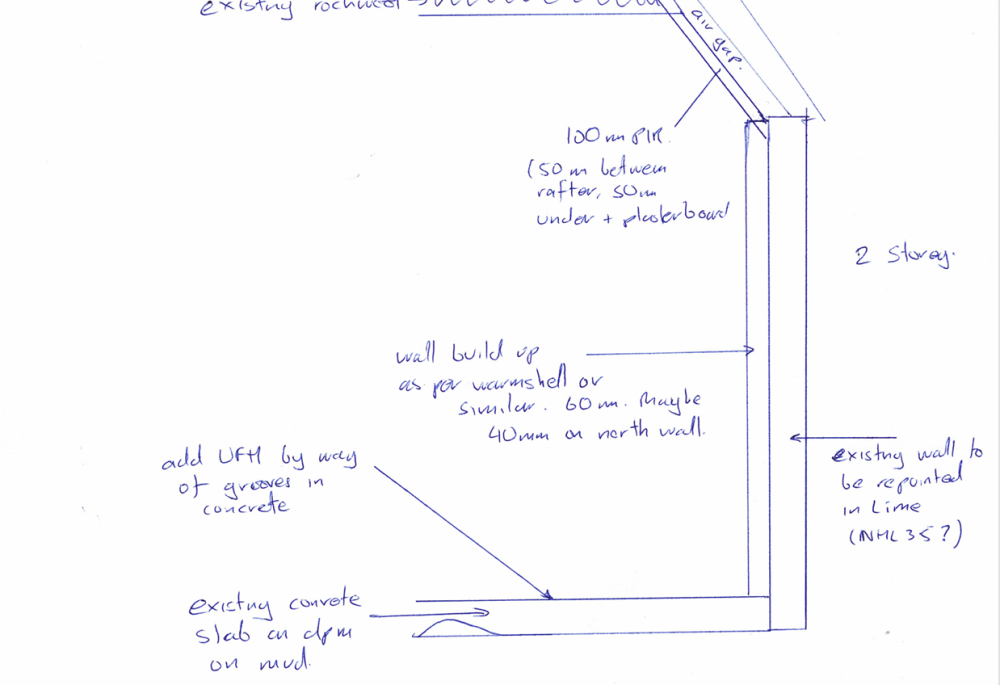
Anybody have any thoughts on my random scribblings please?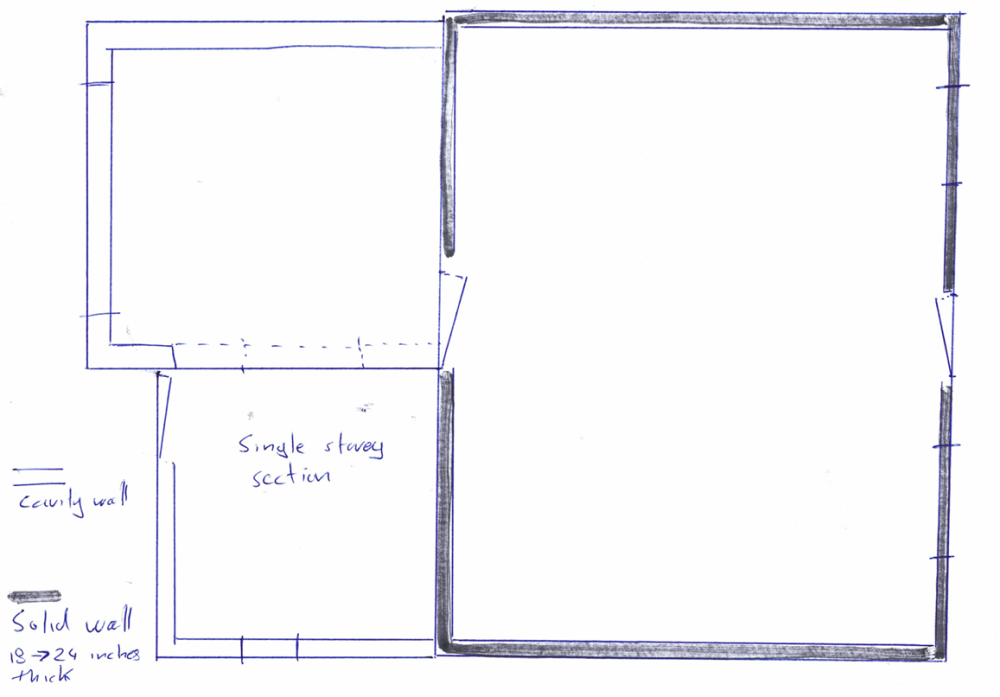
-
Indeed, you have suggested this previously. I like the idea, though at a practical level there are some challenges, mainly the purlins that run along the roof blocking said airflow. And the roof is heavily shaded after midday/ early afternoon by 30m conifers. But ive not abandoned the idea. I did originally start a thread on how to heat the place at zero or close to zero cost.
-
SketchUp fantasy Garage. Drawings for building control
Roger440 replied to Russdl's topic in Garages & Workshops
Because im an idiot, i miscaluclated where the door would land, mainly because i changed my door solution post slab laying, but if we ignore that aspect, i put 2 inch EPS on the upstand where the door was, then cut it back at an angle so the block paving could run up to the concrete. So yes, something of a thermal bridge there. Could have put a thin sheet of something in the gap to actually break the bridge though.. Like a thinner GRP box section. Perfect, no, but light years ahead of any other garage i have had.- 27 replies
-
- 1
-

-
- detached garage
- structural engineer
- (and 1 more)