


Roger440
-
Posts
2171 -
Joined
-
Last visited
-
Days Won
7
Everything posted by Roger440
-
For what its worth, before we bught this place, we looked at a place a few miles away that was off grid. Was running on a ramshackle collection of old gennys, some lead acid cells etc. That would be no use to me. I rang these guys. https://www.energy-solutions.co.uk/applications/off-grid/residential At the time, £40k, all in, solar, batteries, generator, control system etc. Completely automatic. So long as its filled with diesel. The cost of a connection would far exceed that, and if you take out the capex on it, your actual cost per unit of electricity was way way lower than the grid. I thought it was quite a sensible solution. Didnt buy the house though. The one we did buy has an 11kv pole directly behind my barn. I wanted 3 phase in the barn. Still came in at £17.5k plus VAt with me doing the trenching. Im sure that the minute they think you might spend money, they start adding in loads of extra stuff, that would normally be "maintenance and replacement" and get you to pay for it instead. I dont have 3 phase. It does mean, however, with both a house and barn needing heating, oil remains my only sensible option as otherwise overall load starts to get to high if ASHP's were to run both along with everything else. But, tough, not paying £20k. To have higher priced electricity than a domestic supply. Its a good thing that back in the 50's when they were connecting houses to the grid for the first time, they operated in a rather different way!
-
Absolutely this!!! Theres a lot of installers getting rich quite quickly. Always the same with any government scheme. Heat geek might be well ahead of other in the technical aspect, but they appear to be on an equal footing with others at taking the taxpayer for a ride. Same as my "free" 4g internet connection. About 250 quid on the open market. But they pay the installer 850!!!! And he does three a day. I guess the money run out now so they are onto EV charger installation. Funded by the welsh government. Again.
-
This doesnt appear to be clear. This house that you have built, are you saying its still under contruction, and that you need to deal with the rainwater run off from the roof? How much land does it have? I dont think id be telling anyone about the existing soakaway. Thats a whole can of worms you probably dont want to open. However, nothing in your post suggests its not working, so the ground conditions cant be too horrendous. Where did water run off prior to building go?
-

Fine tuning my IWI Solid wall (Warm Batten) design
Roger440 replied to Annker's topic in Heat Insulation
Why the NHL 3.5. Thats not particuarly permeable. Its not like you need the strength. -
The new owners may well create a problem as the IWI build up will no longer be breathable. But thats on them If you are nice, like i was, i left the next owners a "house book" advising them what to do and which walls it was applicable too.
-
How bad is this brickwork & should I start again?
Roger440 replied to Tony L's topic in Bricklaying, Blockwork & Mortar
I guess it probably doesnt matter from a practical point of view, but the two things that would concern me are, 1, given the stabdard of work, what the standard of mortar mixing like? You dont need poorly mixed/weak mortar here. Also if thats the standard or work they can achieve, i cant imagine it would improve later. Personally, id sack them. -
You would have to imgaine there must be some degree of corruption, simply because the sums of money at stake can be huge. With that much at stake, persuading the planner with sums that could take months or years to earn, looks like an easy solution. It will be interesting to see where the leeds case leads.
-
Limewash. Doesnt get cheaper or more breathable than that.
-
I think you may be waiting some time. As above, there is no plan, and no clue. Just fuzzy words. They have used up 8% of there term already.
-
Id say Joe90 is bang on the money.
-
Coldwells Passivhaus Turnkey Houses.
Roger440 replied to TheMitchells's topic in New House & Self Build Design
Ive owned a few houses, granted none were that new, but none had "plant rooms". Not necessary, more of a nice to have id suggest. -
Fine tuning my IWI Solid wall (Warm Batten) design
Roger440 replied to Annker's topic in Heat Insulation
Can i ask what the logic is that drives that decision? -
How much? Just use the Jeremy spreadsheet on here. Will give you a good indication.. I did. Ill be dead before i reach any kind of payback to digging up the floor. Perfection is nice, how ever, some pragmatisim is required unless you dont have bedgetry contraints. If you think you will sell in 10 years, dont even bother doing the calcs. You wont reach payback in that time.
-
Fine tuning my IWI Solid wall (Warm Batten) design
Roger440 replied to Annker's topic in Heat Insulation
Would you use the intello over a woodfibre and lime build up? As opposed to not having the VCL at all as is normally suggested? -
Some basic HP questions for those in the know
Roger440 replied to Gordo's topic in Air Source Heat Pumps (ASHP)
All very nice, but in reality, wishful thinking. Developers are interested in profit, not the running costs. There is simply no incentive to be interested. -
Indeed. Good info, as ive zero intention of digging up my floor to install insulation. Based on my calcs, it will never pay for itself while im alive. If i achieved something like this, it pushes payback even further into the future.
-
An introduction... Renovation + 1950s + subsidence = a challenge!
Roger440 replied to alfaTom's topic in Introduce Yourself
Interesting stuff! -
We need a chemist: Portland cement and Lime.
Roger440 replied to SteamyTea's topic in Research Resources
Well, theres not much point in using lime for pointing, for example, if you then cover it in a layer of less breathable material. Anything with cement is less breathable. Likewise gypsum, though gypsum is a bit more complicated. Where it gets complicated is how breathable does it need to be? There are plenty of armchair experts who will tell you lime isnt necessary, and, for example, gypsum will work as it is resonanly breathable. That statement, taken in isolation is of course true. But the problem with messing around with old walls is that no one really knows just how much moisture is moving through it. So at a practical level, if in doubt, use lime, is a pragmatic solution with the highest chance of success. There is no better performing material for this particular purpose. If you ask anyone who specifies something else in an old, non DPC wall, they will not guarntee their idea/build up will work. Funnily enough, the onus is on you, not them, if, subesquently there are damp issues. Anyone wanting to spend money on alternative scheme, good for them, but ill spend it on the option most likely to succed. Unless, and until someone comes up with a bullt proof way of analysing individual walls accurately, i cant see much change. If you have established you need a breathable build up, and id make sure that you really do, then you have to understand the performance of each layer all the way to the wallpaper covering and glue. Or paint. If it helps, working with lime is so much easier than cement or gypsum, mainly as you are not time limited in the same way. -
Old Roof & Building Regs - Will it take the strain?
Roger440 replied to RobertG's topic in Roofing, Tiling & Slating
Understand the wall issues, and with render, then all the more important. There are, afterall, only types of render, render thats cracked, and render thats going to crack! Which is why i cringe everytime i see EWI covered in render. The long term outcome can surely only go one way. But your roof build up is exactly the same as a modern house, so breathable products here are just spending money for no benefit. -
We need a chemist: Portland cement and Lime.
Roger440 replied to SteamyTea's topic in Research Resources
Good luck with that! You may be some time................................................... -
Old Roof & Building Regs - Will it take the strain?
Roger440 replied to RobertG's topic in Roofing, Tiling & Slating
When you say the walls were sopping wet, do you mean downstairs, or was it wet upstairs? If so, that, surely must be an ingress issue. I see no reason to use "breathable" materials up here. Its no different in contruction to a modern house. They are all fine. Id be doing, and in fact am, what nod and saveasteading are suggesting. Out of interest, there appears to be an error on your drawing for the sloped part. It says to batten to leave a 50mm air gap, then 100mm insulation betweebn the rafters. That suggests they are 150mm deep. The pic, unless its very decieving suggest 75 or 100mm. -
Ooooops Spray foam gets a thumbs down from UK lenders
Roger440 replied to MikeSharp01's topic in Heat Insulation
Shutting the industry down is a nonsense. There are plenty of perfectly valid applications for spray foam. No doubt there are cowboys, so do something about them instead. Stop giving government grants to them would be a good starting point. -
We need a chemist: Portland cement and Lime.
Roger440 replied to SteamyTea's topic in Research Resources
What exactly are you hoping to achieve/learn here? If you ever feel the need to come to wales, ill happily show you a real life example of lime V cement on a wall with no DPC. I was sceptical, i have to admit. But 2 houses later, real world experience tells me what i need to know. None of it is helped by the "hardcore" lime-ists though, who would have you believe its the answer to every problem. There was one on a group im in fitting a kitchen work top wanting to know what breathable sealant he should use where it meets the wall, as though a 5mm bead of silicone was going to make any difference to anything. -
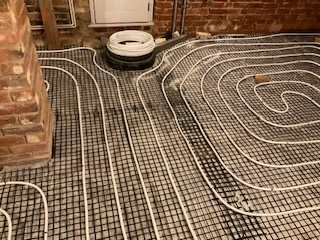
Ive used it, and your description of "shoggled" is about right. Its nothing like whacking down type 1. Significant voids or gaps remain afterwards. A geotextile membrane was then laid before concrete/lime crete. If you didnt, the voids are such that the concrete would fall down into the voids, negating its insulating properties. The main reason i used it aside from being "breathable" (old house) if i can use that term is that it reduced excavation as it is both the sub base and insulating layer combined. Im not one for taking pics, heres a shot with geocell, membrane and heating pipes down
-
Scotland - Ban on stoves in new build houses lifted.
Roger440 replied to ProDave's topic in Stoves, Fires & Fireplaces
I think looking for logic isnt likely to get you far. Its government. Worse still, its the scottish government. One does have to conclude that the wood burining stove lobby are highly effective.



