SteamyTea
-
Posts
23273 -
Joined
-
Days Won
187
Everything posted by SteamyTea
-
You will need to block off the MVHR.
-
If it is like regular skirting board and is fitted onto an external wall, you will be increasing losses as you are heating up a cold wall that conducts directly to the cold outside.
-
Mixed units there, W is power, heat is J.
-
As I understand it, yes, just a rubber stamp, pass or fail. Pretty hard to fail in reality if some care has been taken. If there is a known problem, explain to the people that are pushing you to get it done that the country has been in lock down for 3 months, just in case they missed it. A few insurance companies are in Bournemouth, so they may have been on the beach.
-

What electric heating and DHW for small new build flat?
SteamyTea replied to Mr Punter's topic in Other Heating Systems
I think they do. Do a text search on that SAP document I linked to earlier. With a small flat, I would have thought that ventilation was more important. I have a small house (smaller than some of your flats), if I lived up country, I would have fitted MVHR by now, as it is, I can get away with open windows for the majority of the year, though this does chuck out the heat I put in during the previous night. Worth remembering that when a storage heater is charging up, it shuts down most the the heating. Why they can be good working with PV, even in winter as you may only need a kWh or two a day to keep the chill of a place. -
What electric heating and DHW for small new build flat?
SteamyTea replied to Mr Punter's topic in Other Heating Systems
That is quite an interesting idea. Has anyone worked out the price difference between installing ordinary plasterboard and that aerogel backed plasterboard. Then compared that to say fitting a heat pump over a storage heater. I still think that one 10 kW inline water heater for all the hot taps and modern storage heaters is the cheapest option and the most environmentally benign. Does anyone have the proposed CO2 figured for grid supplied electricity that SAP is changing to? The 2018 SAP document Table 12 says 0.233 kg CO2/kWh with a primary energy factor correction of 1.738. Gas is 0.210 kg CO2/kWh with a primary energy factor of 1.122. So 0.405 and 0.236 respectively. But I am not sure if they are the latest numbers. -
What electric heating and DHW for small new build flat?
SteamyTea replied to Mr Punter's topic in Other Heating Systems
Thinking a little outside he box here. You could heat up one large cylinder with water, then feed off that to the 3 flats, via inline heaters. Does depend on how the water is metered. It is possible to fit PV on a roof at a lower cost that tiling, does depend on roof design. You may also find that fitting a 4th meter and exporting everything that get generated, while collective the 5p/kWh (or whatever you can negotiate) is a better way. I think you will find that the 'government' is doing more that you think. Also a lot cheaper to build a solar farm than get a few thousand panels fitted to new builds. Really need to do both though, but people still think that PV is expensive, don't work well and will break down. -
Exactly. They may not be perfect, but still pretty good, and one can always add more insulation inside the airing cupboard, worked a treat for me. He had one of those horrible cylinders where the feed and header tank was combined. And then it was more a problem where it was situated as the power loss was heating up the bedroom. I like the technology of the SA, but they are too expensive and have control limitations.
-
If you have a heat pump, or use resistance heating, it is easy to divert the power to a normal cylinder. If that electricity comes from your PV, and goes via a heat pump, there will be times when for every kWh of PV generated, you get 3 or 4 kWh of thermal energy.
-
What electric heating and DHW for small new build flat?
SteamyTea replied to Mr Punter's topic in Other Heating Systems
Put it into the largest, or coldest one. -
What electric heating and DHW for small new build flat?
SteamyTea replied to Mr Punter's topic in Other Heating Systems
Are the flats on separate meters (probably best) or sub meters (better for you, not so good for tenants). You may be better off just pumping it into one flat. -
What electric heating and DHW for small new build flat?
SteamyTea replied to Mr Punter's topic in Other Heating Systems
Some PV power can easily be diverted to them, and the DHW store. -
What electric heating and DHW for small new build flat?
SteamyTea replied to Mr Punter's topic in Other Heating Systems
Modern ones are very controllable. They have timers and good air temperature monitoring. Panel heaters are alright, and just like a storage heater, or any type of heater, they need to be sized correctly. The largest expense is going to be DHW. Do you really want your tenants paying standard rate for that. 20 minutes @ 10 kW is around 60p a day. About double what I pay on E7. -
What electric heating and DHW for small new build flat?
SteamyTea replied to Mr Punter's topic in Other Heating Systems
Storage heaters, size them correctly and they will last decades. Assuming a good water pressure, then maybe an inline heater, if pressure/flow is bad, then storage and a pump/accumulator. If you can fit a vented system, then you have no certificates/annual checks needed. If you have hard water, then you will need to fit and maintain a water softener, can't rely on tenants to do that. Should be able to divert PV easily to the DHW system. Or ask a plumber and they will come along with a complicated and expensive system for you, maybe even a Sunamp. -
That's interesting. Depending on the wall orientation to the sun, it is really measuring energy change (of the building fabric), rather than temperature. It is really energy levels that need controlling with either additional inputs to the house i.e. heating, or subtract energy i.e. extra ventilation or active cooling. With a few weeks of data collection it should be possible to collect enough data to work out the characteristics of the house to make a system that is a bit more predictive., even if it is just a simple lookup table, rather than a formula (but the formula is pretty simple, Newton worked it out a few centuries ago).
-
Pocster fiddles during the night It was a horrible sight. All we knew the lights went out. And Buildhub had a terrible fright. (and a law suit)
-
I don't think that LED lighting is a replacement for natural light, think it is more a supplement or used in totally controlled areas with no natural light. Different plants use different parts of the light spectrum, and they can change their needs throughout the year. This is why leaves change colour. Some plants also need a very definite amount of light before they start producing seeds/crops.
-
Full fibre would you or wouldn't you?
SteamyTea replied to Johnnyt's topic in Networks, AV, Security & Automation
I use 4G, plenty fast enough for me and at £20/month, that fibre price is 100 months worth. -
Was you fiddling a couple of days back and you broke our internet?
-
2 fan system. Do we really need one??
SteamyTea replied to connick159's topic in Air Source Heat Pumps (ASHP)
Not at all. What i am saying is that the insulation levels need to be better. -
How does your garden grow?
SteamyTea replied to recoveringbuilder's topic in Landscaping, Decking & Patios
This is my solution to stop @Ferdinand's cats. Sharp slate off cuts.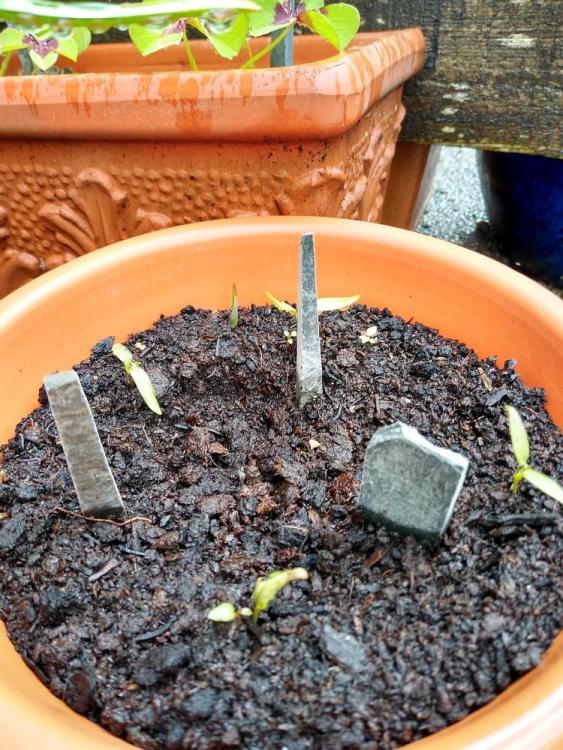
-
Not so far from my Mother's. Quite a few people around you still doing it. https://www.yell.com/s/glass+fibre+services+and+supplies-surrey.html You may be better off contacting a few and asking if you can buy some materials. And don't forget acetone and hand cleaner.
-
If you lived down here I would come over and make a video of it, with @joe90doing the work.
-
Most likely is putting in to much hardener and running out of time, but still trying to put it right. There comes a time when you have to stop, and then, when it is fully cured, get the angle grinder out. The other problem is not using enough resin and getting dry patches (this also happens when it sets hard before it is consolidated with a roller). It is also not just temperature dependant, UV light sets it off to. so working indoors and working outdoors can be very different. But if you do a square metre at a time, with half metre overlaps (assuming at least 2 layer of 450GSM mat here), you will only be mixing up a couple of kilos at a time. I would also make up something that makes cutting the mat easy. I made a table with the mat on a stand. That way I could roll the mat out and cut it with a Stanley knife (a basic one, don't try with a retractable blade one). By having a dedicated mat cutting area, you will not get resin on the mat before it is used.
-
Get an 8 by 4 sheet of whatever is going to be your roof covering. Then say it up into 2 by 2, make at least one upstand, and one external radius (the bigger the better). Then have a play. You can try different methods of applying it i.e. brush, roller, prewetted mat. You can also screw a bit up and find out the best way to recover from it. Also worth doing some bits in multiple seconds. Mat usually has one cut edge and one uncut. Use the uncut edge to overlap a cut edge.