


SteamyTea
-
Posts
23856 -
Joined
-
Days Won
200
Everything posted by SteamyTea
-

Meter Readings Panic and Electricity Costs
SteamyTea replied to canalsiderenovation's topic in Electrics - Other
Not at £8/m3 they can't. But look on the bright side, you paid for it via your taxes, it was installed because there was a disabled person there. £1k to just hang it on the wall and connect a few pipes. I would need to see some quotes about what is actually done for that. We have some plumbers on here, maybe they can say what they would do for a grand. -
Meter Readings Panic and Electricity Costs
SteamyTea replied to canalsiderenovation's topic in Electrics - Other
Not as if a traditional natural gas system is free. I also think there is needs to be a distinguishing between an easily fitted combi boiler and a complicated heat pump installation. If I was to fit either to my house, which I can now (as some poor sap paid to get gas fitted to the end of the road, was £20k when I looked into it), I doubt there would be a huge difference in price. -
Meter Readings Panic and Electricity Costs
SteamyTea replied to canalsiderenovation's topic in Electrics - Other
Why are you so against heat pumps. And if you don't, which is the case here, what do you suggest, a greasy oil tank, filled with a volatile (both financially and chemically) liquid. Or maybe a large rented cylinder, where the filling service may be withdrawn. -
@BartW Have you thought of creating your own design, total from scratch, without using any pre-existing components. This may sound an odd thing to do, but sometimes it is the only way. Then get the components made. For a one off design, it is really down to folding sheet metal, or moulding GRP. Sheet metal folding does not require any tooling, just machinery, GRP does require tooling, though this may just be Contiboard and car filler. The biggest problem, which is true for all building, is the actual fitting. Let's face it, plumbers an electricians use bog standard parts, made to a high quality, and still make a pigs ear of it, constantly. This is part of the reason I think starting with no existing components may be a better idea. You are just solving two problems; the functionality and the fitting.
-
and the airlflow is very quickly disrupted. This is why they can be sited in a dark, sunless area. You feel hot in the sun, not because the local air temperature is much higher, more that you are absorbing an extra 800+ watts of power.
-
Won't the ASHP fan just speed up, or run for longer, if the flow though the heat exchanger is reduced. It is what the fan is there for.
-
I like the look, or lack of look, of concealed gutters and downpipes. Trouble is, it needs an almost complete redesign of a roofing and wall system, that can cope when the guttering fails. This basically means that two sets of guttering are needed. Then some form of insulation is needed to minimise any condensation risks. And that is just the guttering. Down pipes are even trickier if they have to connect, in the right place, to the main guttering, and also pass though the secondary 'safety' guttering, while keeping any joints water tight. Then, you have to deal with any joints in the downpipe that, once the cladding is in place, cannot be seen if they fail. And all this has to be made in a material that will not fail for 60+ years, and must be repairable if it does. And it must be fitted by some 'lads' on site. Seems an ideal job for GRP.
-
Meter Readings Panic and Electricity Costs
SteamyTea replied to canalsiderenovation's topic in Electrics - Other
That will be about 0.44 kWh/°C So raising from 30° to 50°C will use ~9 kWh -
I think in the last 40 years Ragnheiður Steindórsdóttir has lost her attraction for me. and I suspect she would say the same about me. But you can get a bag of donner kebab meat for 2 quid.
-
Meter Readings Panic and Electricity Costs
SteamyTea replied to canalsiderenovation's topic in Electrics - Other
No. I am just careful. I use minimum lighting, no TV, sensible use of washing machine, never use the tumble dryer, cheap laptop that only uses 8W when on. And it is kWh. This week is going to be an exception as I have been using a 2 kW steamer to get paint off my porch walls. My day usage is probably up by 10 to 12 kWh/day. Re your inconsistent immersion usage. Has the legonella cycle come on during the weekend (just turn it off). Have you used more or less DHW without really realising it. Don't know, without looking, but my external temperatures have gone from 0°C to 12°C in the last week. -
Sounds a bit kinky. My dream would be an outdoor pool at 35⁰C.
-
Consider a full time degree course. Gives you 3 years, and plenty of time, plus some cash, to try out other things. What have you been doing for work until now?
-
Have you got a Plan B?
-
Interesting this office vs skill attitude. When I was at school, thick kids did apprenticeships, clever ones went to work in an office, the really clever ones went off to university. Quite a few joined the family firm/farm. The only person I keep in tough with is a production planner. He did an apprenticeship in the merchant navy, but hated not having a proper base, he has been very happy in his work. I think a lot of it is 'do what you like doing' and don't bow to outside pressure when it comes to careers. I stuck at production management way too long, and really hated it, what I liked was product development, not sorting out (expletive deleted)ing staff issues.
-
There are loads of people that have retrained via the apprenticeship schemes. https://www.findapprenticeships.co.uk/adult-apprenticeships/ I heard somewhere that the majority of adult apprentices already have a degree. Mate of mine was a policeman, took an adult apprenticeship in catering, now has his feet up on furlough.
-
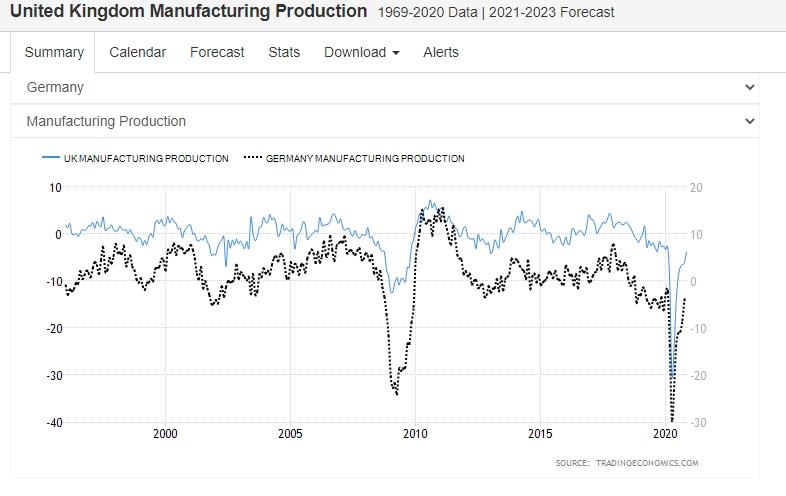
You can play on this site to compare with other countries. https://tradingeconomics.com/united-kingdom/manufacturing-production
-
Regarding the level to aim for, I think Level 3 (used to be called an 'A' Level) is the very minimum. https://www.gov.uk/what-different-qualification-levels-mean/list-of-qualification-levels Heatpumps really require a lot of research (I got a Level 6 in them and still don't know much). The basic principles are fairly easy, it is he detail that is the killer. Traditional plumbers just cannot accept that they are a variable power source, and are physically large, and need somewhere to store the energy they produce. May be worth getting in touch with your local FE/Skills college, they offer courses, but also you get to meet people already working in the industry. I think electrical work is easier than plumbing, and the world is going electric.
-
Did you say the rear of the house was south facing? If so, your proposed design effectively stops the use of PV. If you want to fit UFH, how much can you did down to fit the insulation?
-
Putting in Air Conditioning Ducting - Just In Case
SteamyTea replied to puntloos's topic in Other Heating Systems
https://www.engineeringtoolbox.com/cooling-heating-equations-d_747.html https://www.engineeringtoolbox.com/air-ducts-sizing-d_1736.html -
Double MIRAS stopped in 1989 for new mortgages. Caused a spike in prices over a very short time period. Took years for the housing market to recover. But then we did have the Chancellor setting the interest rates. Regarding local authorities spending. I think each department head should go to every single household and ask for their slice of the cash, i.e. 'I am head of road repairs, can I have £100 please'. Be interesting to see which department collect the most.
-
Putting in Air Conditioning Ducting - Just In Case
SteamyTea replied to puntloos's topic in Other Heating Systems
I assume you are putting in MVHR. Why not oversize the pipework. Double the diameter and you can quadruple the mass airflow for any give slow speed. You can initially hide the larger pipework behind smaller vents, but why bother. Then, you you need AC, just pipe it in later. Just a case of doing some sums for different climate scenarios i.e. prolonged temperatures above 28°C. The marginal cost of larger pipework should be very small, and you will get a quieter MVHR system when it is on boost. -
Meter Readings Panic and Electricity Costs
SteamyTea replied to canalsiderenovation's topic in Electrics - Other
It is an energy monitor. Similar to the internal display you get with a smart meter. But you can clamp it onto any live wire and read the power used and the energy accumulated. You may need to find a live wire that goes to your ASHP (in the consumer unit maybe) and then can you see what it is using at any time, and what it has used in the previous day, week, 30 days. Quite useful as you can spot things that may have gone wrong. I noticed my usage go up drastically, it was my fridge being permanently on. -
Meter Readings Panic and Electricity Costs
SteamyTea replied to canalsiderenovation's topic in Electrics - Other
Buy this. You can even add a cheap RPi logger to it. https://www.ebay.co.uk/itm/Current-Cost-Real-time-Energy-Monitor-CC128-ENVI/324444722680 -
My eyesight is often hurt by people swimming in the harbour where I have my coffee. If only the older ones would wear the wetsuits, makes me think of the moon.
-
Small windturbine and a solar panel. But don't site a small generator next to the inlet.

