SteamyTea
-
Posts
23375 -
Joined
-
Days Won
190
Everything posted by SteamyTea
-
Seems to be doing its job. If you know the RH, the inside and outside temperatures, you can work out if the dewpoint has been reached.
-

Thin mineral wool or glass wool with aluminium layer for cavity wall
SteamyTea replied to Clennls's topic in Heat Insulation
Same way it passes through everything, including a perfect vacuum. By photon/electron/phonon exchange. -
That is generally my thinking. All three do a different job, at different temperatures and at different times.
-
https://www.solarfeeds.com/mag/top-solar-panel-manufacturers-in-europe/
-
Hear those stories about all types of fully filled cavities. Some people on here have used beads, maybe they will come along and comment.
-
Why not use polystyrene beads?
-
What are the azimuth and altitude angles, these can make a big difference. You can get a good projection of what they will produce thought the year at PVGIS.
-
The research evidence on security alarms
SteamyTea replied to Adsibob's topic in Networks, AV, Security & Automation
And 30 odd years ago things were so much better.
-
The research evidence on security alarms
SteamyTea replied to Adsibob's topic in Networks, AV, Security & Automation
Is it now. https://www.ons.gov.uk/peoplepopulationandcommunity/crimeandjustice/bulletins/crimeinenglandandwales/yearendingmarch2024 Steered away from the Daily Mail. -
Really, even ignoring the incorrect units. Those seem very high for 200 m2 in the South East of England. W [watts] is power, kWh [100 watts multiplied by time] is energy.
-
The research evidence on security alarms
SteamyTea replied to Adsibob's topic in Networks, AV, Security & Automation
So you have never heard of a miscarriage of justice, or guilt by association. Not drugs I know, but... https://en.wikipedia.org/wiki/Birmingham_pub_bombings -
The research evidence on security alarms
SteamyTea replied to Adsibob's topic in Networks, AV, Security & Automation
From Wikipedia "President Rodrigo Duterte was elected in 2016 through a platform promising on dealing the illegal drug trade and criminality by having drug addicts killed.[13] He launched a bloody war on drugs campaign. Officially, 6,229 drug personalities have been killed as of March 2022.[14] News organizations and human rights groups claim the death toll is over 12,000" Be careful what you wish for. -
Not really the thinking behind house heating these days. In the past, rooms were effectively separate compartments within the building, they had varying thermal properties i.e. air leaks, high wall U-Values, fixed usage i.e. kitchen, living room, bedroom. This meant, because of the relatively high cost of thermal energy, that it was more normal to heat one room, then crowd people into it. Now we have well insulated and more airtight buildings i.e. windows that actually close shut, no open fireplaces, floor, loft, wall ect insulation. So rather than overheat one part and allow the energy to spread throughout the building, while reducing in temperature, we more evenly heat the whole building, in the knowledge that the exposed to ambient parts of the structure are thermally good. This more modern thinking is taking a long time to override traditional thinking, especially as people think that little used rooms should/can be a a lower mean temperature. This will become much more important as ASHPs take over from combustion technologies because the CoP diminishes as flow temperature rises i.e. running a heat pump for 2 hours at a flow temperature may use more primary energy than 5 hours at a much reduced flow rate (be careful when calculating this as a percentage).
-
Good books on self build project management?
SteamyTea replied to Rachieble's topic in General Self Build & DIY Discussion
We are dealing with an HR problem at the moment. We don't have a site manager anymore (partly why the problem has arisen), so a very difficult process for everyone. -
Good books on self build project management?
SteamyTea replied to Rachieble's topic in General Self Build & DIY Discussion
I have been a production engineer, a project manager, a production manager and a company owner. The first two suited me better as I found out, to my cost, that I prefer the technical side than the people management side. No amount of planning and contingency will stop complete twats (expletive deleted)ing things up. Decide what you are good at, then get others to do the rest. -
Looking for advice on a multitude of projects
SteamyTea replied to Joyosa's topic in Introduce Yourself
We lived in Provence in the 70's and early 80's. It could have been written then as well. The real horror though, is that older men still wear 'budgie smugglers' on the beaches. -
Depends on that you call easy. Dividing the insulation thickness by the thermal conductivity of the material gives you the R-Value. Dividing that number into 1 gives you the U-Value. Then multiply by the metres squared that it covers. The harder part comes working out the variables caused by weather and energy prices. 4 years ago, gas was a third of the price, so adding extra insulations hit the diminishing return earlier. Bet there are a few that wish they added more now though. Weather, which drives the temperature difference is also fickle. While we are getting warmer, globally, it is not evenly distributed. The UK is predicted to get warmer and wetter (generally good for agriculture) but not so good for house temperatures. The only real way to model this sort of problem is to create a mathematical model that allows different parameters to be varied, sometimes changing one parameter will effect a second, or third one i.e. more summer showers may reduce solar gain, increase evaporation loses and increase wind speeds. So care has to be taken.
-
The research evidence on security alarms
SteamyTea replied to Adsibob's topic in Networks, AV, Security & Automation
I lived a few hundred metres from Aylesbury Prison in the 1980s. IRA terrorists were kept there. Now it is a higher security places for lifers, but the younger ones (under 21 I think). Horrible place. -
Or an up hill struggle to get improvements.
-
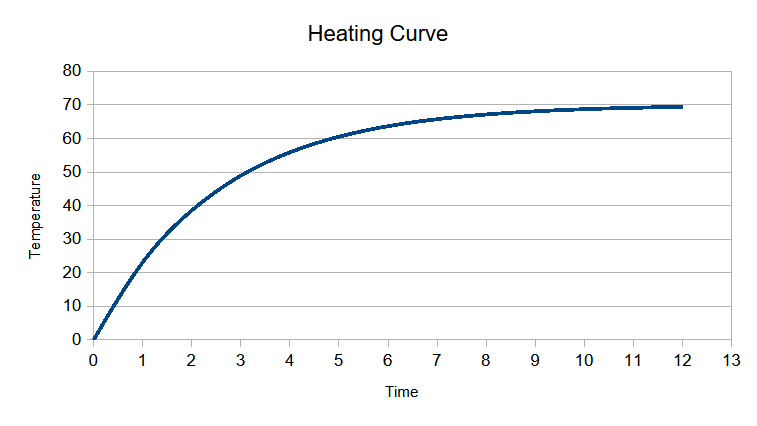
There are two. The basic one, that is good enough for domestic usage is: SHC x mass x ΔT Where: SHC = specific heat capacity of the material: unit J.kg-1.K-1 where J is energy in joules and K is temperature in kelvin. Mass = kg, kilogram. ΔT = change in temperature, T1 - T0 So for 200 lt of water, which just happens to have a density of 1000 kg.m-3 and a SHC of 4.18 J.gram-1 [4.18 kJ.kg-1], to be raised in temperature from 303K to 343K [30°C to 70°C]. 4.18 [kJ.kg-1.K-1] x 200 [kg] x (343 - 303) [T1 - T0] = 33,440 kJ This can be converted to kWh by multiplying by 0.00027778 33,440 [kJ] x 0.00027778 = 9.289 kWh. Dividing the kWh by the power of the heater gives the time to reach the desired temperature. So if the heater was 3 kW. 9.289 [kWh] / 3 [kW] = 3.096 h or 186 minutes. The more complicated formula involves exponential growth and the surround environment temperature. So: TF = Ti -(Ti - Ta) x EXP(-k x t) Where: TF = Final Temperaure Ti = Initial Temperature Ta = Ambient Temperature EXP(-k x t) = Exponent of base e, where k is a unit less number and t is time. This basically shows that as the material gets hotter, it looses more energy to the surroundings, and takes disproportionally longer and longer to get to a set temperature.
-
Radiators needed for ASHP and UFH?
SteamyTea replied to YorkieSelfBuild's topic in Air Source Heat Pumps (ASHP)
Form is just the thermal performance of the heat losses areas divided by the floor area, in this instance. So a cube is better than an rectangular box, less glazing is better than lots. -
ASHP + Solar PV + Battery - Choices
SteamyTea replied to Diarmid's topic in Air Source Heat Pumps (ASHP)
@Jeremy Harris was going to fit a small cylinder as a backup to his SA. Was hoping he would post up some running cost numbers as a back to back comparison. -
Radiators needed for ASHP and UFH?
SteamyTea replied to YorkieSelfBuild's topic in Air Source Heat Pumps (ASHP)
That does not really govern the heat losses. Form is more important than area. -
Your consumption is in kW, which is power. Your actual consumption will be the area under the graph i.e. sum of power multiplied by time.
-
ASHP + Solar PV + Battery - Choices
SteamyTea replied to Diarmid's topic in Air Source Heat Pumps (ASHP)
Close enough, and 60 to 70% will be used in the heating season, but don't forget that the real efficiency of a gas boiler is lower than the stated efficiency, so possibly 25% goes waste.