SteamyTea
-
Posts
23836 -
Joined
-
Days Won
200
Everything posted by SteamyTea
-
I have loaded up my mighty spreadsheet of my energy usage, and looking at the last full 4 years, my breakdown is as follows. This is for an all electric house on Economy 7. Day Mean Power 0.09 kW Delivered Power 0.18 kW % Zero Power 58% Night Mean Power 0.89 kW Delivered Power 1.1 kW % Zero Power 44% The greatest power I have drawn, over a half hour period, is 8.9 kW. During the cheaper night rate, considering there is 3 hours (185 minutes) when no power has been drawn from the grid at all, and I have a 100 A supply, charging batteries would not be at all challenging. When I look at just January, February and December, when I am usually heating the house: Jan Day Mean Power 0.14 kW Delivered Power 0.23 kW % Zero Power 52% Jan Night Mean Power 2.63 kW Delivered Power 3.14 kW % Zero Power 32% Feb Day Mean Power 0.11 kW Delivered Power 0.2 kW % Zero Power 51% Feb Night Mean Power 2.19 kW Delivered Power 2.67 kW % Zero Power 33% Dec Day Mean Power 0.14 kW Delivered Power 0.23 kW % Zero Power 51% Dec Night Mean Power 2.52 kW Delivered Power 3.02 kW % Zero Power 33% So to power my house during the winter days, by charging batteries at night, I would need a battery system that can store a deliverable 2.5 kWh, and deliver a peak of 10 kW. I currently have a 20p kWh difference between day and night rates and looking at my latest bill, which was waiting for me when I came home, I have used 1281 kWh on the day rate and 4538 kWh on the night rate. Those have to be halved as that is for two years, so 640 kWh day, and 2269 kWh night. At current rates that is £215 on Day Rate. If that was on Night Rate it would be £86 a year. So a difference of £130 (with a bit of rounding here and there). Now I have no idea what a suitable system would cost to install, but being generous and assuming that there are only 5% losses during each charging and discharging cycle, and that after 5 years, 90% of the capacity is available, a 3 kWh storage system would be needed and a 10 kWp inverter. Anyone know what that would costs, or to put it another way, it would have to be less than £1300.
-
Quite interesting the constant power draws that some people have. While I am not a financial fan of battery storage, if your constant loads are high, they may make financial sense, though it does depend on the cheap, time of use, electricity price.
-
Try this if you want something really lethal. https://dhmo.org/facts.html
-
Would it not have been easier to fit a ventilation fan?
-
My house used no power half the time, so my background load is zero. This is partly a quirk of metering at the 1 Wh level, but I cannot sample lower than that.
-
https://en.m.wikipedia.org/wiki/Passivation_(chemistry)
-

Insightful piece on more or less today.
SteamyTea replied to MikeSharp01's topic in Environmental Building Politics
So heating and cooling is done with a heat pump. A2A is the most efficient for this, for many reasons. What do you do for hot water? -
Week 8 - And pause... or not.
SteamyTea commented on Benpointer's blog entry in Contemporary build in north Dorset
No. It is unique to Redruth about some public art. -
May have been that I was thinking of. CORTEN is a trade name made from Corrosion and Tensile. A quick search showed that even CORTEN is affected by a 'wrong atmoshpere'. To dry, it does not create the crust, rain not acidic enough, not enough crust. I suspect that either high or low levels of sunlight will also affect it (photoelectric effect).
-
Week 8 - And pause... or not.
SteamyTea commented on Benpointer's blog entry in Contemporary build in north Dorset
"We have South West Insulating from Redruth coming along from 28th July to do that work." Say to them "Welly Dogs". They should laugh. -
I have a vague memory that the steal used in RSJs is meant to get a coating of corrosion. It gets a thin layer of oxidation that creates a skin, which inhibits further oxidisation. I may be wrong though.
-
Intuition and a good sense of proportion is so important in most areas, especially important in engineering, which housebuilding is. I am not sure if I have learnt it, or I have a natural ability to estimate the outcomes. Though there are some things that I find hard to judge at work, portion sizes are one, I look at what I think is good value for money, not what the company dictates is the right size (eating out is such a rip off really).
-
I have not looked at peak power (the monitor is currently on the kettle), may do that later. What laptop do you have as I thought that USB powering would be useful as it can be easily charged in the car. I currently use a 12V (DC) to 230V (AC) inverter when away.
-
You did. Friends are like that. Still have a mate from school, we have not seen each other for a decade, but the friendship is still there.
-
Wow. I think you have done amazingly well. Bet the things that seemed big problems at the time, will seem trivial in a week. You also seem to have a good crew around you, and as you said, most people want to help. Keep that Steve in board, maybe offer him something to come around to have a look and make suggestions, without any physical work involved (he may like a curry night out, or if you are lucky, a kebab supper, we got out for an all you can eat Chinese when we are all feeling a bit down, works a treat) Do you find writing the blog cathartic, reading it is good.
-
Advice on bathroom heat strategy
SteamyTea replied to SomethingSensible's topic in Air Source Heat Pumps (ASHP)
Not the best way to run a low temperature heating system, regardless of the heat source. Day and night temperature difference can still be different, but that often comes naturally because overall heat losses are greater after sundown. If you are used to high temperature gas boiler systems, it takes a while to appreciated the difference. -
Would be at least 6kW if a Granny Smith.
-
The home my Mother is in seems very noisy. It is an old vicarage (ironic as we sold her The Old Vicarage to pay for her to stay in an older one. Sound is a strange thing, but I can recommend secondary glazing over the existing double glazing, it really cut the outside noise down in my place, and saved loads of energy. That makes me think that maybe internal walls should be three layers of something dense, probably not hard to do at construction stage.
-
Advice on bathroom heat strategy
SteamyTea replied to SomethingSensible's topic in Air Source Heat Pumps (ASHP)
Right, I am very tired, but we see post like this quite often. Without more details of the insulation levels, it is hard to really work out what is best. Basic heat loss calculations really need to be done before you delve into detail. 12 kW ASHP seems quite large, but your house may be huge, without some more details we cannot properly comment. Regarding the bathroom floor, I went to a minor Public School, rough textured, cold concrete floors and tepid water, with the company of many other naked bodies, made me the person I am. -
Well I actually bought it towards the end of last year. It was a cheap Asus i5 from AO (brilliant delivery, less than 18 hours). Anyway, I always like to check how much power things actually draw, my last but one laptop was great at 8W, the next one I never checked as it was my Mother's old one and I only used it for a few weeks. This one, I started monitoring on the 5th July at 18:15. Just seen the energy monitor tick over to its first kWh, 337.25 hours later, so that works out at 2.97W. Pretty good I think as it probably gets 3.5 hours of usage a day, but is permanently plugged in to keep the battery charged. If I just assume it has had 50 hours usage in the last 2 weeks, that is still only 20W. Still pretty good.
-
Expected In House Usage of Solar PV Output
SteamyTea replied to John Carroll's topic in Photovoltaics (PV)
Not sure if the predictions take into account air temperature, but they can, if unseasonably high (i.e. 1.5K above mean) reduce output. Like climate science, which is generally 30 year weather averages, solar prediction does not take extreme variables into account. (Also just noticed that a data series on my last chart is missing, the deltaT, because I used a cell to make a random date calculator, makes no difference to what I wanted to show) -
Expected In House Usage of Solar PV Output
SteamyTea replied to John Carroll's topic in Photovoltaics (PV)
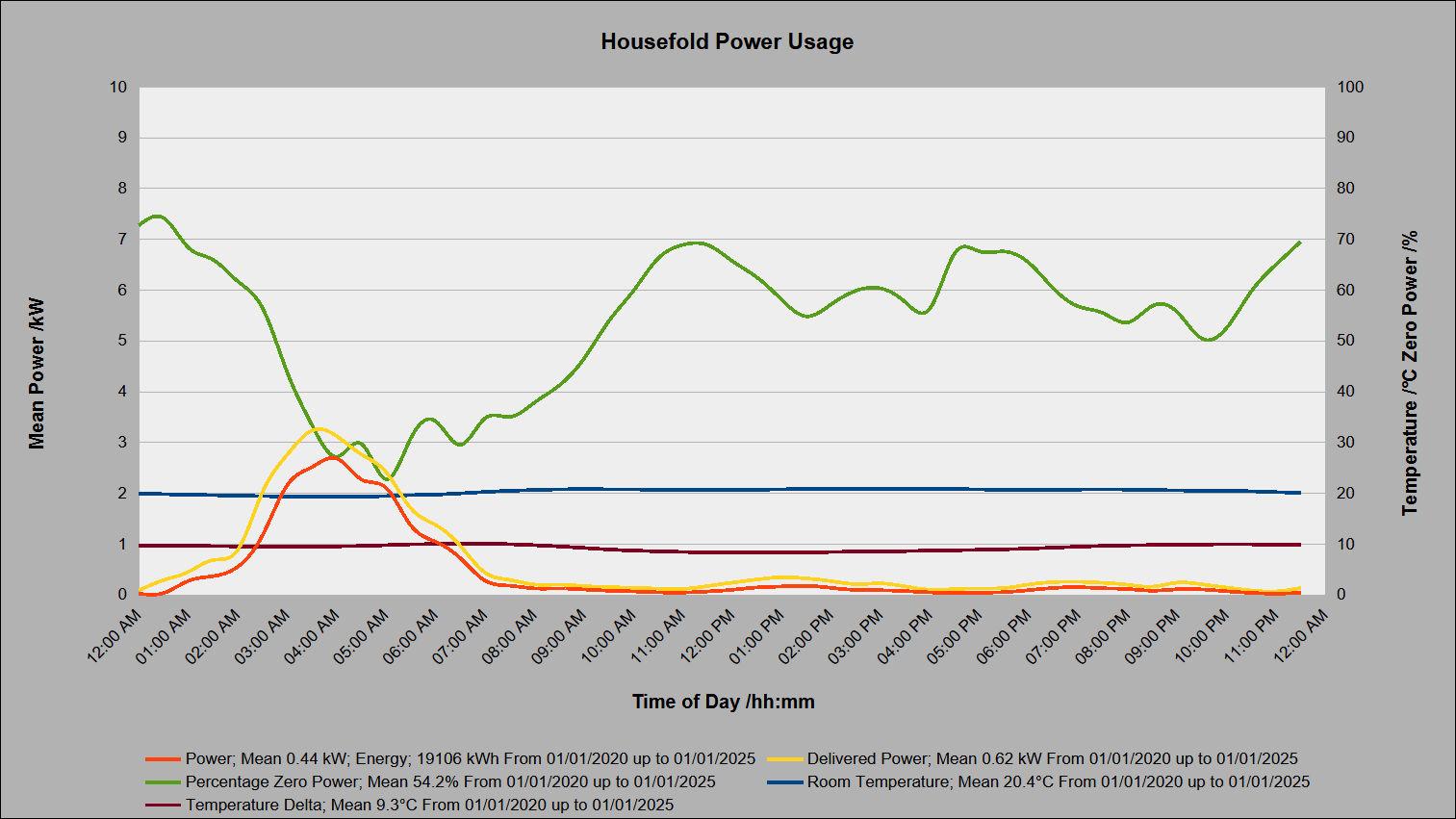
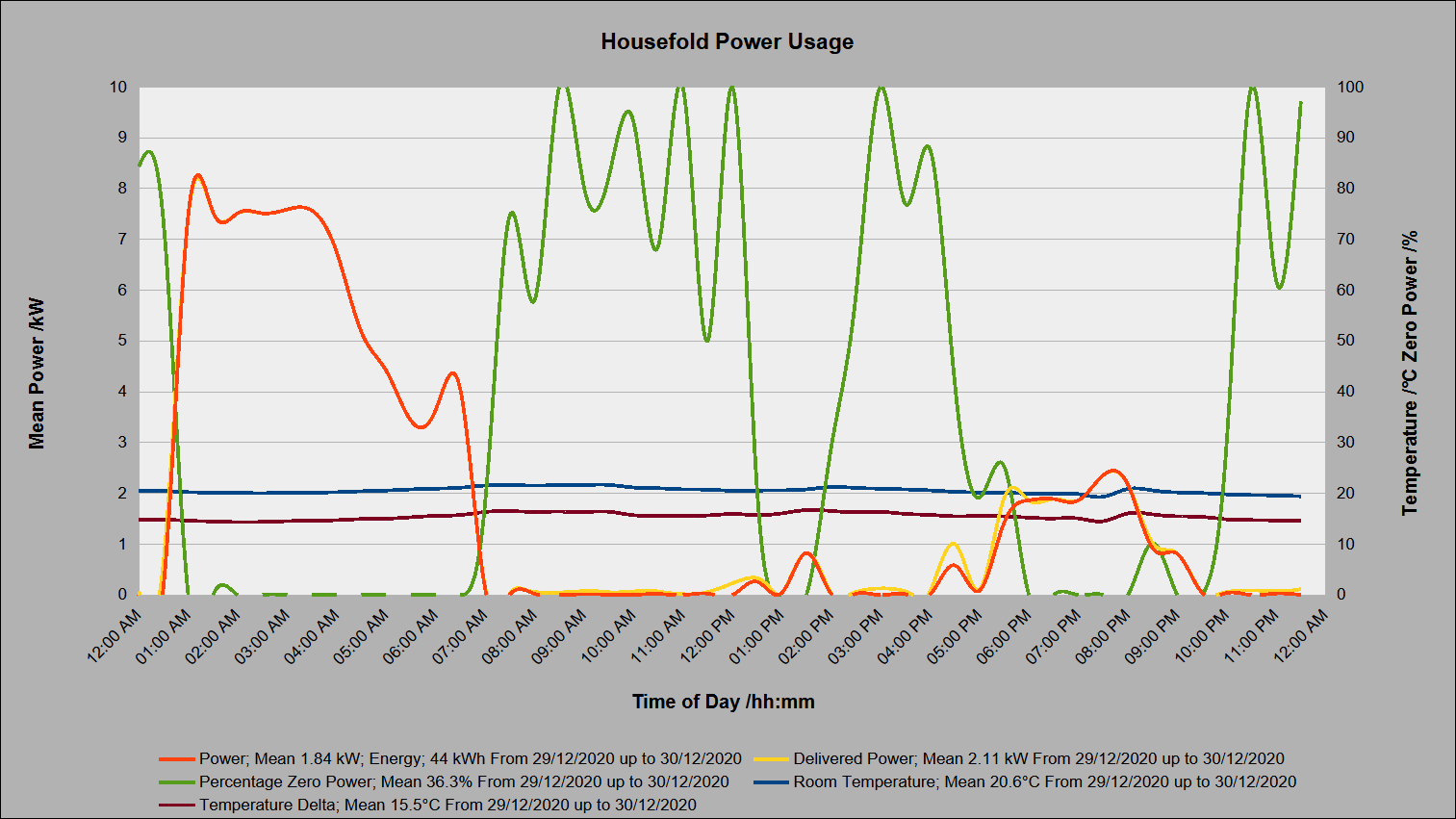
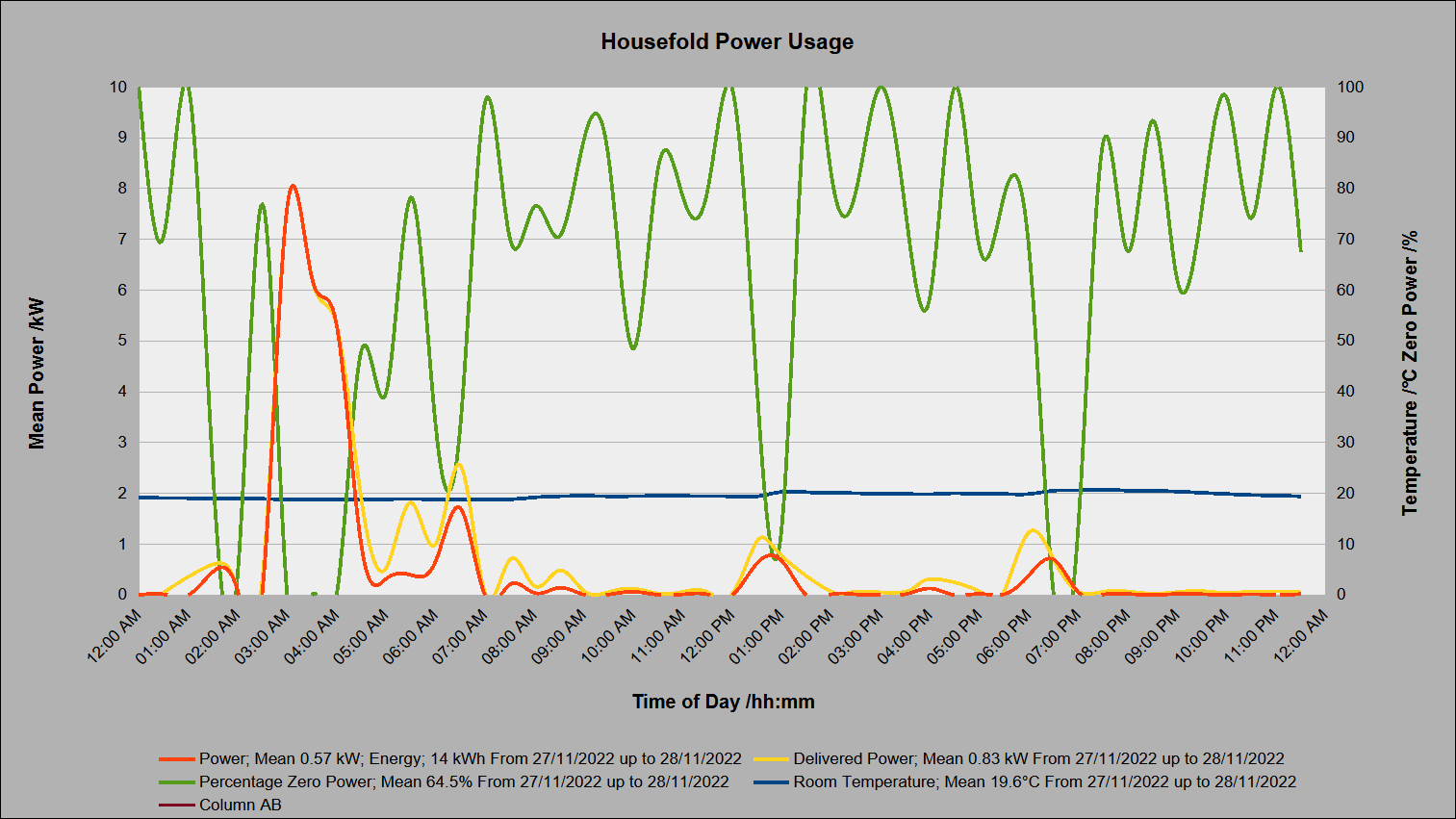
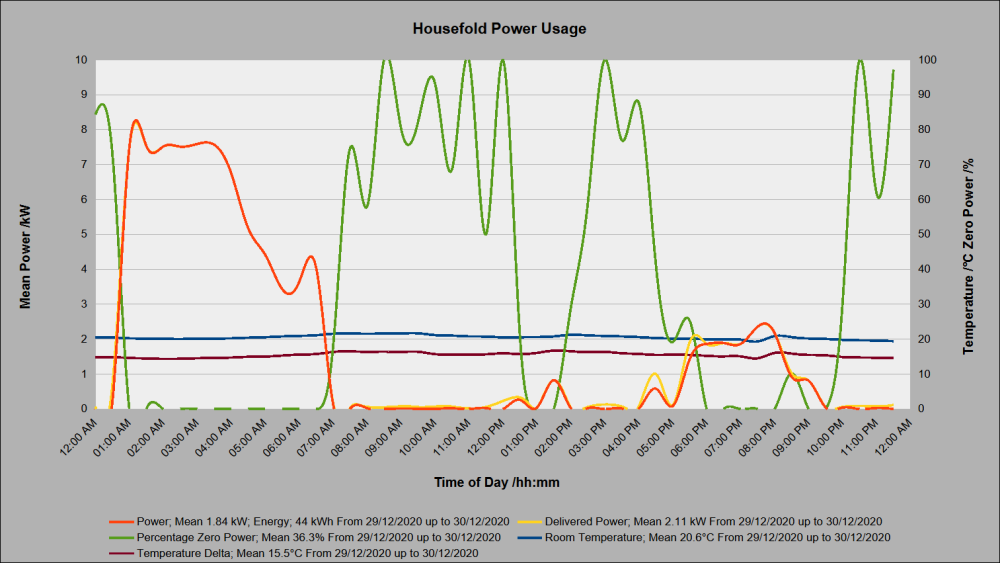
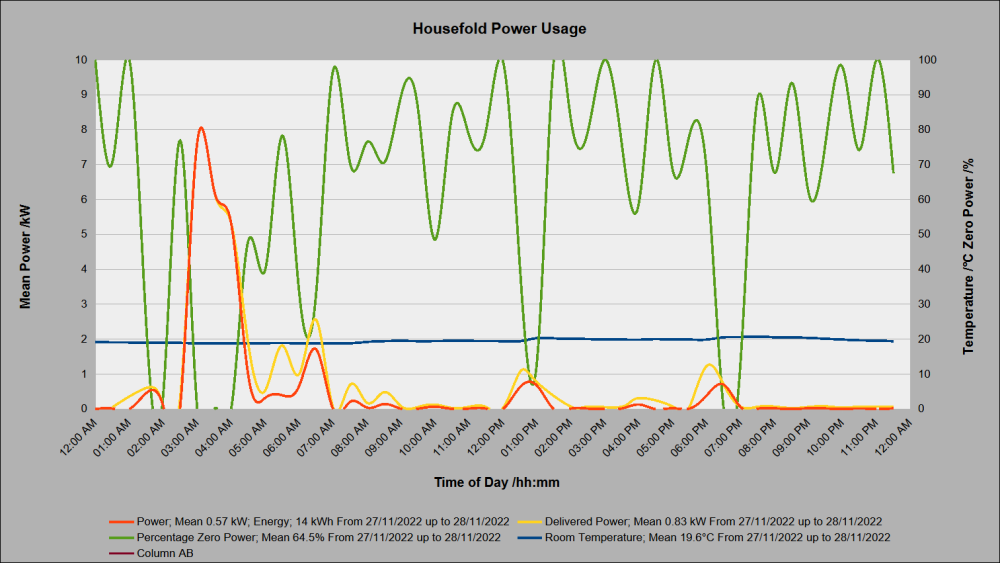
Knowing means values is one thing, but they cannot recreate a detailed, fine grade, model. For that you need other statistical parameters. As an example, here is some of my usage data. It is my mean usage figures for a 5 year block, then a couple of random days.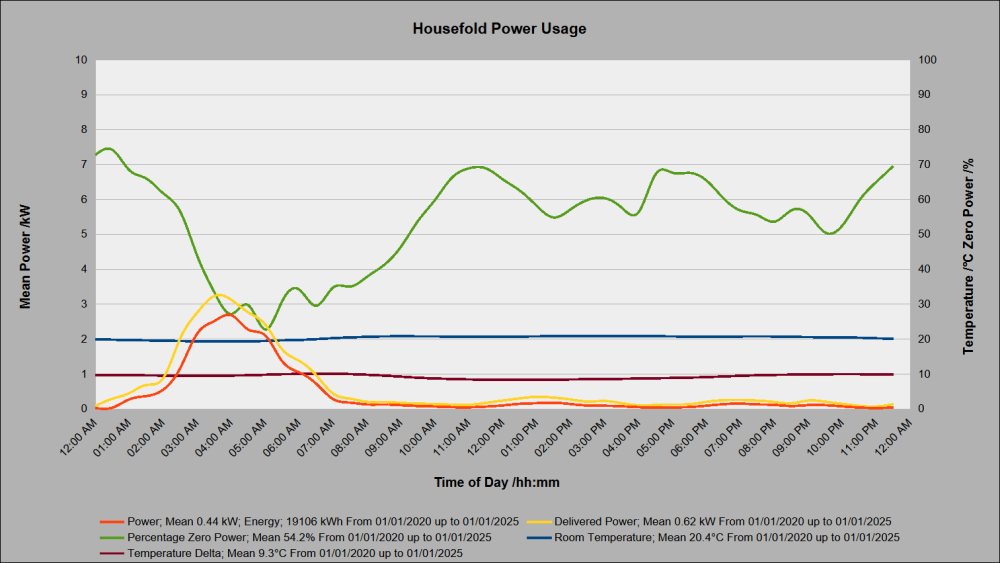
-
Why don't things get any better - well dungarees anyway!
SteamyTea replied to MikeSharp01's topic in Boffin's Corner
Got a vision of Felicity Kendal now. And Rick Mayall. -
Insightful piece on more or less today.
SteamyTea replied to MikeSharp01's topic in Environmental Building Politics
That is impressive. But not wanting to dampen things, you have also paid for a better insulated house, a heat pump (I assume) and probably tough out the odd days with thicker jumpers. But it does show that a lot can be done, relatively affordably. -
Did you calibrate yours, I can't remember.