


SteamyTea
-
Posts
23851 -
Joined
-
Days Won
200
Everything posted by SteamyTea
-

New heating for terraced house in London
SteamyTea replied to Ferdinand's topic in Central Heating (Radiators)
You are trolling again. -
Is it worth paying £9000 more for better U value
SteamyTea replied to Happy Valley's topic in Windows & Glazing
So if, for easy of calculation, you loose 100kWh extra a year, and energy cost go bonkers to £1/kWh. Then in 30 years you will have saved £6k. -
I have a cheap fitness tracker watch somewhere. That can take a signal from the phone. Can't you make up something like that, a band that vibrates when someone rings your bell, or at least vibrates your ring if you are worried about snagging your strap.
-
Is it worth paying £9000 more for better U value
SteamyTea replied to Happy Valley's topic in Windows & Glazing
Depends on the area and how it affects the overall U-Value. While the differences look large on the face of it, the price difference does look very large. You can improve other areas to compensate i.e. extra wall insulation on a North wall, better airtightness, better heating system. Or just do a bit more shopping around. -
Very rough calculation, with 3 ACH and an overall U-Value of 0.2 W/m².K, works out at about 0.1 kW/K. Assuming you can get 100W/m out of the skirting radiator, you should be able to keep the place stable until it is 10⁰C below the temp you normally turn the heating on. I usually turn my heating on when it is 10⁰C mean outside temperature. I have used 20 W/K for all the non air change loss, and 37 W/K @1 ACH for air loss. IF you have less losses, or the radiators emit more, then you can go lower. (But I have had a tough day and worked this out in my head as I sat in traffic, (expletive deleted)ing G7)
-
Bonkers idea or a great idea?
SteamyTea replied to canalsiderenovation's topic in Landscaping, Decking & Patios
Still got some in my NE facing rear garden that are 34 years old. -
No. IF/THEN
-
Buy a picture frame of me, glue one in place, then take it to an art show. At least I will get a tenner, plus package and postage.
-
Thermal Time Constant
SteamyTea replied to MortarThePoint's topic in Energy Efficient & Sustainable Design Concepts
A heat pipe is like a diode. Not sure what an inductive would be. Shall ponder that as I wander about. Basically something that can oscillate with minimum losses I think. -
Thermal Time Constant
SteamyTea replied to MortarThePoint's topic in Energy Efficient & Sustainable Design Concepts
I think if you expand all the derived units you send up with the golden three if kg, m and s, in the same places. Newton's Law of Cooling is the same as discharging a capacitor. Population growth formula are the same as charging up a capacitor or battery. e = 1+1/1!+1/2!+1/3!+1/4!.... A harmonic series. -
Bonkers idea or a great idea?
SteamyTea replied to canalsiderenovation's topic in Landscaping, Decking & Patios
Best to, you don't want to get done for contamination. We all know what happened to Brian Aldridge and he was only just down the road from you. -
Can GIMP or Inkscape convert PDFs to CAD formats. Not every looked, but they are free.
-
Bonkers idea or a great idea?
SteamyTea replied to canalsiderenovation's topic in Landscaping, Decking & Patios
Not sure you should do either of them, not even sure if it is legal to do so, especially as you are so close to a waterway. -
Thermal Time Constant
SteamyTea replied to MortarThePoint's topic in Energy Efficient & Sustainable Design Concepts
Here is the proper way to do it, not saying it is easier. https://en.wikipedia.org/wiki/Heat_equation Right at the start, when you right dT/dt are you really meaning a differential equation? If so, it should be δT/δt, and you would have to solve the first order differential equation and then substitute the number back in. Or divide a small change by another small change, which should be ΔT/Δt and this is an ordinary equation. -
Yes. When I went there, I did not notice the modules on his roof, which was strange as I knew they were there, and I was involved in the business at the time.
-
Welcome. I have no opinion of roofing tiles. But if you are up there doing the work, why not fit integrated PV, it is a similar price to fitting some tiles.
-
It uses the https://www.segen.co.uk/gse/ system. Shop about and the panels (not the modules) are about 30 quid each. (it is a shame that Jeremy built in some shading)
-
Wax (PCM)
SteamyTea replied to MortarThePoint's topic in Energy Efficient & Sustainable Design Concepts
Just remembered, a guy I know, researched some plasterboard replacements that used phase change waxes to store energy. He fell for the marketing bluff (he was an ex marketing bloke), but when we all looked at the technical limitations, it was not so impressive as you are basically stuck with the one temperature range of about 3K. You could make boards with variable ranges, in layers to increase that to say 10K, which may be useful. Or you could go back in time and put a water tank in your loft and let the ambient air increase the temperature, a tank with a larger surface area to volume ratio would heat up easier. Here is what has happened to mine the last few months.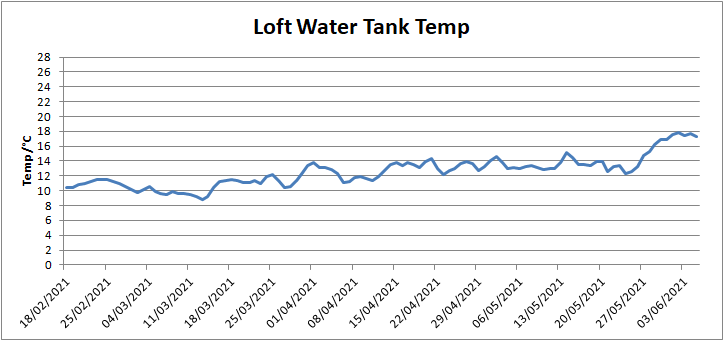
-
Thermal Time Constant
SteamyTea replied to MortarThePoint's topic in Energy Efficient & Sustainable Design Concepts
Yes, whoops, mean °C That is not a bad idea, especially now we have low power LED lights. I would design it as a 230V system though and just run it off a cheap inverter, then it can use standard switch gear, cabling and installation methods, and easily be wired into a consumer unit if needed. -
Wax (PCM)
SteamyTea replied to MortarThePoint's topic in Energy Efficient & Sustainable Design Concepts
Could call it a Sunamp. -
Thermal Time Constant
SteamyTea replied to MortarThePoint's topic in Energy Efficient & Sustainable Design Concepts
Not really a lot when you consider the size of a house. The efficiency of thermal generation plants is, at best, about 60%, but they operate at such a high temperature that it is not comparable, unless you want a house that is at 300°C. Lithium Ion batteries are now fitted to cars, and they are coming in at about £100/kWh, not that expensive, just got to get the same mass production into home products, like the Powerwall. There are a lot of costs when making a home system that are little to do with the battery costs i.e. a useful sized inverter, legislative compliance, packaging etc. -
Thermal Time Constant
SteamyTea replied to MortarThePoint's topic in Energy Efficient & Sustainable Design Concepts
Just read the abstract of that Swedish paper (think I quoted ones), shows how little energy a house stores in reality. £1000 will easily by a battery and some solar panels. It is basically shows what many of us already know, regardless of the material or mass of those materials, a house does not store much. These days ventilation losses tend to dominated. -
Thermal Time Constant
SteamyTea replied to MortarThePoint's topic in Energy Efficient & Sustainable Design Concepts
I may come back to this when I am not so tired. But I think what you have done is calculated the thermal inertia figure. -
I have a pair of trousers that stick to them both. No idea what is special in them, maybe @pocster knows.
-
Is that because of all the tea breaks waiting for the plumbers to turn up and finish?


