


SteamyTea
-
Posts
23848 -
Joined
-
Days Won
200
Everything posted by SteamyTea
-

Global warming is in fact entirely natural and has already peaked
SteamyTea replied to ProDave's topic in Boffin's Corner
Was that the same David Attenborough who was, in effect, a climate change denier until the last 12 years or so. Biology, geology and atmospheric chemistry do not have a 'master plan'. The COVID-19 pandemic was a symptom of poor industrial food production, easy travel between infected areas and non affected areas, very poor science understanding from world governments. The Earth, like us, carries the scares of its past. Entropy ensures that it will never return to what it was before, which is what worries me most about governments setting targets on such things as tree planting, bio-diversity, green spaces etc. Done with the best intentions, but usually misses the point. I get told off for posting up stuff, but bollocks to that, here is an interesting article about how fast, and effective, recolonization can happen. Environment Great Pacific Garbage Patch hosts stable community of coastal animals Arthropods and molluscs dwelling on plastic and other rubbish in the middle of the Pacific Ocean seem to be part of a new type of ecological community inadvertently created by humans By Madeleine Cuff 17 April 2023 Rubbish pulled from the Great Pacific Garbage Patch hosts a community of animals that normally live on coasts Citizen of the Planet/Alamy Stock Photo Coastal sea creatures have been found living and reproducing on the Great Pacific Garbage Patch, thousands of kilometres away from their natural habitat. The discovery could reshape our understanding of where coastal marine creatures can survive. The Great Pacific Garbage Patch is a vast collection of waste – much of it plastic – located between Hawaii and California, covering an estimated 1.6 million square kilometres of ocean. Researchers have previously found ocean-dwelling marine species living around the patch, but now it seems that coastal creatures have also established a permanent home there. Read more: The Great Pacific Garbage Patch is packed with floating life James Carlton at the Williams College and Mystic Seaport Museum in Connecticut and his colleagues collected 105 items of plastic waste from the garbage patch between November 2018 and January 2019. More than 70 per cent of the plastic items had evidence of coastal species living on them, with organisms including shrimp-like arthropods, sea anemones and molluscs identified. In fact, coastal species outnumbered pelagic species that live in the open sea by a ratio of 3 to 1, the team found. The coastal creatures seemed to be permanently living and reproducing on the plastic patch, says Carlton. “These are species that have rafted out with coastal debris and have now successfully found essentially a novel habitat out there,” he says. Sign up to our Wild Wild Life newsletter A monthly celebration of the biodiversity of our planet’s animals, plants and other organisms. Sign up to newsletter The discovery upends the assumption that coastal species couldn’t survive out in the open ocean and helps to solidify evidence that new types of ecological “neopelagic communities” are establishing themselves on plastic debris in the open ocean. “This has reset my thinking about how coastal species can survive in an environment in which they’ve not evolved,” says Carlton. We don’t yet know how this plastic ecosystem functions, including what the coastal creatures eat or how they interact with ocean-dwelling fish species. Carlton warns that floating communities like this one could pose a threat to coastal ecosystems. It has created a new epicentre of coastal species that could travel as invasive species into new coastal habitats, he says. “I would fully expect that as a result of this we will see more invasions of coastal zones,” he says. “This is a fascinating and important study,” says David Aldridge at the University of Cambridge. “It makes good sense that mass accumulations of plastic debris offshore can create artificial islands which support communities we would typically associate with coastal habitats. The authors rightly raise concerns about how these novel habitats can drive change in the wider ecology of the open ocean and assist in the spread of non-native species.” Journal reference Nature Ecology & Evolution DOI: 10.1038/s41559-023-01997-y -
Global warming is in fact entirely natural and has already peaked
SteamyTea replied to ProDave's topic in Boffin's Corner
Like most predicative models, a number of scenarios are created, one or two of those scenarios showed extreme cooling, there were also scenarios that showed extreme heating. What then happens is that a probability of likelihood is attached, then all that data, along with the error bars, is plotted. That plot, along with other researchers work, is then plotted together, creating a distribution of likelihood (confidence intervals is statistical language). The readings in the middle are the ones that are most likely to happen, and the ones that tend to get ignored by the popular press and the public. There is not much news in saying that in a decade the whole Earth will be 0.1°C warmer, but it is a great story if it is projected to be 10°C cooler, or 8°C warmer, especially if you attach a label to it like 'ice age' or 'earth ablaze'. NASA has done some research looking into past models and how accurate they are. https://climate.nasa.gov/news/2943/study-confirms-climate-models-are-getting-future-warming-projections-right/ Below is a plot of the models that were run in 2004, easy to see how well the ensemble line (black) tracks the observed data (red) which is the yearly observations. You can also see that it (black line) does not get close to the upper and lower limits of the Confidence Intervals of all the models (the ensemble). The dip in the early 1990s is from a volcanic eruption, Mount Pinatubo. The models are designed to cater for this, though the actual date of the eruption is unknown until it happens, so is manually inputted. The important part though is that the 'recovery' time is not adjusted, that is the models doing there thing and predicting future temperatures. So let us, on here, not have anymore nonsense about the past prediction of a future ice age, the people researching it back then never said one was coming, so why should we.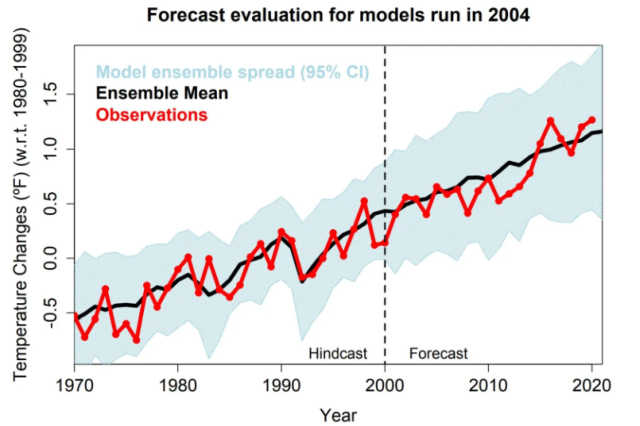
-
Global warming is in fact entirely natural and has already peaked
SteamyTea replied to ProDave's topic in Boffin's Corner
What is wrong with this: "Equalise the retirement age for men and women at 63" Would suit me down to the ground. -
There is reams of data and analysis about how well the MCS systems has worked here: https://assets.publishing.service.gov.uk/government/uploads/system/uploads/attachment_data/file/606834/Report_on_compliance_with_MCS_installation_standards_v32.pdf And https://assets.publishing.service.gov.uk/government/uploads/system/uploads/attachment_data/file/606818/DECC_RHPP_161214_Final_Report_v1-13.pdf
-
Bit hard to tell what is what without seeing the problem in the flesh. As long as there is some ventilation that cannot bypass the insulation, and still does the job, you should be OK. Is that a cable in the top picture?
-
What's the consensus on legionella and dhw storage temps
SteamyTea replied to SimonD's topic in Boilers & Hot Water Tanks
You need to atomise the infected water as well. A shower does not atomise like a cooling system. -
Global warming is in fact entirely natural and has already peaked
SteamyTea replied to ProDave's topic in Boffin's Corner
No, what you are actually doing to misquoting and misunderstanding the research. Here is a very short summary. https://scienceblogs.com/gregladen/2013/06/04/the-1970s-ice-age-myth-and-time-magazine-covers-by-david-kirtley -
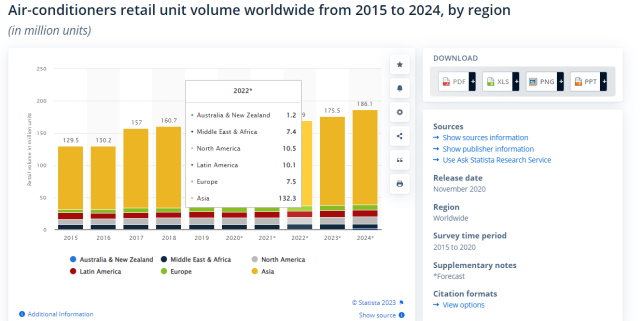
I have rather skimmed most of the replies since my last reply. The IEE has some comments here: https://www.iea.org/reports/heat-pumps There is the Simon–Ehrlich wager regarding metal prices. Don't forget that the stone age did not end because of lack of stones. I don't think the world lacks the production capacity to make heat pumps, we make a lot of air conditioning units. Modern factories produce a lot more goods for less resources.
-
It is to do with geology. Not enough artisan wells, or chalk. Cornwall and Devon are a chain of extinct volcanoes after all. Cleaning up water from deep wells is problematic in a radioactive area, as is cleaning up river water in a heavily farmed area. That is before the residues of 2000 years of tin, copper and arsenic mining is dealt with. There is a reason that Backwater and Red River are names as such.
-
When analysing PV output, UTC, which is just GMT, makes the most sense. Not as if the altitude and azimuth of the sun will suddenly jump to match the stupid clock change. Noon should be Solar Noon, no matter where you are.
-
Global warming is in fact entirely natural and has already peaked
SteamyTea replied to ProDave's topic in Boffin's Corner
They should have put a candidate up against George Eustice. Camborne residences would have voted for them. -
Still have a hosepipe ban in Cornwall. Water reserves are not a function of just one winters rainfall.
-
Oh, the famous ''Up To". Copper has an embodies CO2e content of between 2 and 4 kg/kg. Mineral Wool is around 1.2 Polyurethane around 4 Polystyrene around 3 So pick your insulation carefully as I suspect there is a greater tonnage of insulation in a typical UK house than there is a mass of heat pumps.
-
Global warming is in fact entirely natural and has already peaked
SteamyTea replied to ProDave's topic in Boffin's Corner
Which, in itself, is (expletive deleted)ing odd. How can a fundamental particle, the electron, become a political football. About time most people realised that the electrons jiggling in wires care nothing for peoples political views. -
Global warming is in fact entirely natural and has already peaked
SteamyTea replied to ProDave's topic in Boffin's Corner
And they do not want to be reliant on other countries energy sources. Japan has always had to import the vast majority of their energy, what are the current costs of domestic energy there? -
Global warming is in fact entirely natural and has already peaked
SteamyTea replied to ProDave's topic in Boffin's Corner
Nice idea. How would all the countries of the world agree that tariff free trade on food production needs to happen, and in an unhampered manner. The UK can't even agree on that with Northern Ireland. So 43% of our electricity, in 2020 was from low carbon sources. Installed capacity is up about 3.5 times between 2011 and 2018, generation over 4 times in the same period. The physical infrastructure, or price, is not the problem. We did not have a European war in 2018, and in fact we had historically low energy prices. I really don't understand the general public's dislike of renewable generation. They seem to dislike, but accept, the current high prices, but don't want to change anything. -
Global warming is in fact entirely natural and has already peaked
SteamyTea replied to ProDave's topic in Boffin's Corner
Not really the surface temperature of the heat source, or the overall power. It is to do with the frequency of the photons emitted. There term 'hotter' or cooler is used to hoodwink the uneducated. -
Global warming is in fact entirely natural and has already peaked
SteamyTea replied to ProDave's topic in Boffin's Corner
Is this 'scientific' presentation just this reworked again, again, again... Global Warming Hiatus Anyone here the news about sea temperatures this morning? Also, shall mention that temperature and energy are not the same thing. The Earth's Energy Budget is currently positive i.e. more energy coming in than going out. -
This 'visible from road' which is really just saying not at the front of most houses. Does it not rather clash with the noise conditions. Most people's rear gardens are quite than the front ones, because they are shielded from traffic by 100 tonnes of solid mass. It is not unusual for my road to hit 90 dB (one if my neighbours cars is 80 dB when it is ticking over, and 10 metres away). The rear of my house is generally much quieter at night, though when upstairs one can hear the road more as there is a bend and a rise. If I could put an ASHP at the front of my house, the one installation would be much simpler, make no difference to noise levels and be mostly hidden by some pampas grass. Really there needs to be a better way to enforce noise problems if they arise, not try to make one technology a special case.
-
Hope you mean of the house, not the recently single owner.
-
Umm Reminds me of school. Those candles, reminds me of my sister's school. "Candles out girls" said matron. POP. Now find the matching shower.
-
Welcome. There are a few of us in Kernow. Which end and side are you?
-
How much are the Tigos?
-
Why not 2, 2 string inverters? Then split up as you were going to.
-
Get the metal detector out. Though some misguided souls will tell you that divining twigs works, they don't.


