


SteamyTea
-
Posts
23847 -
Joined
-
Days Won
200
Everything posted by SteamyTea
-
 It has changed a lot since the 1950s. Almost as likely to get a squaddie teaching you now. University life is also not like it used to be. Most students have jobs as well.
 -
ICF How much more expensive ?
SteamyTea replied to Dave Jones's topic in Insulated Concrete Formwork (ICF)
depends on how good the fitters are. -
You are so wrong there. Some of us worked in industry for 20 years after finishing an apprentice and then went into teaching. There are many reasons to end up teaching, 'never wanting to leave school' and 'long holidays' never got mentioned.
-
ICF How much more expensive ?
SteamyTea replied to Dave Jones's topic in Insulated Concrete Formwork (ICF)
Airtightness and continuity of insulation. -
ICF How much more expensive ?
SteamyTea replied to Dave Jones's topic in Insulated Concrete Formwork (ICF)
Yes. I had Lego, and Meccano sets as a kid. There was never enough to make anything interesting. To make something required also buying the next kit up. I never understood why people don't build a stick build shed, them make TF modules in it. But then I am always amazed that people think spending 100 quid making a flat, 8 by 4 table is a waste of money and prefer to scrabble around in the mud, with a hand saw. -
A limited company has limited liability, not really a scam.
-
Not sure education minister is in charge of apprenticeships. That should be Dept of Industry and commerce. As far as education minsters go, probably the first one. William Cowper-Temple
-
Not sure I agree with that. Set by people with a different agenda maybe.
-
Interesting the idea that school failures ended up in the trades. Education does not stop the day you leave school. There is a difference between wanting to learn something news, and not wanting to. There are also many reasons people fail at school, most of them are not educational: it is really a reflection of our poorly managed public education system and a legacy of our old class system. There is also a big difference between educating and training. If your 12 year old daughter is given sex education lessons at school, you probably thing that is a good thing How would you feel if she was given sex training instead?
-
We all love a virtue signaller.
-
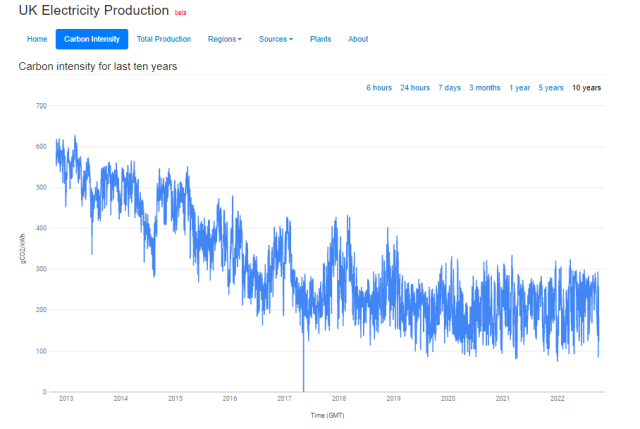
Just a quick reality check on CO2e emissions. Since 2020 the UKs emissions have hardly ever gone above 300g/kWh.
-
Has anyone actually check how much power a CAT5/6 cable can carry? Probably a lot more that 5W. Oh, lots more. https://en.wikipedia.org/wiki/Power_over_Ethernet
-
Have you got anything you can cover the decking with? Sheet of ply, or even an old duvet or two.
-
Not what I was getting at. A small part of the body may be at a reasonably comfortable surface temperature, the rest may be well below. Usually when the body is under stress, it starts to shut down non vital elements to conserve energy i.e. numbness. If the small warm part tricks the body into thinking all is well, when it isn't, there may be unknown effects. Probably not a problem in the UK, but maybe in other places in the world. As I said, not my area of science, so I may be talking bollocks, but I have never been happy with the often quoted correlation between direct electrical heating and dry air causing medical problems. The fundamental physics does not back it up, and data seems to be lacking in this area.
-
@JamesPa Can get a conclusion down to about 300 words, then send it off to BBC Radio 4's You and Yours. Nearly every week they are talking about HPs, most of it is accurate, but often misguided. Pointing out that there are planning restrictions may spur some action. I wonder how a car is allowed to be parked outside the front of a house with our planning laws.
-
I wonder if that is a physiological effect. It may be a case that warmth only needs to be felt on a small part of the body and the whole body reacts as if it is warm i.e. starts perspiring, increased blood flow, hair standing on end. Physiology is not my area of science at all. Like most of the medical sciences, there is so much variation between studies that it seems to invalidate itself very quickly.
-
That is an interesting observation. Was an environmental monitoring done. We hear a lot about how 'electric' heating makes the air dry. Very rare to see data that backs it up. If I remember, I shall try and take some pictures of the thermometer and hygrometer I have at work.
-
Don't think I could walk very far afterwards. Ah, Michael Jackson, can make my eyes water reminiscing, and my hole weak. Blowing Bubbles was a step to far for me.
-
It is, C for coulomb, named after Charles-Augustin de Coulomb. It is the SI unit for electrical charge.
-
Ah, see what you mean. But surely it is the English Way to draw an arbitrary line and then get it enforced. There is an old joke about the Indian neighbour's chicken laying an egg in the Englishman's back garden.
-
He maybe, via a roundabout route, using recycled materials.
-
https://www.dailyrecord.co.uk/news/uk-world-news/couple-ordered-demolish-80000-extension-29838736
-
It does raise an interesting point about the hardware. Take may house, very small heating load, a 4 kW ASHP is way to large, but that is probably the smallest there is. So as I mentioned earlier, at the lower end of the scale, there are limitations that cannot be overcome easily. Very large buffers/thermal stores are the only real solution, but not an easy sell to someone with a small house.
-
Turds are tapered to stop your bumhole closing with a bang. Sounds like a doctor is needed more than a noise.
-
C is a coulomb. C = A.s Or 6.241509×10¹⁸ e With e being the charge of a proton. There are a lot of protons in a battery.

