


SteamyTea
-
Posts
23847 -
Joined
-
Days Won
200
Everything posted by SteamyTea
-
From the driver's seat of their Rangerovers and Model Xs. I thought a new car had the number 58 on the plate, till I started to go to Bucks again.
-
 If you did not have PV, I bet you would charge it at night on some short lived Octopus tariff. A reasonable EV will use about 0.25 kWh/mile. My car, running about, does about 0.8 kWh/mile. Cheap night electricity is between 5 and 15p/kWh, let's call it 10p. Diesel is around 16p/kWh. So 2.5pmile against 13p/mile. Going to be hard to beat that kind of price difference. It does depend on how many mile you travel a year. I do lots, others very little.
 -
Can you replace that with a habitable one? Old static vans goes for scrap value quite often, especially down here. Anything that gets caravans out of Cornwall is a good move.
-
Maybe. Have you a time series of your current energy usage? If you know how much energy you use, and when you use it, you can work out the best compromises. As you have EVs, you already have 100+ of storage, pump it all into them, going to work out cheaper than the alternatives.
-
Anyone know where I can find jumbo sized MDF shelves
SteamyTea replied to Adsibob's topic in General Joinery
How I did mine. -
Anyone know where I can find jumbo sized MDF shelves
SteamyTea replied to Adsibob's topic in General Joinery
Some MDF tends to sag more than others. It is why I split my shelves up into two blocks. Originally they were twice as long.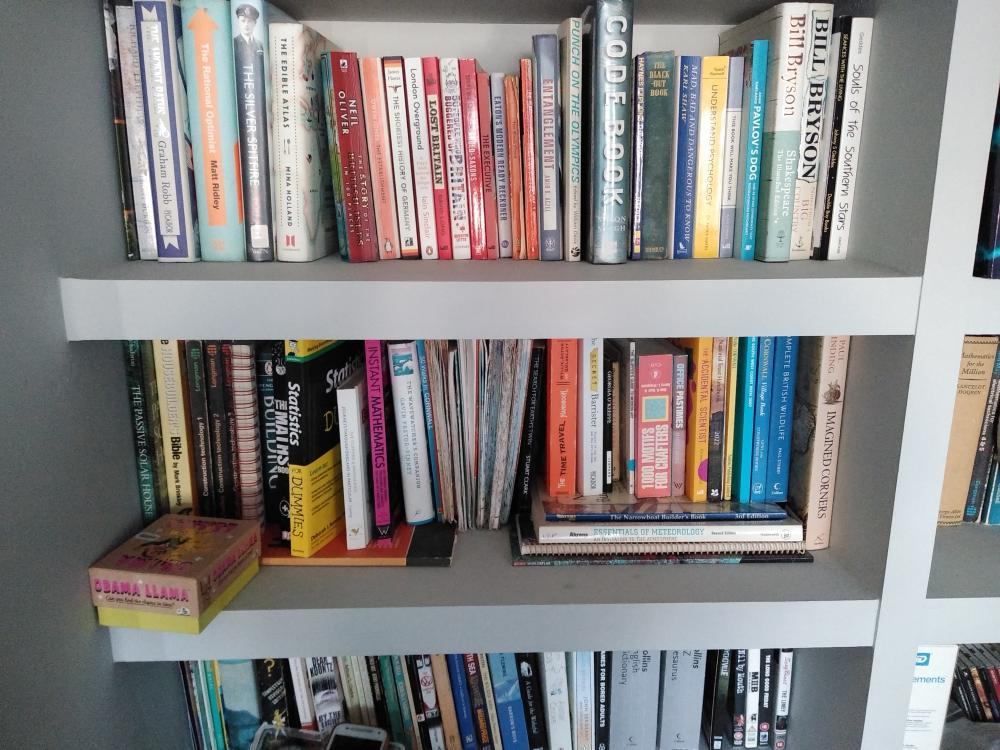
-
What I am about to do.
-
Strange that, as they listed this building. Was up in Bucks last Sunday.
-
You got one right. FFS
-
Is there a no-frills R290 heat pump?
SteamyTea replied to sharpener's topic in Air Source Heat Pumps (ASHP)
800 robots replacing 24,000 workers. I think automation of heat pumps is with is. This from 5 years ago. -
Rapid aging testing. A lot of these chemistries have been around for decades. I was making tooling for Parker Knoll furniture 35 years ago, some of those cushions are still good, and fire proof as well. We also made the dashboard tooling for a few cars, not many fell apart, though the Landrover ones did, and their seats had a plasticiser that caused cancer, of your nut. I did my apprenticeship at a company that made destructive testing machines.
-
There are modern adhesives that will easily last 50 years, and allow for movement. Then you also have the tyvek type wraps that help. It is all down to detail though.
-
Back to the problem. Why not just fit a VCL on the inside of the inner leaf? (leaf is such a stupid term for a wall). That way, vapour is stopped before it gets to anything. Then all there is to worry about is wind driven rain, gutter/roof/cavity leaks and general poor workmanship.
-
I am not sure you can. One way to test this is is isolate the T and SA storage and plug a couple of heavy loads on. Then turn on the T and see what happens, then try the same with the SE, then a combo of the two. Doubt you are currently getting full generation, and if you are, the rain is on its way.
-
I would have thought so, but as you have multiple inverters/charge controllers, is it a case of your voltage rising too much and that limiting the inverter. and it is kW you (expletive deleted)ing (expletive deleted).
-
So is your mind. Draw up a circuit diagram. A lot of it will depend where the generation(s) load(s) and inverter/charge controllers are.
-
Is there a no-frills R290 heat pump?
SteamyTea replied to sharpener's topic in Air Source Heat Pumps (ASHP)
Are you talking just the UK, or even the English marketplace, or globally? Too true. But as Gordon Ramsey shows, you can always improve productivity by shouting, belittling and bullying the workforce, and then offer them a zero hour contract. Works every time. -
Is there a no-frills R290 heat pump?
SteamyTea replied to sharpener's topic in Air Source Heat Pumps (ASHP)
I suspect the biggest driver was property prices. Was much cheaper to develope 100 hectares in the old Eastern Block than it was to redevelop an existing site in the west. HP are very suitable for automation. Let's face it, robotics are so cheap now, there is no need to employ people. -
I don't, others might.
-
Just a VCL. One has to be fitted somewhere, not that is the easiest place. Wall ties will (expletive deleted) it up.
-
Channel 5 tonight "Solar panels are they worth it"
SteamyTea replied to ProDave's topic in Property TV Programmes
"In a well insulated house" -
Our @DamonHD is the man to chat to. He did similar in his place. improving airtightness in a 70s place will make a huge difference.
-
Have you ever wondered why it is yellow?
-
Not surprising that it hits the upper voltage limit when the modules and inverter are that mismatched.
-
Grease filter kitchen extract
SteamyTea replied to Oz07's topic in Mechanical Ventilation with Heat Recovery (MVHR)
What makes you think they may be copies? There is a lot of badge engineering.


