-
Posts
23382 -
Joined
-
Days Won
190
Everything posted by SteamyTea
-
I said something similar a while back about using an old freezer. Then Jeremy Harris, who was a clever bloke, pointed out that a large freezer probably only draws about 700W. So 2.1 kW if CoP is 3. Would still heat my DHW just about.
-
Good, it is too easy to mark one's own homework. I think that the biggest issue is where the hot water leaves the cylinder, normally at the top, initially the hottest point, horizontal cylinder it comes from the mid point, so the median temperature, though it may be the mean temperature.
-
Shutters *other* than roller shutters for sound and heat insulation?
SteamyTea replied to Garald's topic in Sound Insulation
I made my own from clear styrene sheet and a bit of moulded timber. Less than £10 a pane. They made a huge difference to the sound coming in. -
CCS is like hydrogen, it is not worth doing.
-
We have had, since 1997, a Tory government, a New Labour Government, a Coalition Government, Tory Government and a couple of loonies in charge, not to mention Brown and Cameron. We vote them in, so I don't think the real problem is political will, more that the general public is politically naive and we get what we voted for.
-
Because we are not building many houses, so the cost to the tax payer is pretty low.
-
One is connected to a large, well regulated network, and the other just cuts power. Don't think they can be compared to us really. Now if that EU super grid gets built, they may let us connect to it at a price.
-
Can anyone help with my MVHR saga?
SteamyTea replied to Deniance's topic in Mechanical Ventilation with Heat Recovery (MVHR)
The way to check is to run the numbers and see if it makes sense. https://www.engineeringtoolbox.com/amp/heat-recovery-efficiency-d_201.html -
That is what the data should show, as I said, I have never looked at that side if it.
-
No. https://en.m.wikipedia.org/wiki/List_of_countries_by_uranium_production Kazakhstan, Namibia and Canada produce about 70% of it. Forget that one, no system has survived long once out at sea, or bolted to the rocks. Tidal stream is the most promising, but it minces up small whales and cuddly dolphins. Gridwatch shows how much travels in and out of Scotland, never taken much notice if it, but may be interesting to see how close Scotland us to being 100% independent.
-
How about the upfront price to build, the MWh price of delivered energy, the relatively small lack of power modulation, with the associated slow ramp up and down. Then there is the security of supply of the fuel, there has not been a mine open in Cornwall since the 1998, and I don't think there is much uranium ore there, that comes from South Terras, near St. Stephens, and they are all a bit angry over that way, probably because the mine closed in 1930. Then we have to agree where we are going to bury the waste. It will be in Cumbria, they just want a lot of cash to do it. There is also the skill set needed to build and run a modern reactor, skills the UK does not have at the moment as there are only 3 EPR PWR in Europe, and I don't think any are working right yet. Then there is the planning system to negotiate, at lest ten years of horse trading. And solar and wind are cheaper, even after adding storage. We can build a GW of offshore wind in 18 months, not the 20+ years a new reactor takes to not be build.
-
Almost. There needs to be some standardisation of the control systems that the general public will understand i.e. room temperature setting and maybe a fast heat and an eco heat, which may be a case of switching weather compensation on and off. Then the general public have to learn that these systems have to be left switched on all the time, not mucking about with timers, that will have to be built in (via GPS maybe).
-
That is a reasonable plan for an individual. But it's a lousy plan for a nation. If we all use off peak electricity, it's no longer off peak In reply to that, if we all used about 2 kWh of electricity to heat our hit water, then that is about 135 GWh/day. During the summer the nighttime generation is around 20 GW. Winter that goes up to about 30GW. That would use up all our current night capacity between 4.5 hours and 7 hours. I am not sure how much wind is generally curtailed at night, all the solar is in the winter. Nuclear stays pretty stable. So capacity wise it is not a problem, just the timing window. That could be varied, it does not have to be a fixed window i.e. 00:30 to 07:30, nor does it need to be totally reactive to grid demand. Personally I hope that the price skewing of different generation methods reduces in the not too distant future, then we can get back to better planning of both the infrastructure and the demand management. I will say that our demand management has made for a very reliable grid, only have to look at the frequency time series to see that we are doing a good job of it.
-
ASHP / Octopus Cozy - any experiences?
SteamyTea replied to Paene Finitur's topic in Other Heating Systems
How much hot water do you use? Have you measured it? -
Removing bricks from fire place to get more heat
SteamyTea replied to kestrel's topic in Stoves, Fires & Fireplaces
I seem to remember all you wood burner people claiming it is the warm glow from the fire that keeps you warm. -
ASHP / Octopus Cozy - any experiences?
SteamyTea replied to Paene Finitur's topic in Other Heating Systems
Generally, you have two different flow temperatures, one for UFH and the other for radiators. Chances are your UFH is running too warm, and with probably only building reg minimum insulation under it, you are keeping the worms cosy. Then you have the flow temperature for the DHW, usually at the higher end of a heat pumps delivery, around 55⁰C. Do you know any of these flow tempers? -
Was that the case in Taunton, Or the Penzance case.
-
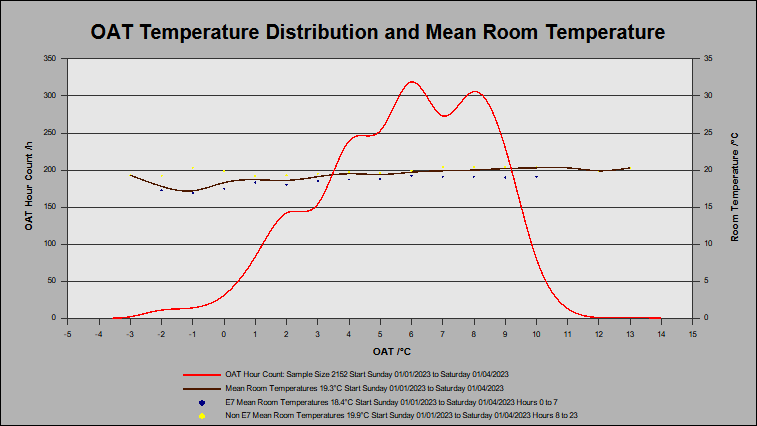
I don't that that is true, nor has it every been. There is a lot of confusion and misinformation about heat pumps. It mainly boils down to the general public having fallen asleep during science lessons. Temperature, power and energy are not the same thing. The main points to remember about any heating and hot water system is that it needs to be designed and operated correctly.
-
I modelled it not long ago because someone asked the same question. I think there was not much in it, and if I remember correctly, vertical had higher losses. Posted August 10 (edited) I have never seen it modelled, so hard to tell. Take a cylinder with a 0.5m diameter ad a 1.2m height. Assuming a U-Value of 0.2 W.m-2.K-1 Volume will be 235 lt. Surface Area will be 2.28 m2 Base of cylinder temperature, once settled, 36°C, top of cylinder temperature 60°C. Ambient Temperature 10°C. If one assume a temperature gradient of 20K.m-1 (about what mine is), then the power losses, when vertical, will be the sum of the top end, plus the area of the diameter (hoop), then the sum of the hoops, and finally the sum of the last band and the base area. Using a course 0.1m down the cylinder, the power losses are 18W, or if the cylinder is unused for a day, 0.44 kWh. Now lets turn the cylinder horizontally. Working out the surface area is not quite so easy here as for every 0.1m loss in height, the end area and the hoop area do not scale in a linear fashion, so I sketched it up in CAD, sliced it, triangulated it, then worked out the dimensions. Accumulative errors was between 1 and 8%, so shall use 4% as the error. The cylinder power losses are now 20W, 0.49 kWh.day-1. A difference of 0.05 kWh. The above is on a static model, but there will be some turbulence. With a mean temperature of 48°C for the vertical temperature, the mean density of the water is 988.7 kg.m-3, at the top of tank temperature, the density is 5.53 kg less, 4.48 kg more at the bottom. A total of 10 kg.m-3 difference The horizontal cylinder only has a 12°C temperature difference (because I used the same temperature gradient of 20K.m-1), so the density difference is only 5.6kg.m-3. Now without getting into Reynold Numbers and tangential surface areas, a simple way to model it would be to look at the difference in stored energy and the difference in mass as energy is the ability to do work, which can be reduced to moving a mass a distance. The vertical cylinder will have 233 kg of water in it, the horizontal one 232.4 kg, so 0.6 kg less. To move 1 kg of water, 1 metre, will take 1 joules of energy. So to move 232.4 kg 1.2 metres will take 279.6 J in the vertical cylinder. There is only 0.5 metres of height in the horizontal cylinder, so 116.2 J, so the turbulence losses will be in thee order of 42% less. So I would not worry about the cylinder orientation. I am going outside to sand some wood now the glue has set.
-
What makes you think there is a performance difference because of orientation?
-
My cheap Titan cordless drill has variable speed, torque limiting and hammering. https://www.screwfix.com/p/titan-tti886drs-18v-2-x-2-0ah-li-ion-txp-cordless-drill-driver/328pv Or were you after a really cheap, corded drill, something like this. https://www.ebay.co.uk/itm/386148043015 You will soon find out that you only wasted 18 quid.
-
Environment Global power sector has almost hit peak greenhouse gas emissions This year could have been the beginning of the end for emissions from generating electricity, were it not for a drought that saw a fall in hydropower generation 5 October 2023 Listen to this article By James Dinneen Hydropower was hit by droughts this year Evgeny_V/Shutterstock Global greenhouse gas emissions from generating electricity would already be on the decline this year, were it not for drought – itself potentially caused by climate change – leading to a shift away from hydropower to fossil fuel generation in China, the US and India. “The world is teetering at the peak of power sector emissions,” says Malgorzata Wiatros-Motyka at Ember, an energy think tank in the UK. Generating electricity by burning fossil fuels is the largest single source of carbon emissions, responsible for around 40 percent of the global total. The rapidly rising share of renewable energy in the mix has led to forecasts that power sector emissions would peak as soon as this year, an important milestone towards decarbonisation. But the peak hasn’t yet been reached. Wiatros-Motyka and her colleagues counted emissions from the power sector using data on electricity generation through the first half of 2023, looking at 78 countries representing 92 per cent of electricity demand. They estimated emissions for the remaining countries based on historical data. According to their report, a substantial jump in wind and solar generation, as well as lower demand for energy, led to a decrease in emissions in several countries. This included a 17 per cent decline in the European Union, a 12 per cent decline in Japan and an 8.6 per cent decline in the US. Emissions in India rose by 3.7 per cent, though at less than half the rate of the same time last year. However, the reductions were offset by a 7.9 per cent increase in emissions from China’s power sector. Despite the country’s grid starting 2023 with emissions below those of last year, severe drought and heat waves saw China’s hydropower generation drop to record lows, prompting an increase in coal generation. Read more Why China's clean energy tech will determine our climate future Drought in the US, India and several other countries also drove a global decline in hydropower generation of 8.5 per cent, in what could be a historically bad year for hydropower. “Despite adding more hydro capacity, generation capacity factors of hydro are not going up,” says Wiatros-Motyka, pointing to climate change as a possible factor behind shifts in the water cycle that reduce hydropower. ”We don’t know why it is. Is it a new normal?” Minghao Qiu at Stanford University in California says he is wary about reading too much into a single-year decline, but says climate change is expected to drive changes in hydropower, even though exactly how much and where is unclear. “The magnitude of the global total change will probably be small, but hydropower supply in certain regions will decrease dramatically,” he says. Taken together, the researchers found that emissions from the global power sector remained effectively flat for the first half of 2023, increasing by just 0.2 per cent compared with the same period last year. This was despite a 12 per cent increase in wind and solar generation, as well as a fall in energy demand in several of the highest energy consuming countries due to slowing economic activity, a mild winter and energy-efficiency gains. If it weren’t for the droughts, the researchers found emissions from the power sector would have fallen by nearly 3 per cent this year. They may still reach their peak in 2023 depending on what happens with hydropower and energy demand, says Wiatros-Motyka. But even if the peak doesn’t happen this year, she says the growth of renewable energy means peak power sector emissions are almost certain to happen next year, with clean sources of electricity meeting any new demand. “I think that we are very, very close.”
-
- 1
-
-
Any YIMBYs on here? Keir Starmer is.......
SteamyTea replied to ToughButterCup's topic in Planning Permission
I would say there are only two issues. Inequality and barriers to entry. -
Any YIMBYs on here? Keir Starmer is.......
SteamyTea replied to ToughButterCup's topic in Planning Permission
Why not legislate so that local residents (i.e. council tax payers in that area) are allowed to purchase the land at market value. So if they object to a local development, regardless of scale, they have the right to buy the land. By putting a price that locals are willing to pay to keep it as is, sends a big message to everyone. -
Any YIMBYs on here? Keir Starmer is.......
SteamyTea replied to ToughButterCup's topic in Planning Permission
For whom? I have not said about building developments. I think this is the problem, we build ghettos, we just called them towns and cities. It has never been a problem in the past, it is a problem we have created by restrictions, rather than inovation. What is wrong with personal transport, it does not have to be 2 tonne 4 wheel drive vehicles. Yesterday, I left work and Amazon Prime had a convoy of delivery vehicles going to the rural depot. Or to put it another way, the fleet of eclectic vans was full of locally employed drivers who contribute to the area.