


SteamyTea
-
Posts
23837 -
Joined
-
Days Won
200
Everything posted by SteamyTea
-

Improving an "ok at best" ASHP installation
SteamyTea replied to pstunt's topic in Air Source Heat Pumps (ASHP)
Before getting bogged down in arithmetic and heat pump settings, do you know how much insulation is under your floor where the UFH is? -
Why are people leaving construction?
SteamyTea replied to IanBECC14's topic in General Self Build & DIY Discussion
Welcome Ian Maybe a bit more context is needed, who has tasked you?, why have they tasked you, I have only worked on the periphery of the building industry as a supplier/installer. I found the majority of people in it a bit too 'laddish' and generally under educated.- 7 replies
-
- 1
-

-
- leaving construction
- employment
- (and 2 more)
-
I have just done a blog post about insulation and commented on my phone not being able to insert a superscript minus sign, and if it is an R-Value or a R-Value.
-
Last year the heat wave missed us, even though we did have a severe heat weather warning. 2022 was worse as we had similar OAT but clearer skies. This did cause my house to get to a mean of about 27°C inside. For an experiment I covered the inside of the windows in tin foil, this reduced the temperature a lot. Not very practical as no light at all comes in, and you can't open the windows. And it looks silly. But may be a useful idea if made into easily fitted panels (see my other thread about that).
-
No it didn't. kW
-
Why do people get so hung up about thermal insulation, it really is not difficult. The main thing to remember is that the power, in watts (W, J.s-1) that passes though a material is approximately proportional to three things, conductivity (k, λ), temperature difference (∆T) in kelvin (K), and thickness in metres (m). In arithmetic terms, the thermal conductivity of a material is written as W.m-1.K-1, or W/m.K (as I have never found a way to write a superscript negative sign on my Android phone). Different materials have different thermal conductivity. Taking extreme ends of the spectrum, natural diamond conducts at a rate if 2200 W.m-1.K-1 and a pure vacuum, for these purposes, is 0 W.m-1.K-1. Now we don't, in the real world, work at the extremes. So let us stick to some more common building materials. Ordinary brick, k = 0.72 W.m-1.K-1. Concrete k = 1.28 W.m-1.K-1. Timber k = 0.14 W.m-1.K-1. Mineral wool insulation k = 0.038 W.m-1.K-1. Expanded polystyrene k = 0.04 W.m-1.K-1. Polyurethane foam k = 0.03 W.m-1.K-1. Orientated Stand Board (OSB), 6% adhesive k = 0.16 W.m-1.K-1. Plasterboard k = 0.19 W.m-1.K-1. There is, obviously a lot more materials and it is down to whoever is calculating to find and check figures. An example of this is granite, there are a lot of different types and the k-Value can range from 1.73 to 3.98 W.m-1.K-1. So do your research. It is not normal to fit a metre thickness of any insulating material, If we did, none of this write up would be necessary. Because we use fractional dimensions i.e. 0.2m when planning the insulation levels of a building, the more common thermal resistance (R = K.m-2.W-1) is used. There are two advantages of using the R-Value, it takes the thickness of the material, and the area of the material, into account. Converting from the k-Value to the R-Value is really easy, just divide the thickness by the k-Value. R = l / k R-Value is often quoted and one thing to be careful of is that imperial units are often quoted. You may have noticed that R-Value has somehow introduced a m-2 unit, this comes about from dimensional analysis of all the International System of Units (SI) units W, which is kg.m2.s-3 and some arithmetic rearranging when combined with the other units, m and K. This is a useful as we do not have building elements that only have thickness, they also have area. The most useful thing about R-Values is that they can be added together to give a total thermal resistance (ΣR). Taking a simple wall build up of:) Outer: Brick, k = 0.72, 0.1m thickness. Full Fill Mineral Wool, k = 0.038, 0.2m thickness. Inner: Brick, k = 0.72, 0.1m thickness. Plasterboard, k = 0.19, 0.012m thickness. The overall thickness is 0.412m (dimensions may vary, so check). Using the sum (Σ) of l / k for every component makes for a long equation, and it is usual to use a spreadsheet. ΣR = 0.1 / 0.72(outer brick) + 0.2 / 0.038(mineral wool) + 0.1 / 0.72(inner brick) + 0.012 / 0.19(plaster board) ΣR = 0.139(outer brick) + 5.263(mineral wool) + 0.139(inner brick) + 0.063(plaster board) ΣR = 5.604 K.m-2.W-1. Note here that the effects of the mineral wool are dominant and that large R-Values are better. It is not normal to talk about a house, or wall, having an R-Value, but a U-Value (anyone know if R should be proceeded with 'a' or 'an', sounds like it should be 'an', but U sounds better with 'a'). Changing to U-Value, which is W.m-2.K-1 is simply a matter of taking the inverse of the R-Value K.m-2.W-1 U-Value = 1 / R So in this example: U = 1 / 5.604 U = 0.178 W.m-2.K-1. If the wall, ceiling, roof or floor is of timber construction, the technique is just the same, just that the appropriate areas also have to be included in the final solution, so you work out the U-Value for all the studs and noggins, plus the OSB thickness, and then the U-Value for all the insulation and the OSB thickness. There is one other thing when looking at heat losses, and that is the air film surrounding them. Air has a very good k-Value of 0.026 W.m-1.K-1 and is really the component that is doing the majority of the work in insulation, the material i.e. mineral wool or polyurethane foam is just there to stop the air conducting by trapping it in place. Because of this, some allowance has to be made for any air voids in the wall build up i.e. a service gap. To simplify this, it has been decided that two standard values are used, one for walls and one for roofs, with no regard to thickness. The wall R-Value is 0.18 K.m-2.W-1, roof R-Value 0.04 K.m-2.W-1. So taking the above example, and extra 0.18 K.m-2.W-1 must be added to the sum of the R-Value. ΣR = 5.604 + 0.18 ΣR = 5.784 Convert to U-Value U = 1 / 5.784 U= 0.173 W.m-2.K-1. It only makes a small difference, and at the third decimal place, but is still worth including because when the numbers are rounded, it may be the difference between the desired value or not.
-
MVHR intake and exhaust separation
SteamyTea replied to dnb's topic in Mechanical Ventilation with Heat Recovery (MVHR)
Was pretty good wind yesterday, had stronger ones in the past, but as soon as the windspeed is over 40 MPH, then it makes things rattle. Think we hit around 55 MPH for a few hours in the evening. -
@Nok Hopefully you will get a notification because I have tagged you into the post. I can't really help with the plumbing, but hopefully others with a lot more experience will be along that can. But of you do not have enough fall, then you will, as you say, get stagnant water building up.
-
Welcome. You will get a lot of advice on damp, sometimes 3 different solution from the same person.
-
Welcome Nok What kind of shop is it? While this site is basically about houses, many of the techniques are transferable.
-
I am not sure which bit of Ireland you at at, but a lot of your climate is similar to the SW of England. 250/300 miles East of me and the climate is really quite different. 40⁰C was recorded last year, so while full time, central heating systems may not be needed, cooling almost certainly will be wanted. As an ASHP can do both heating and cooling, apart from the system size, a system will almost certainly be needed (not everyone likes the high temperatures that I do). So I am not sure there is much saving to be made really. Initial better thermal design if the building is really the answer, but it is impossible to convince people that they can live with small windows, and still get a good view. It is even harder to convince people that reducing energy usage is the right thing to do as most think they are immune to the effects of climate change, and anyway, the severe weather we have had in the last decade is just that, weather, and (expletive deleted) all to do with climate.
-
What Boiler to prevent short cycling?
SteamyTea replied to windsor-tg's topic in Central Heating (Radiators)
Is it a hedgehog foetus? -
Which way is it reflecting, back into what what it is in contact with?
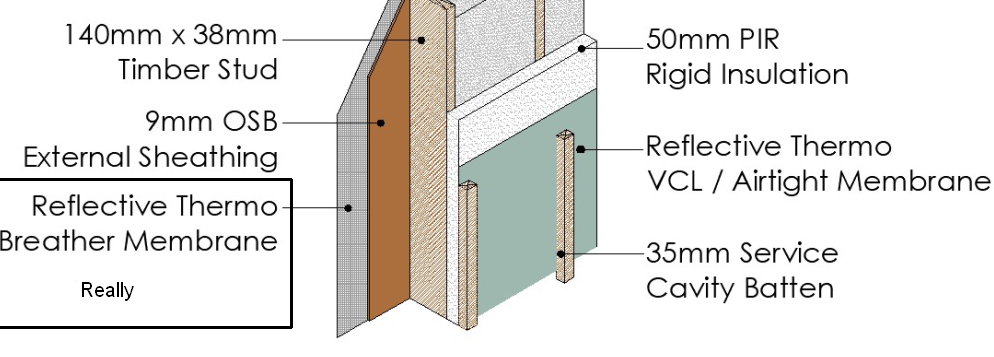
-
Weights of Different Construction Methods
SteamyTea replied to Paul K's topic in General Construction Issues
I think you will have to work from first principles. I am not an SE, but in reality, I can't see there being much difference in foundation loading for a normal house, it is not worth scrimping on a foundation, it may have to be reused in the future. -
Lots of women too. How did you get the square feet, was it by traditional Chinese foot binding.
-
Difficult to identify cause of water ingress
SteamyTea replied to kaye's topic in General Construction Issues
And how long after the rain has stopped. That was one of my clues. -
Welcome. There are 3 main things to consider (4 if you consider safety). Will it affect any Fit payments. Will you need a new inverter. Will your DNO need notification for the increased generation capacity.
-
Difficult to identify cause of water ingress
SteamyTea replied to kaye's topic in General Construction Issues
My house is not the same design as yours at all, but myself, and my neighbours, have all had the same leaks. They happen when we have strong south westerlies (and they are strong down here). Leak leak in the same corner of all 3 of us was caused by the lift insulation moving, then somehow soaking up wind driven water. This caused damp patches on the bedroom ceilings. The other leak, similar to yours, is above the downstairs window, and can be a lot of water coming in, a constant drip for hours. This was caused by a crack in the render. This crack (in my house) was not that close to where the leak in the inside was (about 3m away). I 'temporarily' fixed with a squirt of sealant and it has held for several years now. Main thing I learnt was with a timber frame house, water paths can be very long and contorted. My neighbour was a bit miffed when he had new windows fitted and the leak did not go away. The give away to me was that the leak was higher up than the window frame, by about 40mm. -
Welcome The hot water is probably not 'going cold' in the afternoon, it has probably been used up in the morning. This is probably just down to how the controller/s for the ASHP has been set up. Get as many relevant model number for the parts involved, and I am sure someone on here wil know how to set it up. Why do you want a double garage? Not many cars need to be kept in a motor house these days. If it is for a workshop, then a different building method may be more suitable. Why home automation. Houses basically look after themselves. The ability to turn up heating or lights on and off while away is really way over the top (though useful for holiday let properties). As you have an ASHP, I am assuming you are not on the main gas grid. So get/make a decent electrical energy monitor and collect data, it will tell you so much i.e. what saving would be made with PV.
-
Sounds like one of your old slave ships from the 17th and 18th centuries. "Once she goes black, she ain't every coming back"
-
Depends which side you look at. All the interesting' ones are on the French side.
-
Just imagine going to see an ancient Aunt and she starts rambling on about chemistry and how her house is insulated with Icynene, then noticing the castor oil plants in her living room, and her Palestinian husband. Or is it just me that has strange Aunts.
-
So is Ricin. Castor Oil Plant has so many uses.
-
Yes, most probably are, and bio based will be for specialist installations. And there there will be the clash about land usage. We had a spike in grain prices back in the mid 00s because some twat of an oil trader could not work a calculator when working out the consequences of adding 5% bioethanol to gasoline would actually mean. It is going to be either price or legislation that changes the market. But I would still use blown in cellulose.
-
And a lot less extraction needed.

