


SteamyTea
-
Posts
23689 -
Joined
-
Days Won
198
Everything posted by SteamyTea
-

I can finally drill! Oh wait. What is the matter here?
SteamyTea replied to Garald's topic in General Joinery
Not really as it is an electronic speed controller. When drilling masonry, you are really chiselling it, unlike drilling an elastic material like steel. You really won't come to any harm with a 700W drill and a 7mm drill bit and n 100 year old brick. -
I can finally drill! Oh wait. What is the matter here?
SteamyTea replied to Garald's topic in General Joinery
Thought you might have been. Get the smallest masonry bit you have, drill at top speed, you will find it goes in no problem. Then get the drill bit you actually need, probably 7mm for a 'brown' wall plug, and follow down the original whole. You can always practice against the wall outside in the courtyard. The biggest problem with drilling through plaster is when you hit between brick and mortar, that throws the position off. -
Vinyl onto osb. Will the texture show through?
SteamyTea replied to saveasteading's topic in General Flooring
Can she add some hardboard over the OSB, and that will get rid of any worries and give a much better surface to adhere to. -
Not always. It is hard to calculate as it is marginal generation that counts. So if you swap your FF energy supply to a finite RE supply, the difference is made up by either someone else swapping to FF or extra marginal FF generation. In reality, as we are heading to a low CO2 generation system, electrification is the best way forward, as well as energy reduction.
-
I can finally drill! Oh wait. What is the matter here?
SteamyTea replied to Garald's topic in General Joinery
What sort of drill bit are you using, and are you using the hammer attachment on the drill? -
Why they have such good weather.
-
Not really the UFH that is expensive to run, it work just like a radiator. It is really down to two things, the thermal losses to the ground/building periphery and what temperature it is run at. Covering an UFH system with underlay and thick carpet, could cripple a system quite quickly, it would be like replacing a window with a radiator, then shutting the curtains. I am not sure, but maybe your local Building Control has some details, they almost certainly signed off the development, though it could be a private company.
-
Start butting some numbers on the design. Store volumes, mass flow rates, temperatures and then calculate the energy levels. Lower storage temperature just mean lower potential energy, not less energy per se.
-
Have to question why steel houses are not made. https://en.wikipedia.org/wiki/BISF_house
-
It is used as a filler with some paints and resins. Comes in a large bag and goes everywhere as soon as you open it up.
-
The trouble is that this is heading into 'off grid' thinking. When off grid it has to be accepted that there are times when there is just not enough stored energy, so compromises have to be done. It really does not matter what sort of storage is used, if it is empty, it is empty. One problem with water storage is that there is a minimum temperature, below which, say 30°C, it is just an efficiency loss. Chemical batteries suffer less from this, but you have had efficiency losses during charging and discharging, so may all even out. That would require a lot of real data. What may be possible, with a bit hardware and plumbing, is to preheat the air entering the ASHP, from excess stored energy. A truck radiator and fan, placed in front of the ASHP intake, fed from a thermal store that is heated when there is excess solar, would warm the intake air. It would also reduce the inefficiency of the storage by allowing the store temperature to go as low as ambient. A bit madcap maybe, but the science is sound.
-
Good man. Once set up I find making repeat items quite relaxing.
-
Vacuum is best. In reality, when you look at the numbers, there is not much in the normal range of insulation and other losses will soon dominate. Material Thermal conductivity [W·m−1·K−1] Notes Silica aerogel 0.02 Polyurethane foam 0.03 Expanded polystyrene 0.033–0.046 Fiberglass or foam-glass 0.045
-
Welcome Janner. Quite a few people on here are near you.
-
Drying and re-insulating a 2.5 year old damp cavity wall
SteamyTea replied to Adsibob's topic in Heat Insulation
Having followed this a bit, but not really understood it, I think I am now getting to see the problem. Does the wall face the prevailing wind? Causing rain to get blown under the membrane. -
Drying and re-insulating a 2.5 year old damp cavity wall
SteamyTea replied to Adsibob's topic in Heat Insulation
I have a 'Nigel in the Arches' feeling. (The 'pips' are 100 years old at 9PM today) -
I have just noticed that I made an error in working out the volume of the water cylinder, this changes the heat capacity to 0.701, which is over double the 0.301 I originally posted. So that line is now. Properties Water Cylinder (Kingspan 250 lt AU12250ERP) Sunamp (Thermino 210e) Storage Heater (Creda TSR12) kWh/m3.K 0.701 8.736 3.940 Still looks pretty poor in comparison but that cylinder has the expansion chamber built it, so it bigger than it needs to be to hold 250 litres of water. If it was just the water, then the volume would be 0.35 m3 rather than the 0.41 m3 that it works out as with the expansion vessel and insulation. Floor loading becomes 12.6 kN/m2 as well.
-
Yes, why it is a big K for kelvin. No. Specific means by mass, kg, small k as it is 1000. Every material will have a different specific heat capacity and it is not based on material type i.e. gas, liquid, solid, density shape, metallic, non metallic, natural or man made, pure or alloy etc, and just to make it worse, most materials will vary the SHC with temperature and what phase they are in i.e. gas to liquid. This is also known as sensible heat. Wedged in between phases, the place where the state changes, but the temperature remains the same, will also have a different heat specific heat capacity, this one is called latent heat. Basically yes, when half the energy has gone, there is only half of the original to loose. This is where shape comes in, and is why surface area is important. The larger the surface area, the faster the energy can be lost, why we have large surface area radiators with low temperature systems. What is really happening is that it is giving up its sensible heat, specific heat is basically fixed. Heat is only the old word for energy and has nothing to do with temperature. This often causes confusion, just remember, if you see the word heat, replace it with the word energy, and see if it makes sense, if it does not, then replace it with temperature. I tend to think in terms of energy and power for most thermodynamic 'things'. All that means is how much of something do I have to play with, and how fast, or slow, can I get rid of it. Bit like budgeting at the end of the month when you know you have a bill or two to pay.
-
This is quite difficult, but only because it is laborious. I made a matrix of some common properties of a water cylinder, a Sunamp and a storage heater, all with a similar nameplate thermal capacity. I converted the values into rated capacity in kWh, cubic metres, litres/minute flowrates, input power, dimensions, volumes, mass, standing losses (though not relevant for a storage heater), kWh/m3.K and kWh/kg.K, floor loading and recharge times. Then it is just a matter of picking from the lists the properties that best suit the installation i.e. floor area, height etc. I have not put any prices in as they are way to variable and very specific to the installation i.e. pipe runs, cabling, floor reinforcement. A quick not on a storage heater. These work by loosing heat at a controlled rate, which is why the numbers look a bit strange. I made an assumption that there are no losses during the recharge period (even though this is not true in practice, but more closely matched the way water storage is measured), then worked out an equivalent amount of water storage (the Equivalent Storage /lt row), which was divided by 17 hours discharge time, then converted to litres per minute. This is not really a fair comparison and only really relevant for water delivery. Another way to look at it is to divide the storage capacity by 17 hours (the usage period) and get a kW delivery (they are all pretty similar). The biggest problem is know what temperature difference to use, so I picked 35K for water storage (maxing out at 65°C), 5K for the Sunamp (delivery is 40° after all) and 45K for the storage heater (the bricks get very hot). These numbers are very much open to debate and are really, in this instance, something to work to. They can be adjusted. Properties Water Cylinder (Kingspan 250 lt AU12250ERP) Sunamp (Thermino 210e) Storage Heater (Creda TSR12) Input kW 6 2.8 1.7 Height m 1.744 0.87 0.705 Diameter/Width m 0.55 0.365 0.56 Depth m 0.757 0.17 Mass kg 305 178 77 Equivalent Capacity lt 250 210 208 Standing Losses W 84 32 N/A Flow Rate lt/min 12.5 20 0.01 Rated Capacity 10.2 10.5 11.9 Power kW 0.60 0.62 0.70 Volume m3 0.91 0.24 0.07 kWh/m3.K 0.317 8.736 3.940 kWh/kg.K 0.001 0.003 0.001 Floor Loading kN/m2 5.7 6.3 7.9 Recharge Times /h 1.7 3.8 7.0 A kettle is a good thing to play with. You can easily check the input power, it is written on the base, easy to put different amount of water in, what a Pyrex jug is for, the starting and ending temperatures will be the same (run the cold tap for a few seconds first) and then time the time to boiling. If you want to get a much better feel for what heat capacity is, every 10 minutes after boiling take some water temperature readings, then plot them. It won't be a straight line. Will be, roughly, 3 times longer for every 10K temperature drop. Actually
-
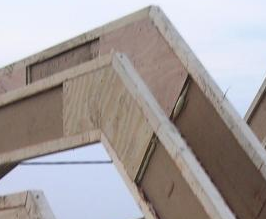
And plenty of polyurethane adhesive.
-
May be worth having a look around here: https://www.structuralbasics.com/ https://www.structuralbasics.com/timber-column-design/ There is a reason that beams and columns have different names.
-
Most hydrogen would be run though fuel cells.
-
Generally, apart from coal powered generation, the efficiency gains more than offset the emissions. But we really need to stop combustion technologies.
-
When I get around to making my new shed, this is how I intend to do it. For a house some analysis of buckling will have to be done. Adhesive bonding.
-
Your dead right, I was eating a kebab while watching the sun set. Timber has a lower density, so larger volume for the same mass. Does highlight why it is not a good idea to mix units, until the very end.

