SteamyTea
-
Posts
23689 -
Joined
-
Days Won
198
Everything posted by SteamyTea
-
@ToughButterCup I made a bit of an error, should have said that both the sun altitude And azimuth angles are the same. If only one angle changes, then you get greater power.
-
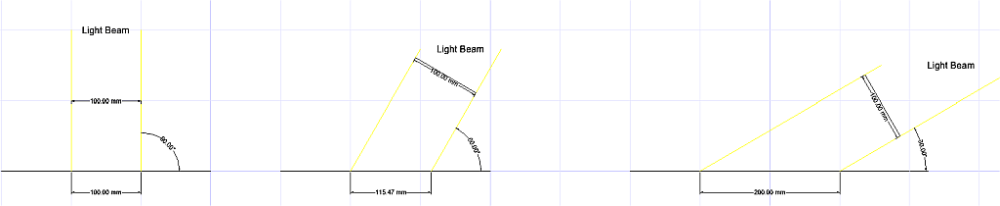
Trigonometry, Power and Specific Heat Capacity. To keep things simple, assume the same light beam, with a power of 200 W.m-2, and using the sketch above. When the sun is at 90° to a surface, the area will be 100 mm by 100 mm, so 10,000 mm2, or in proper language 0.01 m2. The power per square meter is therefore 200 [W.m-2] x 0.01 [m2] = 2 W Angle the beam over by 30°, the area changes to 115.47 mm by 115.47 mm, so 0.0133 m2, 33% greater area, at 60° it is 200 mm by 200 mm, 0.04 m2, 4 times greater area. So it goes from 2 W of power, though 1.5 W at 30° to 0.5 W at 60°. If your wall was granite (or most stone/brick/cement) it has a specific heat capacity of around 0.8 kJ.kg-1.K-1. Now a W is a J.s-1, a small amount really. The density is around 2500 kg.m-3. Taking an area of 1 m2, but just the first 10mm of wall depth that is facing the sun, this will have a mass of 2500 [kg] / (1 [m] x 0.01 [m]) = 25 kg. So to heat up 25 kg of wall, by 1 K will take: 0.8 [kJ.kg-1.K-1] x 25 [kg] = 20 kJ of energy. At a power input of 200 W.m-2 (200 J.s-1), and not taking any losses into account (which will be quite a large fraction) to increase the temperature by 1 K will take: 20,000 [J] / 200 [J.s-1] = 100 s. At 30° light beam angle, 133 s, and at 60°, 400 s.
-

Exciting borescope pictures of wall insulation!
SteamyTea replied to Garald's topic in Heat Insulation
Some of them have a small marker on them that shows up on the screen, or if yours does not, stick a little bit of tape on the bottom. -
Anyone had first hand experience of Shower Power Boosters?
SteamyTea replied to Del-inquent's topic in General Plumbing
Is that all it takes, a smelly partner. Should have told my BiL that, would have saved my sister robbing him. I fitted my shower pump under the bath, it pumps to the bath mixer tap, and therefore the shower as well. Can you do something similar as a temporary measure. -
More foundation fun - straw bale garden room on clay
SteamyTea replied to Nick Thomas's topic in Foundations
Makes it look liker a crime scene. Tape the joints up with some of this.
-
Anyone had first hand experience of Shower Power Boosters?
SteamyTea replied to Del-inquent's topic in General Plumbing
It is always nice to go for the easy solution, which is what probably happened when it was fitted. Can you just bring the fitting of a newer system forward as it is going to be redone anyway. -
Heating / hotwater systems -self build
SteamyTea replied to cairstiona's topic in Central Heating (Radiators)
Welcome Seems an odd priority list to me, other may think differently. If that is just resistance heating, then it could cost you 3 times more than running through a heat pump. You can get Air to Air Heat Pumps for space heating and Exhaust Air Heat Pumps for water heating. Those two could be an option. As you don't want to fit an UFH system, what levels or floor insulation are you fitting? -
Anyone had first hand experience of Shower Power Boosters?
SteamyTea replied to Del-inquent's topic in General Plumbing
What sort of system do you already have, vented, unvented, combi. If you had a pump, why not just replace it. I put a twin impellor pump on my hot water for the bath/shower, 16 years ago, not had to touch it since. It was the cheapest pump from Screwfix, about £100. -
Many materials have chemicals added to them to help the manufacturing process. Some MDF have a resin that bonds to timber, but rejects water. This is because one end of the molecule hydrophobic (non polar), this rejects water (polar), and other materials that have the same electrical charge.
-
How to measure the remaining HW in an unvented cylinder
SteamyTea replied to Adsibob's topic in Boilers & Hot Water Tanks
When he drives a car does he accelerate in the lowest gear possible up to the red line, then hit the brakes, then does it over and over again. I do the long journey up to Buckinghamshire every couple of weeks, always amazed me, on the motorway, the number of cars that have no traffic in front of them that keep apply the brakes, for no obvious reason. -
They have fire retardants put in them. Though there is a review going on about how good after the Grenfell fire. Worth checking what the rules are in France, especially Paris, if they are different.
-
Some MDF has a release agent built in, why it is not used to reinforce composite plastic parts.
-
I think it is always worth insulating, especially a North wall as that gets very little sunshine on it. As for what sort, it is usual to use a sheet foam, a fireproof one.
-
-
Renovating a 1920s end of terrace in wales
SteamyTea replied to joseywales's topic in Introduce Yourself
Read up on how to make an old building airtight first, then the MVHR becomes simple, you may get away with dMVHR then. -
It is, indirectly, with a GWP of 5.8. https://agage.mit.edu/publications/global-environmental-impacts-hydrogen-economy Water vapour has a GWP of 0.001 and 0.0005 over 100 years. https://ui.adsabs.harvard.edu/abs/2018AGUFM.A21H2774S/abstract It is easy to get GWP and radiative forcings mixed up.
-
How to measure the remaining HW in an unvented cylinder
SteamyTea replied to Adsibob's topic in Boilers & Hot Water Tanks
Not really, it is much more complicated than that as it is not really stratification at all. There is a mean temperature gradient, but that changes with the mean temperature. Why I suggested that you look for another solution. -
Then the company needs to look at its medium term viability. These are exactly the same things I hear and see down here, except we have 5 million visitor days a year, so a much bigger problem. What is not a real problem is the number of holiday lets, in reality they make up a tiny fraction of the whole, though people often say that it is the biggest problem and that 'nearly all house' are holiday lets. If renting, of any sort, in any area, is a problem, and it seems to be so, then the problem is lack of building, not really anything else. Near me there was a proposal to put in 1100 houses, there was strong opposition, and it got turned down at the planning stage. They still built 1100 houses, just dispersed around the same locality. All that did was increase the price of building, which is not what is wanted. I often wish they would build a new town down here, so 250k units over a few years. If planned right it could be quite nice and not take up much room. If each 'plot' including services took up 625 m2, then that would be 160 km2, 4.5% of the land area.
-
Then one of two things needs to happen. Build them accommodation or pay them more. The one of two things needs to happen, pay them more or the business owner needs to get a better business plan i.e. do they have a viable business. What was the rational for turning down suitable candidates, other than they were not local? Sounds like a bad policy to me, or bad business ethics.
-
Most hydrogen would be passed through a fuel cell, not burnt. Combustion technologies have really poor efficiency. Fuel cells are not that much better. https://www.linquip.com/blog/efficiency-of-fuel-cell/ There is a reason they are called 'fool cells'.
-
Can you fit a sub meter for that supply, then at least you know what is going where. And while the power is off, fit one to monitor just the heat pump.
-
When’s a good time to self build
SteamyTea replied to nod's topic in General Self Build & DIY Discussion
Or cussedness/stubbornness. -
Market distortion happens everywhere, it is how markets work. If a local sells a house, say for £200k, and that place becomes a holiday let, then there is potential an extra £200k in the local economy. Say that holiday let raises £20k/year in revenue, it still takes a decade before it has recouped the original amount. But you have to add to the original £200k any money that the visitors spend locally, say another £20k/year. I think the real problem is locals don't want to get extra properties built. As you well know I am all for more house building in all places. I often wonder why people are so against new developments.
-
When’s a good time to self build
SteamyTea replied to nod's topic in General Self Build & DIY Discussion
Not since the Rwanda policy. It often shows an ignorant disregard for failed ideas. Think Zoot and running his heat pump, he refused to try anything that was suggested. -
When’s a good time to self build
SteamyTea replied to nod's topic in General Self Build & DIY Discussion
Isn't it like the best time planting a tree. 40 years ago, or today.