SteamyTea
-
Posts
23836 -
Joined
-
Days Won
200
Everything posted by SteamyTea
-
 You make no mention of the boiler size, or the expected heat loss of the building.
 -
I shall remember that when I next pull my winceyette nightie on. But just last night, I noticed that if I put a bit of pillow case material under my hand, then rest it in the metal bed head, it feels nowhere near as cold, compared to a naked hand on it. Same with socks and a cold floor, even the thinnest of socks impede the energy flow significantly, and the k-value is probably very high for a compressed sock.
-
Facial wrinkles and back muscles.
-
Call it what is it, thermal effusivity. e = (kpc)0.5 Then just to complicate it, the the temperature differences decrease, the power transfer decreases. T = e(-kt) The e are has different meanings in each formula.
-
Over a typical metrological year, they are same. I did a similar experiment a few years ago and posted the result up on this site predecessor, there was no difference. Was brick, timber and polystyrene, all coated to the safe reflectivity (albedo). Was a follow on from "Paint your roof white" I posted up about on the Other Place. Thing is, I was not showing volumetric differences, but specific differences. But how about this for a thought experiment, how much concrete would you have to add to internal walls to stabilise the air temperature to a fixed band i.e. ±1°C? It is easy to create an experiment designed to go looking for anomalies, but that is rather missing the point, as well as bad experiment design.
-
They did not bid in the last round of licenses, but that may have been for England only. I have a relatively small (about 500 kW) turbine near me. Most of my neighbours do not know it exists and it is only 0.7 miles away. They often mention the wind farm at Chiverton, which must now be 30 years old and all the turbines could be replaced with just one larger one now (they are ancient 100 kW ones). Back to the overhead power lines. If the line is part of a windfarm delivery network, technically, overhead cables are better as when the windspeed is high, more power is delivered, but the cables get cooled more, so can be smaller. That cannot happen with underground cables, so they have to be larger. I also heard some farmer (on Farming Today) saying that the underground cables meant that he could not farm 50 metres wither side of the path they follow. He did not specify if that was only during construction, or was a permanent bad. He also did not talk about the rental he would get, that would have ruined his narrative.
-
Your not likely to find a simple diagram with the correctly sized components for your installation. But let us start at the beginning. You have a Sun, the output, once rays hit the ground, at your location, will vary during the day, week, month and years. This variation, usually measured in kW/m2, but often shown as kWh/m2 over a set time period i.e. a month. The difference is the mean instantaneous power delivered, or the total energy delivered over a period. Now as instantaneous power is very variable, the electricity that the modules (PV panels) is also variable. Modules are generally fixed voltage devices i.e. produce no voltage when it is dark, once a threshold light level is reached they 'jump' up to a fixed voltage (usually around 0.5V per individual cell). This voltage stays the same until there is extreme light when the voltage may either increase slightly, or decrease slightly (not worth worrying about those extremes). The individual cell voltage is irrespective of the physical size of the cell, a 1 mm2 cell will be at the same voltage as a 1 m2 cell. But we don't make a few large cells for reliability reasons, we make several relatively small cells and join them together in series. You may have noticed that manufactures often specify the number of cells in a module i.e. 60, 72, 96. This translates to a modules output voltage i.e. 30V, 36V, 48V, 12V modules will have 24 cells. So when photons of light hit a cell, a voltage is produced (0.5V), if more photons of light hit a cell, more current is produced. Current is measured in amps (A). Current can be thought of as the thing that does the work. Say you are chapping down a tree, one swing at it every 5 seconds. To cut it down faster you can chop every 2.5 seconds, or get a heavier axe. As the speed (the voltage) is fixed, the only option is a heavier axed. To make a module 'heavier' it is just a matter of increasing the surface area so that it catches more photons. It really is that simple. Larger area, more amps. Now getting back to a real system and why a 'charge controller' is used. A basic charge controller does two things, controls the voltage and limits the maximum power. This has to be done in all PV systems because of the varying sunlight levels which react a 'wild' DC current i.e. unregulated. Now you are worried that the electronics is all a bit voodoo and therefore unreliable. Like a car, they can be unreliable if the wrong one is used for the job. Get a small car, fill it will people, stick it in second gear and redline it, it will not last long, get a large car, fill it with people use the gears appropriately, and it will last a very long time. So think of a charge controller as a gearbox, it varies the fixed voltage (the RPM) that is delivered by changing 'gear' with varies the amps (the torque). As voltage multiplied by amperage is power, V x A = W (watt). But what comes out is a fixed voltage supply i.e. 12V, 48V, 230V, 600V, but with a varying power that is correlated to the amount of sunlight hitting the modules. This output power is direct current (DC). Posh charge controllers have got sophisticated and can be set up to limit the amount of power they deliver, this is important when charging batteries, very good charge controllers can also sense the type of batteries and the state of charge those batteries are in, and vary the power delivered accordingly i.e. more power when battery is flat, less power when it is reaching full charge. They can also 'search' for the point, at any time, that will deliver the most power, this is called maximum power point tracking (MPPT). A charge controller is not the same as an inverter. An inverter, in its most basic form, just converts direct current (DC) to alternating current (AC). Most PV inverters have a charge controller built in, which is why you can wire PV modules into them directly, they also have sensors and circuits in them that can detect the the grid voltage, the grid resistance and the load resistance. This is done for safety and reliability. Unlike a teenager in a car, they are designed to work nowhere near the ultimate limit of the components (actually most teenagers only think they are at the limit, they would shit themselves at the real limits of their cars, then hit something). So basically, a charge controller takes varying power from the modules, changes it to generally a higher, more useful voltage, and lets the current vary. That power is then fed into an inverter which makes it AC, at 230V (or whatever is appropriate), which then drives the load. If the load is too high, it tries, via the MPPT to deliver, but if that fails it disconnects for safety and reliability. Getting back to your question a while back, 'how big a battery is needed to start a heat pump'. Not very big at all as it only needs to deliver a high current for a few seconds. The right sort of battery is needed though. A lead acid battery basically comes in two sorts, a cranking battery or a leisure battery. A cranking battery can deliver a very high current for a few seconds, that is how it can turn over a large diesel engine, but a leisure battery is designed to deliver much lower current, but at a more steady voltage, over a much longer period. Lithium batteries generally can deliver a high current and at a steady voltage. This is because the chemistry is different (the number of free electrons and how far they are from the protons). Now I know the above does not 'specify' which components need to be bought, and which order they need to be put in, but I am just trying to explain what each major component does and how they work. To help specify, you need to know the maximum power that will be drawn i.e. heat pump starting current, and the length of time it needs to run off a battery.
-
Kent's Cavern or Wookey Hole
-
Right. Thought it was strange as no one has offered to build new onshore windturbines since the moratorium was partially lifted.
-
I am a bit confused, you saying that they are going to build a turbine on your land? The best place for a turbine is on top of the highest hill.
-
So the decadal global increases in RE generation was just a figment of an accountants imagination then. Nothing to do with business and commerce supplying the expertise and finance 1990 2880 TWh 2000 2864 TWh 2010 4189 TWh 2020 7510 TWh https://ourworldindata.org/renewable-energy Last year, the Chinese people purchased 8 million EVs, that is more than the EU has purchased in the previous 7 years, and there is a lot of government restriction on car ownership in China. Now I know you are going to say that all Chinese manufacturers are state owned, state controlled is probably a better term, but the big German and Japanese manufacturers are there, as are Tesla, so business and commerce again. https://www.iea.org/data-and-statistics/charts/electric-car-sales-2016-2023 Lets have a look at primary food loss percentage The World average in 2016 was 13%, 2020, 13.3% and 2021 13% Northern Europe was 9.8%, 9.9% and 11.69% North America 13.3%, 14.5%, 11.72% Central and Southern Asia 13.8%, 13.6%, 12.62% The Northern Europe is not doing too well, but you will blame that on CAP not inefficient privately owned farms. Data here Now there is 3 useful links you can use to search several database, Up to you if you want to.
-
Exactly, the best a lot of people do is tiny stuff of no consequence at best that makes then think they are saving the world. Thankfully I think industry and commerce are slowing getting behind climate change regardless of governments' policies. Gone to take a long time and a lot of pain for some countries, and the ones that can afford it will have no choice but to pay for it, one way or another.
-
I am never going to be able to look at a thermometer again now. What is the difference between an oral and an anal thermometer? The taste.
-
What is it called, most book are available online these days.
-
How much do drywall screws impact insulation value of a wall?
SteamyTea replied to nostos156's topic in Heat Insulation
Here is a chart covering the last hour of having the window open.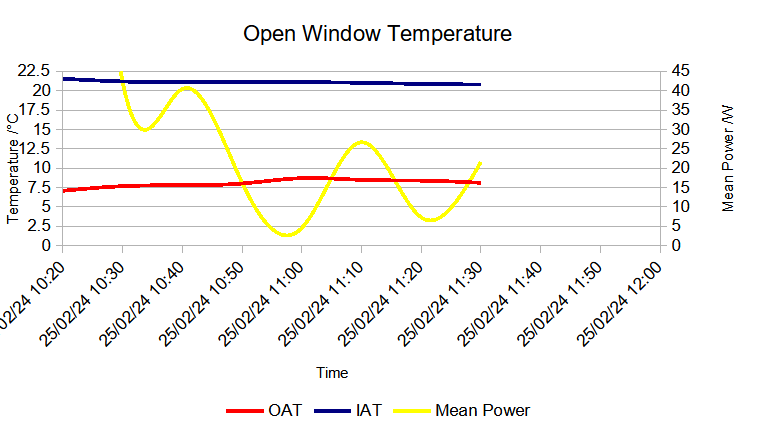
-
If your DNO is National Grid (used to be Western Power) then I think they are installing 3 Phase by default now. Real shit that mortgage lenders do not allow you to borrow without a mains connection. Just goes to show how little the finance industry thinks of reducing domestic energy usage.
-
How much do drywall screws impact insulation value of a wall?
SteamyTea replied to nostos156's topic in Heat Insulation
Very true. My thermometer is on the wall next to my window. It is now 10:25 AM and the display is showing 22°C I shall open the window and come back in a while and see how much the temperature has dropped. 15 minutes have passed, the thermometer is showing 21°C. This is a small room as well. 3.5m by 2.5m. Thought I better look at the OAT as well, 10:25 7.2°C, 10:40 7.8°C (the sun has come out and it has stopped raining) -
Without do a detailed thermal model it is very easy to attribute the wrong things to the outcomes. The things that will make the biggest differences are the ventilation rates, the solar gain though windows and the insulation levels, not the difference in the thermal inertia of the walls. There is generally a very large difference between the mass of air in a building (even allowing for air changes), and the mass of the construction. No one goes looking for heavyweight insulation. To get the equivalent insulation value from a brick wall, compared to 0.25m of mineral wool would mean that the brick would need to be 3.5m thick.
-
No it does not, just shows that there is a huge variation in farming practices, just as there is in shopping practices. (I think people forget that I did a ResM in Agriculture, predominately dairy farms)
-
Well it is to me, but not to everyone. Does need a bit more clarification as obviously, directly heating interior air will raise the temperature very rapidly.
-
Only with you because I am a There is no need for you to reply. For everyone else, just highlighting that sustainability is it is not as simple as it first seems. Be great if it was, would have sorted out the nonsense several millenniums ago.
-
Add in a couple of sin waves for good measure, if only for moon phases.
-
Food is getting like religion, based on nothing but believes. But then the food industry is good at corrupting evidence. People got poisoned at the Fad Duck after all.
-
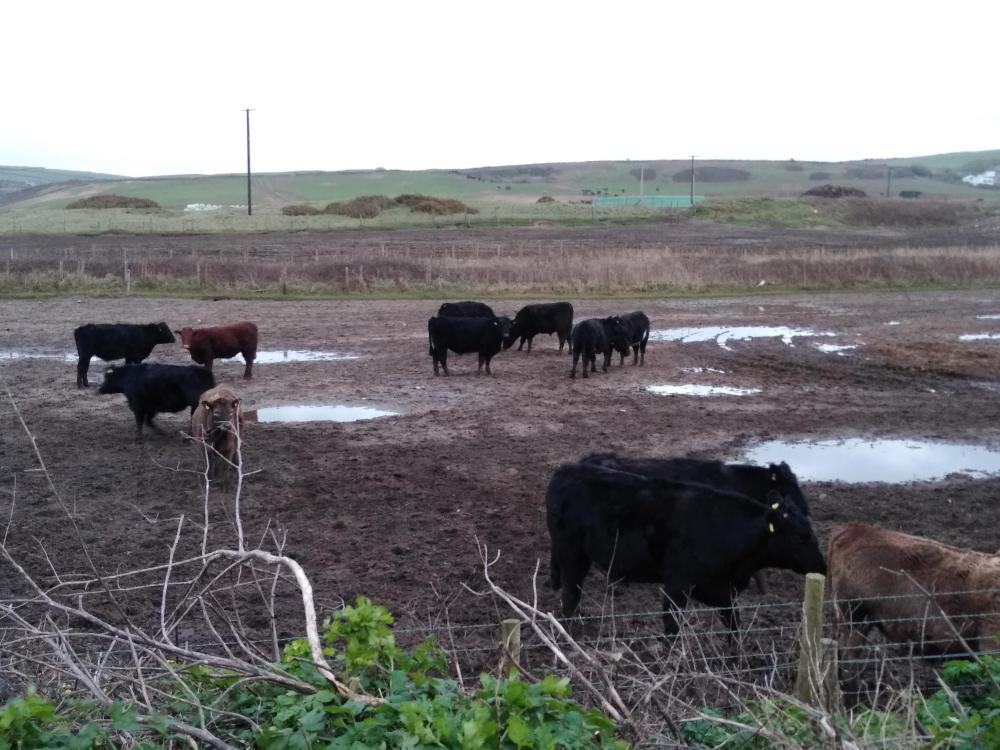
Here is a picture of a beef farm near to me. All outdoor reared. Like this all year round. Cornish beef anyone?
-
Not necessarily. If you think about animal welfare too long, you end up a vegan. So, as an example, how much energy is used to bring in food for a few bullocks, compared to feeding thousands of them. I was at university with a couple of guys from Uganda, their farming model is very different from ours, as is the Argentinian, Australian, Kenyan, Spanish, French etc. Some are better, some are worse.