SBMS
-
Posts
1075 -
Joined
-
Last visited
Everything posted by SBMS
-
Question - how could someone incorporate this into their self build at say first fix phase (so Wind and watertight but pre plaster)? would be great to catch anything at this stage by going round with a thermal camera, but with no heating source in the building what would people recommend? An electric radiator in each room?!
-
Self build mortgage costings with our without VAT
SBMS replied to PSC88's topic in Self Build Mortgages
They, didn’t add VAT on for us, or reflect any reclaim. Some Items in a build that do attract VAT such as fitted wardrobes aren’t fixed items and therefore typically necessary as a built cost. Things that aren’t zero rated should be budgeted at their inclusive of vat price. I guess the impact of this depends on who is building. If you are primary contractor driven you won’t really ever see any VAT or have to cover any VAT - it’ll be covered and reclaimed automatically by contractor. Are you buying materials and managing yourself? -
I don’t think your self builder lender will care about your warranty? Ours didn’t. Do you mind me asking what your total sqm is? Your build costs seem high for no primary contractor - but then again you might be building a mansion!
-
I wouldn’t worry about planning. Just make sure building control are aware. Doubt your warranty will even be aware of any changes, your warranty inspector won’t have looked that hard at your original plans - ours certainly didn’t.
-
BC might have requested calculations that the floor can take the loading of a full UVC if it is a first or second floor for example. Apart from that can’t see why BC would care where a cylinder goes.
-
Congratulations @mjc55! Care to share your plans? I followed the boundary dispute thread with interest and always wondered what you were building!
-
Non material amendment. Quick and cheap. We did it on ours to remove some timber cladding for brick instead. Stated that due to timber availability and pricing the materials need amending for economic and construction reasons. We then did another non material amendment to remove some decorative dormer peaks. Stated that they couldn’t be constructed and roof leaded correctly.
-
What about one of these for 3900 https://www.fonteyn.co.uk/barrel-sauna-rustic-6-feet
-
DDN - Planning officer missed discharge deadline!
SBMS replied to Bounce's topic in Planning Permission
For future reference there is no need to put ‘hope you can agree’. It’s a legal notice you’re serving. A planning consultant would write it to the point unambiguously. Your condition is interesting. Technically the LA would only have part discharged this condition. There is a second part of condition compliance in your condition which refers to implementation, post works registration etc. I think though that now this entire condition would be deemed fully discharged. I’d check that with a planning consultant as it might meant that you don’t actually have to implement the bat mitigation strategy or register the license… my guess if the LA are in any way diligent you’ll have a part discharged determination in your inbox tomorrow 😆 -
DDN - Planning officer missed discharge deadline!
SBMS replied to Bounce's topic in Planning Permission
If your deemed discharge set out the condition you are referring to and the date on which deemed discharge is to take effect then the LA has 14 days to determine your application. The order sets out some other things you must include in your deemed discharge notice. (https://www.legislation.gov.uk/uksi/2015/595/article/29/made) They can’t reject the request but they can issue a not discharged notice (but would have to justify why). Or they can discharge your condition. Both outcomes nullify your deemed discharge if they respond within 14 days (or the Date you put in your notice). If they don’t respond within 14 days and then the deemed discharge date you specified passes without correspondence, then under DMPO your condition is deemed to have been discharged. There are exceptions though as some conditions cannot be deemed discharge (such as flooding conditions, contaminated land a few others). If your condition is not subject to an exception then the LA cannot reject your deemed discharge. It automatically is in effect under Town and country planning order. FYI you could have sent your seemed discharge notice 6 weeks after your application for discharge as well. -
Ah - so the forming of the blocks is just the hole for a pre-made spa pool to sit in. It won’t actually even be touching the inner face. Just the base. No liner and no concrete. It’s basically a 1.5m hole with a big hot tub sitting in it.
-
Renting out now won’t really ‘offset’ any CGT (there is none) as CGT is future gains that you haven’t yet realised. What you’ve got to really look at is whether the return on your investment renting it out (less income tax of course) inclusive of any appreciation in capital value (less CGT at that future stage of course) is better than an alternative investment, such as stocks, shares, pension contribution, fixed income etc. Also bear in mind that rental income can push you into an additional rate. Not a problem if you’re income is less than say 80k but if you get pushed over 100k you’re going to lose out on personal allowance, additional rate and any benefits such as child tax credits, nursery allowances etc (might not be relevant). Rental yields are currently very high so if there is no borrowing on property A it’s likely a good investment. Interest rates are high so if you have outstanding or planned borrowing on property A you might struggle to make a return that beats stocks and shares or even potentially a fixed rate cash account! Be under no illusion as well that being a landlord is no small task. I would never manage the portfolio myself and I would certainly never live next door to my tenants. But YMMV.
-
Thanks @saveasteading - might ask the SE about this. Is cracking typically due to the pressure being exerted by the ground outside the structure, or something else unique to blockwork walls underground?
-
Sorry completely misread house B with A.. long day! I would say you’d be absolutely fine then as you’re occupying it as your principal residence. I think the legislation states that it must be occupied by P as P’s sole or main residence. The qualification is or and therefore sole is only supplied to make clear that if it is your sole residence it must also be your main residence. But if it is not your sole residence it must be your main residence. I’d say it’s pretty clear.
-
What next for heat pumps after BUS and MCS?
SBMS replied to joth's topic in Environmental Building Politics
Does MCS have a pricing structure? I would have assumed it was up to the supplier to quote accordingly? -
Our LA are very clear that CIL is payable if you no longer ‘occupy’ the residence. They specifically call out renting it out as a CIL triggering event. How they would find out is another matter but I would not risk it.
-
We've had some input from the SE and it's looking more of a go-er. He's got a 'basement design' that means it can be constructed out of minimal blockwork with a simple waterproofing, drain and backup sump pump. Chap who sells the pools told me that you don't really need any chlorine in it because the oxygen generator, UV light, sand filter etc is so good, but we could drop a chlorine table in once ever couple of weeks if concerned. Anyway - is there any reason not to consider putting a conventional MVHR system in the pool room? My thinking is that if I installed a conventional MVHR system (say a vent-axia sentinel) and put the ACH target slightly higher - perhaps 1ACH, then every hour the entire content of the room would be replaced, and dehumidified, and heat recovered. The room is around 144m3. Bearing in mind the swim spa pool I am looking at has an electric roller cover 90% of the time, so really it'd just be MVHR boost when we open the pool room up... I understand some MVHR suppliers (Zehnder) are nervous to approve their usage because of chlorine in the air, but if that's minimal then I can't think of a reason not to use it? A lot of the systems that are used in residential pools (£10k like @AliG's) are so expensive because they have a lot of ducting, and they also heat the pool (I don't need this). So.. good idea? Bad idea?
-
Explaining this thermal bridging door threshold detail?
SBMS replied to SBMS's topic in Brick & Block
Probably a mad idea, but is there any reason not to put superfoil under (and overlapped potentially) the track in door openings to reduce thermal bridging? By my reckoning the R value of SF60 is comparable to a thermoblock brick? -
Explaining this thermal bridging door threshold detail?
SBMS replied to SBMS's topic in Brick & Block
Thanks. The marmox technical support chap said to do something similar to this: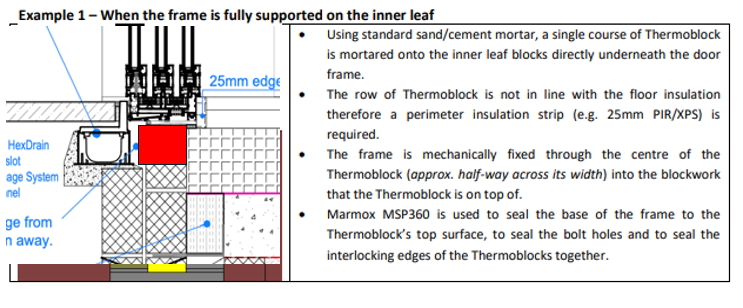
-
Explaining this thermal bridging door threshold detail?
SBMS replied to SBMS's topic in Brick & Block
Thanks Russell. Can I do a row of marmox (easier to source than compacfoam) - and would it be advisable to do the full width of the cavity in marmox (two 100mm)? -
Explaining this thermal bridging door threshold detail?
SBMS replied to SBMS's topic in Brick & Block
Do you think the EPS is actually doing anything? -
Explaining this thermal bridging door threshold detail?
SBMS replied to SBMS's topic in Brick & Block
Cavity above but then what supports the door track? -
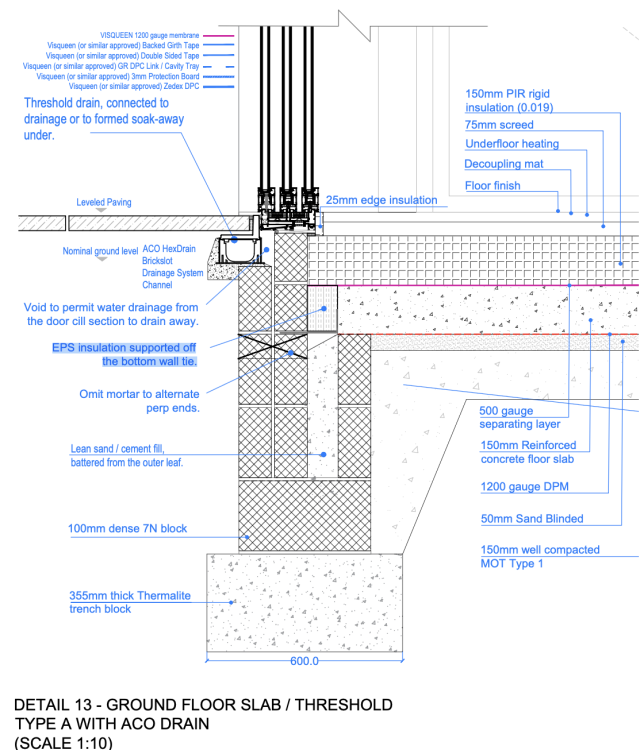
The architect has designed a detail to minimise thermal bridging at our door thresholds. We've got a 200mm cavity with EPS beads, and large sets of sliders. I asked for a detail that minimised thermal bridging, but also a detail that needed to support the weight of the bottom of the sliding doors. They didn't look at compacfoam etc because we tried to keep it as standard construction details as possible. However, I am struggling to understand, on the below, what the purpose of the "EPS Insulation supported off the bottom wall tie" is for? Does this aid in reducing bridging? Builder also can't understand how the detail reduces thermal bridning. Our sliding door track does actually have a thermal break in it as well so I might be overthinking this detail?
-
Is this side and rear extension Permitted development?
SBMS replied to SBMS's topic in Planning Permission
Thanks @DevilDamo I guess I wondered how much diligence planners take to actually check the status of the build and whether it is in a PD ready state. As planners don’t have access to BR sign off status do they actually take any measures to check this in determining an LDC or just assume it is in this state.. -
Is this side and rear extension Permitted development?
SBMS replied to SBMS's topic in Planning Permission
When can one submit an LDC out of interest? If the main house is currently under construction does it have to be ‘substantially complete’ before an LDC can be submitted? I understand that PD rights only arise once it is substantially complete, but can an application for an LDC be submitted earlier?