SBMS
-
Posts
1075 -
Joined
-
Last visited
Everything posted by SBMS
-
Is this side and rear extension Permitted development?
SBMS replied to SBMS's topic in Planning Permission
Do you mean submit both option 1 and option 2 simultaneously as a LDC? -
Is this side and rear extension Permitted development?
SBMS replied to SBMS's topic in Planning Permission
Thanks Marvin. Have read all this, no other conditions like AONB, 50% curtilage etc is all met. Property has brand new PD rights (new build). It’s just option 1 isn’t actually referenced as an example in the tech guide… -
Is this side and rear extension Permitted development?
SBMS replied to SBMS's topic in Planning Permission
I tried reading the entire guidance for permitted development (the 60 page guide) and there’s a clear example of option 2. We will be submitting a LDC prior in any event - but is there anything prohibiting option 1 in permitted development rules? It’s still less than half the house width and less than 4m deep… -
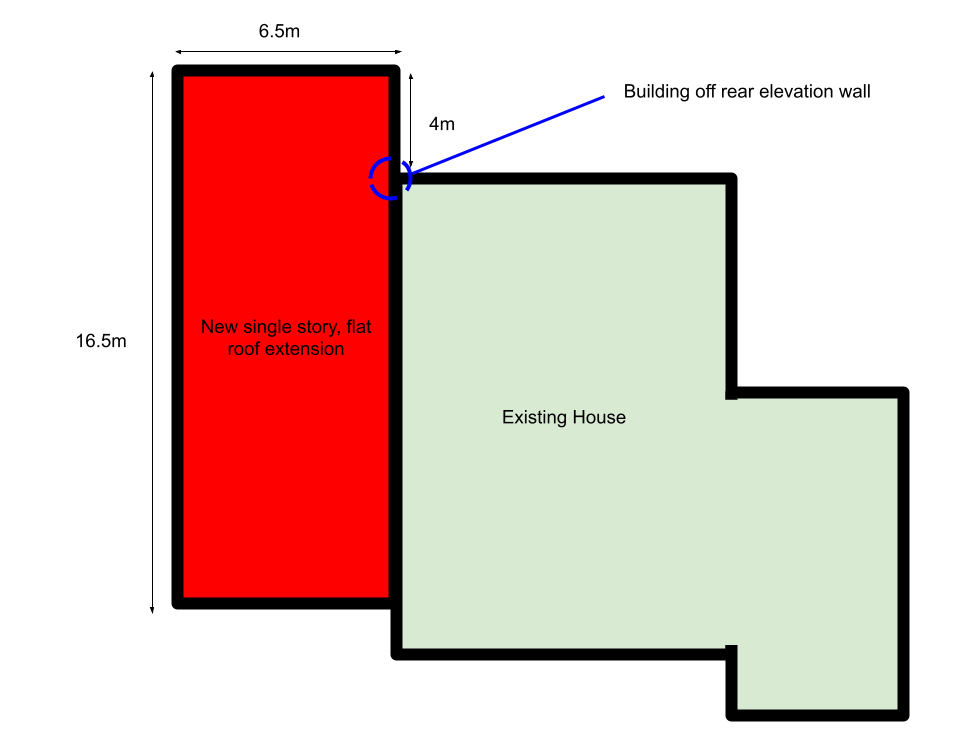
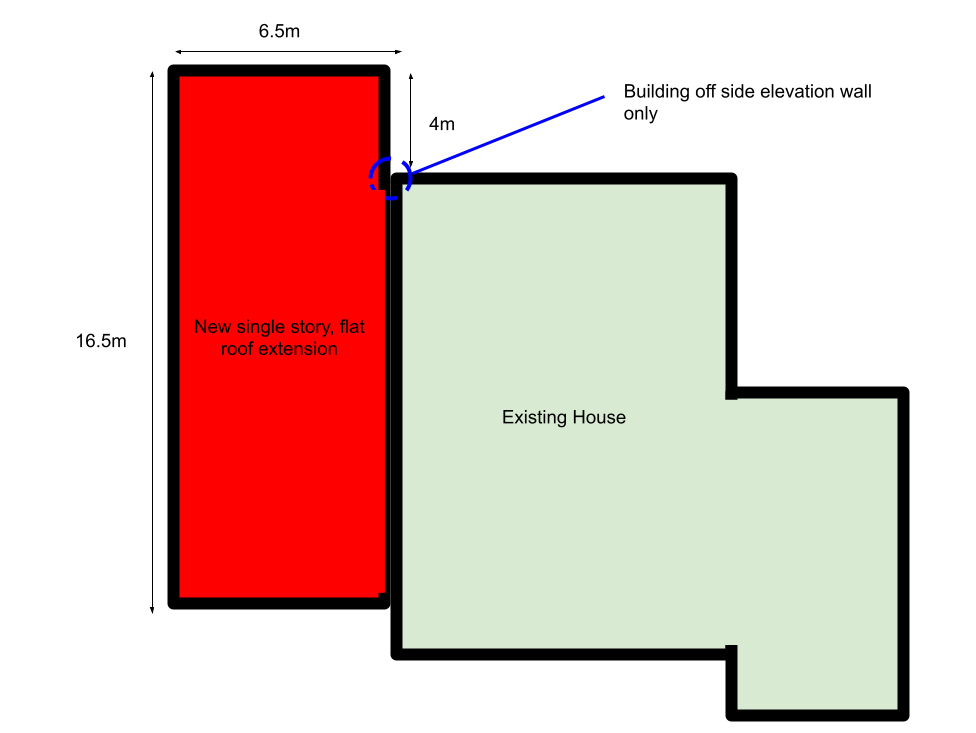
We are looking at what is possible under permitted development. As I understand you can build a side extension that projects past the rear elevation 4m without any prior approval, under permitted development. I understand that if you go more than 4m you need prior approval (shouldn't impact this question). Am currently unsure if building a side extension off the rear elevation (option 1 below) is permitted development, or does this trigger some form of 'wrap around' limitation? I am pretty sure that option 2 (where the extension only connects to the side wall) is definitely permitted - but is option 1 permitted under PD? Its technically a side and rear extension but wasn't sure if it needed to expressly not touch the rear elevation wall in order to be PD? @DevilDamo - I know you've commented on a similar one before on the forum, be interested for your take too.. Option 1 - building off rear elevation Option 2 - Only building off side elevation
-
Probably gone a bit off topic here, but my two cents was when I looked into this it did sound like MVHR and solid fuel stoves weren’t an ideal match and we therefore steered away from them for our build (although I am a sucker for a real fire). Be interested to hear how others with airtight houses, with MVHR run their wood burner?
-
I think ChatGPT is in itself a pretty good research tool as it can provide a balanced list of reasons. I would say that whilst I agree with the point from @ProDave on air drawn down the flue what ChatGPT is actually advocating is neutral pressure which makes sense. I can see an argument why slightly negative is not desirable to @ProDave’s point. However I can’t see many scenarios in which positive pressure (your argument) is desirable and I think this accords with what @JohnMo was stating.
-
ChatGPT disagrees: “When building an airtight house, it is generally recommended to maintain neutral or slightly negative air pressure in a room with a multi-fuel stove. Here’s why and what to consider: 1. Neutral or Slightly Negative Pressure Neutral pressure is ideal to prevent backdrafts (where exhaust gases flow back into the room) and ensure safe operation of the stove. Slightly negative pressure ensures that combustion gases from the stove are safely drawn up the chimney or vent. However, too much negative pressure can cause drafting issues or make it harder for the stove to operate properly. 2. Key Considerations Air Supply: A multi-fuel stove requires a dedicated supply of fresh air for combustion. In an airtight house, this is typically achieved by installing an external air intake directly connected to the stove. Ventilation System: If the house has a mechanical ventilation system (e.g., an HRV or ERV), ensure it is balanced to avoid creating excessive positive or negative pressure in the room. Chimney Design: The chimney should be properly designed to create a consistent draft, which helps with safe exhaust of combustion gases. Room Sealing: The room containing the stove should be sealed from other areas of the house to prevent pressure imbalances caused by other appliances or ventilation systems. 3. Avoid Positive Pressure Positive pressure in the room can cause combustion gases to leak into the house instead of exiting through the chimney, which poses safety risks, including carbon monoxide exposure. admission: I know nothing about this topic, just thought I’d ask ChatGPT. Its responses do make logical sense though. admission #2 ChatGPT could be wrong. It’s sources might even be this forum 😂
-
Not being overly pedantic but it does increase ventilation losses, all things being equal. It’s only ever adding to the ventilation, never taking away so how can it not increase ventilation losses? Obviously we design it in because we build an airtight house that therefore needs controlled ventilation. But if you have two identical houses with the same ACH50 score and one has MVHR and the other doesn’t, isn’t the one without MVHR more energy efficient? Only if airtight and using MVHr. Otherwise It certainly can be. If a house is well insulated and poorly ventilated, then ventilation can easily account for the majority of the heat loss.
-
Coldwells Passivhaus Turnkey Houses.
SBMS replied to TheMitchells's topic in New House & Self Build Design
Seems expensive. Davidson 170m2 on their self build price is around £1600 sqm for a shell. That doesn’t include groundworks either.. and, in my opinion, very bland layouts and designs. -
Completely agree @MikeSharp01 and this is exactly how I look at it from a design point of view - ie what is my ventilation and heat loss strategy. I think I was mentioning it from how I think the MCS installer might look at it, and from a fairly procedural view: whatever natural ventilation exists + mvhr ventilation = more heat loss. Of course it’s right that if you start out to minimise natural ventilation and control it with mvhr the overall heat loss will be much lower. Jeremys spreadsheet was great for this as I realised how much of a difference controlled, heat recovered ventilation makes. Tweaking his ACH figure and reducing the MVHR recovery to zero was a bit of a shock first time I tried it. It is by FAR the biggest contributor to heat loss and it surprises me that there’s a singular focus on fabric heat loss and tightening of u values when so much heat loss is through uncontrolled ventilation. it’s why I stopped with a 200mm cavity and beads because I really was in the realm of diminishing returns - better to spend money on airtightness and MVHR by far. And also that it’s a challenge to get the MCS installers to properly factor this in (especially when it’s pretty easy from a modelling perspective).
-
It does - if you think about it, @SteamyTeais right. There’s uncontrolled ventilation from air tightness. Then, no matter how airtight your house is, adding MVHR always ADDS more ventilation and therefore more heat loss. It can’t remove the heat loss from the uncontrolled ventilation so it necessarily always adds to heat loss. That being said, the idea is to be so airtight that we need mvhr to provide minimum ventilation, and that controlled ventilation is heat recovered so overall it’s efficient. But it does have to increase the heat loss somewhat.
-
Does sound like I’ll need to sit down and discuss with the installer what they would be prepared to accept.
-
Thanks @JamesPa this is useful. May I ask what values your installer agreed to regarding your ACH? Did they use a higher ACH but allow you to factor in MVHR? Or did they just allow you to adjust the ACH value to accommodate the heat recovery and if so, what value did they use?
-
Presumably this allows me to prove my natural/uncontrolled ventilation - but what about taking into account the MvHR controlled ventilation rate - and its heat recovery capability? Can MCS factor this in?
-
Thanks @SteamyTea. So is it fair to say the heat loss calculation done by the MSC supplier is horribly going to oversize the heatpump? I imagine that I can adjust the ACH figures for natural ventilation once I have a blower test done pre ordering. We’ll target 1ACH50 - Obviously at 0.05 ACH I would die, hence I will use MVHR to make sure we don’t asphyxiate. I’ll probably run the MVHR at, say 0.3 to 0.5 which will push the ventilation rate back up to the MCS’ ventilation rate. My question then is whether MCS heat loss allows them to accommodate the heat recovery capability of the MVHR?
-
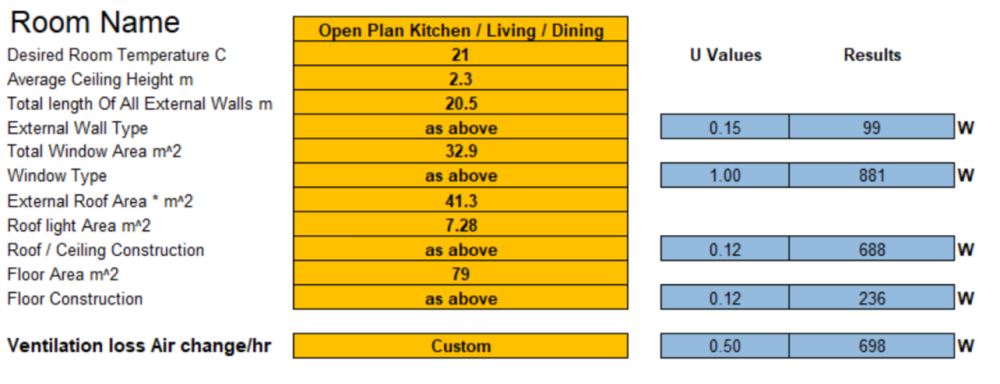
Surely only a tiny amount? If my house’s ACH50 is around 0.5, then the normalised infiltration rate I’ve seen used is 1/20 of this so 1/20 of the 698W is lost to ventilation. So the actual ACH is nowhere near 0.5 and the uncontrolled ventilation loss is around 35W. I then add my MVHR which, let’s say I run at ACH 0.5 but it’s recovering 96% of that heat loss. So yes it adds to the ventilation losses but only about 4% of that 698W figure (28W). so the actual losses to ventilation would be nearer 63W? Does this sound right?
-
I asked ChatGPT and it stated 695W so sounds like that part of the heat loss is correct? Am I right in assuming this drops to something like 28W with MVHR?
-
It is a small section in my example because two of the walls are internal (it’s a corner room). The maths still doesn’t make sense. I’ve asked the question but think the supplier has finished for Xmas so won’t get an answer before. I wonder if there is some sort of magic number for thermal bridging that increases the heat loss? Also - Does the ventilation heat loss look correct? The room is 181m3 and they’ve said the ACH to 0.5. I did mention that we are having MVHR but I don’t think the ventilation heat loss of 698w takes any heat recovery into account? How would I calculate the ventilation heat loss at 0.5ACH (without MVHR and then with MVHR at 96% efficiency - zehnder q600)?
-
Completely agree - this is what I'm trying to find out from the supplier as it doesn't seem to work.
-
I’ve done this already. The MCS calcs are miles out because they can’t account for MVHR. However I’m unclear what formula they are applying. I can make the heat loss work for the window but for the wall or floor I don’t arrive at the same value for heat loss…
-
We’ve had some heat loss calcs back from the ASHP supplier. I just wanted to check the maths. Given the following for the heat loss through a 1.0 Uw window: the window area is 32.9m2 and the resultant heat loss is 881w. Am I right in thinking therefore that this is calculating for an outside temperature of about -5.8 degrees (delta t of 26.7 degrees)? Not sure I understand the maths of the above regarding the heat loss through the wall/window and ceiling…
-
MVHR - one unit or two?
SBMS replied to SBMS's topic in Mechanical Ventilation with Heat Recovery (MVHR)
How come all MVHr designers size off the volume of the house, not the number of occupants? -
MVHR - one unit or two?
SBMS replied to SBMS's topic in Mechanical Ventilation with Heat Recovery (MVHR)
Thanks. Never really thought about from perspective of number of people in house. Family of four with 2 dogs so my gut is that although it’s a large house, something like the q600 would suffice. @JohnMo why did you go for two units out of interest (and how on earth did you get that for 2k!) -
MVHR - one unit or two?
SBMS replied to SBMS's topic in Mechanical Ventilation with Heat Recovery (MVHR)
What would you aim for? I did do my heat loss calcs targeting 0.3ACH as it was a ‘healthy minimum’. I suppose this reduced the need for a larger unit even more? -
MVHR - one unit or two?
SBMS replied to SBMS's topic in Mechanical Ventilation with Heat Recovery (MVHR)
So if the house volume was, say, 900m3 and I was aiming for 0.5ACH the unit would need to do 450m3? (Obviously would want to run it around 70% so probably would need 645m3?) when they do their sizing do they account for target ACH?