


SBMS
-
Posts
1075 -
Joined
-
Last visited
Everything posted by SBMS
-
Sorry @DevilDamo - I get that sequencing but wasn’t what I was asking. Say I am building a new house. It’s not yet wind and watertight, but I have an intention to add a rear extension under a PA application. When can that PA application be submitted? Do you have to wait till the house is finished? I know that you can only start the works under PD once the house is substantially complete, but can you put in a PA if the house is not?
-
So a property doesn't need to have actually been finished in order to submit the prior approval related to an extension under Permitted Development?
-
Out of interest, at what point can you apply for prior approval and LDC? We plan on adding an extension (under PD, but using prior approval as it is 8m at rear) to our self build once we are at wind and watertight stage. That is typically the stage our LPA accept PD rights become available. But can we put in the application for prior approval and the LDC prior to this? And then start work immediately once the building is substantially complete?
-
Which bits are contestable vs non contestable?
-
Plenty of green belt infill plots that have been refused around us. And upheld on appeal so I wouldn’t say it’s a given. Still open to interpretation as to the ‘facts on the ground’ as appeal inspectors like to call it.. is it an established frontage is often open to interpretation. Some authorities set a specific gap or plot size but this isn’t in the NPPF. Ours does not and typically only approves for single plot gaps. Anything larger doesn’t settle their test of ‘small gap in a continuously developed frontage’. Notable case in our area was dismissed by appeal inspector. He agreed with the council that it wasn’t infill because the gap was too wide, was more analogous to an agricultural field, even though it was between two properties. Settlement boundary is relevant when defining the actual extent of a village - as authorities will also look at where exactly your location is and whether the makeup of the surroundings constitutes making up the ‘village’. If your patch isn’t technically in a village then you can’t use this exception. Planning consultant first, if I was you, but keep the optimism 👍
-
It doesn’t sound like their reason for refusal was because there ‘wasn’t ever a building on the plot’ - which isn’t really a condition of infill anyway. If you can prove the settlement boundary extends to encompass your plot and there’s a clear gap then infill should be a reasonable scenario for planning. Did the council not address this in their response? Have you got the delegated report or link to application for us to look at?
-
Anyone else had cellulose and had problems with slumping... I assume its an installer issue rather than an inherent problem with cellulose in pitched roofs?
-
What problems out of interest?
-
If you could have had warmcel over foam would you have used that instead?
-
Have you got a contact for Gordon?
-
Was speaking to another installer that blows in Supafil Frame (https://knauf.com/en-GB/p/product/supafil-r-frame-21496_4206) - anybody used this in pitched roof?
-
@JohnMo - which foam did you use out of interest and what was your end U Value? Am happy to look at all options really, but have been very wary of foam for obvious reasons (mortgages being one)...
-
Metal web… I wouldn’t pick the easy option would I?! I’m going to speak to Steico today as they do a blown cellulose and a blown wood fibre product. I think their installer network is a bit more mature than warmcel…
-
So we have designed our roof using posi rafters. Originally our makeup was going to be from inside out… plasterboard battens propassiv 304mm blown cellulose 22mm Steico sarking counterbatten slates This Yielded 0.12 u value. We have really been struggling to get someone to do the warmcel blown insulation so I am now considering other options… I would rather not change out the posi rafers So I have 304mm Of rafters depth to work with. Could I just swap out the cellulose for 2 layers Of say 150mm mineral wool? Would I need batts or the roll? The warmcel was 0.038W/mk so I think a 0.035 or even 0.032 would give a better u value… does the above makeup support this or would I need to change it? Reason I went cellulose was to minimise issues with fitting which is the same reason I don’t want to go PIR..
-
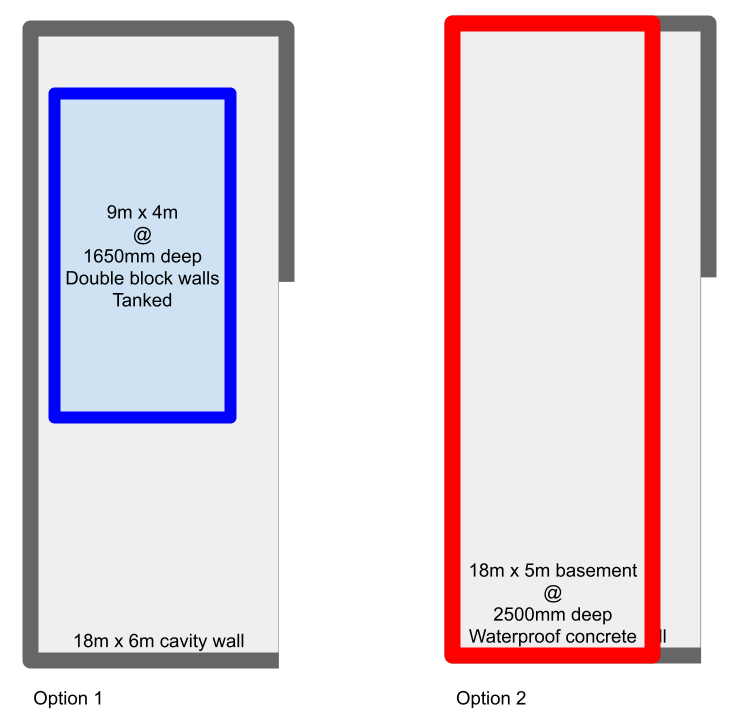
Thanks Nick - the 1650mm would be the height just for the sunken area for the pool! I would have to crawl into a room if it only had 1650mm ceilings. Option 2 would have ceiling heights of 2300mm for a cinema room.
-
Thanks @Nickfromwales. I was looking to see if anyone came back with "never use a cinema room, waste of money" - having never had one I worry about not using it, but it costing ££s to build it into a basement. I think I need to price up the difference tbh and then understand if its worth doing or not. This is the rough structural difference:
-
Is it in a basement?
-
We are in the middle of our self build and up to first lift. We are planning a side extension (always planned but had to come later due to planning restrictions). We are designing this to include a gym and indoor pool (a sunken swim spa actually, discussed on another post). My ambition is probably running away.. our builder suggested that as we are digging an 8x3m hole (at depth of 1.6m) for the pool, why not make the whole building a basement level and go 18mx4.5m (at depth of 2.5m)? This would give me space for a 6x4.5m basement cinema room… I’ve always wanted one but not sure if it’s the geek in me kitting it out rather than actually using it. Q1 - for those with a cinema room, was it worth it? Is it used sufficiently that you’d do it again? Q2 - I can predict the answer on here, would anyone recommend the additional cost and headache to dig out and down just to stick a cinema room down there?
-
Thanks @saveasteading I have been asking for past 6 months on here. It’s our second self build so learned a lot on the first one. Like bouncy floors because they werent designed to minimise deflection. Not best airtightness etc which in trying to remediate. Got the builder doing a Tony tray for example around the joists. Posi rafter roof with blown cellulose instead of attic trusses with PIR. Architect designed cold ventilated flat roof for a portion of the build. This forum had me switch out for a warm roof.. Learning a huge amount on here. There is definitely a lot that I don’t know!
-
Thanks both. Thought that’d be the case but wanted to check
-
Looking at specifying some of our floor posijoists to be 400mm to minimise deflection. However we need to use eger protect or caberdeck as floor will be exposed until watertight. Most flooring sheets are 2400x600mm. However does this work for 400mm spaced floor joists?
-
You can have a toilet/sink/water supply to an outbuilding. Only restriction is that it cannot be separate living accommodation (and even that is vague). nothing I have ever seen about combustible materials in PD… your building can be within 1m of boundary as long as it is under 2.5m at its highest point. building regs nothing to do with and not required for planning or PD. it sounds like you’ve built a fancy, but compliant, shed!
-
First question - is this not covered under permitted development? If not - simple indemnity policy in the event it’s even picked up at sale stage. £200 tops for a simple planning consent insurance. Probably less than the cost of an LDC.
-
Kitchen appliances..... decision options
SBMS replied to dan_cup's topic in Kitchen & Household Appliances
Why prefer Siemens @nod? We are looking at neff this time round (aeg last time, not impressed). -
biodiversity Net Gain Exemption and LPA conditions!
SBMS replied to Lincolnshire Ian's topic in Planning Permission
Have you seen this is any official policy, local plan or is it individual applications that are experiencing this?

