


Ferdinand
-
Posts
12213 -
Joined
-
Last visited
-
Days Won
41
Everything posted by Ferdinand
-
 A couple of potential impacts: 1 - I would see low end house prices in Bolsover drift up over time due to the reduced cost of running a house, which would lift certain zombie infill building plots into viability. ie Plot work cost + build cost becomes > potential sale price. ie Some plots become worth more than zero. 2 - Potential price reductions in London and similar? Needs more evaluation, and the London market is slightly chaotic at present. F
 -
Back on topic. I have been running some numbers on the proposals we discussed for replacing Council Tax and Stamp Duty with an annual tax of 0.48% on house value, and it is surprising in 2-3 respects: 1 - Significant benefit for less wealthy areas. In eg Bolsover virtually everyone will benefit. A household in a 80-100k trad terrace will be approx £1000 a year better off. In that sort of area the balance is between Council Tax and the new Tax, and Stamp Duty is nearly irrelevant for the huge majority. That is a 2-3% uplift in a typical household income. It becomes neutral at roughly the level of a 250k-300k house in that area. But above that no Stamp Duty becomes a bonus. 2 - In wealthier areas the balance at 300k-500k or so house level is between CT and the new Tax, with no Stamp Duty as a long term sweetener as the new tax exceeds current CT level. Even in London the median house price is 450k-ish, so a majority benefit. 3 - In really wealthy areas it alters. Take George Osborne's old house in Notting Hill, £4m ish, and the Annual Tax is 19k, but about 400k of Stamp Duty is taken out of the transaction on sale or purchase. Is that a loss? It is a really intriguing hybrid of a services tax and a wealth tax, and very well designed by the coalition. The website for the original proposers are here, and it includes a loss/gain calculator: https://fairershare.org.uk/ Their numbers are that 75% of households will save. To me this looks like potentially the first strategic shift towards the so called "levelling up" agenda, whilst so far we have had proposals for revectoring of Govt Expenditure. May write to my MP on this one.
-
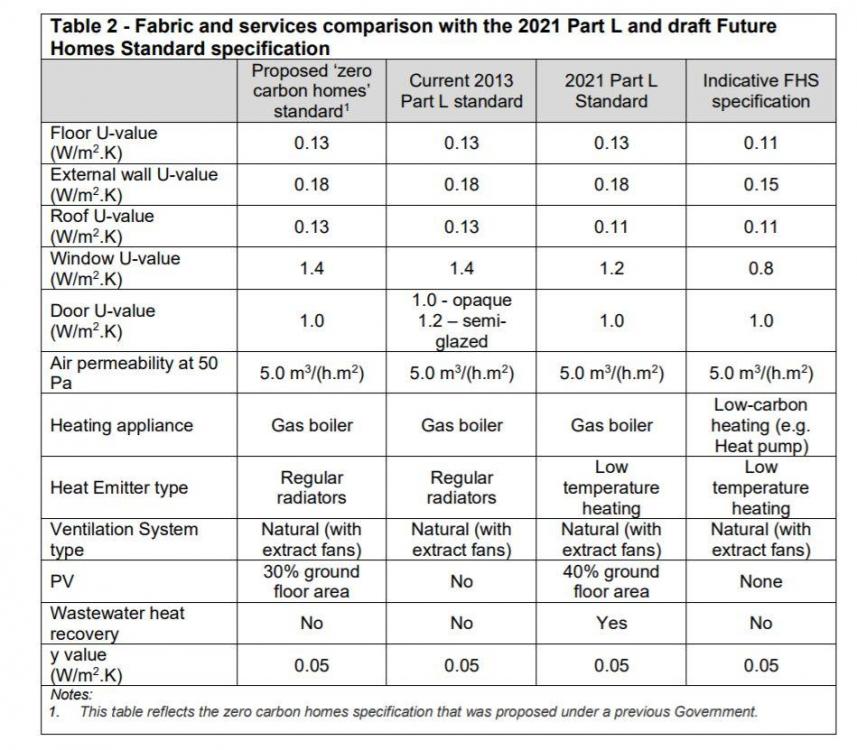
This is the comparison table with past and future regs @the_r_sole. Plus doc attached. Where do you think the extra cost is? Column 3 is the interim measures to come in soon. Column 4 is the FHS, which in connection with a decarbonised power supply is the route to Zero Carbon. I'm not really sure that I see huge extra cost in the interim, though some certainly, and I think that is by design. The big changes are the low temp heating (wonder if big rads count?), and the interesting tactical thing of Wastewater HR and is that compulsory PV (would affect estate layout?), which go away again (later put them back for a route to carbon positive?), and the gas boiler ban. To me the fabric changes are not *that* ambitious. I think that including the impact of zero carbon energy supply is probably correct, as that is likely to happen first given where we are at present. There's a contrast between the huge majority of responses demanding more, more, more, and the smaller number of people living in older houses who have not taken action themselves. I think the air permeability is not ambitious enough, and perhaps also a couple of others. 2021-Government_response_to_Future_Homes_Standard_consultation.pdf
-
er .... but perhaps not Kingspan or St Gobain ?. I think 0.15 is roughly what many of us build to. eg 0.15 is Brick Outer, 120mm Celotex or 225mm EPS, and Lightweight Block Inner. So not that demanding in BH context. There's a comparison table which I will post. I have not got my head around what standards will apply to extension. Will this be the same? The thicker of the two versions of Durisol, without extra internal insulation, is about 0.15 .
-
Agree with Tony's last comment - I have been whinging about this for some years in various places. ? My estimates are that theoretically "reasonably" well insulated homes are recent (what do we say - post 2000? or post 2010) only accumulate at about 1% of the stock per year (250k a year, 25 million stock, ish), and that each of these represents perhaps 20-50% (guestimate based on about 3 bands of EPC grading representing a halving of C02 emissions very roughly) of the emissions of an older one. I think a move from an E/F to a C is a halving of emissions roughly. There are various profiles you can do about how far various grades of stock are insulated and how much to get numbers. On this one we need to follow, Scotland and begin to think about applying the "rental EPC ratchet" (rentals likely required to be EPC C by 2030 unless a spanner is put in the works of the ratchet) to all Owner Occupied housing. That has worked in that in England rental housing is now better on the EPC scale than OO (English Housnig Survey 2 years ago) - albeit by not vey much. I think this will happen because it is the easiest way imo to hit the medium term extra C02-reduction target. And GHG is beginning to address the issue. Ferdinand
-
In the Hi Tech Telegraph you just switch Javascript off.
-
Are you sure insulation in the ground will keep it warm? Worth a heat modell?
-
Put in a Homer Simpson video by mistake. More seriously, perhaps find an outside authority to define what you need for PP. Maybe there is an instructional video somewhere. One source is to look at a few other PPs for individual houses on your Council website and see how extensive the document set isn't, and also perhaps how the design evolved. Somebody on here did a very few pages, with self-drawn hard copy plans.
-
And welcome.
-
If your architect is knowledgeable in Planning and engaged to get it through planning, I would perhaps back off and let them run it. So you hopefully swerve the whole domestic tussle. If that will work. Though a different floor height may affect windows which may affect planning. In general, planning are interested in stuff that affects other people rather than what colour your taps are. Relatively little internal affects other people, beyond things inside that define penetrations eg windows and flues etc, stuff that defines appearance etc. F
-
That looks ... quite posh. It will be fun when Buttercup visits.
-
Planning Amendment vs Full Planning Application
Ferdinand replied to harry_angel's topic in Planning Permission
Here you go for a description of Special Measures. It has only been applied to 3 LPAs - that is once every 10 years. You are quite special ? . ------------------------------------------------------------- https://www.designingbuildings.co.uk/wiki/Special_measures_designation_for_under-performing_planning_authorities Special measures designation for under-performing planning authorities Section 62A of the Town and Country Planning Act 1990 allows certain applications to be made directly to the Secretary of State for Communities and Local Government where a local planning authority has been 'designated'. The Growth and Infrastructure Act 2013 gave the Secretary of State power to 'designate' local planning authorities if their performance in handling major planning applications was below an acceptable standard. Under the original provisions of the Act, local planning authorities could be designated as under-performing and placed under 'special measures' by the Secretary of State if: 30% or fewer of their decisions on major applications were made within the statutory determination period or such extended period agreed in writing with the applicant. The statutory period is 13 weeks, unless an application is subject to Environmental Impact Assessment, in which case it is 16 weeks. A major application is an application for 10 homes or more, or the equivalent commercial floorspace. More than 20% of major applications decisions were overturned on appeal. Local planning authorities under special measures have applications determined by the planning inspectorate and lose a proportion of the application fee. Special measures designation is reviewed annually to allow improving authorities to regain their determination powers. However, on 28 November 2014, in response to a consultation on the criteria for identifying under-performing planning authorities, the Department for Communities and Local Government (DCLG) announced its intention to raise the threshold for decisions on major applications from 30% to 40%. Ref Planning performance and planning contributions. Then, on 24 August 2015, following publication of ‘Fixing the foundations’, the government formally revised the threshold again to 50 per cent. Ref Improving planning performance: criteria for designation. The government pointed out that up until that time, only three planning authorities had been subject to special measures and two of those had subsequently had their designation lifted. In November 2016, the government published Improving planning performance Criteria for designation (revised 2016) Presented to Parliament pursuant to section 62B of the Town and Country Planning Act 1990. This will increase the threshold for major projects to 60% and for non-major projects of 70%, but will also introduce a quality threshold of 10%. The quality threshold relates to the percentage of the total number of decisions made by the authority on applications that are then subsequently overturned at appeal. The criteria have effect from the day following the end of the statutory 40 day period during which Parliament may consider the measures, provided neither House resolves not to approve it. -
Planning Amendment vs Full Planning Application
Ferdinand replied to harry_angel's topic in Planning Permission
Government appointed supervision / management because the thing has gone to hell in a handcart. -
Planning Amendment vs Full Planning Application
Ferdinand replied to harry_angel's topic in Planning Permission
Every Appeal costs the Council money to pay for prep. -
Does it create a microclimate where you can grow something interesting? It will certainly keep moulds and bugs down via the airflow, and probably protect from frost. Why not try some container-plants. I suppose also it matters where it blows or sucks from, as potentially leaves could be sucked in.
-
Have a look at some on previous similar planning apps, until you are clear that you understand what is required (also compare the Planning Conditions). Then find yourself a pro to do it - I do not think you can do this one yourself. If i am wrong a n other will shout up. And welcome.
-
These have been very popular for a few years now. Half of it is dedicated to cleaning plants, and the rest for swimming, with some sort of divider. I always fancied the idea of having one with water running through it at less than the unlicensed limit of 20 cubic m per day, next to a local river. But that would be different. My dream would be a sandy bottom over a liner on the swimming half. Budgets for a built-for-you one are substantially more than an outdoor swimming pool. Get a HaHa with a liner. F
-
I was going to lower the tone there but I'll just give you another Partridge-esque shrug. Perhaps a wrong call on tor part imo. I think COVID will have a significant effect on all of this. Not perhaps in my area ... here prices are low enough that the market has always been functional, even for eg minimum wage couples. Here trad 2 bed terraces are available at around 70-75k or 60k for a doer upper. You can get a new 2 bed semi on a new estate for under 140k. That is the same in cash terms as the peak of 2003/4 when they previously doubled in 18 months in the Blair property boom, and then drifted back down by nearly half. It took 15 years to recover. But imo there will be a change in London. I monitor a small no of developments for rents and prices, and even the desirable have *far* more availability than usual. Many Central London asking rents are 5-25% down, after several years of static or down-ward drift before that. Add in that it is reported to be 300k down in population, plus COVID fleeing work-from-homers. And that will imo may well take down quite a few of the highly leveraged zombie LL businesses, who have been under the cosh since 2015. I'm expecting a lot of letting-sized flats going through auctions in the next 2 years. There will be some investment from LLs, but investment plummeted after the various Osborne taxes. The upshot will be more availability, and perhaps lower prices for a catchup period. Given that there are particular segments of the population that have fared better financially during COVID - yes some service pros, but also public sector working every hour God sends. I think that some of those will be buying in some parts of London and other places. Maybe not a sea change, but a change. F
-
Oh, and go in and read through *all* the file. Take an iPad for notes, and subtle pictures though not allowed. Something like a Photoshop or Pintshop Pro can pull out the distortion via a stretch tool.
-
I would go and talk to people with the other garages to see if anyone has had thee Council going beserk before. It might also be a good Q for Planning Aid (run by RICS) to see if they can advise you on the legal principle of enforcing a condition 50 years later when there are extant breaches, and when the original planning docs used appear to be the non-approved plan (if that is the case). You have to ascertain your facts yourself, then ask a general Q about the planning principles. Find them via google. I would consult your Planning Solicitor or member of the Royal Town Planning Institute (MRTPI) about arguing that the condition is no longer enforcible. If it were a covenant not a condition then you would I think not have much trouble with it, as breaches of the same covenant close by undermine its enforcibility. I do not knows the ins and outs, or how the "requirements" apply to old planning conditions that are breached elsewhere: "planning conditions should only be imposed where they are: (i) necessary (ii) relevant to planning and (iii) to the development to be permitted (iv) enforceable (v) precise and (vi) reasonable in all other respects;" iv, v, and vi look questionable here, to me. But it is obscure, so you need an expert to worry them - and ultimately that is an MRTPI. Ferdinand
-
The Self-Build-But strikes again: this time lights switches,
Ferdinand replied to ToughButterCup's topic in Lighting
Wait until COVID is over then take a torch down your local nightclub. (Can't see it with 2 black eyes, mind). For a serious solution, consider either trad Dymo Tape (which does come in at least 5 colours of Flourescent) https://www.amazon.co.uk/Compatible-FLUORESCENT-Embossing-Label-Maker/dp/B01M22VXXG or the stuff the RNIB call "Liquid Plastic", which goes on as a liquid and then sets (in Orange and Black) (*) https://shop.rnib.org.uk/rnib-tacti-mark-tactile-labelling or you could even use the sort of "nipples" I put at the right spot on the back of a cupboard door to stop it hitting something, or on the wall where the handle with hit. El-cheapo from Amazon. or if it is temporarily to see them, get a head torch F (*) Comes with large print instructions in case you take a few years to get round to it. -
I think there are still places which are below their 2003-7 levels, in cash terms ... never mind inflation. I would look for success to be that prices rise broadly in line with somewhere between inflation and wage inflation.
-
Running a few numbers on mine. For my personal property it would be virtually neutral. For a rental at say 100k value, Council Tax could be £1000 very ish, and the new one would be £480. I think my Ts would agree to such a change in rent, as it is a split of benefit and that is a principle I often use. One fly in the ointment is if they tried to do the Osborne "business expenses are part of taxed income" thing, which would make it more difficult.
-
OTOH might it encourage an adjustment through moves and different supply/demand balance? London rents are substantially down after COVID - like 5-20% down, and have been softer than everywhere else for several years. No idea how it will go.
-
Hmmm. Another benefit of Stamp Duty going would be to reduce savings required by first time buyers. F



