Ferdinand
-
Posts
12183 -
Joined
-
Last visited
-
Days Won
41
Everything posted by Ferdinand
-

How to do a Maintainable Insulated Floor?
Ferdinand replied to Ferdinand's topic in Floor Structures
(Bump). Comments would be welcome on this one. Ferdinand -
Of course, an appropriately sized garage usually counts as a space, even today. F
-
Just like self-build: "You are here to stay until the rattle in your dying throat relieves you!" And there's even an H&S lesson at the end.
-
Your Local Planning Authority may well have a policy and a Guidance document. Look on their website or phone up planning and ask for a steer as to their parking and turning requirements. For background you want a document called the Manual for Streets, which is available online, I think that is the latest, and reading through will give you much background about layout etc. Ferdinand
-
Liability on a neighbour's land
Ferdinand replied to LeanTwo's topic in Party Wall & Property Legal Issues
i am not sure that 'up to the boundary' activates the PWA, unless you also meet one of the conditions for depth of foundations etc. The Govt imnformation seems to be worded differently from the RICS information on this. THey seem to say it applies to walls 'astride' the boundary. http://www.rics.org/Global/RICS-consumer-guide-Party-Walls.pdf And voluntarily using the PWA may not be valid legally, and does sound slightly bureaucratically masochistic ! Open to correction, however. F -
Hi again @marsaday I do not think that anyone here will give you specific comments on question 1, 3, 4. There are too many variables (soil conditions, neighbour foundation condition etc), and it would need a site visit by a qualified professional. I will comment on 2 that I personally cannot see a reason for such a membrane. And that I personally agree with your interpretation of the PWA, but note that appointing a Surveyor who is qualified for PWA may be a good way to keep your neighbour happy by professional confirmation that the PWA does not apply, and to get an authoritative opinion on your Qs for a relatively small sum as part of the bundle. Perhaps you may get more by chatting to your BCO, and then confirming your chat in writing as a preserved record. Ferdinand
-
Liability on a neighbour's land
Ferdinand replied to LeanTwo's topic in Party Wall & Property Legal Issues
I do not see how your neighbour would be found liable for things that *you* or *your agents* have done, without a very good reason. The Occupiers Liabilty one that I think about is if eg I had an exposed septic tank (once had some b*gger drop the square lid into the tank - which is why I like round manhole covers) or mini cliff hidden by bushes, and somebody fell off it by mistake. I guess if they trip over an unidentified rockery or fall onto a fencepost that might qualify. The OL Acts circumscribe liability based on circumstances, which may be worth a skim if you feel the need. F -
Liability on a neighbour's land
Ferdinand replied to LeanTwo's topic in Party Wall & Property Legal Issues
(Note: this is opinion not advice. I may be anal sometimes but IANAL.) This is a tricky one, as much for the relationship as for the law. This is my longish analysis trying to be relevant to projects of all sizes for future visitors. Agree with @RichS above on yours - this is probably not a hill of beans. I was going to try and summarise the principles, but it is difficult without reading the Occupiers Liability Acts from both 1957 and 1984 and writing an essay about Common and Statute Law. To understand Duty of Care read those 2 acts or a summary thereof. Wikipedia will probably be a place to self-educate quickly, as it is established law so not very controversial. With the husk off, this is how I see it: 1 - Should you go "formal", you are in a very weak position to negotiate. At the end of the day, this is a favour by permission only, and he can have you over a barrel holding a horse-whip whenever he wants. You need your neighbour to allow your scaffolding or your workers on his land. He can tell you to take a running jump with no cost to himself except a potentially ugly wall built overhand and the loss of whatever rent you will be paying him for scaffolding if you are using it (£25-£100 a week perhaps?). 2 - Legally you can enforce access to maintain existing structures in the end with a Court Order under the Access to Neighbouring Lands Act. That does not cover new developments or structures. 3 - From his viewpoint, if a bloke wanting scaffolding or workers on my land - with or without a rent - started talking about his need to preserve the right to take legal action against me if one of his builders did something stupid and broke his neck, trust would evaporate completely and I would quite possibly simply not allow you to do it. Ever. 4 - I trust you are aware that Planning Permission does not overrule any of your neighbour's legal rights; it gives you permission to build something provided no one else has a legal right to stop it that they choose to enforce. A favourite phrase by Planners is "not a material planning consideration", which translates to "this is your problem or opportunity and we will not get involved". So how to proceed? 1 - Your need is a) to convince / satisfy your neighbour and then b) to make sure your workers are safe. Proving b is perhaps the best route to satisfying a. 2 - Throwing the document back in his face, or a blunt refusal to consider it is not a possibility imo. One option is to sign it and rely on the rareness of landowners being sued after construction accidents to third parties using their land by permission (I wouldn't be surprised if the actual occurrence is a couple of cases in 25 years), plus the professionalism of your builders. 3 - I would consider several steps: a - Identify what the neighbour is actually worried about (and probably have my answer available before any conversation as a good tactic). b - Talk to your builders. Look at the Public Liability and Employee Liability insurance of your builders. These are I think a legal requirement. And look at their policies to see how this meets the concerns of your neighbour. c - Do you need / have your own liabiliy insurance for the project? What does that say. d - Do a specific risk assessment relating to your work on his land, and specifically the risks relating to his liability concerns. Perhaps consult with your advisers / builders / local authority on that, or look for resources online. Your builders or architect may have run up against this in the past, or there could be one attached to a previous PP that you can find. Manage those risks - eg fence off the area you are working in etc. e - You may be able to get specific insurance if you need, but that could be compromised if you give him an agreement. It very much also depends on the project being done and the relevant risks. So cut your cloth to fit etc. It is easy to overanalyse these things and over elaborate your measures. 99 times from 100 this is probably not mentioned, and 999 from a 1000 there is probably no issue when it is. If you do damage their property, then unless you have dug a 5m deep hole where their house used to be and filled it with asbestos, just getting your builders to fix it to their satisfaction, or you or your insurance company paying for their builders to do the same, will be many times cheaper for both than Court Action. People just usually want their lives back rather than spend 5 years making you suffer. Ferdinand -
Rock, Rock and more Rock
Ferdinand replied to Barney12's topic in General Self Build & DIY Discussion
Seriously, is it worth a look at selling those rocks? A bulk bag of rockery stone costs £100 or so, and it would save you X loads at £200 (?) each. It needs the right contact - eg local garden centre attached to a farm, but could be quite a saving. Turning waste into a product is a good strategy. Or will you (or your neighbours) need some to keep cars off the verge? Ferdinand -
One other point on distances - I take it that you have ascertained the distance you can go back under Permitted Development, including that to go beyond the 4m backwards to the 8m relaxation there are certain things you need to have done. My thought is that it relates to the original wall of your dwelling, rather than to the SS extension already existing. https://www.planningportal.co.uk/info/200130/common_projects/17/extensions An informed and engaged neighbour is a very good way to encourage us to follow the rules :-) . When i feel slightly hit over the head with a planning requirement, perhaps by a Krummelkacker, I try to think of it as helping me (the elephant) avoid the elephant traps before I fall into one, which is usually the cheaper option. Best of luck with your extension. Ferdinand
-
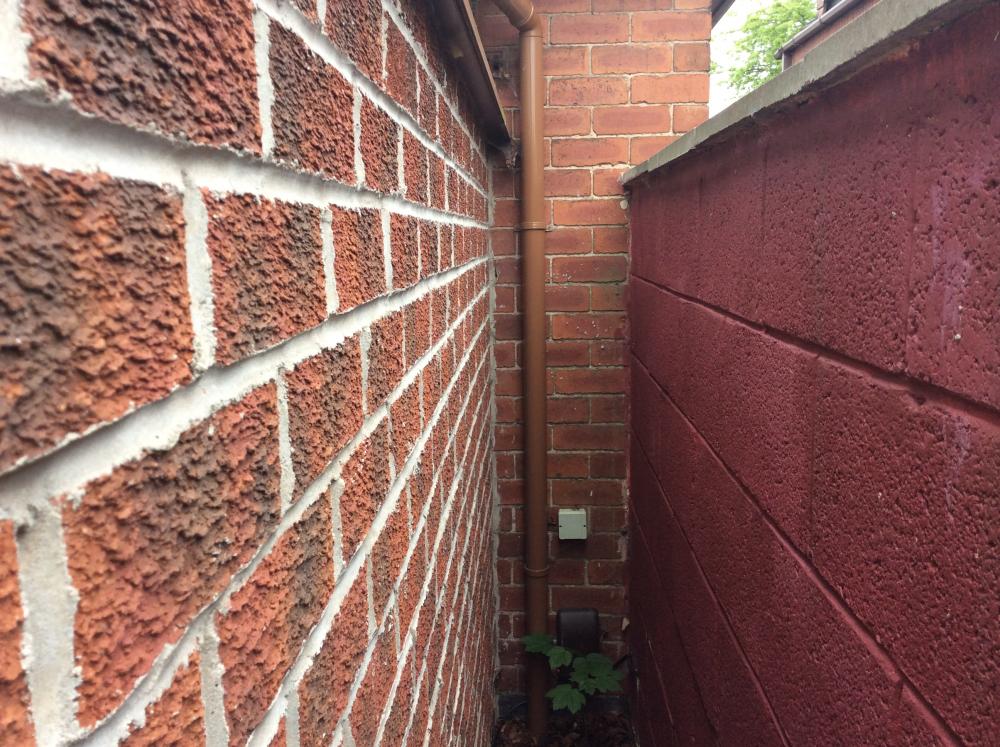
On your first point I think this is a question for you and your bricklaying skills. Perhaps build something like a BBQ or garden seat from brick close to a fence (or put a temporary fence up 450mm behind where you are building it) to see how much space you need? The other point on yours assuming the photo is the right way round is that you will be working left-handed, which may be more difficult. Mine .. pic later .. is actually just under 400mm between the (done by a conservatory company) conservatory 1.5m wall and the boundary wall, and I wish I had a little more width. You can see that the brickwork is OK if not perfect. But if I become like Friar Tuck I can see problems later. I applaud your descision to do 100mm celotex .. that was something I had done in the walls and floor of our conservatory over the standard 50mm and It makes a huge difference. F
-
Welcome to the forum and thank you for such a clear explanation. I will leave others to comment on the PWA aspect, but I question that 200mm gap you are suggesting. That seems to me to be the wrong width because it is not easily maintainable: 1 - ISTM that there is not space for you or your builders to build it tidily (bloke plus trowel and room to work is more than 200mm). For such a narrow gap you or your builders will be working overhand (ie from the inside) which will make your new wall a probable mess. 2 - Once it is built it will be impossible to maintain your wall and the ground in the gap. eg What will you do when it fills up with autumn leaves which bridge the damp proof course, or should building work ever be required down there,or if a child gets stuck, or if you or your neighbour get rats and the ratman needs access? My suggestion is that the gap should either be zero, or at least 450mm (= 18 inches), which is just wide enough to get in to sweep out etc. 600mm seems to me to be more sensible, as you can then do something with it such as ladder storage etc. The only exception I would make would be where your gap is short enough that you can reach down it with your arm plus a sweeping brush, rake etc. and reach the end. I would suggest reducing the width of the extension by 300mm to make the gap wider. You can recover much of any lost inside space by using a thinner design of wall ... eg by using Celotex rather than Rockwool insulation. Alternatively talk to your neighbour about butting right up - even if you are not needing the PWA it is good to talk unless there is a good reason not to do so. Ferdinand
-
Obviously do not cut corners on asbestos unless you are a professional yourself. My dad was killed by asbestos from (we think) being a supervisory architect on a short 6 week project 40 years earlier.
-
No one seems to want to say how thick it is. What do they use in forklift warehouses?
-
@Weebles Re the gas, do you mean 'cap' or 'disconnect' ? If you mean cap so you can strip the gas appliances and pipes to weigh in for cash, then any gas man will do it at the meter in1 minute. If you mean disconnect at the road then you are into your provider or network operator as discussed above. Ferdinand
-
Great news @RichS It would be useful to know the key points that convinced them, if you could post a summary. Ferdinand
-
@vivienz No problem :-). Bat welfare comes above your desire to build your house in the hierarchy of priorities, so you either a) Cater for them or b) Show that they have gone and will not be back. On this thread about build costs @Barney12 explains about his bat related expenses, which is perhaps a worst case. If you want some amusement, this hyperbolic Telegraph column by Nicholas Coleridge is nicely written. There are horror stories, but I am sure that in the large majority of cases it is all more or less OK. F
-
This is for the Little Brown Bungalow project, but may be more useful here in future for reference. The current floor buildup is, from the bottom: Concrete raft. 300mm or so ventilated void. Suspended wooden floor. Underlay + carpet or similar. The void contains some water and gas pipework. The question how to maintain this access in future. I am planning a 'floating' floor ... though not completely floating. The intended buildup is something like: Concrete raft. Ventilated void. Insulation between joists - 100-200mm rockwool. Suspended wooden floor. Vapour / air membrane 50mm Kingspan between battens. It is from Seconds and Co so the battens are to be safe. 18mm OSB, screwed down to battens. Underlay. Click fit laminate or carpet, depending on room. The question is how to do the floor so that I can get at the gas / water piping if necessary. I am able to adjust the buildup if necessary to a degree. I could potentially leave the battens out altogether or not screw them or the OSB down depending on the Kingspan which I will find out when it arrives, and insert a separation membrane to ease movement. Any comments are most welcome. Cheers Ferdinand
-
Products such as Celotex CF5000 allow this with pir, but Foil Faced EPS seems very rare. https://www.celotex.co.uk/products/cf5000 Ferdinand
- 29 replies
-
- 1
-

-
- u value
- insulation
- (and 1 more)
-
If you look on eg Money Super Market Self Build or similar, there seem to be a surprising number of banks and Building Societies that deal direct. Worth a look? As for a broker, I would suggest asking the most experienced and qualified (MRICS?) staff member at your local independent self-owned estate agent for 3 recommendations, which was how I found mine a few years ago. You will pay about £500-£700 for going via a broker (subject to London Area higher prices). Based on your other conversations, I would suggest cultivating that relationship over time. If your project goes ahead you will be sitting facing your good architect and your main contractor dealing with a nearly £1m project, and a half-created relationship with a local expert from outside your project bubble who knows your Council and their policies and staff inside out will be an invaluable standby. If you only have a bit of work from them ("please spend a couple of hours looking at my plans before I commit" or similar at a key point where you have been asked for feedback) for a couple of hundred on a couple of occasions, a good tip or leading question could save you thousands or tens of thousands. IMO one hole in your setup may be a knowledgeable local informal 'mentor'. Ferdinand
-
Discount Offers of the Week
Ferdinand replied to Ferdinand's topic in General Self Build & DIY Discussion
Travis Perkins De Walt Drill / Driver clearance. Here De Walt have a good 18V hammer drill driver and 2x1.5Ah X-RAY batteries for £120 inc VAT. This is the model which has been my mainstay since 2013. I paid £150 in a Screwfix Sale, and has been excellent. https://www.travisperkins.co.uk/DeWalt-DCD785C2-18V-Xr-Li-ion-Compact-Hammer-Drill-Driver/p/550474 Ferdinand -
@vivienz My comments / suggestions. Not formal advice. Ecology Report + Planning Conditions I think reading the existing ecology report will give you a grounding in bat issues if you read it cover to cover, as there is likely to be 50% boilerplate basics included which is the same for every report. You also *must* be familiar with related Planning Conditions. The report will contain: 1 - An assessment of your site. 2 - Recommendations as to what you should do. 3 - Probably an expiry date beyond which the report is out date. Technically that means that you need a new report or the Ecologist or Bat Man to give you written evidence that it continues to be valid, which would require a further payment. It is often routine Councils to not notice such dates in subparagraph X.I.1.a (iii), so you may dodge that one if you keep quiet. The Council Planning Permission will have a Planning Condition telling you what you are required to do, which typically would call out to the report. If the Condition is different to the report or only mentions parts of it, you should take note of the Planning Condition on the Planning Notice. Demolishing under Existing Planning Permission You need to understand your bats and trees and all the other reports before you decide that. For bats: To work out what you do under the existing PP, you need to talk to the relevant Council person (Planner / Naturaiist / Conservation Officer etc - find out who), and probably the Ecologist advising you,and ask them. You may get lucky as pointed out above - or not. If you work with the existing PP, make sure that your new Planning Application is consistent with what you do. And check with your Planning Officer, Council Nature person, and your Ecologist / Bat Man to make sure you are OK. Your new Planning App will need to relate to the situation you have now created by doing work, and of course they could set different Planning Conditions. I have never expored Council attitudes to doing half of one PP, then then second half of another one. It feels a bit "Here Be Dragons". When you are are actually doing work with bats you will need a Licensed person to supervise / carry out the work. You may also need a specific License for the item of work from English Nature. Again, you need advice from your qualified adviser, who may organise it for you. Intellectual Property One other thing you need to know is whether you can use the Intellectual Property in the reports relating to the existing Planning Permission in the new Application. If you do not have permission, then you will either need entirely new reports, or to pay the authors for the right to use them. You may get away with the Council by eg just mentioning the previous report in the Design and Access Statement, or you may not, and you may receive expensive demands from irate Consultants. I am interested in others' experience here; I have never tried it. If you have permission, it will be recorded in the documents around the sale of the plot. The best scenario is when these reports have been "Assigned" to you, which means that you have become the Client for those reports and benefit from eg the Liability Insurance of the author. Alternatively you may have just been granted the right to use the reports, or not have the right. Hopefully the person who sold you the plot included a clause giving that right to their purchaser in their original contracts with their consultants, which was then written into your contract with yoru vendor. What did you (or your solicitor) negotiate when you bought the plot? My suggestion is that if you find you need a Licensed Bat Man, or new reports, then talk to the same person who wrote the first report - you will save as they already know the site. You may get free reuse of the existing report as a perk. Ferdinand
-
This is a passive slab, to be more exact @JSHarris' passive slab (sequence of photos). It is a concrete raft foundation (= less deep digging) incorporating about a foot of insulation such that, when combined with similar walls and roof, your heating bills are approximately zero. It is a shallow hole over the whole house footprint filled with hardcore and blinded (smooth layer on top to be less nobbly) with sand, and insulated under the concrete pour, perhaps with ufh and other bits and bobs poking out (soil pipes etc). Then the house is built on the layer of insulation usually as timber frame, with cladding. In the pic, all the black polythene round the edge is covering special insulation blocks that meet the insulation in the walls. A number of people here have used this (which is from a company called MBC) or similar systems.
-
There was a good education on how not to do self-build on Homes under the Hammer this morning. It is the first example in this programme, and about 20 minutes in for the outcome. http://www.bbc.co.uk/programmes/b08ny6bx My favourite: 'I photographed all the noggins, and then deleted all the photos. Then when my plumber asked where my noggins were, they were harder to find." And a lot more. To be fair, they just about broke even ignoring their own time, and plan another one.
-
Will pm you.