Ferdinand
-
Posts
12213 -
Joined
-
Last visited
-
Days Won
41
Everything posted by Ferdinand
-

Meeting expectations in the bedroom
Ferdinand replied to Crofter's topic in General Self Build & DIY Discussion
At Sandbanks they have installed a pubic dog-washing machine to keep sand out of the Bentleys. http://www.bournemouthecho.co.uk/news/14385922.Dog_owners__joy_at_new_dog_washing_machine_in_Sandbanks/ What about one of those :-) -
Meeting expectations in the bedroom
Ferdinand replied to Crofter's topic in General Self Build & DIY Discussion
Imo probably a safe assumption usually for 2-3 days; not for 5-7 days. Have you checked with a personage of the female, gay, southern, bicyclist, horseriding, retired, American, or parental genders? Yes, stereotypes, but they always have a grain of truth in them. Ask me and I need storage for a comb, a toothbrush, a cocktail shaker, and a coffee machine; ask my sister ... I think secure equipment storage matters - climbers or surfers or bikers or hikers or fishermen sometimes come with a lot of junk. eg Where can they store a tandem? Strange requirement but 4 couples on tandems once a year is a month of business. Fold up "X" section suitcase racks are very good. Is there an argument for having eg some child stuff that you put in when they are parents? eg board games, toys, playpen, Wendy House, Shaun the Sheep, leg-irons, crocodiles etc. Depends on how your market pans out or when regulars start having kids. I think you are likely to want to review after a year or two as you identify your market and have caught your regular guests. That could the time to consider eg the child kit. It will also depend on your chosen routes to promotion ... if you list in something like Cyclists Welcome with the CTC (now British Cycling) then particular facilities will help (secure bike storage, but also a mass USB battery recharging facility). On washing and drying, one way is a sealable shower with an extractor fan, which also lets them wash wetsuits 'n' spraydecks etc. Or an outside tap plus a shower head. My landlord used to take a nud shower in the yard everyday after he had been for a swim in the Hampstead Heath Bathing Pond and a jog back; there is a lot to be said for it (the outside shower head). And do you know an experienced Holiday Accommodation owner who could spend half an hour looking at it and advising you? Or do the Highland Tourist people offer advice or guidance docs? They do in Derbyshire. I am sure it will be great. Ferdinand -
Rock, Rock and more Rock
Ferdinand replied to Barney12's topic in General Self Build & DIY Discussion
Are you sure that isn't a new harbour? (Or, as my niece put it when she was about 6: "We're 'avin' an 'arbour in the back garden." (*)) F (* In 'ucknall, Annesley and 'arby 'aitches 'ardly 'ever 'appen.) -
You could view it on your phone or iPAD and Google Chrome to the TV using the Google Dongle. Worra Lorra Options. F
-
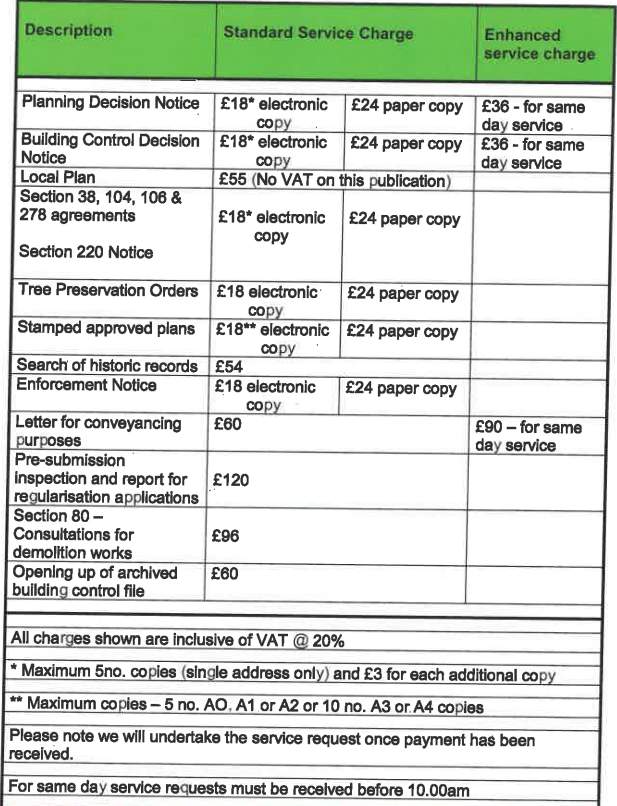
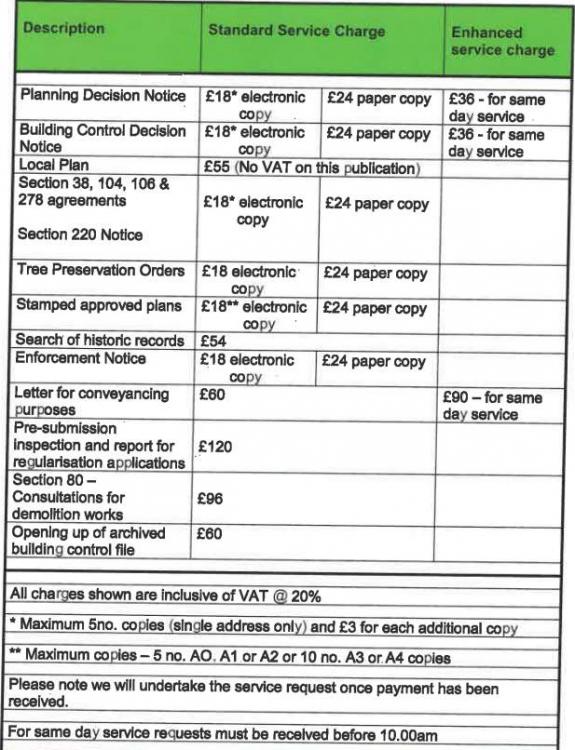
My Council has just introduced a policy of "discretionary charges" (*) for obtaining copies of Planning and Building Control Documents. Does anyone have any comparative examples, or any other comments as to legality etc? I need to try one or two methods that have been free previously, and see what happens with all the records available by online searches - since my Council has added oodles of historic and building control information docs, as I have posted previously. I can now eg do most of the Local Searches on the website. I've slugged this post in Google for now to avoid too many casual inquisitive eyes. That looks rather expensive if you need a lot of stuff. (*) Discretion presumably means they have the discretion to charge me (under the General Power of Competence?), and there is nothing I can do about it . Rather after "eligible" in "you are eligible to pay this fee / receive this Parking Ticket" etc.
-
Take care that it can view the feed you want to see. I have a Smart TV and it is quite limited e.g. I cannot view internet video on the TV. And typing in addresses is a little awkward. Ferdinand
-
For properties bought to renovate, it is sometimes full cover for 2 months which then drops back to fir / theft until a tenant is in occupation, as another example. Ferdinand
-
Quality of Wickes 60% off Laminate Floor?
Ferdinand replied to Ferdinand's topic in Wood & Laminate Flooring
I normally put double or commercial quality underlay when I *have* done laminate, going back. Back in 2000 my dad did about 750 sqft in a bungalow a bought a huge roll of hundreds of metres of the underlay that lasted years and years. Getting into say £20 + underlay per sqm activates a Landlord Dilemma, in that it then becomes equivalent to a decent underlay and about 3 lots of reasonable carpet :-) . Because of depreciation rules under Deposit Schemes, the value of carpets and perhaps floating floors depreciates to zero quite quickly ==> not going for top quality items as damage cannot be reclaimed. Food for thought. Cheers all. Ferdinand -
Quality of Wickes 60% off Laminate Floor?
Ferdinand replied to Ferdinand's topic in Wood & Laminate Flooring
Glad it worked for you. I would think @Onoff may have drink taken trying to generate enough empty cans for his solar system . That would be wind as in Three Sheets To The... -
Quality of Wickes 60% off Laminate Floor?
Ferdinand replied to Ferdinand's topic in Wood & Laminate Flooring
Can you link me a good click fit one, which is what I really need? The alternative is that I buy enough spare so that I can lift and replace a portion if necessary .. over a water leak for example. Cheers F -
Quality of Wickes 60% off Laminate Floor?
Ferdinand replied to Ferdinand's topic in Wood & Laminate Flooring
Asking around, the thing most people regret with laminate and similar flooring is not buying the expensive enough product. There seem eek to be the good ones then the rest, and it us more divided into two tiers on the click-fit submarket, and the division is whether it can relifted and relaid practically. Which is why I need a good one at about 65% off normal retail price, but can be quite flexible on colour etc. -
Quality of Wickes 60% off Laminate Floor?
Ferdinand replied to Ferdinand's topic in Wood & Laminate Flooring
Suspect that there is a difference between the £7.99 per Sqm and £47.99 per San ptoduct, even for a shed own brand. Or was it the posh stuff? -
Quality of Wickes 60% off Laminate Floor?
Ferdinand replied to Ferdinand's topic in Wood & Laminate Flooring
Could you give some steers, please, @PeterW ? I am somewhat at sea in this area; I have only done this twice recently - once Uniclic laminate came free with a nearly new castoff Jessop's kitchen, and the other time the T did the final decor. So I never actually had to buy any ! And the advertising is worse than secondhand cars. Ferdinand -
Quality of Wickes 60% off Laminate Floor?
Ferdinand replied to Ferdinand's topic in Wood & Laminate Flooring
Hmmm. Beginning to think that branded is the way to go here, even with the extra outlay. Probably QuickStep or Pergo for me, since both use the Uniclic system. There is a lot of online squatter advertisers using QuickStep as a keyword for their different systems. So, it is AC4 or AC5 grade, with Uniclic. -
How to do a Maintainable Insulated Floor?
Ferdinand replied to Ferdinand's topic in Floor Structures
It is a bungalow, and I could probably put the boiler within a few feet of the meter box (kitchen cupboard perhaps, or in the hallway). Thanks for the comment. Until I have the gas man in for a quote, I am not sure about the compromise which will be imposed on a small kitchen by modern boiler access space requirements. -
This weekend Wickes have a whole selection of Laminate Floor Products at about 60% off - that is £25-40 per sqm down to about £10-15,, which can then be salami-sliced by a few more percent. There are also a couple of £15 or so versions down to nearly £5 per sqm. http://www.wickes.co.uk/Products/Flooring/Laminate-Flooring/c/1000887 eg as well as their own such as Wickes Aspiran Oak Laminate Flooring at £7.99 per sqm, they have Kronospan Valley Oak Laminate Flooring (for one example) down from £36 to £16 per sqm. Can anyone comment on any of these. They seem to review at 4 or 5 *, but with a question mark over the durability of the click system. Are there any particular ones which are good? At these prices they are only slightly more or even less than an underlay plus a cheap carpet. I may need about 50 sqm :-). Ferdinand
-
Laminate Floor Fit for a Tortoise From a review of Wickes Laminate Flooring here: Ferdinannd
-
I am not clear how Section 75 would play with a Trade supplier, even supplying a Consumer purchaser or a Business Buyer using a Consumer Card (like me). Suspect that the buyer would win after a certain amount of persistence.
-
How to do a Maintainable Insulated Floor?
Ferdinand replied to Ferdinand's topic in Floor Structures
Yep. The target market is either dinky couples, retirees or possibly families with 1-2 children. Lovely street close to a primary school and unusually 3 double bedrooms. Aiming for 5 year tenancies. Ferdinand -
How to do a Maintainable Insulated Floor?
Ferdinand replied to Ferdinand's topic in Floor Structures
Thanks for the feedback so far @Onoff @ProDave @MikeSharp01 @Nickfromwales So, working with this, I get: 1 - No pipes under the suspended floor. 2 - My battens arranged such that there is a 63mm deep x approx 200mm void all the way round all the walls. Including battens round the edge at the base of the wall. 3 - All electric (except that in the loft for lights, fire alarms etc and a few bits in stud wall where appropriate and gas in that void. Also water pipe and signal cables where necessary. 4 - Void filled with insulation just like the rest of the floor where unused, but probably round the outside walls as far as possible. For future adaptability. 5 - Maintenance by raising a row of click-fit tiles and a panel of screw-attached osb. 6 - Battens screwed to each other rather than to the floor where possible, to avoid more punctures in the air membrane than necessary. Questions and details: Existing insulation is a filled 50mm cavity, and there will be 100 or 200mm of rockwool under the suspended floor. A - Water pipe penetrations to rad are just a 50mm notch in the floor against the skirting. B - Electric wire runs to sockets at 450mm are normal mini-chases behind skirting boards to be added as decoration. Sockets either sunk-in or surface mount depending. C - Is it worth putting 25mm insulation into the 63mm deep (CLS on edge) void and the pipes etc on top of that. Can one cable clip or similar to 25mm Celotex? D - If I am running cables around the void where it is unavoidably against the outside walls, I am thinking I want some insulation against the horizontal cold bridge - eg a 100mm strip of insulation on the outside edge of the void alongside cable runs. Necessary? E - When screwing down battens to the suspended floor is this a place for a blob of silicone on each screw as it is screwed down? Cheers Ferdinand -
How to do a Maintainable Insulated Floor?
Ferdinand replied to Ferdinand's topic in Floor Structures
The property is probably a 10-30 year keeper. It already has an externally mounted gas meter box, and a Nautilus-escue creation of pipework inside the kitchen where it was taken outside. Bet the pipes take up as much space as the old meter box :-). F -
That is enough to butcher and eat a pig, so good call :=). Ferdinand
-
Non-potable water supply during build
Ferdinand replied to Ferdinand's topic in General Self Build & DIY Discussion
So if the bloke with the bowler hat and the clipboard comes and walks your hose back to its source at pump which connects to the tank under your drive or your well, he will go away happy, even though the neighbours may have had a fit of outrage previously. Cool. -
You could turn part of your turning head into semi-lawn, using something like this: http://www.grassform.co.uk/buy/heavy-medium-duty-mesh/ As for the non-used space, what about turning it into a front sitting / BBQ etc area by the front fence, which in a cul-de-sac would provide a good "intermediate" area for having a chat with the neighbours etc or for the childen or teenagers to hang out where they can be semi-private but also semi-supervised. One approach stolen from the "Pattern Language" people ("Half-Hidden Garden") would be to have a slightly raised area (also good for putting rubble to avoid paying to have it taken) so that a (say) 5ft fence / hedge / wall would be 1-1.2m from the inside but perhaps 1.5m from the roadside, so sitters are private but standers can chat. Or make it perforated in places. A good strategy for making the public / private divide less stark and your cul-de-sac more sociable without sacrficing your privacy. Ferdinand
-
We have had conversations about private water supplies, particularly with respect to boreholes - and the right to draw 20,000 l per day without regulation. I believe that these are not usually caught in hosepipe bans etc. Can anyone point me to the regulations around drawing water from small watercourses and springs. Is there a limit there and are they caught in bans? It is not an immediate question for me, but I am interested whether such a source could be used for watering gardens etc, or using during construction. Ferdinand