


Marvin
-
Posts
2389 -
Joined
-
Last visited
-
Days Won
3
Everything posted by Marvin
-
Where is the kWh price heading in 2022?
Marvin replied to epsilonGreedy's topic in General Self Build & DIY Discussion
Hi @epsilonGreedy Further to your original question. I think price of the kWh is heading higher. Over the long term prices will rise because humans are generally greedy. Its not rocket science. -
Hi @ASHP-user There are many ways to set up the controls.... Main hall stat: In my opinion @JohnMo is right, that setting the stat higher is the way to go but only if every other emitter has its own temperature controller. ( you have experienced colder rooms already but if you turn it up without radiator TVRs those rooms could get too hot.) Definetly do not disconnect the stat. All my other questions @JohnMo just asked...
-
Where is the kWh price heading in 2022?
Marvin replied to epsilonGreedy's topic in General Self Build & DIY Discussion
First the carrot... -
Refurb - setting up for heat pump in future?
Marvin replied to -crashd's topic in Other Heating Systems
Hi @-crashd Not a stupid Idea.👍 In my humble opinion: Decide the size and makeup of the finished building. Work out the thermal resistance of the finished building through all the types of wall floor and roof in the building (Don't panic there's help about to guide you). Decide what the lowest outside temperature you want the ASHP to work against and this will give you one part of the heating requirement. Decide how you are going to refresh the air in the building and use calculations to work out the heat loss. Use the same outside temperature that you use for heating to calculate the heat loss through replacement air to the building ( a MVHR system can save you 80%- 90% of the heat loss which is a big amount of energy!) This will give you another part of the heating requirement. Add to this the water heating requirement and you have the size of the output you require from an ASHP. (after this I added 25% for the reality of not everything being perfect) These calculations will give you the whole house heating need depending on the outside temperature. Radiator and UFH pipe calculations: Split the heating into areas or rooms depending on the design. Identify how much heat the under floor heating (UFH) or radiator (often referred to as emitters) needs to give off in the individual areas then use Delta T30 calculations to work out how much pipe you need for under floor heating and how big you need radiators. (Delta T30 on radiators is the information radiator manufactures supply to say how much heat you will get off one of their radiators if you use lower temperature water like when using an ASHP. A boiler would typically use Delta T50 information.) So in summary because your going to use lower temperature water, the radiators need to be bigger to supply the same amount of heat as a smaller radiator using higher temperature water. You now know what you need, apart from hot water tank size, a buffer tank, manifolds for UFH, and controls. The next thing is siting the ASHP outside and the siting of tanks and manifolds inside. If you look at the installation instructions of an ASHP you will see the site requirements. If you read the Planning Permission requirements you will see where you can install an ASHP. When you decide the position you can then consider the connections required: one flow and one return pipe usually 28mm. Electric power supply Temperature sensor cable between buffer tank and ASHP Temperature sensor cable between hot water tank and ASHP Communication cable between control system in building somewhere and the ASHP outside A way to deal with the condensation water produced by the ASHP Anything else I have forgotten which I'm sure someone will point out. The pipes between the ASHP and the hot water tank and or buffer tank will need to be 28mm flow and return. Main thing is to work out where you would put the ASHP and where the pipe would have to connect to, choose the route and prepare the hole through the thermal envelope of the building (outside wall in your case, I would guess) making an opening that will take two 100mm diameter pipes (this is to allow 28mm pipes with insulation). Fill the holes with insulation until required. Don't forget holes for the cables... Check you will have enough power supply. Ours is only a small one. The ASHP will require its own fuse which, depending, will need to be an MCB, RCB or RCBO. See ASHP instructions. The electric supply cable will have a bigger cross sectional area than you expect, and that will be because the voltage must not drop too much. See ASHP instructions. The temperature sensor cables and the control cables need to be long enough to reach between the ASHP and tanks. Condensation is not a big issue, but you don't want to end up with puddles! Our is on the flat roof to collected by the gutter. I would suggest the following when considering the installation: The shorter the length of pipework from the ASHP to the inside of the thermal envelope the better the COP. The greater the insulation to the external pipework the better the COP. The shorter the pipework form the ASHP to the tank/tanks the better the COP. The lower the set temperature for heating and hot water the better the COP. The greater the insulation to the 28mm pipework inside the building the better the COP. Ensure any hot water tanks or buffer tanks are inside the thermal envelope to ensure the best COP. Good luck M -
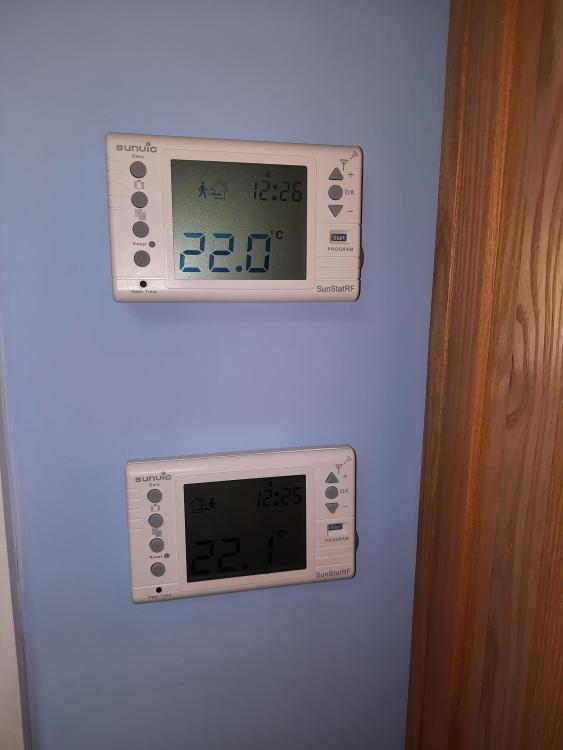
This is very close to what we are doing and our results. We are 24/7 set back 2C at 10.30pm until 6am. ASHP using (altered to our particular site and use requirements) the weather compensation mode. Difficult to split the heat/hotwater energy use so: All ASHP energy use approx 10kWh a day from 5th Jan until today for 100m2 floor. Presently 14C outside with heating automatic setup at 35C Top one heating, bottom one cooling.
-
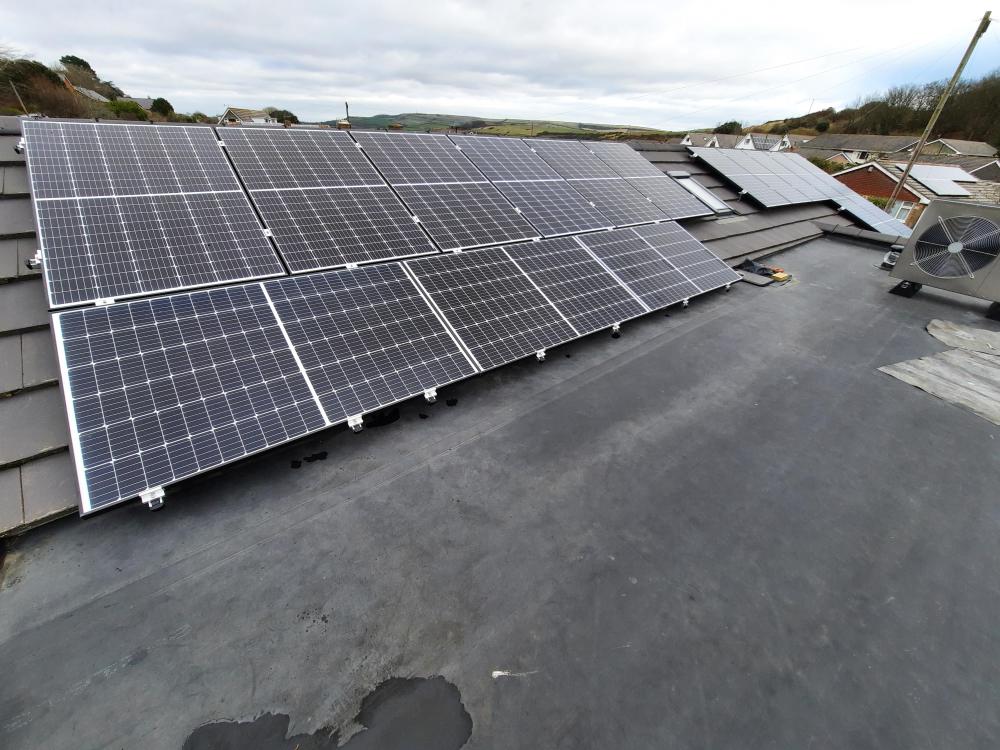
My rule was top height below a horizontal line from the ridge (planning regulations I think) and 300mm from the roof sides. Loads: well, we just had 120 mile an hour winds a couple of weeks ago and there all still there, and now I wait for the one foot of snow test....
-
Leave unconnected until night time. Hence my neighbours thinking Santa was early last year.
-
Bu&&er all. 6kWh so about 2kWh discharge.
-
Yes the top and side are ok but the bottom a little different....
-
I needed a large delivery. Self installed. DNO approved, (I have the bill) electrican finished.
-
PV power to the batteries but no way for power from the batteries to go to the grid.
-
Not directly.
-
The good thing for us is the PV power (when available) direct to the ASHP. And in the summer ASHP cooling when we get LOADS of power.
-
Yes
-
Oh f...! Yes your right I meant AMPS not WATTS.
-
I don't know much about PV panels and the different costs or outputs of roof integrated ones, but I would use the ones that replace the tiles on a lovely new build.
-
What pitch is the roof?
-
Think I'm going to change my name to Slayerofdreams.
-
I also think the peak demand is a BIG price concern. Out hob usually uses about 21kW when 3 rings on. So I think there are alot of unknowns from @SBMS causing caution in my costing. 30kW sine wave inverter price?
-
Yes I messed up. I have revised figures. Searched for 80kWh but given price for 10kWh storage
-
Hi @SBMS I had to revise the battery costs in my last post
-
Hi @SBMS What is your peak demand in amps? Generally you should only discharge a battery down by 40% Converting power costs power. It think losses of about 15% can happen. You would need to check the equipment specification. So you want to use 28kWh over 20 hours you will need to discharge say 20% more to convert from DC to AC so you need to draw from the battery array about 31kWh which is only about 40% of the battery capacity so batteries need to have about a 78kWh capacity. To charge about 31kWh you will need about 20% more so about 34kWh which is about 9kW output for 4 hours. The lost power is basically converted into heat. Many inverters indicate the max power conversion rate which is actually only for a limited time. I think one of the deciding factors for us was coping with our peak demand. If you are mixing the battery supply with the mains supply you will find you do not use the power evenly. My guesses: Inverter anywhere between £1.5k and £3k for a 10kW! Batteries anywhere between £10k and £50k Cabling, switches fuses housing and installation costs (not sure about the main grid permissions/costs if any) Basic set up cost say £6k ( I'm sure someone will correct me if I'm wrong... ) 34kWh at 7.5p is £2.55 a day. Normal power rate say 25p per kWh so 28kWh at 25p is £7. Therefore saving per day £4.45 if battery system fully used every day. So final money guess: Basic system installed total cost £25k System used fully 60% of the time so saving about 60% of £4.45 each day is about £2.67 £25,000 divided by 2.67 is break even in about 26 years. As @SteamyTea says will the 7.5p price lasts? In conclusion, in my humble opinion, the whole problem with PV is not the production of power but the storing and subsequent use. We use batteries on "isolated from the mains low power continual demand systems" charged through our PV and hope to include the MVHR this year. Our 5.12kW system supplies ALL the power we use in the year, just not exactly when and at what rate we need it. Good luck. M
-
Hi @SBMS I think your thoughts above open up a whole load of questions. The first would be about the use of the energy: What do you hope to run from the batteries? Our fuse box (Consumer unit) has a 100amp fuse and some times we require 60amps all at the same time for cooking, washing, heating, etc. So when I looked at running the house on battery storage I realised that I would need a system to be able to handle the peak loads and gave up. I assume you have taken into account the following in your calculations: The maximum power you can draw from the batteries: Ours are about 40% Each time you convert the power you loose some. So AC to DC and then DC to AC again. Yes a 5kW system charging for 4 hours would give 20kW, less the energy lost converting, but the link info doesn't seem to be saying that is what it does. Are you saying you require 28kWh of power over the 20 hour period? If so you would need about 80 kWh storage depending on the loss converting DC to AC. Other bright sparks will correct my thinking I'm sure.... M
-
It's a bit difficult to comment without knowing a bit more detail. Extent of the removal... Extent of the making good... Plastering Carpeting Ceiling works Decorating. and so on, although it's always worth getting a couple of prices for comparison. M
-
Tile Edging Options - Metro Sage Tiles
Marvin replied to canalsiderenovation's topic in Floor Tiles & Tiling
Waterproof tile adhesive Mapei grout, tile spray protector all from either screwfix or toolstation should be fine. Silicone between countertop and bottom of tile. Would not use premixed grout myself. Make sure you apply the spray as soon as the grout is completely dry and before being made dirty. Leave to dry. Second coat. This should protect grout from staining. Yes I know spray not cheap...




