Mattg4321
-
Posts
562 -
Joined
-
Last visited
Everything posted by Mattg4321
-
I installed a Reolink Poe doorbell a customer bought. It seemed ok to be fair. On a par with Ring for build quality and ease of setup
-
If you mean actually plastered in flush, so they are not proud even by the depth of the plate, don't ever do that! Total nightmare when they need to be removed for whatever reason. EICR/Testing for fault/Replacement when faulty. Also, unswitched sockets look naff in my opinion!
-
No offence intended, but sounds like the blind leading the blind! No requirement to have RCD protection on a TT system, you just have to ensure the circuit can reliably meet max zs values. In reality, on a domestic job this isn't reliably possible, so you need to provide additional protection. ie an RCD. The only proper way to do it is to fit an S Type RCD on the sub main and double pole/single pole switched neutral RCBO's at the garden room. This means a separate switch fuse at the origin and probably a new consumer unit/RCBO's at the garden room as your RCBO's are probably single pole. Probably not what you wanted to hear. You could fit a 50A RCBO on the sub main and end up with no selectivity, but it would be safe, just not right imo. I doubt you will find a 63A RCBO. 15mm cable? Not a size that exists. Could you post a picture of inside both house and garden room consumer units? Then it can be decided if it can be easily sorted or if I feel like you should be seeking help from a local electrician. Apologies for bluntness.
-
Unvented Expansion Vessel Pre Charge
Mattg4321 replied to Mattg4321's topic in Boilers & Hot Water Tanks
Agreed that an accumulator is the silver bullet, however, not a snowballs chance am I giving up garage space! As the noise seems to be better since I pumped it up then let it down, going to try living with it for a while and see how it goes. -
Unvented Expansion Vessel Pre Charge
Mattg4321 replied to Mattg4321's topic in Boilers & Hot Water Tanks
I’ll have to look into how to do that, but it could work -
Unvented Expansion Vessel Pre Charge
Mattg4321 replied to Mattg4321's topic in Boilers & Hot Water Tanks
https://www.plumbnation.co.uk/joule-cyclone-platinum-unvented-250l-indirect-short-cylinder-302-19749?utm_source=organic&utm_medium=shoppingfeed&utm_campaign=googlebase&gad_source=1&gclid=CjwKCAiAzba9BhBhEiwA7glbagdV4fjHIm0Nbv5QTbyua3ayiSpIs0bGjZWV14UmKhapS2XfvEY_AhoCyLkQAvD_BwE -
Unvented Expansion Vessel Pre Charge
Mattg4321 replied to Mattg4321's topic in Boilers & Hot Water Tanks
No, although it could no doubt easily go in the garage as adjacent to where the main is. However, theres more chance of the sun rising in the west than that. Far more important things to be fitted in there! -
Unvented Expansion Vessel Pre Charge
Mattg4321 replied to Mattg4321's topic in Boilers & Hot Water Tanks
It's one of these https://www.mrcentralheating.co.uk/water-storage/unvented-cylinders/thermowave-18-litre-unvented-potable-expansion-vessel?gad_source=1&gclid=CjwKCAiAzba9BhBhEiwA7glbaqbL_VFwijXyCmtOYqZedccRbzUq-NnH4RZxg7MUGEn2gvyofQtMVBoC2ywQAvD_BwE -
Unvented Expansion Vessel Pre Charge
Mattg4321 replied to Mattg4321's topic in Boilers & Hot Water Tanks
It tails off, so 28LPM wouldn't be sustained for too long. Will see how things go for a few weeks I think. -
Unvented Expansion Vessel Pre Charge
Mattg4321 replied to Mattg4321's topic in Boilers & Hot Water Tanks
60 degrees -
Unvented Expansion Vessel Pre Charge
Mattg4321 replied to Mattg4321's topic in Boilers & Hot Water Tanks
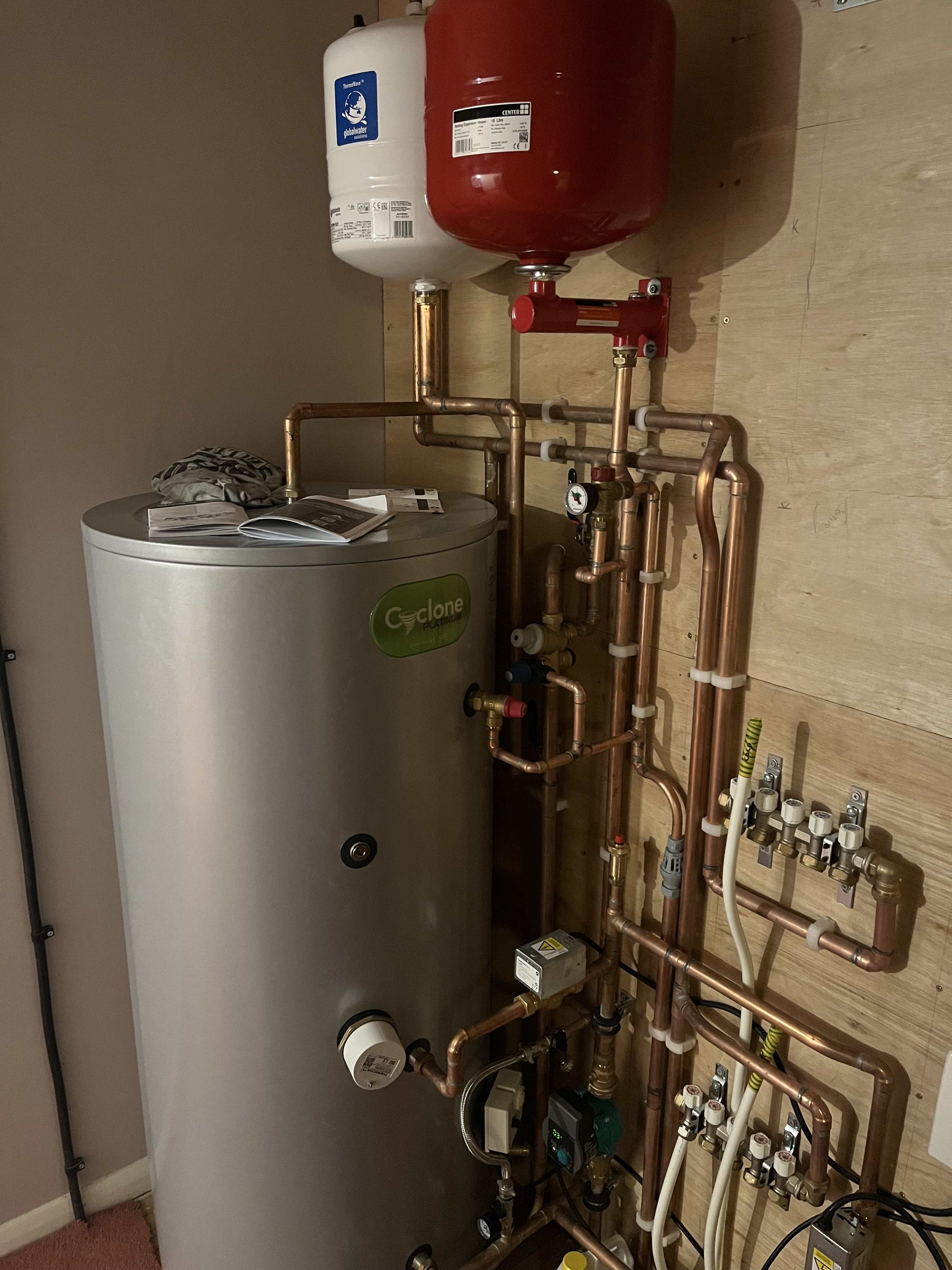
The EV provided by Joule isn't actually a (the) Joule product. It's a Global Water Solutions EV. As an update. I pumped the EV back up to 2.5 bar to see what would happen. Noise got much worse. Even just opening basin tap caused fairly loud noises from the EV/cylinder. I let it back down to 1.5 bar and if anything seems slightly better than before. Only opening the bath tap wide open suddenly causes the gurgling/vibrating noises. If opened gently it's just a moderate hiss as the EV empties presumably. Also notably I tried measuring flow at hot bath tap. Got 28 litres per minute. So significantly more than the outside tap directly off the main. I guess this is proof the EV is acting as an accumulator. I can only think it must be the large difference between static pressure and dynamic pressure causing the noise. Maybe the diaphragm bottoming out? For now it's only a minor problem in it's current state to be honest. I think the only way to fix is to get a better flow by upgrading the main. -
Unvented Expansion Vessel Pre Charge
Mattg4321 replied to Mattg4321's topic in Boilers & Hot Water Tanks
Sorry for the poor picture. Yes, it’s after the PRV. Between that and the cylinder -
Unvented Expansion Vessel Pre Charge
Mattg4321 replied to Mattg4321's topic in Boilers & Hot Water Tanks
Yes -
Unvented Expansion Vessel Pre Charge
Mattg4321 replied to Mattg4321's topic in Boilers & Hot Water Tanks
Yes although EV from pipework to cylinder. Which looks fine from my research.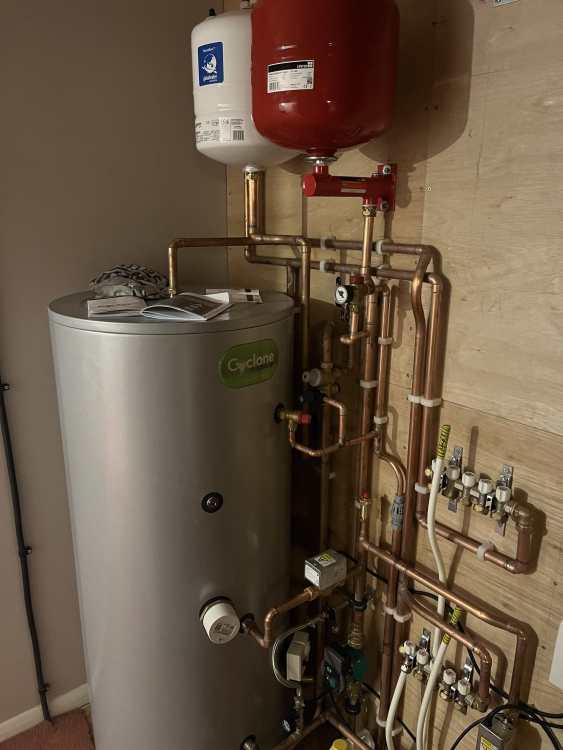
-
Unvented Expansion Vessel Pre Charge
Mattg4321 replied to Mattg4321's topic in Boilers & Hot Water Tanks
Not sure that I’ve ever seen or heard of an AAV on the DHW side! Fit where exactly and how would it help? -
Unvented Expansion Vessel Pre Charge
Mattg4321 replied to Mattg4321's topic in Boilers & Hot Water Tanks
I've tested the pressure on the balanced cold/hot at 3 bar, so that rules out PRV leaking by? Both PRV and EV only been fitted a week or so - hope they are not faulty already! Gut feeling tells me its something to do with the way its plumbed or the supply rather than faulty components -
Unvented Expansion Vessel Pre Charge
Mattg4321 replied to Mattg4321's topic in Boilers & Hot Water Tanks
Noise was much worse at 2.5 bar than at current 1.5 bar. The flow isn’t the main problem, I just want to stop the noise or mitigate it as best I can! -
Unvented Expansion Vessel Pre Charge
Mattg4321 replied to Mattg4321's topic in Boilers & Hot Water Tanks
Well it’s not a million miles from what I’m getting when I measure it I suppose? -
Unvented Expansion Vessel Pre Charge
Mattg4321 replied to Mattg4321's topic in Boilers & Hot Water Tanks
Looking at it properly I just measured the black alkathene main at 22mm external diameter. According to Google this could be either 15.5mm internal or 14.1 depending if Class C or D. Nominal size is 1/2 inch. This is approx 15m in length from street. Then I have approx 12m of 15mm copper pipe to position of outside tap and kitchen tap where I carried out the test. Internal diameter 13.6mm. Do you still think I have a restriction? The length in total is much further than your calcs - sorry if I provided duff info! EDIT. Also goes through a 15mm stop cock and numerous fittings - mostly copper but including 1 or 2 push fit plastic I seem to remember. Cylinder is 250 litres and the EV is 18 litres. -
Unvented Expansion Vessel Pre Charge
Mattg4321 replied to Mattg4321's topic in Boilers & Hot Water Tanks
Stop cock in street looks new. Last 5-10 years. Blue pipe I seem to remember and definitely has a quarter turn handle on it. Operated by hand easily. -
Unvented Expansion Vessel Pre Charge
Mattg4321 replied to Mattg4321's topic in Boilers & Hot Water Tanks
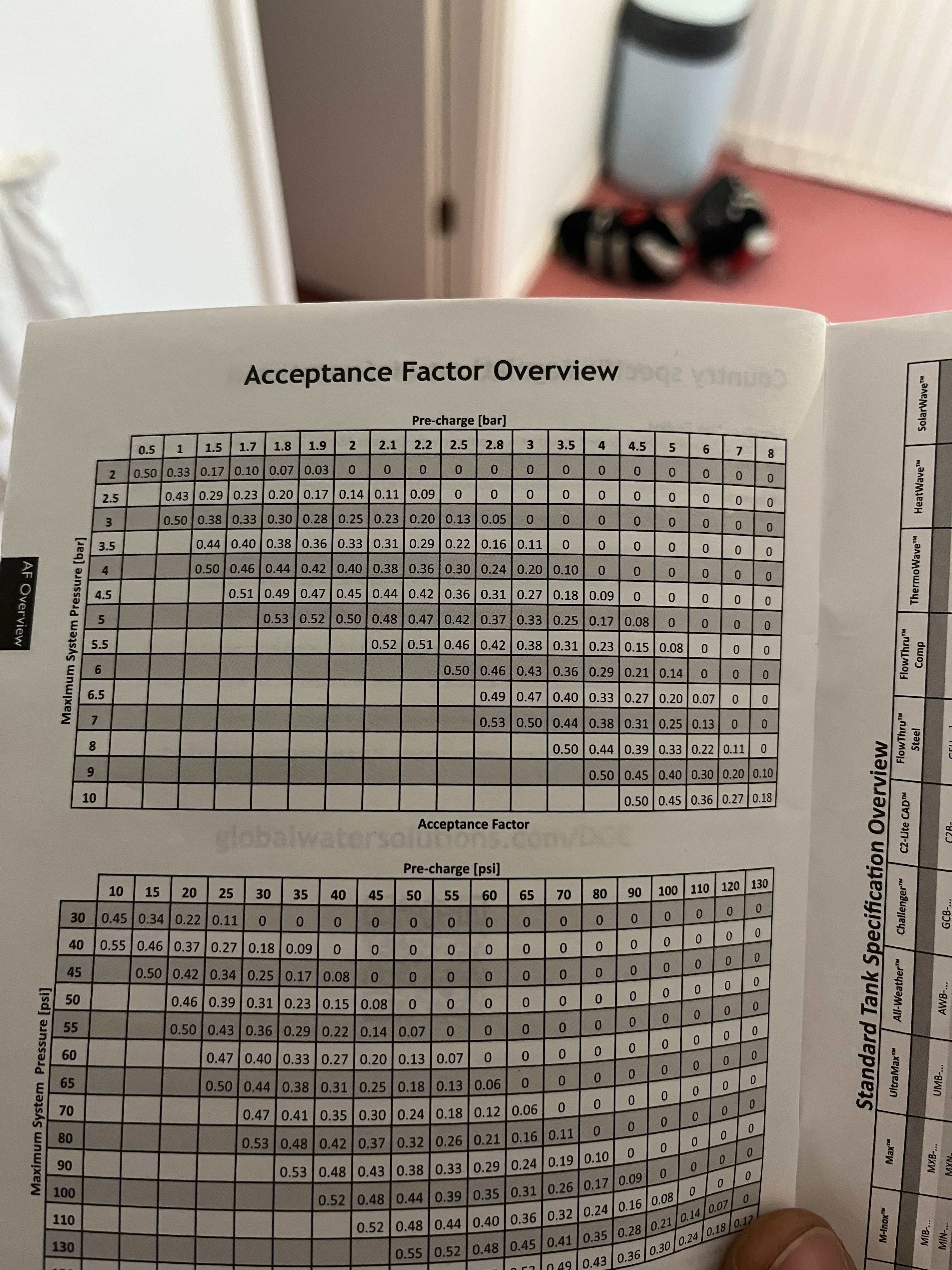
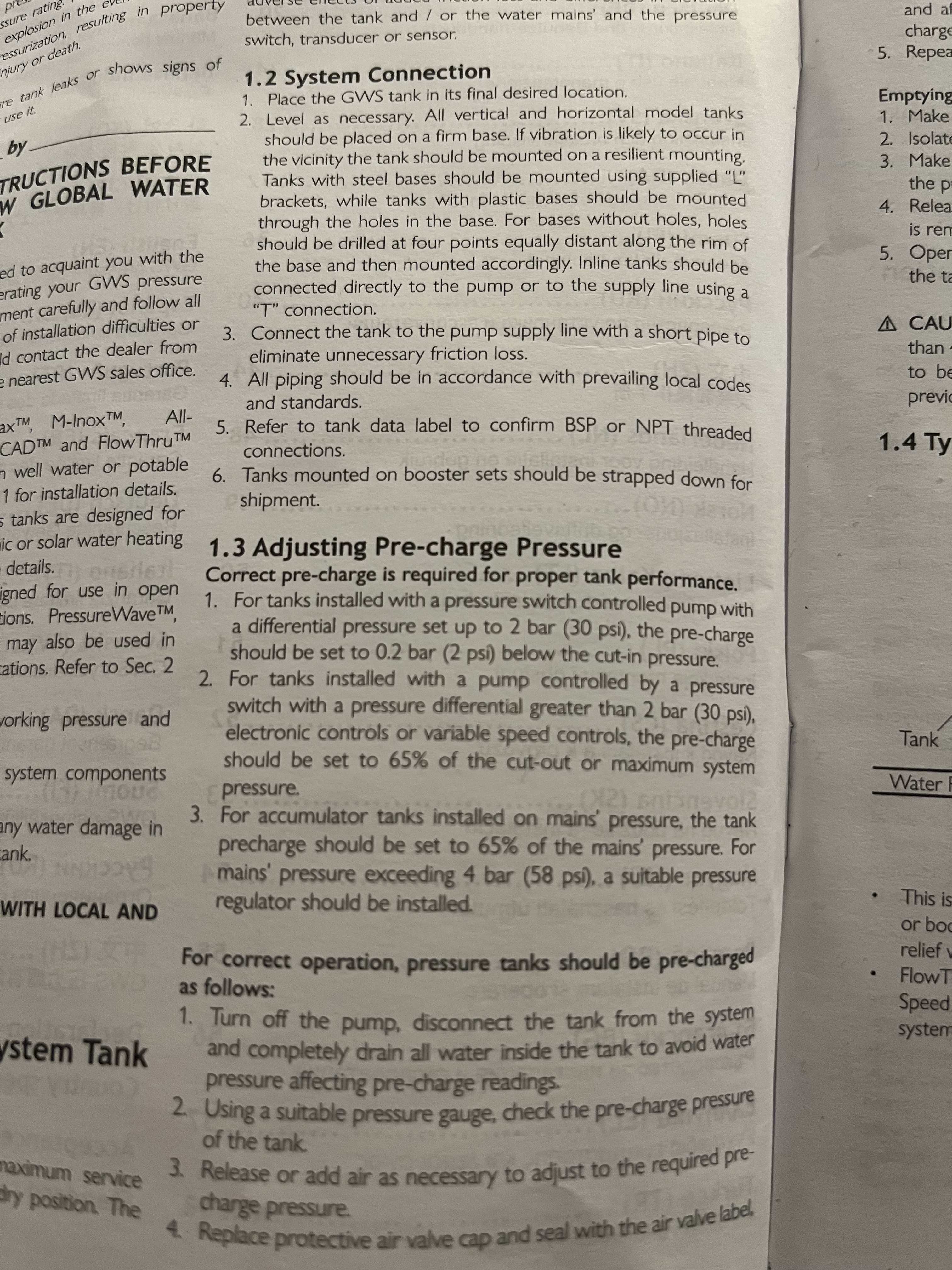
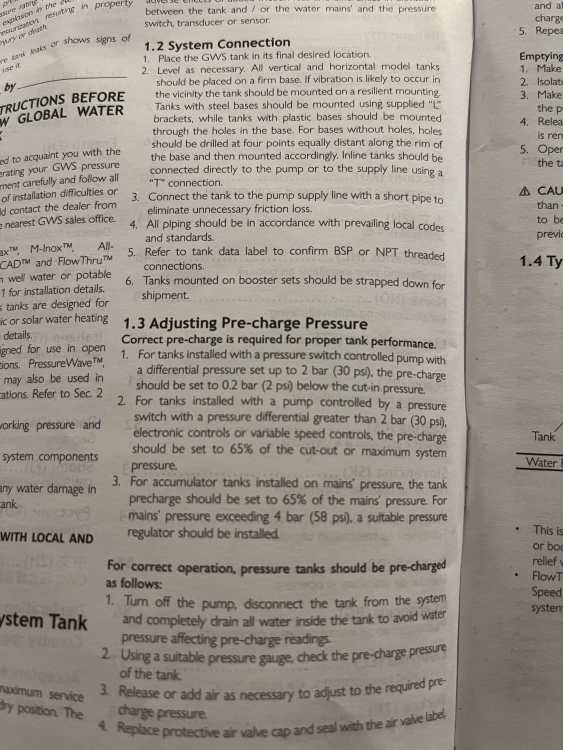
Just checking the EV instructions. I think it says 65% of max pressure. So 65% of 3 bar. Equals 1.95 bar However there is a pre charge acceptance factor table. But I don’t really know what it relates to at a glance through instructions.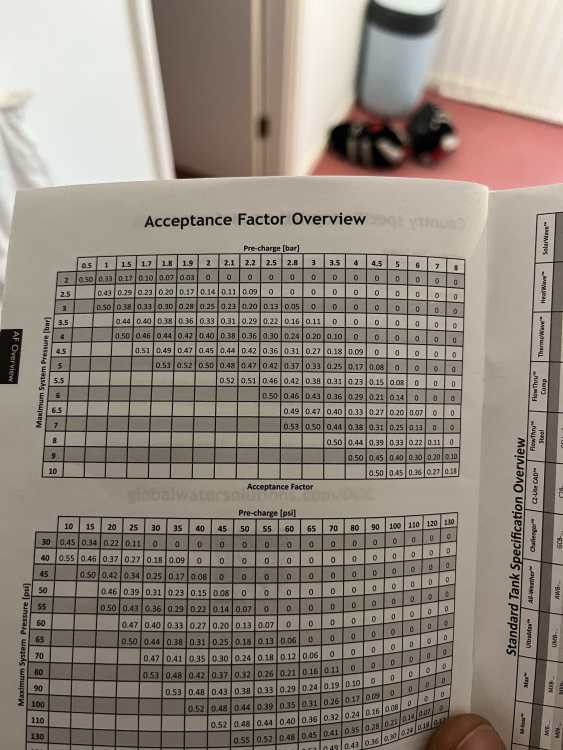
-
Unvented Expansion Vessel Pre Charge
Mattg4321 replied to Mattg4321's topic in Boilers & Hot Water Tanks
I just repeated the test. Pressure measured at the kitchen sink directly off the main. New pipework so won’t be furred up etc Had the outside tap fully open. Also directly off the main. static pressure. 3.6 bar dynamic pressure. 1.4 bar with outside tap wide open flow rate at outside tap with it wide open. 18 litres per minute outside tap fed by 15mm copper not sure what that tells me! -
Unvented Expansion Vessel Pre Charge
Mattg4321 replied to Mattg4321's topic in Boilers & Hot Water Tanks
Thanks. So it seems like I need to get a new main in. 25mm or perhaps even 32mm if there’s any benefit to that? Then fit a 3 bar PRV at stop cock to match the 3 bar PRV at cylinder. Should sort my dynamic pressure problem and potential backfeed problem at new kitchen tap? I tested dynamic pressure on the main. Ie before the cylinder and PRV. So it can only be a problem on the main or the stop cock (which is almost new and fully open) I think? Guessing that black pipe is just too small. The stop cock is 15mm copper as that’s apparently the size of the black main internally. Then steps up immediately to 22mm copper to cylinder. -
Unvented Expansion Vessel Pre Charge
Mattg4321 replied to Mattg4321's topic in Boilers & Hot Water Tanks
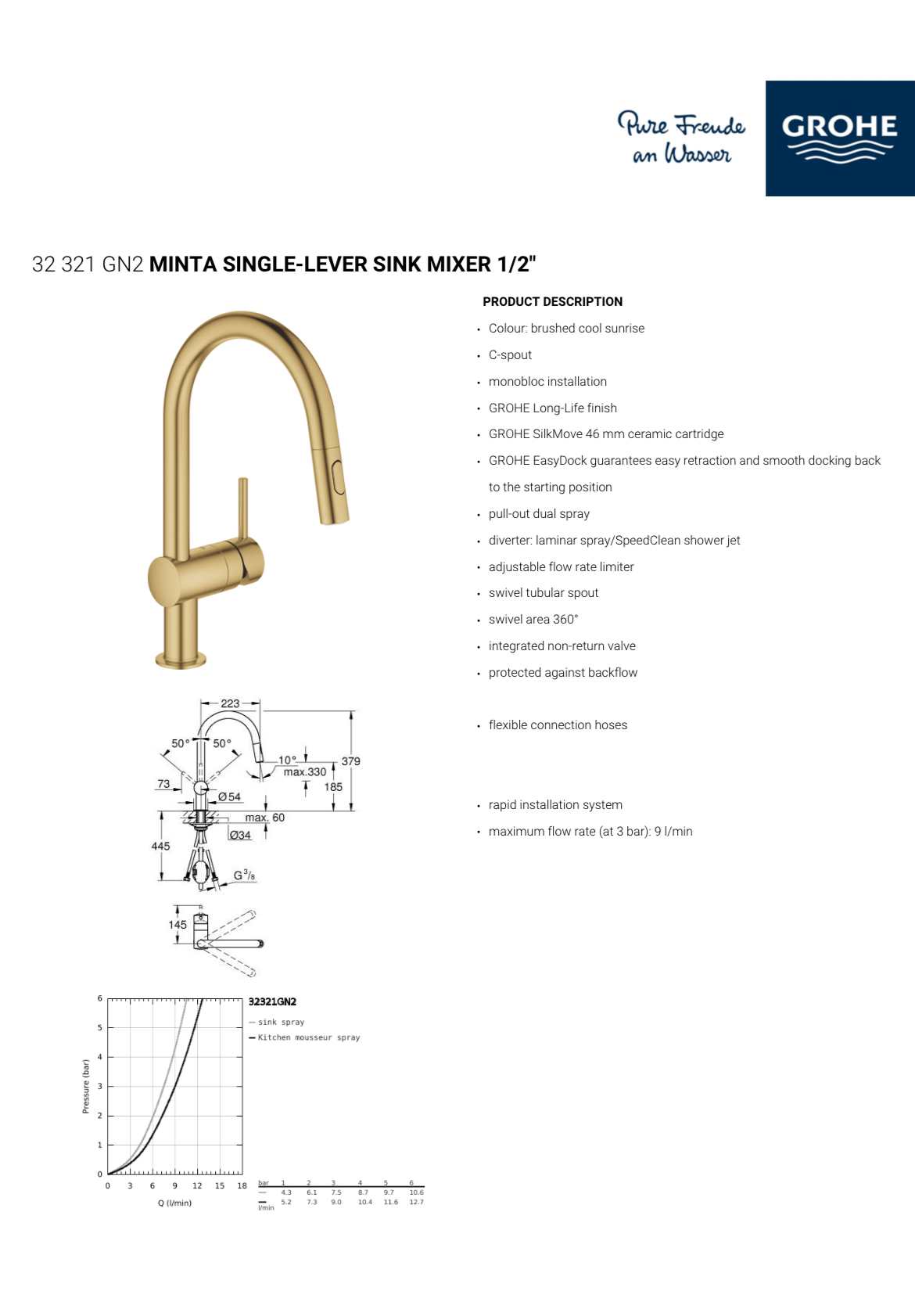
Looking like this will be the new tap in the not too distant future. Assume it means I don’t need to worry as it says it’s protected against backflow with an integrated non return valve?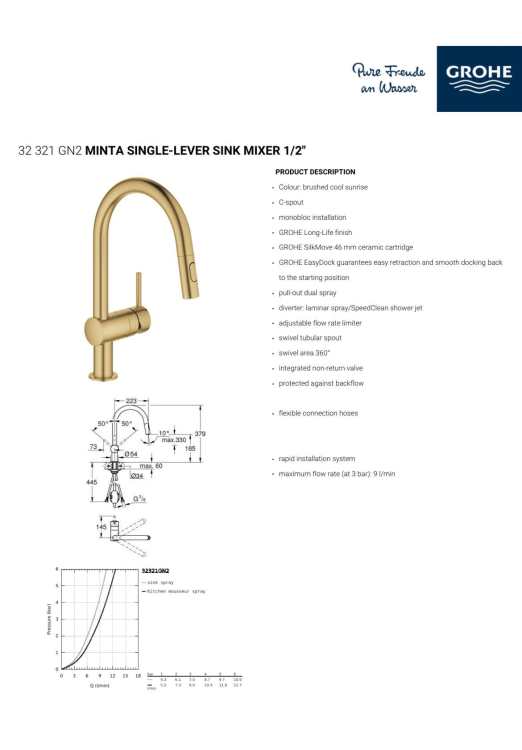
-
Unvented Expansion Vessel Pre Charge
Mattg4321 replied to Mattg4321's topic in Boilers & Hot Water Tanks
It’s in 22mm copper and around 800mm