


saveasteading
-
Posts
11094 -
Joined
-
Last visited
-
Days Won
98
Everything posted by saveasteading
-

Floor slab insulation. Test my logic please?
saveasteading replied to saveasteading's topic in Barn Conversions
you mean the yellow version? JG? Is it more robust? Define flat and level please? 3mm under a 3m straight edge with an overall tolerance of x? Your mate gets it right but a lot don't, from what I read. -
Floor slab insulation. Test my logic please?
saveasteading replied to saveasteading's topic in Barn Conversions
Ok I'll maybe buy one and fix it and give it a prod test. You appear to have a pump mix concrete that is 200mm thick or so. We will have 45mm to whatever self-levelling screed. Is the yellow stuff stapled on? -
Floor slab insulation. Test my logic please?
saveasteading replied to saveasteading's topic in Barn Conversions
Yes there is 35mm variation on the slab, with dips occurring at various areas. It is an existing agricultural slab which was good enough for tractors and barn use. There are a few local lumps too where the slab was extended or adapted but I'll have them chipped off. Overall though, now that the rain doesn't get in, you wouldn't notice the variation, except that the sole pate is all level, packed up from zero to 35mm. The insulating slabs will follow the shapes smoothly enough. Now that the rooms are formed we can use different thicknesses of eps on the bottom, and optimise the use of insulation rather than thick screed. But sods law combining with likelihood has it that the biggest room also has the maximum variation within it. -
Floor slab insulation. Test my logic please?
saveasteading replied to saveasteading's topic in Barn Conversions
For context this shows the construction. So to the external face there will be a pir edging onto the block face. The finished floor is at the top of the block. Elsewhere the construction is all stud., and no facings yet. Obv we don't want to flood screed through the walls. Btw that is the offcut pile from several 100 metres of stud.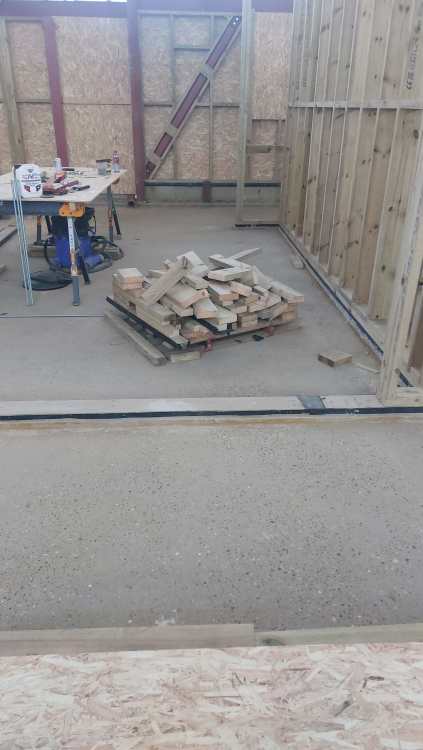
-
Floor slab insulation. Test my logic please?
saveasteading replied to saveasteading's topic in Barn Conversions
When fitting this stuff to walls, does it self support between studs or need some help? Otherwise fixing ply or other to the all room perimeters is a pain and a large cost for something that is working for a couple of hours. i'll get it as 100mm probably. the screed looks like being between generally 55mm ish, but from 45mm to 85mm due to some extreme wobbles in the floor. For most rooms I can vary the insulation thickness but the biggest room has the biggest variation.... of course. Or maybe we first pour some latex in the low points.... is that much cheaper than screed though? (screed seems to be £600/m3 or more.) Currrent logic is to have 100mm PIR on top of eps, which will be variously 100/125/150 according to the slab level. Thus the screed top level will be a set level but the thickness will vary at dips and humps. It's a right fiddle but worth about £4,000 to optimise screed and use eps instead of pir. That's a good few day's survey, research and analysis by my book.
-
Internal Roof truss has split 😳
saveasteading replied to Andy62's topic in Roofing, Tiling & Slating
That looks to have been exposed for a long time. Was the bit still there or long gone? It looks to have been a " shake" in the timber which was never contributing much strength. I see nail holes. Did you take something off? The house isn't about to fall down but ask an SE for assurance by all means. If you might be selling in the future then get a letter from the SE. If it had to be strengthened ig would be easy but ugly so you'd then box around it. -
I forgot about compo and can't remember where that was. Is that short for something? Midlands?
-
ACO drain around whole house?
saveasteading replied to flanagaj's topic in General Self Build & DIY Discussion
Ground should be well below dpc. Ramps work., aided by aco locally, but then the water has to get away to a pond or soakaway. For the garage you can have a small hump. -
Wood Bark, and just a little nominative determinism
saveasteading replied to SteamyTea's topic in Boffin's Corner
I wasn't aware. can you point me towards this please? Presumably some government policy relaxation (to allow more building??) rather than a technical matter, -
See if you can keep the wood structure completely dry . as @JohnMo , but also with clear space underneath (not boxed in) so that it can have draughts and dry Unless you use very special timber it will start to go mouldy and rot immediately, and a 10 year max life should be expected for the wooden surface.
-
Cold flooring in extension
saveasteading replied to TryC's topic in House Extensions & Conservatories
More questions. How recently was this built? The plaster looks damp still, and perhaps the floor too. How thick do you think the celotex is? Is there a space between concrete on the ground, and the timber floor? Is there any heating in the room? For an immediate benefit, stuff the draughty hole with rags: it will be a good test before doing it permanently. -
Does aerobarrier negate need for airtightness detailing?
saveasteading replied to SBMS's topic in Ventilation
Accepted. I can see that bigger gaps would fill substantially as you say, and the microscopic ones are the least issue anyway. and it is filling from the inside so the weather shouldn't be any issue. -
Does aerobarrier negate need for airtightness detailing?
saveasteading replied to SBMS's topic in Ventilation
Do we know that this stuff will stay in place / not detetiorate as a permanent seal? I'm wondering if some/ most of the seals are just a few fibres, because as soon as they cover a hole, the draught ceases and no more fibres will adhere. What happens when there is air pressure in the other direction (out to in)? -
Copper vs aluminum clouts for slate roof?
saveasteading replied to ruggers's topic in Roofing, Tiling & Slating
There will be specialist local roofing merchants who will know what is the local preference. -
And what was mortar called in your area? Frog up or frog down? Did they request... Mr Flanagaj, would you awfully mind making us another batch of your excellent mortar whenever it suits?
-
Great. And what about sourcing the sand to be suitable and all the same? That's a huge advantage having been there and done that. Were you instructed on accurate mixing? What else did you learn about tricks of the trade?
-
They will have regular gangs too, not just picking up whoever is available or cheap. They probably aren't working on mass production sites. I think you would best put a query up on your local social media.... brilliant brickie wanted.
-
How do you install Compriband _under_ windows?
saveasteading replied to Alan Ambrose's topic in Windows & Glazing
it will be fitting the space exactly, including any lumps and bumps, eg mortar courses, so will require a hefty tug. it will then start to expand again as it has been released, so won't go back in. -
What @Russell griffiths says. This will take a bit of research and a lot of management. And you will have to pay a bit more for the materials and a very professional bricklayer. The typical bricklayer will engage a ' trowel' (another bricky) or two, and a labourer. He may understand your requirements but not convey that properly, or they don't understand or don't care. The labourer especially is unlikely to make much effort and will be under constant pressure for 'more bricks, or more pug/muck/mortar ' acc to region. Then next day it is a different labourer. Most just shovel in sand and cement and add some water. The same shovel holds different volumes of cement / dry sand/ damp sand. I have never witnessed the use of a gauge box. Even getting them to use buckets rather than shovels is a pain. Explaining is likely to be met with a smirk implying 'what do you know?' they dont know what they dont know. And then you must only use one brand of cement...fairly easy. And one source of sand. This week's big bags may be completely different from last week's as they come from a different sand pit or a different layer of the same one. The BM has little to no control over this. Some sand is remarkably orange and will never look like your pics. But I don't want to discourage you as the right mortar makes the wall right too. Perhaps you have to be cheeky and knock on the door of a house that has achieved what you want. a few compliments will excuse the intrusion and you might get the info you need. To me the answer is a professional and proud bricklayer or builder who knows how to achieve this, and will want an extra 20%. They exist. You will choose your sand and get it all delivered in one hit. Why's this? Again because of getting the mix exactly the same for every single mixer load. No chance really other than black.
-
How do you install Compriband _under_ windows?
saveasteading replied to Alan Ambrose's topic in Windows & Glazing
In case this is relevant or of interest. From my experience, limited to non-glazing uses. 1. The Compriband I knew in structures was close celled and fully closed on the outer surfaces. 2. In constructing hundreds of steel buildings, every one had lots of profiled foam fillers to close off the ends where there were crowns in the cladding. It came from a single source from our cladding supplier. One of our clients happened to be a manufacturer of foam sheet and board for packaging. The owner examined a piece of the roofing material and expressed huge satisfaction that it was closed cell, saying it was a superb product and he was pleased to have it in his building. He added that it was an unusually high quality and relatively expensive. Thereafter I took more interest and looked at all foam fillers from other sources, and the difference in quality was clear. I suppose I am saying that there will be all sorts of similar products out there, with differing performances. The wrong one may save the installer £30 on your house, but you will pay many times that in heat loss and deterioration. -
How do you install Compriband _under_ windows?
saveasteading replied to Alan Ambrose's topic in Windows & Glazing
I have no doubt you are reputable and have a proven solution. I've had badly used foam cause extensive damage and leave a bodge behind. -
How do you install Compriband _under_ windows?
saveasteading replied to Alan Ambrose's topic in Windows & Glazing
The reputable ones anyway. Aerosol expanding foam is banned on my projects without express permission. It (esp the cheap varieties) is the preferred solution of the bodgers. Even the more flexible varieties should be used with knowledge and skill. -
How do you install Compriband _under_ windows?
saveasteading replied to Alan Ambrose's topic in Windows & Glazing
It appears to be that the Illbruck product is Compriband and other manufacturers are adapting the name as a generic. -
How do you install Compriband _under_ windows?
saveasteading replied to Alan Ambrose's topic in Windows & Glazing
@craigmay correct me. I only know Compriband from major Civil Engineering works, eg bridges, basements and sea defences and long ago. The band had to be compressed using a special machine exerting huge pressure, was inserted or cast in, and then would return to shape over many hours and continue to exert pressure indefinitely. It was intended to seal joints and cope with future movement. By hand it barely compressed under a thumb. From what I understand there are umpteen products for different situations thus for every case it can be the appropriate strength to not crush. Ie it will keep pressure on both sides of the gap. BUT I've a suspicion that many installers use cheap and quite flimsy foam strips. I came across a supplier who seemed to have a wide range of products for the window industry, which was encouraging. I asked what was the difference between theirs and Compriband, and they insisted theirs "is Compriband". I suspect the trade name was being abused as a generic term. -
Do you mean that you have adjusted it to be low and also bent the arm down to make it close more quickly?



