


saveasteading
-
Posts
11094 -
Joined
-
Last visited
-
Days Won
98
Everything posted by saveasteading
-
 Why please?
 -
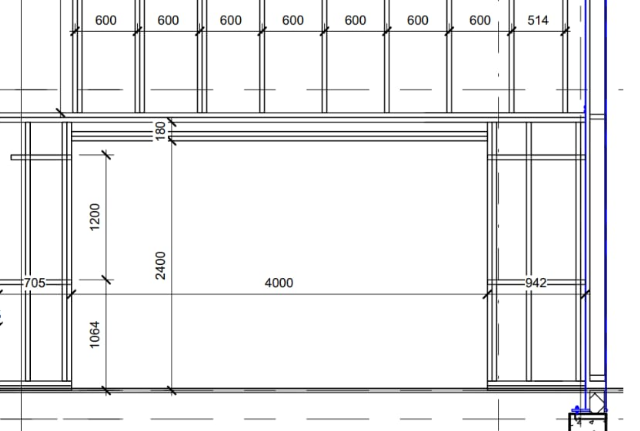
We will have this opening for a bifold door. Big and heavy, and moving so it must not jam. Looking for any experience of issues from such a door deflecting. Its not the Engineering in question but any idiosyncrasies of such doors. We have two choices. 1. a steel macross the opening. \there is room for 178mm RSJ and then timber around it. It would sit on timber so we would add 2 more uprights at each end. 2. Simply retain the timbers as currently designed and plate both sides with high quality 12mm plywood, and screws every 150mm. The ply could be whole sheets so say effectively 1200mm high, but 600mm will surely suffice.... the outside will be faced in osb anyway. This make it an immensely deep timber beam of the James Jones / Pasquill type. we would probably add suds between the horizontals to ensure a precise level beam before plating. And perhaps noggins/ dwangs at the top of the 600 sheet. the timbers are 6 x 2 tanalised. You may get the idea that I like the latter, because it is a neat composite design, and we dont have any issues how to fix the door. But my only doubt is in the reality in use: do bifolds
-
A large proportion of councillors haven't even looked at the agenda, never mind considered or consulted. thy look to their leader/ idol and follow their vote. Others see it is a chat forum and waffle away, with no reference to policy. Parkinson's laws has it summarised. Fortunately a strong, and hopefully fair, chairperson and/or planning officer reminds them of the rules, but it is exasperating. I feel the new proposals are intended to be clearer cut and reduce the effect of personal opinion.
-
I must be woke. And having skimmed the whole consultation ( asking for opinions) document I thought it was clearly written, unpretentious and realistic. I haven't even opened the second document which is perhaps denser. It says otherwise re small communities away from infrastructure, but there will be resistance from other interested parties. See chapter 14.
-
That's an interesting read. It hadn't crossed my mind that rents might drop so much... so major landlords may resist this. In my experience the big issue is that most new houses are aimed at and occupied by already well-off people, upgrading and commuting. The so-called affordable housing is an imposed add-on and remains expensive. In the North of Scotland ( I know this document is for England) thousands of houses are built commercially and filled with immigrants from the South, and in the nice places. Not for locals and not enough infrastructure of course. I think this is the same in certain English areas. I sense resistance to white settlers and major industry being imposed. There isn't enough water supply or infrastructure, and drainage likewise....and this needs a lot more work by central government. It's a good report but various parties will right now be looking to work it to their advantage.
-
Ooops. Can a clever person shift this? In my defence the page opened without the usual checklist. @Daniel H I don't have my settings set to see everything. so apologies for jumping in. This feels very different. I've had a quick read half way through the consultation document It is very well written and I'd say by experts and realists. Revive town centres, make sure facilities can be reached, build on all brown fields sites, a bigger proportion of affordable and accessible. etc. It doesn't mean worse building work, (all must meet building regs and space standards) simply that Planning authorities cannot impose their own view on aesthetics and increased space standards . Yes, it bothers me a bit that it might all be very ugly. If anyone comes across any editorials etc. from the industry before I do, please point them out. There is a lot to read if that way inclined. As I am working (voluntarily) on a Neighbourhood Plan I'm very interested. but I can't read and study it all.
-
This is going surprisingly un-noticed in the media but is hugely consequential for landowners and developers (including smallish garden owners) and for the effect on existing communities. In very brief summary.... YIMBY Yes, in my back yard...or is i t YIYBY to be considered in detail. England only. consultation but with the intention of swift implementation. big developments must be near public transport esp a station. fewer constraints on quality and style. Infill easier. Local opinion perhaps not much considered?? https://www.gov.uk/government/consultations/national-planning-policy-framework-proposed-reforms-and-other-changes-to-the-planning-system
-
Does aerobarrier negate need for airtightness detailing?
saveasteading replied to SBMS's topic in Ventilation
or do they treat one unit and test it, then use that figure for the rest? Someone on here said that isn't allowed these days but Im cynical. -
WElcome @Garage build A lively question. Agreed with the above:. Unless you are a highly skilled joiner, when timber would suit you, buy a metal kit. I'd be disappointed but not surprised if the kit suppliers don't have fire certificates for structural integrity and also for fire. But you can get help from an SE (who you pay for their 4 years at Uni and minimum 3 more before getting the qualification). Or even on here (But I and the others would not be putting their name to it). Fire must not break through the wall and spread, and the heat should also be held back. At the same time, the building must stay standing at the boundary, which means protecting the structure. Think of it please, if next doors garage fire set alight yours with your car in it. Not really. You seem very annoyed at everything, but I appreciate that construction is not your field of experience. Perhaps you think building is just joining things together. In my opinion it is fair that a person building should pay for all services, which would otherwise be paid by ratepayers who dont need the building. Intumescent paint is the material you have heard of. It is a complex product requiring vast resources to invent, perfect and test, and then is much more expensive than normal paint to make too. £1,000 seems optimistic as you would need many coats then a sealing coat. There are other ways to protect structures. You've had good advice from everybody from the sound of it. Yes I have and so have others above. But our reasonable charge for design or cost to build may be your small fortune. Have you a budget in mind? It may be realistic or perhaps the project is not viable. How secure do you need it to be? There is a big range from making it lockable through to preventing determined and expert thieves. The metal building above would not stand a ram raid or a bright couple of guys with a screw gun, but would deter the idle passer-by thief. btw that front building's vehicle door will cost about £1500 minimum. The building, I'm guessing £8,000 and then there are footings and floor slab. and fire walls. for a contractor to do it all add 30% In my experience a building of that sort is almost more secure with a window. Otherwise it is imagined as having lovely expensive tools or vehicle in it, and gets broken into regularly. Sorry it also sounds negative and disheartening but that is reality.
-
Plants in a designated hedge should never become the full trees on which foundation depths are based. So it should be OK. Is the hedge in your control and how close to the nearest point of the building?
-
Temporary power to the building from our existing supply.
saveasteading replied to saveasteading's topic in Barn Conversions
We have bought a cable reel with 2.5mm blue cable, 25m long. It is rated at 3,100W. It is to 'Arctic' ,specification for outdoor use. It is very visibly a much heavier duty than normal cable, and the spec confirms it. We plumped for a reel rather than a loose cable as it will be e asier to move around /relocate/ remove and be less vulnerable to damage. The downside would theoretically be that it is lft prly oiled, but our guys know this and we will remind them. From what I can find, the most powerful 110V router/bench saw draws 2,100W I have also taken on board the suggestion to retain 110V supplies for the lighting. As well as spreading the load this might stay on if the other circuit trips. It cost about £70. The one shown in earlier discussion seemed cheap but doubled when the checkout page added 'delivery'. Also I trusted the specialist supplier more than the other options through Amazon etc. Thanks for the advice. -
Any fibres would have been distributed very thoroughly as part of the manufacturing process. And If a lab had considered the sample too small then they would have said so. Best not even discuss the matter with friends or family as there is no need for anyone to even know you had been concerned. Unless they ask of course, and you have the answer. there is no asbestos.
-
YES. It is proven safe, so stop worrying.
-
as @Russell griffiths says. first tidy it all up. I have no idea where the outlet could go. We don't know the site or circumstances. That's why I'm asking you if you have any ideas or more information. I have been presuming you might dig out 600mm to 1m and have a pipe at the bottom of that, so water would run to an end and from there you need to take it elsewhere or it won't drain the area. What is on e land you took the photo from? ie to the inside of that fence. Is it your land? And is there more retaining wall between the fence and the house? Not wanting to be rude but it's always worth checking... are you following the logic of building a drain and getting the water away from behind the wall?
-
Fixing Metal back box to a steel box column
saveasteading replied to Spinny's topic in Electrics - Other
You don't worry about it. The heat loss will be miniscule. For perspective, you could counter it by closing the front door a second more quickly or turning a light off for 10 seconds... I'm guessing. Depending how much space you have, it makes it easier to screw or glue a timber or ply plate to the steel, and then the box fitting is by wood screws. -
Agreed. That's a start and may solve the water thing. Maybe that's enough, but my concern is that it is a wall by a builder and not technically designed. I guess if it is ever overloaded by the land above it won't collapse just crack or rotate. @slystallone if you do that, where can you take the drainpipe from the end of your new trench?
-
Groundworks and utility install sequencing
saveasteading replied to sjmtlewy's topic in Project & Site Management
All the above. Every site is different. Ducts and talking to real people (eventually) at the facilities companies. You can work for a while with a generator and bowser. Or even bringing in a few containers of water every day. Until the generator gets stolen. It is more difficult than you think. But you must become the expert. -
Doubtful. £500 for the gravel. Add pipes, membrane, digger, and the earth has to be taken away. Anyway, how deep and where would you take a drainpipe?
-
If you use bathroom drain pipes, then you can join them with junctions and bends, either down to a drain or angled across the wall.
-
that could be changed very readily if there was the will.
-
Is this a load bearing wall?
saveasteading replied to WhiskyInTheJar's topic in New House & Self Build Design
Let's have a guess that it needs a steel beam on 2 new steel posts on new concrete foundations, then lots of making good. £10k?? Structural Engineer, Building regulations, mess and disruption (living elsewhere?) -
One of the nicest things a client said to me ...we were a subcontractor to them but with design input, they being a bigger contractor, was..... "you are not always the best price but always the best value." He retired. His successor use someone cheaper and handed on some of my suggestions. They went bust. Sometimes expertise is doing simple things well. Such relationships are more difficult to find on self build, because you don't know each other. Fundamentally though the real expert may not have to charge more, because it's easy for them.
-
I wish, but don't think. No party politics here, but we know a lot of people like to hear that everything is somebody else's fault and easily sorted.
-
If you tell the public the whole, realistic story you don't get elected.
-
Exactly so. The former would cost £10k for a job half done. And is it your land? Holes £500. A heavy duty core drill with diamond core cutter can be hired for £150 or so. You could join your outlet pipes up to drain away tidily, or make it a natural water feature of moss, slime and ivy.


