


saveasteading
-
Posts
11094 -
Joined
-
Last visited
-
Days Won
98
Everything posted by saveasteading
-
You can grind it but the fibres will show.
-
Let's go back a step. Are we looking at the surface of a concrete slab (lots of big stones in it) or a screed? Are you simply looking to get it smooth enough for covering with resin, as prev response? 1. I'm guessing that the surface is a few mm of surface "fat" in jargon. That is probably quite soft. Have you tried scratching or abrading it? If so, it will grind off very readily. You do not want a heavy duty grinder that can smooth the concrete with stones in it. 2. The fibres will look ugly but won't affect the surface you put over it. 3. Unless the resin is very hard and inflexible it should flex if necessary, but the crazing is almost certainly static now. Ask the resin supplier. How thick will the resin be?
-

Plastic sheet moisture test for thin 'screed'
saveasteading replied to Julestools's topic in General Flooring
Works well except in very damp environment when there is no cause of evaporation. -
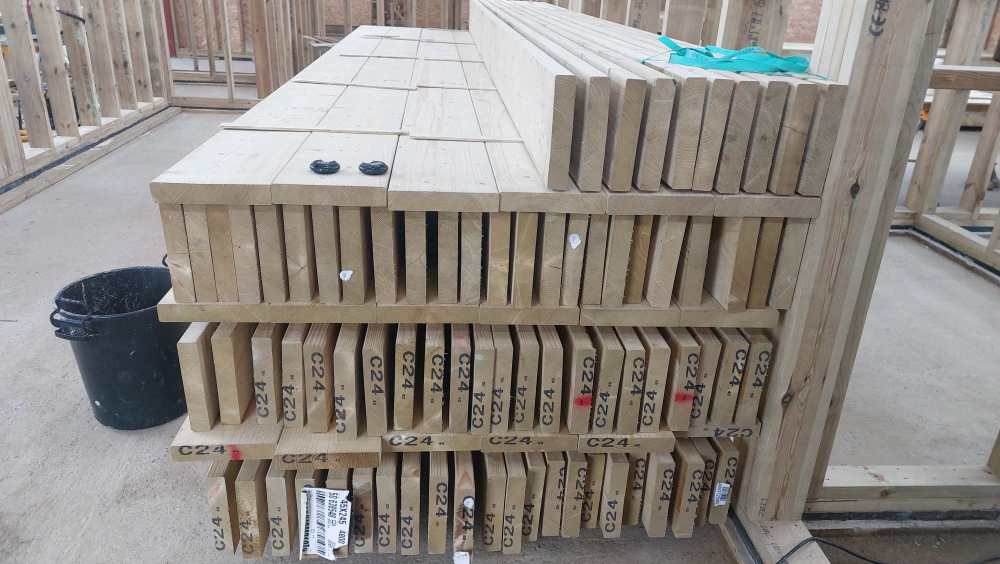
I did this in a BM once and the yard man complained we were taking the good stuff and leaving the rubbish. We've had masses of 10 x 2 delivered and it is beautifully dry. It will have been wrapped from Finland to the BM then straight to us.
-
Plastic sheet moisture test for thin 'screed'
saveasteading replied to Julestools's topic in General Flooring
There won't be any free water in this by now unless it's getting wet from rain or other source. Even if there was some dampness it won't get through the dpm and insulation. -
Agreed. Of 80 lengths of 6 x 2, we took wet in an earlier batch, we sent back 40. I had wrongly assumed that the vacuum treatment would have collapsed and filled open pores with the treatment chemical. BUT someone suggests that was the case with old, oil-based treatment but no longer. The 40 rejected were up to 50mm bend over 6m. They will sell them to less critical builders. Cutting into 3m will make most passable. I once needed some 2 x 2 in a hurry so accepted the dregs from a merchant. One had a complete 90° twist over 4.8m.
-
So it is a panel rather than a slab that can be routed etc. Eg a profiled or cut edge would lose tha pattern? A panel for a builder rather than needing stone mason skills? So cheaper?
-
Aluminium guttering/downpipes recommendations?
saveasteading replied to Chris HB's topic in Rainwater, Guttering & SuDS
Yes. Depending on the building, plastic can sometimes simply look wrong. I dont know why, but metal gutters don't seem to fail or need maintenance. I suspect plastic twists in heat and cold, and so opens joints and sometimes goes out of line and level. Or maybe plastic is too easy to fit ( bending to suit less than perfect allignment) and isn't done so well. If you want black and it isn't a main feature then use plastic. -
That's posh with the handle and standing up. That will do it rather quickly as a diamond grinder is OTT for that soft surface. But better that than struggling. Are you just smoothing it or taking a mm or two off? Dust! You'll need masks etc and do you vacuum it up? Whose decision was it to pour despite the rain? Or was it not forecast? It's a very big decision to cancel a pour, so I appreciate the pressure to do it.
-
In what respects? Better, worse?
-
I have been out of that industry a few years now, but last i knew, it was an epoxy or polymer, not concrete. So it's a paint really, in any colour, but not at all interesting. If you want your house to look like a garage....
-
Aluminium guttering/downpipes recommendations?
saveasteading replied to Chris HB's topic in Rainwater, Guttering & SuDS
Have used Lindab and been very pleased with the appearance and effectiveness, especially the hoppers which were curved to maximise flow. It all seems to be very durable (still good after 20 years) and lots of colours available, including copper effect the last time I looked. But Id advise against using copper effect. I've heard of it being stolen in the belief that it is real copper, although on Lewis perhaps that isn't a concern. But I expect black will look appropriate anyway. Even if the roof area only needs one downpipe you should consider two, or a weir overflow in case there is a blockage OR use a design where any overflow is outwards. -
I have simply googled 'kitchen worktops stone resin' and found a specialist 10 miles away. They even quote a guide cost of £450 to £900/m2 (not fitted) and have an online quote service. AI has very cleverly found the same one and 2 others. It seems they can supply sinks in the same material. Why not? It's a goo made into a shape. The number of slab manufacturers remains boggling and I don't see any reason to not use the cheapest which appears to be Silestone.
-
Unless they have done the same.
-
Do a sketch and you will see that this won't happen, or be the tiniest amount of liquid that will be replaced every flush.
-
I am pretty sure they have added water to the mix, causing these very visible shrinkage cracks. If you have the delivery ticket, they will have had to sign an instruction to add water as it absolves the supplier. It is a common mistake but utterly misguided and you could ask for some recompense. These cracks will be right through the depth so taking the surface off will not remove them, although the crack widths may reduce. It's possible that only the top few mm was hideously wet and overworked. Are there contraction joints elsewhere, and what has happened there? It's ok for any overlay as it won't move again.... unless overworked. I'd try chiselling a bit off the surface to see if it is well bonded to the mass. Re the tamping ridges, that may not matter for tiling but has to be ground off for anything else. It's a diy job with a grinder made for the very purpose.... but hard work. A new poured surface is possible but would be very expensive. It would involve taking all the pasty surface off then laying a granolithic or resin material. It might not crack if very skilfully done. Best to decide that you really like tiles or vinyl. If you must have a concrete finish then you could regard the existing as a base layer and pour a new floor, 100 thick, with reinforcement and careful attention to detail BUT all concrete crazes and my opinion is that it is for commercial buildings. You could also consider grinding down about 20mm into the stone, so you will se the matrix of stone and sand/cement. then you'd have to seal it as it will show stains. Again, this will cost an awful lot.
-
That's great work. We have much the same in mind at a change in level and we have a stack of harvested sleepers from previous agricultural use. I am inspired by the lighting and wondering if it can be low voltage. A length of armoured cable and stacks of connections is rather daunting. I don't mind the steel being visible, using the 'display the structure' principle. I guess the other option would be a vertical piece of sleeper tucked into the web. The steels and sleepers align perfectly. Beautifully done.
-
The cost of doubling the extension size would only be about 1/3 extra as a guess, so I endorse this, and get a proper shower as result.
-
I looked at the Dekton website. Loads of info and I had no idea there were so many options of manufacturers and products. No prices though so it's difficult to know where to start. Diy Kitchens Direct oth have a virtual walk through of their 60 displays, and immediate costings incl resin stone worktops and most appliances. Very impressive and I respect the openness. Anybody know if that comes down in negotiation? 5% ot so of a lot would be worth having. The cost is a good third less than we've had as a 'Starting Price' elsewhere.They were more interested in "what is your budget" and didn't understand that freezer doors can't sit against a wall. So much for expertise. The only issue so far with DIYKD is their modelling tool only seems to accept rectangles. @Tom I'm nowhere near you. do i search for "worktop suppliers".
-
Why we need "Net zero"
saveasteading replied to Beelbeebub's topic in Environmental Building Politics
Yes I guess that works as the principle. Except no targets. -
Why we need "Net zero"
saveasteading replied to Beelbeebub's topic in Environmental Building Politics
I often follow the 90% better principle, and so should the country. That way at least something gets done. I relaid the paving slab patio. Lift a slab, remove muck, ants and lumps and then rebed in sand or mortar. Done and passable 90% towards passivhaus is optimal in my book. Ufh and air source, solar and battery, but a woodburner for emergencies and Christmas. And so on. Net zero is extreme and hence won't happen , and I don't think is optimal anyway. But what snappy phrase would apply to mine, "90% improvement will do".? I reluctantly feel that we need a nett zero target to aim at and wing. -
To others : Always remember that opening windows creates strong draughts for the quickest effect when humidity is very high. You don't get the satisfaction of emptying buckets though. Machines for when you have a deadline.
-
Hmmm. Thinks. No that would be wrong of me so of course I will discard the thought.
-
Why we need "Net zero"
saveasteading replied to Beelbeebub's topic in Environmental Building Politics
to the people in pretty villages. I'm meaning the huge pylons that would traipse over the Highlands, Lowlands, Dales etc. But perhaps not the Cotswolds.. roads run both directions. bringing services and selling goods. Pylons tend to be sending energy in one direction. I live in the SE but do think that it is a resource for the areas it comes from and there should be recompense. A very big meter at Dalwhinnie, or Banchory or wherever. -
Why we need "Net zero"
saveasteading replied to Beelbeebub's topic in Environmental Building Politics
That is not really an issue though But the gentle people of SE England don't want to see turbines or pylons but do want the energy. Some power somewhere is keeping it that way. And the transmission lines really do disfigure vast areas of beauty and wilderness, The residents, through whose areas they pass, get no recompense.



